

Read This Before You Plan Anything Else
There’s a particular kind of regret that only mountain people understand.
Not the regret of doing something. The regret of not going. The tab you kept open for eight months, the screenshots folder on your phone titled “Spiti someday,” the conversation where someone described Chandratal Lake at 5am and you thought — this year, definitely this year — and then life happened and it didn’t.
I know that folder. I had it for two years.
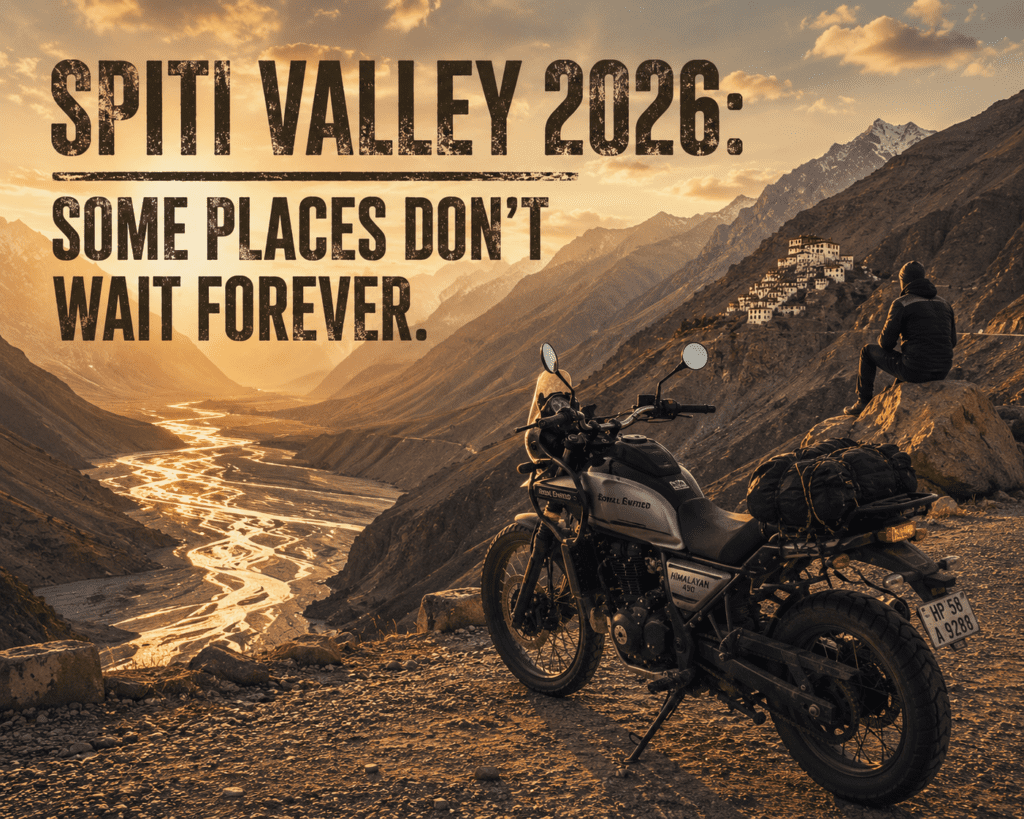
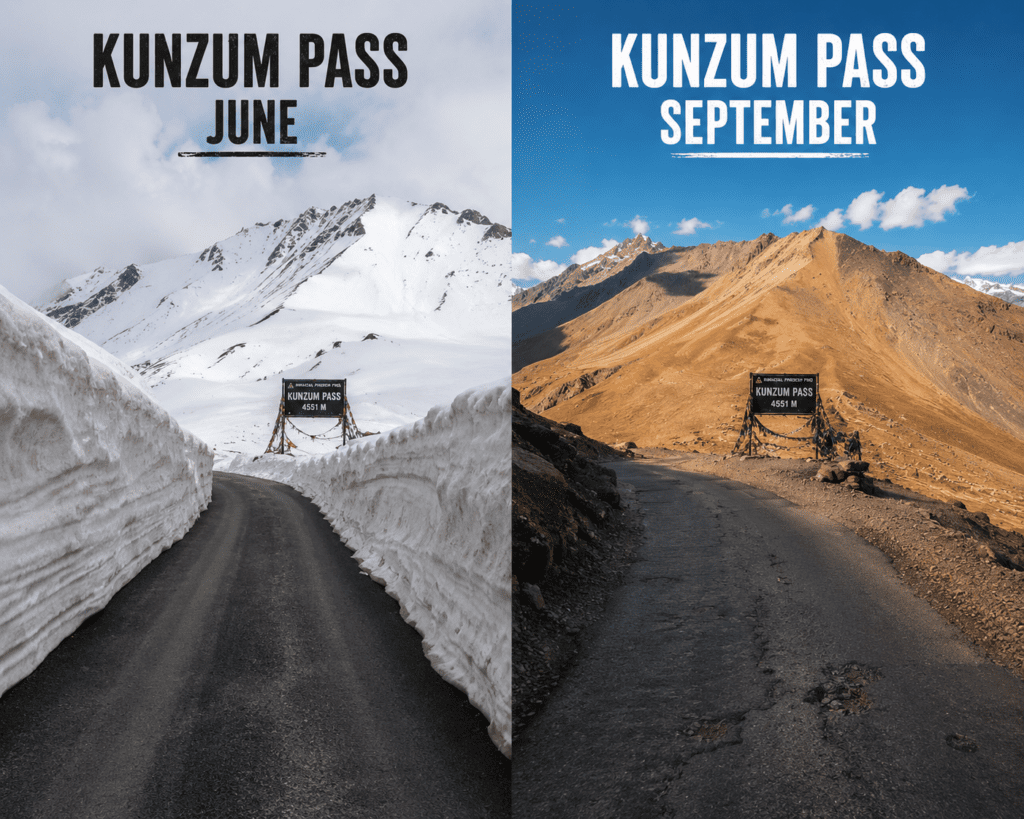
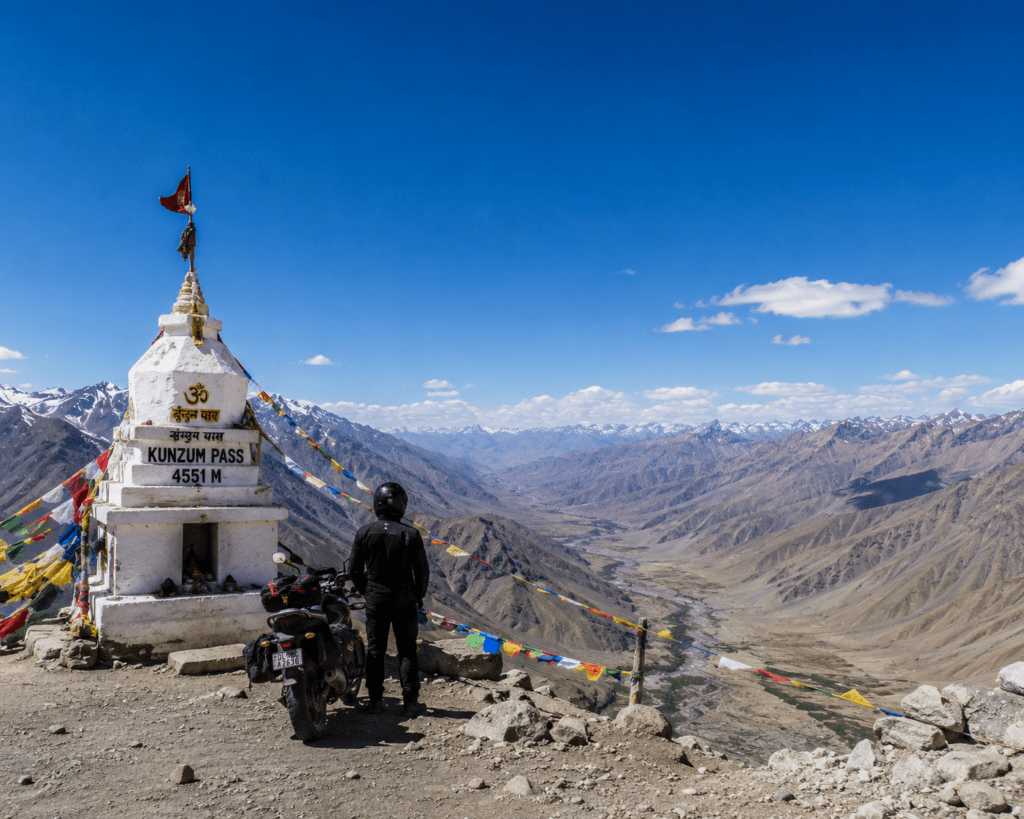
And then I drove into the Spiti Valley on a morning in late June when the Kunzum Pass had just opened, the snow walls on either side of the road were still three feet tall, and the valley opened below me like something from a geography textbook that had decided to become real. Brown. Vast. Utterly, almost aggressively silent. A river that looked like hammered silver at the bottom of a gorge so deep you couldn’t hear it from the road.
I pulled over and just sat with it for a while.
Spiti is not like the rest of India. It’s not like the rest of the Himalayas, honestly. It doesn’t ease you in. It doesn’t have a coffee shop at the trailhead or a hotel lobby with good Wi-Fi and Instagram-worthy breakfasts. What it has is something rarer — the specific feeling of a place that has no particular interest in impressing you, and does so completely.
This is the guide I wish I had before I went. Written in 2026, from real research, real numbers, and the hard-won knowledge of a region that punishes assumptions and rewards preparation.
Stop waiting. Let’s plan.
Quick Summary Table
| Category | Details |
|---|---|
| Location | Lahaul and Spiti district, Himachal Pradesh |
| Altitude of Kaza (HQ) | 3,800m (12,467 ft) |
| Highest point on circuit | Kunzum Pass — 4,590m (15,059 ft) |
| Season window | Mid-May to mid-October (full circuit) |
| Best time — sweet spot | Mid-June and September |
| Peak season | July–August (most crowded, priciest) |
| Indian permit needed? | No permit for main circuit. ID (Aadhaar/DL) sufficient |
| Foreign permit needed? | Yes — Protected Area Permit from DC/SDM office |
| Two main routes | Manali–Kaza (via Kunzum Pass) OR Shimla–Kaza (via Kinnaur) |
| Ideal duration | 10–14 days for full circuit |
| Budget (10 days, per person) | ₹18,000–₹35,000 (budget) / ₹40,000–₹70,000 (mid) |
| Mobile network | BSNL postpaid only in deep valley. Airtel works in Kaza |
| ATM situation | Last reliable ATM: Reckong Peo (Shimla route) or Manali. SBI in Kaza is unreliable |
What Spiti Actually Is — And Why It’s Different From Ladakh
The Geography of “The Middle Land”
Spiti means “the middle land” in Tibetan — positioned geographically between India and Tibet, and culturally between Hindu India and the Buddhist plateau. It sits in the northeastern corner of Himachal Pradesh, at an average elevation of 3,800 to 4,500 metres. To put that in context: Manali is at 2,050 metres. Leh is at 3,524 metres. Spiti is higher than both, colder than most, and drier than almost anywhere.
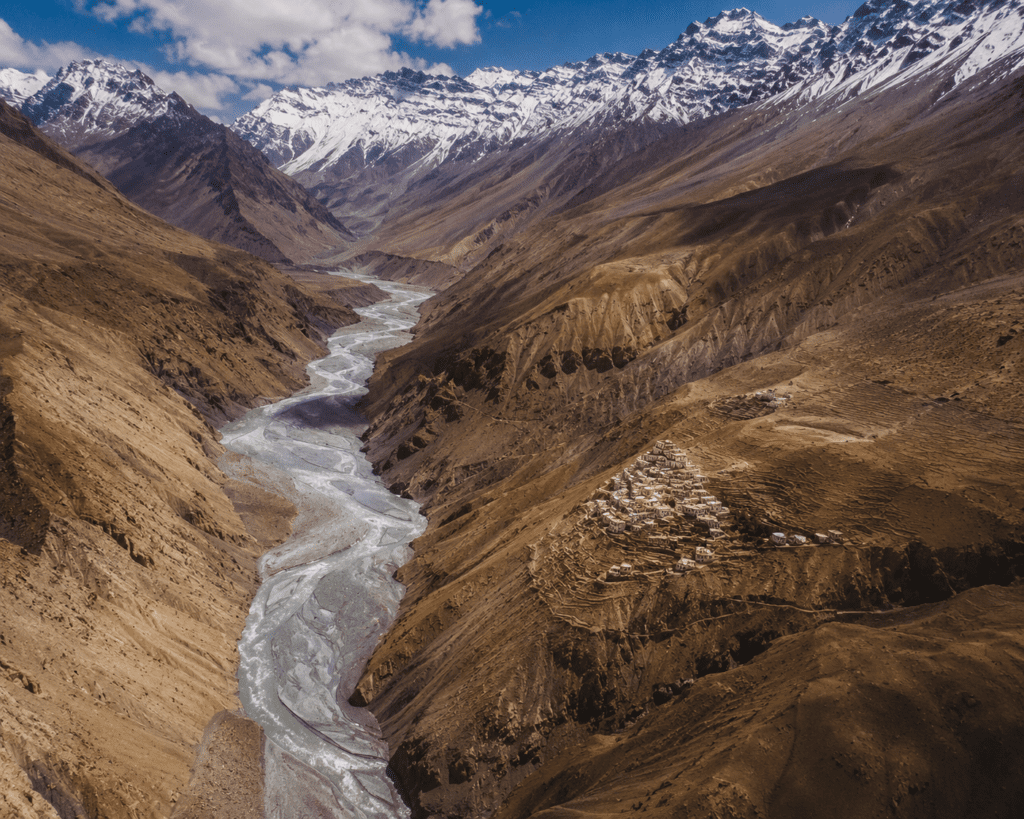
The valley receives less than 170mm of rainfall annually — less than some deserts. The landscape reflects this: brown-grey mountains stripped of everything but their bones, deep gorges, a river system that somehow sustains a handful of thousand-year-old villages and monasteries that look like they were placed there by someone with a very specific aesthetic vision and no concern for accessibility.
The total population of the entire Spiti Valley? Around 10,000 people. Spread across settlements separated by hours of difficult mountain driving.
The honest difference between Spiti and Ladakh:
People ask this constantly. Here’s the truth: Ladakh has better infrastructure, more accommodation options, smoother roads, and the iconic sights. Spiti is rawer, less visited, more demanding, and — for a certain kind of traveller — more rewarding. Ladakh feels like a destination that’s been discovered. Spiti still feels like a secret that got out.
If you’ve done Ladakh and want the version with the difficulty dialled up and the crowds dialled down — Spiti is next. If you’re starting from scratch and want something genuinely wild, Spiti is the right call if you plan properly.
When to Go — The Month-by-Month Truth
Don’t Trust the Generic “June to September” Answer
Every website tells you June to September. That’s broadly correct but unhelpfully vague. Here’s the actual breakdown:
May (Late May from 20th onward): Kunzum Pass typically opens late May 2026 after BRO snow clearance. The first two weeks are for hardy early-season riders only — roads are unpredictable, some stretches still have ice. The Shimla–Kinnaur route is accessible. Accommodation is opening up; prices are at their lowest.
Mid-June to Early July: The sweet spot for non-peak travel. The pass is reliably open, snow walls on either side of Kunzum are still impressively high, waterfalls are at maximum from snowmelt, and the roads have their best window before monsoon damage sets in. Crowds are manageable. This is the window.
July–August: Technically monsoon, but Spiti sits in a rain shadow and gets dramatically less rainfall than the rest of Himachal. However — the approach roads through Kinnaur and Manali experience heavy rains and landslides. NH-5 (Shimla-Kinnaur route) has taken damage in 2025 monsoon around Nigulsari and the Pooh–Kaurik stretch, and repair work continues through 2026. Expect single-lane stretches and delays. Peak tourist season with highest prices. Build in 2–3 buffer days minimum.
September to Mid-October: Arguably the best combination of factors for most people. Monsoon has retreated, skies are clear, the Spiti River turns extraordinary shades of aqua and green, autumn colours begin on hillside villages, crowds thin out significantly, and the photography is exceptional. Temperature drops sharply at night. Ideal for photographers and those who don’t want peak-season crowds.
November to April: Spiti in winter is a different expedition entirely. The Manali route closes. The Shimla route remains technically accessible but brutal in conditions. Sub-zero temperatures, minimal facilities, deep snow. For experienced winter adventure travelers only — not a first-Spiti trip.
Getting to Spiti — Every Route From Every Starting Point
The Two Routes Into the Valley
There’s no flight to Spiti. There’s no direct train. The journey is the thing — and first-timers should understand this is not a complaint. The road in is part of what Spiti does to you.
Route 1: Manali → Kaza (via Kunzum Pass)
Distance: 200–220km Time: 10–14 hours (this is not a typo) Road condition: Rough to genuinely difficult in sections Season: Late May to mid-October only Passes crossed: Rohtang (now bypassable via Atal Tunnel) + Kunzum Pass (4,590m)
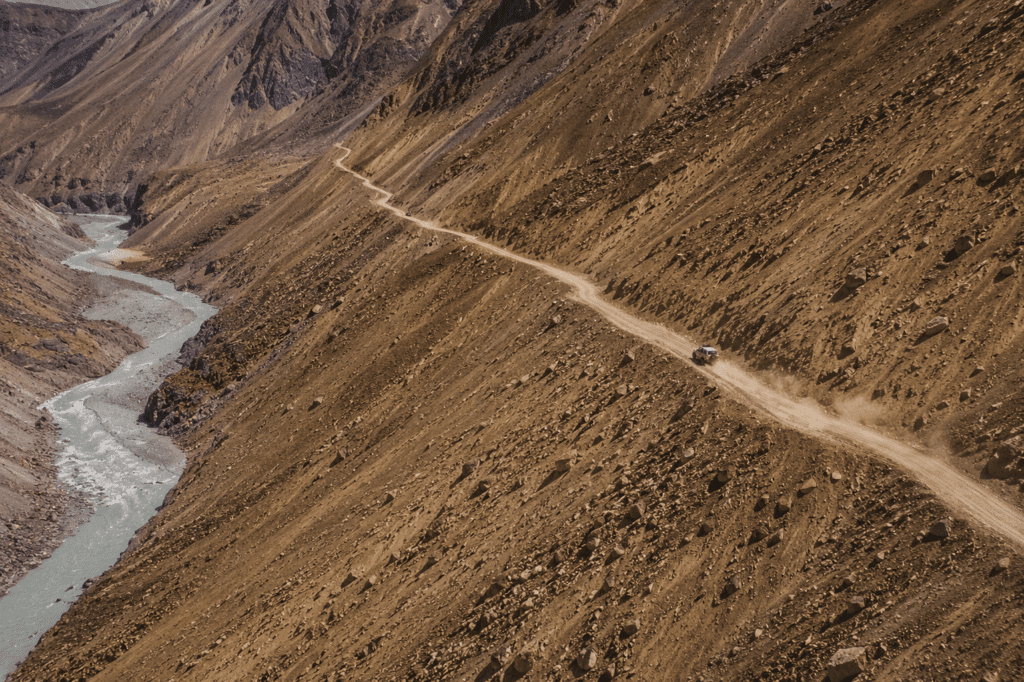
This is the dramatic route — the one that gets you to Spiti via the Atal Tunnel through Lahaul, then the Gramphu–Batal road (which is less a road and more a geological argument between rocks, river crossings, and engineering), and finally Kunzum Pass.
The Atal Tunnel now bypasses Rohtang Pass, which is a significant time saver. But from Gramphu onward, the road reverts to high-altitude mountain track. The section from Batal to Kunzum Pass has improved slightly but still requires high ground clearance vehicles. Someone in a Honda City attempted it in 2024. They turned back at the first water crossing.
You cross Rohtang Pass (now bypassed by Atal Tunnel for the first part), drive through the moonscape of Lahaul, and then tackle the infamous Gramphu-Batal road which is less a road and more a collection of rocks, river crossings, and prayers.
How to do it:
- By Bus: HRTC buses run from Manali to Kaza during season. Journey takes 12–14 hours. Cost: ₹500–₹700. The budget option — genuinely fine but physically demanding.
- By Shared Sumo/Taxi: More comfortable, faster. ₹1,200–₹1,800 per seat.
- By Private Cab: ₹8,000–₹12,000 one way for the vehicle. Worth splitting between 4–5 people.
- By Bike: The iconic option. More below.
- Self-Drive Car: SUV minimum for Manali side. Sedans turn back.
Permit note for Rohtang Pass: If you specifically want to drive over the old Rohtang Pass (not through the tunnel), you need a Rohtang Permit from the HP government portal. Daily quota applies — book 2 days in advance. Green Tax of ₹50–₹100 at Sissu/Koksar barriers regardless of route.
Route 2: Delhi → Shimla → Kinnaur → Kaza (The Cultural Route)
Distance Delhi to Kaza: ~700km Time: 2–3 days with stops (don’t rush this) Road condition: Better overall, but NH-5 has damage patches in 2026 (Nigulsari and Pooh–Kaurik stretch — expect delays) Season: Year-round but best April to October
This route is the slower, more culturally layered approach — and for most non-bikers, the recommended way in. The road hugs sheer cliff faces over the Sutlej gorge through Kinnaur, passes apple orchards clinging to impossible slopes, goes through villages where houses have flat roofs stacked with firewood, and eventually arrives in Tabo — home to a monastery founded in 996 AD that has been continuously operational for over a thousand years.
The Shimla route is your acclimatisation-friendly route — the altitude gain is gradual compared to the sharp climb on the Manali side. Your body will thank you.
Stage breakdown:
- Delhi → Shimla: 360km, 8–9 hours. Overnight bus (₹800–₹1,500 Volvo from ISBT Kashmiri Gate), self-drive, or Shatabdi Express to Kalka then toy train to Shimla.
- Shimla → Reckong Peo (Kinnaur): 215km, 7–8 hours. The road gets serious from here. Stay overnight in Reckong Peo — this is your last reliable ATM and fuel stop on the Shimla side.
- Reckong Peo → Nako → Tabo → Kaza: 170km, 6–8 hours. The valley deepens, the landscape changes colour from green to brown-grey, and Tabo arrives like a quiet announcement that you’re in Spiti now.
The circuit recommendation everyone who’s been there gives:
Enter via Shimla (acclimatise gradually, see Kinnaur en route), exit via Manali (dramatic pass crossing as the finale). Or reverse — both work. Just don’t do the same route in and out unless time forces it.
From Mumbai
Mumbai to Delhi: Rajdhani Express or flight (₹2,500–₹6,000 by train; ₹3,000–₹7,000 by flight). Delhi onwards: Overnight bus to Shimla (₹800–₹1,500) or fly Delhi to Bhuntar (Kullu) — ₹3,000–₹6,000 — then road to Manali.
Total travel time Mumbai to Kaza: 2–3 days minimum. Budget it properly.
Getting Around Spiti — Bikes, Cars, Buses & What Actually Works
By Motorcycle — The Right Way and the Realistic Way
A Spiti bike trip is one of India’s most genuinely thrilling road journeys. The roads are narrow, the passes are high, the river crossings are real, and the sense of arriving somewhere under your own power is unlike anything a car window can give you.
The bikes that work in Spiti 2026:
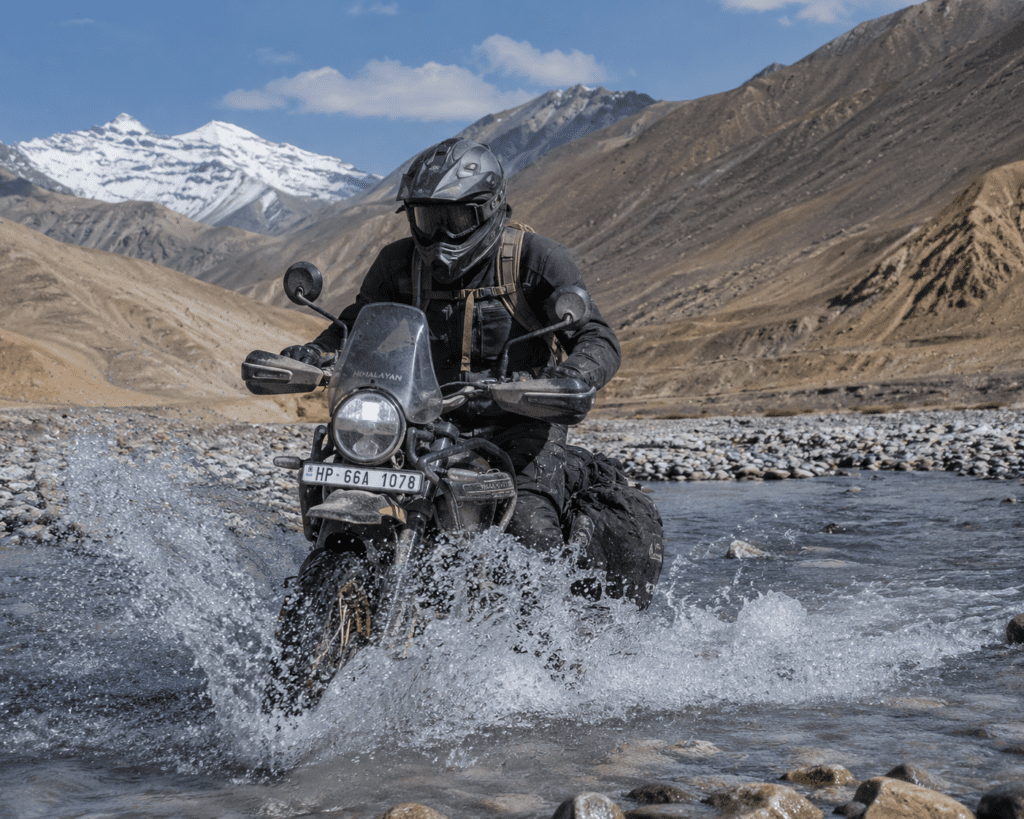
In 2026, the Royal Enfield Himalayan 450 and the Hero XPulse 200/400 are the kings of this terrain. Long-travel suspension, good ground clearance, manageable weight at water crossings. The Classic Bullet 350 works but its heavier weight makes the slushy crossings more work. Make sure your bike has a bash plate — flying stones are common and a punctured engine sump in the middle of nowhere is the specific nightmare you want to avoid.
Where to rent in Manali:
Manali is the main hub for bike rentals for the Spiti circuit.
- Bikes and Trails, Manali: Long-established, good fleet maintenance. Himalayan 450 at ₹2,000–₹2,800/day.
- Himalayan Riders, Manali: Well-reviewed, reliable, range of bikes available.
- Royal Enfield showroom, Manali: Official self-drive rentals available with proper documentation.
Rental rates 2026:
- Royal Enfield Himalayan 450: ₹2,000–₹2,800/day
- RE Classic 350: ₹1,500–₹1,800/day
- Hero XPulse 400: ₹1,800–₹2,500/day
Documents needed: Valid driving licence with motorcycle endorsement, original ID, security deposit (₹10,000–₹15,000 cash or card hold).
The water crossing thing: There are multiple river crossings on the Manali–Kaza route, particularly on the Gramphu–Batal section. Do not cross water that reaches above your boot tops without assessing the current first. If you’re on a bike alone and unsure, wait for another vehicle going the same direction and follow their line.
By Self-Drive Car
Self-driving Spiti is increasingly popular and genuinely excellent — more comfortable than a bike, more flexible than a shared taxi.
Vehicle recommendations:
- Manali side (Kunzum route): SUV mandatory. Mahindra Thar, Scorpio-N, Bolero, Maruti Gypsy. A Vitara Brezza can manage on good days but don’t push it. No sedan past Gramphu.
- Shimla-Kinnaur route: A hatchback with decent ground clearance is fine all the way to Kaza. But past Kaza — Chandratal road, Pin Valley, Kibber — high clearance preferred.
Self-drive rental in Manali:
- Thar/Scorpio-N: ₹4,000–₹6,500/day including fuel
- Innova Crysta (with driver): ₹5,000–₹8,000/day — often a better option than self-drive for groups unfamiliar with mountain roads
Self-drive in Delhi: Zoomcar operates in Delhi — book an SUV (XL6, Creta, Thar), drive Delhi–Shimla–Spiti. Most rental companies restrict driving to HP and Himachal. Verify before booking.
By HRTC Bus — The Budget Option
HRTC (Himachal Pradesh State Transport) buses connect Shimla to Reckong Peo to Tabo to Kaza. Slow, cramped, and occasionally terrifying on cliff-edge roads — but cheap (₹500–₹700 for major legs) and completely doable for budget travelers.
The Kaza–Shimla route has buses running daily during season. Kaza–Manali buses run when the Kunzum route is open (June–October).
For solo travelers on tight budgets, the HRTC + homestay combination is the authentic Spiti experience. You end up in the same places, just slower and cheaper.
By Shared Taxi/Sumo from Kaza
Once you’re in Kaza, shared taxis to Key, Kibber, Langza, Komic, and Hikkim run based on demand — usually early morning. Rates fixed by local taxi union:
- Kaza to Key Monastery: ₹300–₹400/seat shared, ₹1,500–₹2,000 full taxi
- Kaza to Kibber–Chicham: ₹600–₹900/seat shared
- Kaza to Hikkim (world’s highest post office): ₹400–₹600/seat
- Kaza to Chandratal: ₹1,800–₹2,500/seat shared (limited availability)
Group Travel by Tempo Traveller
For groups of 8–12, a Tempo Traveller with driver from Manali or Shimla is the most efficient group option.
Tempo Traveller rate: ₹8,000–₹12,000/day including driver. Split between 10 people = ₹800–₹1,200/person/day. Driver knows the roads, handles mountain logistics, frees everyone else to look out the window.
Book through local travel agents in Manali or Shimla — advance booking essential for July–August peak season.
Permits — The Clear, Accurate 2026 Version
This is where the internet loves to confuse people. Let’s make it simple.
Indian Citizens
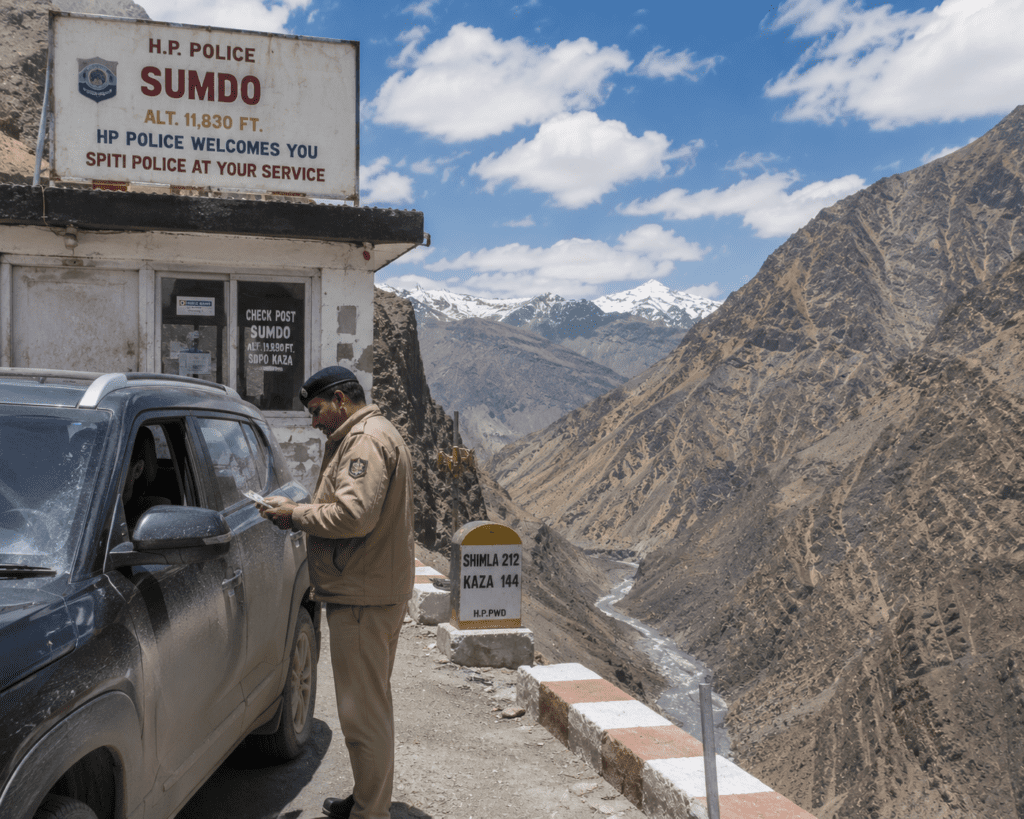
Good news first: Indian citizens do not need any special permit to visit Spiti Valley, including Kaza, Tabo, Key Monastery, Dhankar, Langza, Komic, and Hikkim. Simply carry a valid photo ID — your Aadhaar card, driving licence, or voter ID will do. You may be asked to show ID at police checkpoints along the way, which is standard procedure.
Rohtang Pass Permit (Manali route): If you specifically want to drive over Rohtang Pass (not through the Atal Tunnel), you need this. Book 2 days in advance at the HP government portal. Daily quota, so don’t leave it last minute in peak season.
Chandratal Camping Permit: If you want to camp at Chandratal Lake — and you should — a separate camping permit is required. Register at the Forest Department checkpoint near the lake. The camping area is designated (approx 1km from the lake shore). Wild camping directly at the lakeshore is prohibited as of 2026. No plastic permitted in the Chandratal zone — carry all waste out.
Foreign Nationals
Foreign travelers need a Protected Area Permit (PAP/Inner Line Permit) to enter restricted areas of Spiti that are close to the Indo-Tibetan border. This permit can be obtained at the DC/SDM office in Reckong Peo (on the Shimla–Kinnaur route) or in Kaza. The online portal epass.hp.gov.in also accepts applications.
Required documents: Original passport, valid Indian visa, 3–4 passport photos, copy of travel itinerary. Groups of 2+ are preferred by issuing offices; solo foreign travelers can get a local agent in Reckong Peo or Kaza to assist for ₹300–₹500.
The Spiti Itinerary — Day by Day
12-Day Full Circuit (The One That Covers Everything)
Starting point: Manali. Ending point: Shimla/Delhi via Kinnaur. The recommended circuit.
Day 1: Delhi → Manali
Overnight Volvo bus from ISBT Kashmiri Gate (departs 5–6pm, arrives Manali 6–7am). ₹800–₹1,500. Or fly Delhi–Bhuntar and cab to Manali (₹800–₹1,000). Sleep in Manali. This is also a vehicle/bike pickup day.
Day 2: Manali (Rest Day + Vehicle Day)
If you’re biking, this is when you pick up your bike, check it thoroughly, and ride it around Manali to verify everything works. If you’re driving, finalise the vehicle. Sort your Rohtang permit if needed. Visit Old Manali in the evening — walk the main street, eat at a rooftop café, sleep early.
Day 3: Manali → Kaza (The Big Drive)
Start by 6am. No argument on this. The Gramphu–Batal–Kunzum stretch needs daylight for safety and you want to arrive in Kaza before dark.
The Atal Tunnel (3km) takes you under Rohtang — no drama, very modern. Past the tunnel, the landscape changes immediately. You’re in Lahaul now. The Chandra River runs alongside as the road deteriorates proportionally to how beautiful the surroundings become.
Batal — a lonely dhaba at a river crossing that serves the best Maggi you’ll ever have, purely by virtue of altitude and hunger — is the halfway mark. Stop, eat, sit for twenty minutes.
Kunzum Pass (4,590m): The pass that opens this season gate. A small temple sits at the top where most travelers do a ritual circumambulation. The views from here — back toward Lahaul, forward toward Spiti — are the first confirmation that you came to the right place.
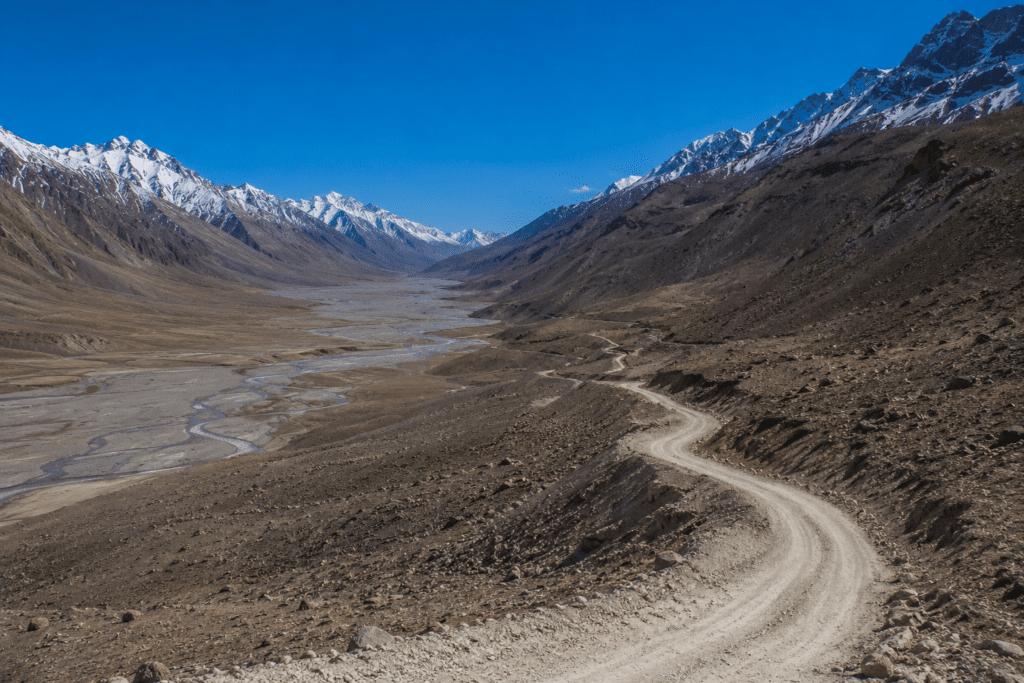
The descent into Spiti from Kunzum is… it’s something. The valley floor appears impossibly far below. The river is a thread of silver. The road switchbacks down the cliff face in a series of hairpins that require your full attention and reward you with a view at every corner.
Arrive Kaza evening. You’ve driven one of the great roads in India.
Stay in Kaza: Zostel Kaza (dorm ₹500–₹700, private ₹1,200–₹2,000), Spiti Sarai (mid-range ₹2,500–₹4,000), Dewachen Retreat (₹4,500–₹7,000, best property in Kaza).
Day 4: Kaza — Rest and Acclimatise
Do not rush Day 4. You’re at 3,800m. If you came via Manali the day before, your body has climbed from 2,000m in roughly 10 hours. Respect this.
Walk slowly. Eat well (local restaurants in Kaza town are surprisingly good). Visit the Kaza market — small, functional, warm. Drink 3–4 litres of water.
Kaza essentials:
- SBI ATM: The only ATM in Spiti. Frequently runs out of cash or goes offline. Do not rely on it — come with enough cash.
- Petrol pump: The only reliable fuel in the valley. Fill up completely. Every. Single. Time. There is nothing between Kaza and Manali (200km).
- Bakery/café: Café 3600 in Kaza — basic but warm, good coffee, Maggi, local bread. A gathering point for travelers.
Day 5: Key Monastery + Kibber + Chicham Bridge
The day for the classics near Kaza. All within 30–45km.
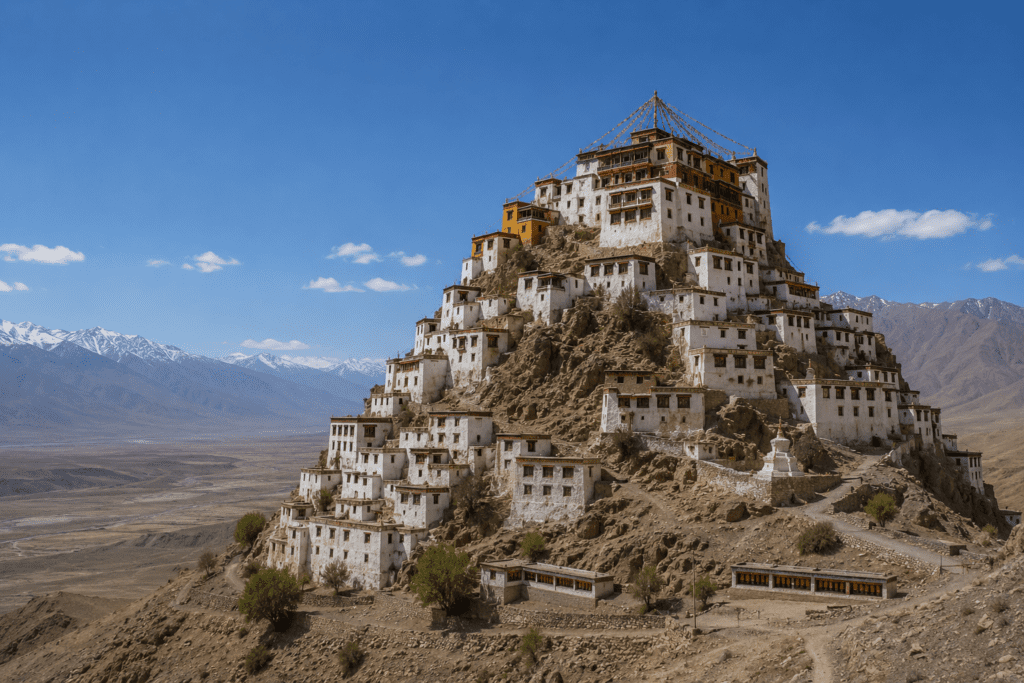
Key Monastery (4,166m): The landmark of Spiti. Founded in the 11th century, it sits on a conical hill above the Spiti River like something placed there to make photographers weep. Home to approximately 300 monks. Wake up early and go at 7–8am — morning prayer sessions are open to respectful visitors. Entry free; donations appropriate.
Kibber (4,205m): One of the highest motorable villages in the world, at the top of the valley above Key. A cluster of flat-roofed whitewashed houses, a small monastery, extraordinary views. Snow leopards are occasionally spotted on the slopes above Kibber in winter — in summer, keep an eye on the ridgelines for bharal (blue sheep).
Chicham Bridge: Asia’s highest suspension bridge for a period. Hangs 150 metres above a gorge that makes your stomach do things you didn’t ask for. Walk across it. It’s fine. It just doesn’t feel fine.
Day 6: The High Altitude Village Trail — Langza, Hikkim, Komic
These three villages sit at 4,400–4,587m and are connected by a single road that loops above Kaza. This is the day that most travelers underestimate and then describe as their favourite.
Langza (4,400m): The village with the giant Buddha statue overlooking the valley. The surrounding fields are full of marine fossils — the valley floor was once a Tethys Sea seabed, and the rocks here yield ammonites and other fossils. Children will sell you small specimens. Buy one. It’s both a souvenir and a fact about geological time that will sit with you.
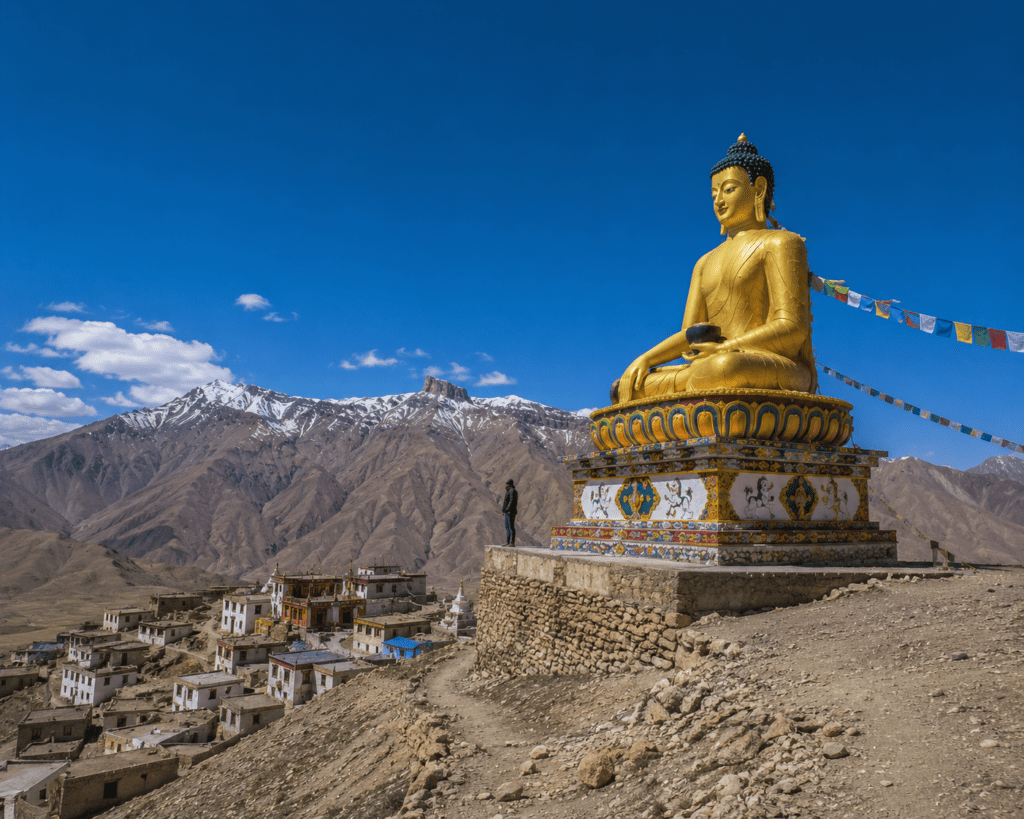
Hikkim (4,440m): The world’s highest post office. An actual, functioning post office at 4,440m. Send a postcard from here. The postal worker stamps it with the altitude and the date and sometimes writes a little note on it. The recipient will not know what to do with this information. That is correct.
Komic (4,587m): The highest inhabited village connected by road in Asia, by some counts. A few dozen houses, a monastery, and a view from the village that made me stand in the road for ten minutes unable to do anything useful.
Day 7: Chandratal Lake — The One That Justifies Everything
This is the day. Wake up at 5am. Start driving by 5:30am.
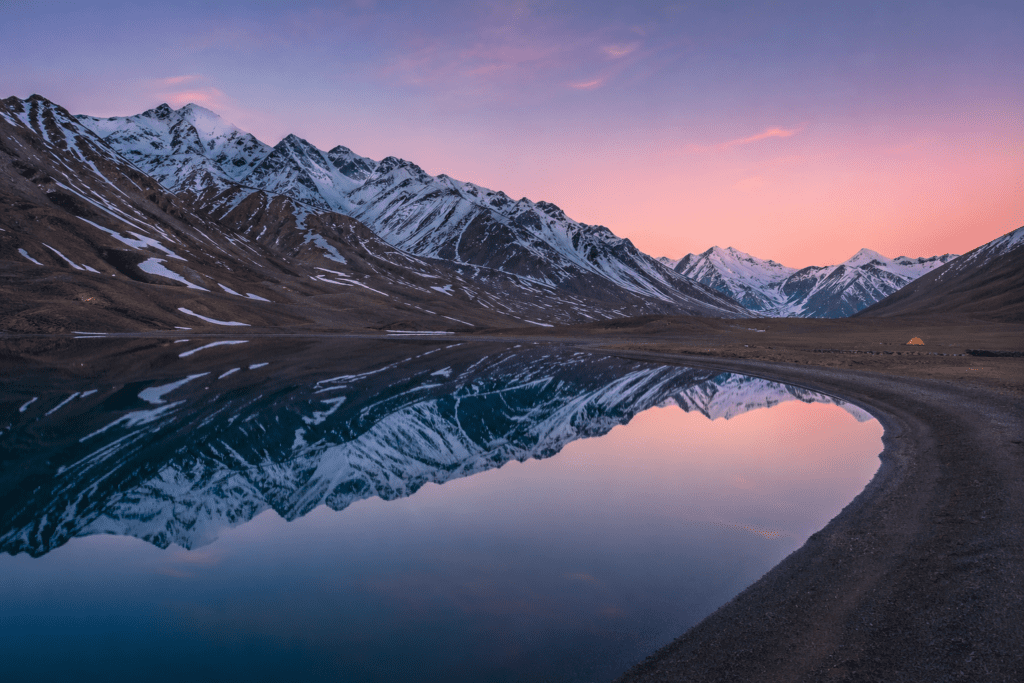
Chandratal (the Moon Lake) sits at 4,300m and is accessed via a 14km dirt road from Batal, then a 1km walk to the lake. The lake is a deep, clear crescent of blue-green water surrounded by scree slopes and distant snow peaks.
At sunrise and sunset, the colours shift through ranges that justify every Instagram cliché ever written about it.
The 14km access road from Batal is rough and requires a 4WD or bike. Sedans cannot make it. Go early — the morning light on the lake is the thing.
Camping at Chandratal: Designated campsites approximately 1km from the lake. ₹2,500–₹4,000/person per night including dinner and breakfast. Carry all plastic waste out — this is enforced, as it should be. The lake and its surroundings are maintained with genuine care by local communities and should be treated with the same respect.
Staying at Chandratal means sleeping at 4,300m. If altitude is affecting you even slightly — headache, nausea, dizziness — don’t camp here. Day trip from Kaza is entirely sufficient and gives you the lake at its best.
Day 8: Dhankar Lake and Monastery
Dhankar sits above Tabo where the Pin and Spiti rivers meet — an ancient fort-monastery that appears to be melting back into the cliff it was built on. The fort is genuinely on the edge of collapse in sections, which is both a conservation concern and a reminder that nothing here is permanent.
The hike up to Dhankar Lake (4,100m) from the monastery takes about 1.5 hours. The lake is small, still, and perfectly silent. On a clear day, the views across the confluence of the Pin and Spiti rivers below are the kind of thing you describe to people who weren’t there and watch their eyes glaze over because it sounds made-up.
Day 9: Pin Valley — The Off-Road Option
Pin Valley National Park branches off the main Spiti circuit between Shichling and Attargo. Less visited than the main circuit, the valley leads to the village of Mudh (3,843m) — the last settlement and the starting point for several treks including the famous Pin-Parvati Pass trek to Kasol.
The road into Pin Valley is rough — proper 4WD required. The reward: wildlife (snow leopard territory, though sightings are rare), near-total isolation, and the village of Mudh where homestays operate at ₹600–₹1,000/night and the family will cook you whatever they’re having for dinner.
Day 10: Tabo — The Town That Has a Thousand-Year Monastery
Tabo is not a place you drive through. It’s a place you stop in.
The Tabo Monastery was founded in 996 AD and has been continuously operational for over a thousand years. Not as a museum — as a living monastery, with monks in residence, prayers conducted daily, and a collection of murals and clay sculptures that scholars travel from across the world to study. The Ajanta of the Himalayas, it’s sometimes called.
The murals inside the nine temples are among the finest examples of Tantric Buddhist art in existence. Entry ₹50 for Indians. Leave your phone in your pocket for at least part of the visit. Some things are better as memories than as photographs.
Stay in Tabo — it deserves more than a drive-through. Tabo Monastery Guest House (₹800–₹1,500/night, basic and perfect) or homestays in the village (₹600–₹1,000 including meals).
Day 11: Tabo → Nako → Kalpa (Kinnaur)
The valley changes as you descend toward Kinnaur. Brown Spiti cold desert slowly transitions back to a landscape with trees — first a few junipers, then apple orchards, then proper Himalayan forest. The river runs differently here, less dramatic, more generous.
Nako Lake: A small, high-altitude village lake with a beautiful monastery on its shore. Good lunch stop.
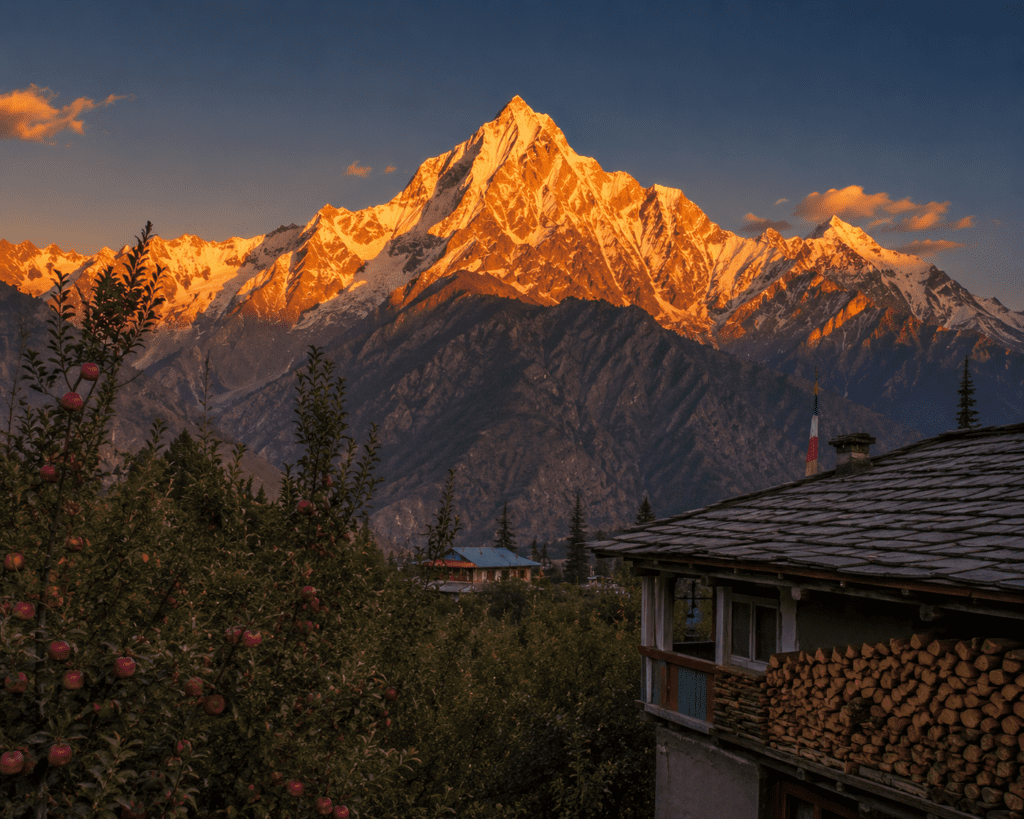
Kalpa: A village above Reckong Peo with direct views of Kinnaur Kailash (6,050m) — the peak that dominates the Kinnaur skyline. Stay overnight here. The sunset on Kinnaur Kailash from Kalpa is one of the best mountain views you’ll have on this entire circuit.
Day 12: Kalpa → Shimla → Delhi (Or Extend)
The final push out — Reckong Peo for your last ATM, Shimla for an overnight if you need to catch a flight, or straight to Delhi overnight bus.
Or — and this is the better option — build two extra days and slow the whole thing down. Spiti rewards the traveller who isn’t chasing the exit.
Where to Stay in Spiti — The Honest Guide
Kaza (The Base)
Budget (₹500–₹1,500/night):
- Zostel Kaza: Social hostel, dorms from ₹500, private rooms from ₹1,200. Common areas, fellow travellers, good energy. The booking.com equivalent for meeting people.
- Moustache Kaza: Similar hostel vibe, slightly more facilities, private rooms from ₹1,500.
- Local homestays (Kaza town): ₹600–₹1,000 per night including dinner and breakfast. Stay with a Spitian family, eat what they eat, talk to them. This is the way.
Mid-range (₹2,500–₹5,000/night):
- Spiti Sarai: The reliable mid-range choice in Kaza. Clean rooms, good service, mountain views.
- Hotel Snow Lion: Centrally located, good restaurant, heated rooms — matters at 3,800m in September.
Premium (₹5,000–₹12,000/night):
- Dewachen Retreat, Kaza: The best property in Spiti. Well-designed rooms, excellent kitchen, a retreat rather than just a hotel. Worth the splurge for a night or two.
- Spiti Ecosphere: Premium eco-stay that also runs community development programs. Staying here directly supports local village conservation work.
Village Homestays — The Soul of Spiti Travel
Langza, Hikkim, Komic, Kibber, Mudh (Pin Valley), Tabo, and Nako all have homestay options at ₹600–₹1,500/night including meals.
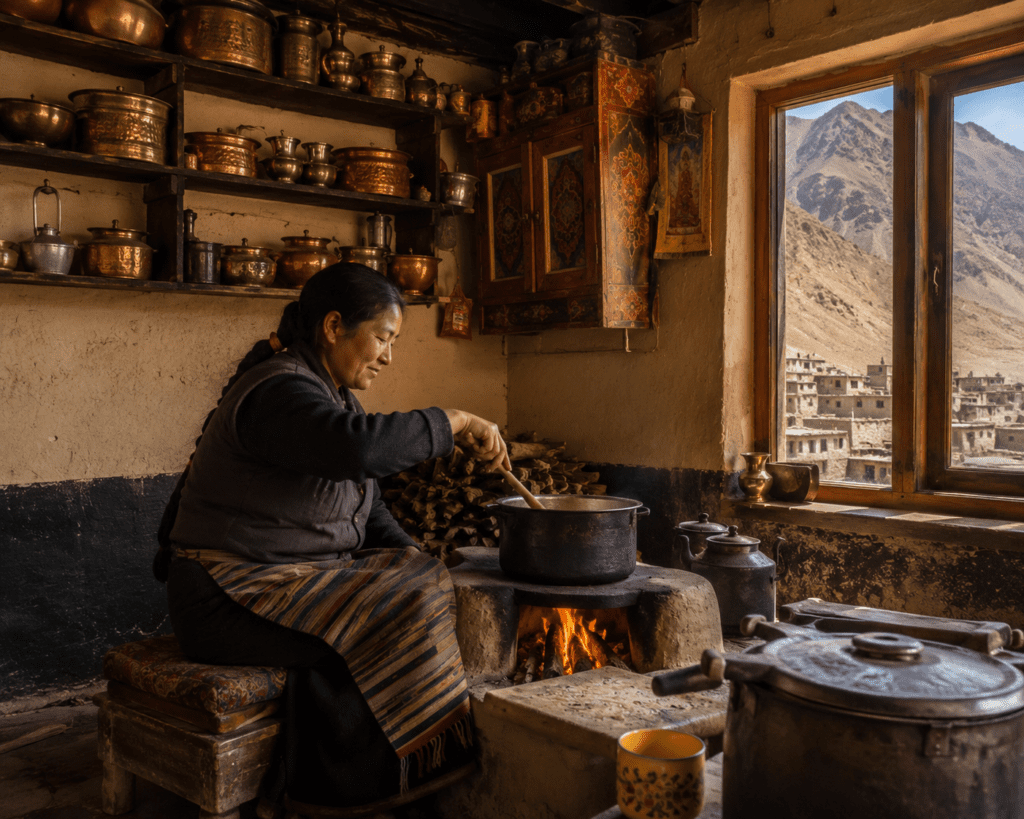
These are not tourist hostels. These are Spitian families with a spare room and a kitchen producing barley bread, yak butter tea, thukpa, and dal that tastes different at altitude. The conversations — in a mix of Hindi and gesture — are worth more than any hotel amenity.
Book through:
- Local tourism offices in Kaza
- Spiti Ecosphere homestay network (spitiecosphere.com — direct booking supports community)
- Booking.com has some listed; many are walk-in or WhatsApp booking
Chandratal Camps
Camps at Chandratal operate during season (June–September). ₹2,500–₹4,000/person/night including dinner and breakfast. All camping is in the designated zone. Book through local Kaza operators or online platforms.
What to Eat in Spiti
The Spitian Table Is Small, Honest, and Very Good
Spiti’s food culture is Tibetan-Buddhist — simple, high-calorie, designed for altitude. Don’t come expecting variety. Do come expecting the kind of warmth that only comes from food cooked in a small kitchen for someone who walked through a mountain pass to reach your door.
Thukpa (₹80–₹150): The staple. Tibetan noodle soup — hand-rolled noodles in a clear or slightly cloudy broth with vegetables or meat. At 3,800m on a cold day, a bowl of thukpa is one of the more important meals you’ll eat.
Momos (₹80–₹150 for 8 pieces): Steamed dumplings, vegetable or meat. Spiti’s momos are less polished than the restaurant versions in Delhi or Manali — and better for it. The dough is thicker, the filling simpler.
Tsampa (₹60–₹100): Roasted barley flour mixed with yak butter tea into a thick paste. Traditional Tibetan staple food. An acquired taste — the texture is unusual, the flavour earthy and nutty. Try it at least once at a homestay. It’s what the mountains have fed people here for a thousand years.
Yak Butter Tea (₹30–₹60): Made from fermented tea, yak butter, and salt. Warming, fatty, savory. You’ll either love it or understand it. Most people, over the course of a few days at altitude, quietly come around. Drink it.
Chhang (₹60–₹120): Local barley beer, slightly fermented, low-alcohol, served at room temperature. Offered at homestays and local dhabas. The social drink of Spiti — accepting a glass is good manners.
Barley Bread / Tingmo (₹50–₹100): Locally baked flatbread, sometimes steamed (tingmo). Served with whatever is on the stove — dal, vegetable curry, leftover thukpa broth. The best versions come from homestay kitchens.
Local Restaurants in Kaza:
- Himalayan Café, Kaza: Good food, reliable kitchen, reasonable prices. Thukpa ₹120, momos ₹100, dal-roti ₹150.
- Sol Café, Kaza: Popular with travelers, Wi-Fi (on good days), coffee that tastes like it was flown in. ₹150–₹250 for a meal.
- Café 3600: The traveler gathering point in Kaza. Basic menu, warm atmosphere, Maggi when everything else seems uncertain.
Things to Do in Spiti — Beyond the Circuit
Trekking
Spiti has some of the finest high-altitude trekking in India with a fraction of the crowds of Ladakh or Uttarakhand.
Pin-Parvati Pass Trek (7–10 days, Grade: Difficult): The legendary crossing from Spiti’s Pin Valley to Parvati Valley in Kullu. Crosses a 5,319m pass. Considered one of India’s most challenging and rewarding high-altitude treks. Guide and porter: ₹3,500–₹5,000/day. Best done July–September.
Dhankar Lake Trek (Day hike, Grade: Moderate): From Dhankar Monastery to the lake. 3km each way, 300m elevation gain. 3–4 hours round trip. No guide needed. One of the finest easy hikes in Spiti.
Kibber to Chicham Trek (Day hike, Grade: Easy-Moderate): The loop above Kibber with views of both the bridge and the upper Spiti Valley. 5–7km, 4–5 hours.
Parang La Trek (9–12 days, Grade: Difficult): Connects Spiti to Ladakh via one of the most remote high-altitude routes in the Himalayas. For experienced trekkers only.
Wildlife — The Snow Leopard Valley
Kibber Wildlife Sanctuary covers the upper elevations above the main Spiti circuit and is one of the best snow leopard habitats in India. Sightings in summer are rare (snow leopards move to higher elevations); winter is when they come down with the bharal. Summer gives you bharal (blue sheep), Himalayan ibex, Tibetan wolf, red fox, and the extraordinary lammergeier (bearded vulture) circling on thermals above the valley.
Birdwatching: The Spiti River corridor is excellent for Himalayan birds — Brown Dipper, Chukar Partridge, Steppe Eagle, and various buntings. Carry binoculars.
Stargazing
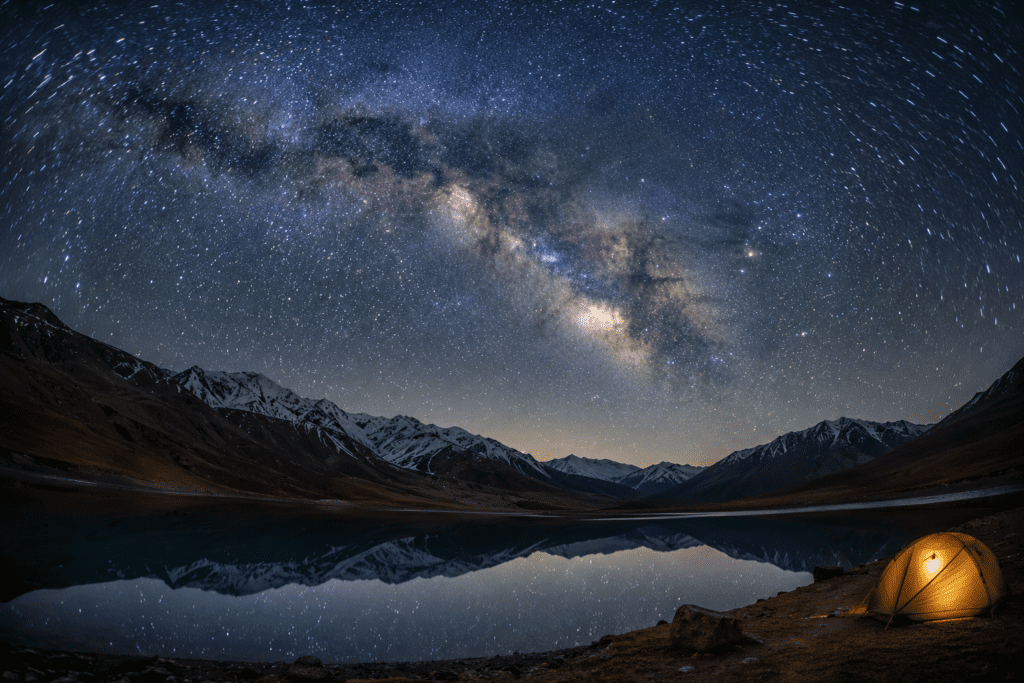
Spiti has near-zero light pollution. On a clear night at Chandratal or the villages above Kaza, the Milky Way is not a vague smudge — it’s a structure. A dense, directional, three-dimensional structure that you can see with your naked eye and that makes every city sky you’ve lived under your entire life feel like a lie.
No equipment needed. Just go outside at midnight. Look up. The altitude means the atmosphere is thinner — stars are brighter, more numerous, and better defined than at lower elevations.
Fossil Hunting at Langza
The hills around Langza are a fossil hunter’s treasure. The Tethys Sea that covered this region 40 million years ago left behind ammonite shells, brachiopods, and other marine fossils embedded in the rock. You can find specimens lying on the ground or buy them from village children (₹50–₹200 for a decent ammonite). This is one of the most quietly extraordinary things about Spiti — standing at 4,400m holding a 40-million-year-old ocean creature.
The World’s Highest Post Office
Hikkim Post Office sits at 4,440m and is genuinely operational. You can send postcards, letters, and small packages. The postmark has the altitude on it. Address it to someone who will appreciate the strangeness. The post takes 7–14 days to reach most Indian addresses.
Spiti for Every Type of Traveller
Solo Travellers — This Valley Is Yours
Solo Spiti travel is entirely doable and, for a certain kind of person, deeply right. The traveller community in Kaza and at places like Zostel means you can arrive alone and leave with people you’ll keep in touch with for years.
Solo biking: Doable but requires serious planning. Inform your guesthouse of your daily route every morning. Carry a first-aid kit. Don’t attempt technical crossings alone at dusk. BSNL postpaid is your only network in most of the valley — get a SIM before leaving Manali.
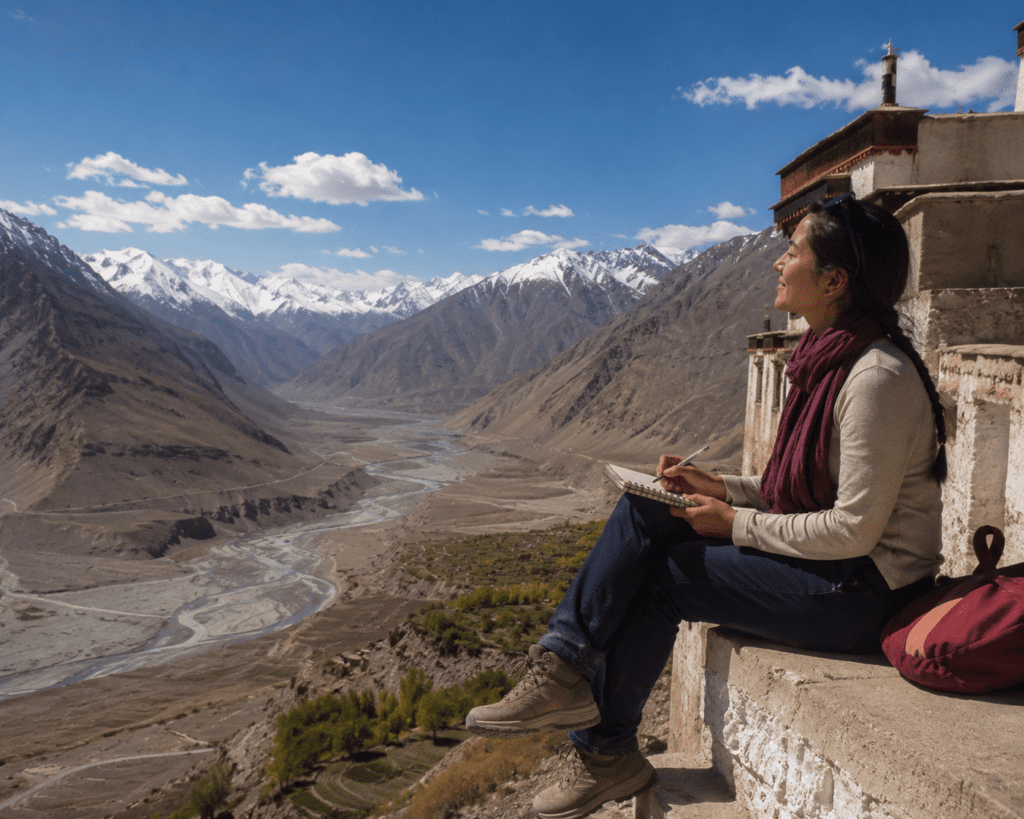
Solo female travellers: Spiti is consistently cited as one of the safest destinations in India for solo women. The Buddhist and Tibetan culture of the valley is respectful and unhurried. Homestay women in Spitian villages are among the most capable, independent people you’ll meet. You’ll be fine. Go.
Couples — Where Spiti Does Something to Relationships
There’s a theory I believe completely: extreme landscapes do something irreversible to couples who visit them together. Not always the same thing, but always something significant.
Watching the sun clear the peaks above Chandratal together at 5:30am, wrapped in everything you brought, the lake going from black to deep blue to impossible green in twenty minutes — that’s not a date night. That’s a reference point.
For couples by car: Self-drive in a Thar or Scorpio-N gives you privacy and pace. Stop when the light is good. Change your itinerary when something unexpected appears. Drive slowly on the Batal stretch with music and no particular agenda.
Romantic stays:
- Dewachen Retreat, Kaza: The best private rooms, mountain views, good food. ₹6,000–₹10,000/night.
- Chandratal camp stays: The tent, the stars, the lake — possibly the most romantic accommodation situation in Indian travel. ₹2,500–₹4,000/person.
- Village homestay in Langza: Wake up at 4,400m, have tea brought to you by a Spitian grandmother, watch the peaks turn gold at sunrise. ₹800–₹1,200/night including meals.
Groups — The Trip That Becomes a Group Story
Spiti group trips have a specific magic. The shared difficulty — the water crossing everyone holds their breath through, the altitude headache someone pushes through, the Chandratal sunrise that nobody wants to leave — becomes a group mythology.
For groups of 6–12: Book a Tempo Traveller from Manali or Shimla with an experienced driver. ₹8,000–₹12,000/day split between 10 = ₹800–₹1,200/person/day. Book accommodation in advance — in July-August, Kaza guesthouses fill completely.
Group permit tip: For foreign nationals, a single group application is faster than individual applications. Designate one person to handle all IDs and submit them together at Reckong Peo or Kaza SDM office.
Budget Breakdown — What Spiti Actually Costs in 2026
Budget Traveller (Per Person, 12 Days, Excluding Getting to Manali)
| Expense | Daily | 12-Day Total |
|---|---|---|
| Accommodation (homestay/hostel dorm) | ₹600–₹1,000 | ₹7,200–₹12,000 |
| Food (3 meals, local restaurants/homestays) | ₹400–₹600 | ₹4,800–₹7,200 |
| Transport (shared taxis, HRTC buses) | ₹300–₹600 | ₹3,600–₹7,200 |
| Permits, entry fees | — | ₹300–₹500 |
| Activities (treks, camping permit) | ₹200–₹500 | ₹2,400–₹6,000 |
| Miscellaneous + emergency buffer | ₹200–₹400 | ₹2,400–₹4,800 |
| Total | ₹20,700–₹37,700 |
Mid-Range (Per Person, 12 Days)
| Expense | Daily | 12-Day Total |
|---|---|---|
| Accommodation (private room/mid guesthouse) | ₹2,000–₹4,000 | ₹24,000–₹48,000 |
| Food | ₹800–₹1,500 | ₹9,600–₹18,000 |
| Transport (private taxi/bike rental) | ₹1,500–₹2,500 | ₹18,000–₹30,000 |
| Activities + Chandratal camp | — | ₹8,000–₹15,000 |
| Miscellaneous | ₹500–₹1,000 | ₹6,000–₹12,000 |
| Total | ₹65,600–₹1,23,000 |
Getting to Manali from Delhi: ₹800–₹1,500 (bus) to ₹5,000–₹9,000 (flight to Bhuntar + cab)
My Personal Recommendations
The thing to prioritise above everything: One morning at Chandratal. Set an alarm for 4:30am. Walk to the lake alone. Wait for the sun. Everything else on this list is secondary.
The surprise recommendation: Tabo over Key Monastery. Key gets all the photography attention, and rightly so — but Tabo’s interior, with its thousand-year murals in near-original condition, is a deeper experience. Fewer people go in. Fewer people know what they’re seeing. That’s the point.
The stop most people skip: Dhankar Lake hike. Three kilometres up from the monastery, almost nobody else, a lake that doesn’t ask for credit on your Instagram and gives you the full Spiti silence completely uninterrupted.
Where to save: HRTC buses between Shimla and Kaza are fine. Local homestay food is better than most restaurants and cheaper. Skip the organised tour markup — Spiti is actually a place you can plan yourself.
Where to spend: One night at Chandratal. One meal at Dewachen Retreat in Kaza. A guide for the Pin-Parvati trek if you’re attempting it.
Pro Tips for Spiti 2026
- BSNL postpaid SIM is the only reliable network in deep Spiti. Airtel works in Kaza and Tabo. Jio and Vodafone are largely absent. Get a BSNL SIM in Manali or Shimla before entering the valley. Download offline Google Maps for the entire Spiti circuit before you lose signal.
- Cash is king. The SBI ATM in Kaza is unreliable — runs out of cash and goes offline regularly. Withdraw enough at Reckong Peo (Shimla route) or Manali (Manali route) before entering. Carry mixed denomination notes. Budget for the full trip plus a ₹5,000 emergency buffer.
- Fuel. Petrol pumps exist at Reckong Peo, Tabo, and Kaza — and that is essentially it. Fill completely at every one. Bikers should carry a small jerry can. There is nothing between Kaza and Manali (200km). This is not an exaggeration.
- Altitude. Kaza is at 3,800m. Chandratal is 4,300m. Komic is 4,587m. Headaches, nausea, and breathlessness are common on arrival. Drink 3–4 litres of water daily. No alcohol for the first 48 hours at altitude (it dramatically worsens AMS symptoms). If symptoms include confusion or severe difficulty breathing, descend immediately.
- Diamox (Acetazolamide): Talk to your doctor before travel. 125mg twice daily starting 24 hours before reaching altitude is commonly prescribed preventatively. Not mandatory; useful.
- Sunscreen at altitude is not optional. UV radiation at 3,800–4,500m is significantly higher than at sea level. SPF 50+. Reapply every 2 hours outdoors. Bring proper sunglasses (UV400 minimum — these altitudes will damage eyes without protection).
- Warm layers for night. Even in July, temperatures in Kaza drop to 5–8°C at night. Chandratal is 0°C or below at dawn. A sleeping bag rated to -5°C minimum for camping. Don’t trust homestay blankets to be enough — carry your own base layers.
- Shooting stones. On steep dirt sections — especially Gramphu–Batal — stones fall from the hillside without warning. Don’t stop directly below cliff faces. Move through exposed sections at a steady pace rather than stopping in the middle.
- Build buffer days. Roads block unexpectedly. Landslides happen. Passes close for a day after heavy rain. If you have a non-refundable return flight booked on the day you exit Spiti, you’re asking for the mountains to remind you who’s in charge.
Mistakes to Avoid
Treating Spiti like a hill station trip. This is a high-altitude desert at 3,800m minimum. People who treat it like a weekend in Shimla are the ones who get turned back by altitude sickness, vehicle failure, or a closed pass. Plan like an expedition.
Going without cash. The SBI ATM in Kaza has a line and an irregular temperament. Coming in short of cash is a serious problem in a valley where there is no backup option for 200km in either direction.
Attempting the Gramphu-Batal stretch in a sedan. It gets said and ignored repeatedly. The Honda City that turned back at the first water crossing in 2024 was not an isolated incident. The road is unambiguous on this point.
Wild camping at Chandratal. It’s prohibited, it harms the ecosystem, and the fine is real. The designated camp is 1km from the lake and perfectly fine.
Skipping Tabo. It is a thousand-year-old monastery with original murals. Stop for at least half a day.
Underestimating driving times. Google Maps estimates on Spiti roads are optimistic by 40–60%. A road that shows 3 hours will often take 4.5–5. Plan your daily driving accordingly and give yourself daylight margin.
Not telling your homestay your route every morning. If you’re biking solo, someone needs to know where you’re going. Leave a note or WhatsApp your guesthouse owner your planned route and ETA. Spiti is safe — and also remote in ways that require basic protocol.
FAQ Section
Q: Do Indian citizens need a permit for Spiti Valley?
A: No. Indian nationals do not need any special permit to visit Spiti Valley, including Kaza, Key Monastery, Kibber, Tabo, Dhankar, Langza, Komic, Hikkim, and Chandratal. Carry a valid government photo ID (Aadhaar, driving licence, or voter ID). You’ll be asked to show it at police checkpoints. Foreign nationals require a Protected Area Permit from the DC/SDM office in Reckong Peo or Kaza.
Q: What is the best time to visit Spiti Valley in 2026?
A: Mid-June to early July and September to mid-October are the sweet spots. Mid-June offers freshly opened passes, snowmelt waterfalls, and minimal crowds. September gives you clear post-monsoon skies, autumn colours, and significantly fewer tourists than peak season. July–August is peak season with the highest prices and busiest roads. The Manali route via Kunzum Pass is accessible late May to mid-October only.
Q: Which route is better — Manali or Shimla to Spiti?
A: Both have merit and the ideal trip uses both (enter one, exit the other). The Manali–Kaza route via Kunzum Pass is dramatic and shorter in distance but harder on vehicles and requires high ground clearance. The Shimla–Kinnaur–Kaza route is longer, passes through the culturally rich Kinnaur district, and is better for acclimatisation. Most experienced Spiti travellers recommend Shimla in, Manali out.
Q: How much does a Spiti Valley trip cost from Delhi in 2026?
A: Budget travellers can do 12 days for ₹25,000–₹40,000 per person (excluding Delhi–Manali transport) using HRTC buses, homestays, and local eating. Mid-range travel with private cab, mid-tier guesthouses, and Chandratal camping runs ₹60,000–₹1,00,000 per person. Add ₹1,500–₹9,000 for Delhi–Manali transport depending on whether you take an overnight bus or fly.
Q: Is Spiti Valley safe for solo female travellers?
A: Yes — Spiti and the Kinnaur–Spiti circuit are consistently cited as among the safest destinations in India for solo women. The Buddhist and Tibetan culture of the region is respectful. Homestay families are welcoming and protective of solo women guests. Crime rates are extremely low. The main risks are altitude-related and road-related — apply the same preparation as any traveller.
Q: Can I do Spiti Valley by bike as a first-timer?
A: Yes, with preparation. The Royal Enfield Himalayan 450 or Hero XPulse 400 are the recommended bikes for the terrain. Know how to handle water crossings before you leave Manali. Carry a basic toolkit and a bash plate. Don’t ride the Gramphu–Batal section at night. If you’ve never done a mountain bike trip, consider doing the Shimla–Kinnaur route first (more forgiving) before attempting the Manali–Kunzum section.
Q: Is Chandratal Lake worth the trip?
A: Unreservedly yes. It is a 4,300m high-altitude lake of extraordinary beauty, accessible via a rough dirt road from Batal. The sunrise at Chandratal is one of the finest experiences available in Indian travel. Camp overnight for the full experience. Go early in the day to avoid afternoon clouds. Carry all plastic waste out — the lake is maintained with genuine community care.
Q: What should I pack for Spiti Valley?
A: Warm layers for evenings and nights (temperatures drop to near-freezing even in July at high camps). SPF 50+ sunscreen. UV400 sunglasses. Sleeping bag rated to -5°C if camping. Cash in mixed denominations (minimum ₹10,000–₹15,000 in valley). BSNL postpaid SIM card. Offline Google Maps downloaded for all Spiti roads. Diamox if your doctor recommends it. A first-aid kit with ORS sachets and basic altitude medication.
Conclusion — The One Thing I Want You to Take From This Guide
Spiti doesn’t care how long you’ve been meaning to go.
It doesn’t maintain a waitlist. It doesn’t send reminders. It sits at 3,800 metres in the northeastern corner of Himachal Pradesh, winter sealing it off for half the year, the season opening and closing with the indifference of geology, the monasteries going about their thousand-year business with or without you.
I’m saying this not to be harsh. I’m saying it because every year, the season opens in late May and closes in mid-October, and the window between those two dates contains everything — the freshly cleared pass, the Chandratal at dawn, the yak butter tea in a homestay kitchen, the specific silence of a valley that contains ten thousand people spread across a space that could hold ten million.
And then the window closes.
Your Spiti trip does not require a perfect plan. It requires a date. A rough route. Cash. A capable vehicle. The willingness to be uncomfortable sometimes and the understanding that uncomfortable in a place this extraordinary is not a problem — it’s the whole point.
The Kunzum Pass opens in late May 2026. The season closes mid-October.
That’s your window. What’s in your calendar?
Go. The valley doesn’t wait.