

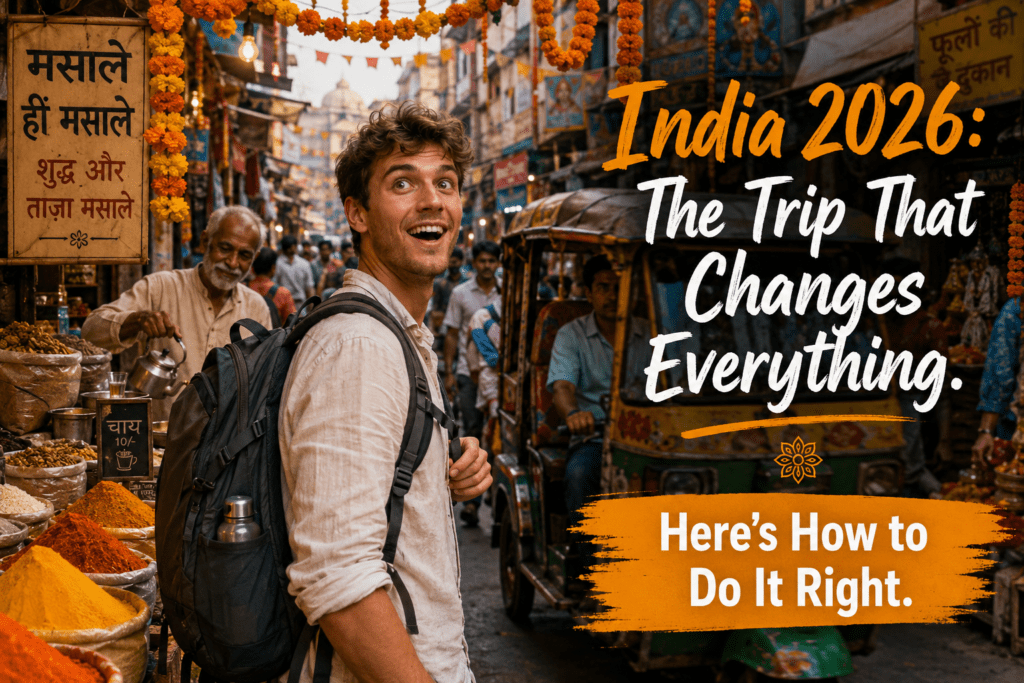
A NOTE BEFORE YOU START: India is not a destination. It is an experience that happens to have borders. It will overwhelm you, enchant you, frustrate you, feed you better than anywhere else on earth, and send you home fundamentally changed. This guide was written with one purpose: to get you there properly prepared, so that India gets the chance to do what it does best — which is everything, simultaneously, loudly, at full colour saturation. Welcome.
A Foreigner’s First Week in India
By Maya, 28, from Portland, Oregon — first India trip, October 2025
I landed in Delhi at 2am. The arrivals hall smelled like marigolds and jet fuel and something I couldn’t name then but can now — it’s the smell of a country that is absolutely, defiantly, magnificently alive regardless of what time it is.
My first mistake was booking a hotel I’d seen on a dodgy booking site. The second was not getting a SIM card at the airport. The third was getting into an unmetered auto-rickshaw at 3am without agreeing on the price first.
The driver took me to my hotel on a route that I’m fairly sure added 6km to the journey, delivered me in one piece, and charged me 800 rupees instead of the fair 200. I was tired, I paid, he nodded respectfully, and that was that.
The next morning I woke up to the sound of temple bells and a crow sitting on my windowsill and the distant, insistent rhythm of a city that had been at this for five thousand years and had absolutely no intention of adjusting its tempo for my sleep schedule.
I walked out, found a chai stall, paid 15 rupees for a small clay cup of tea, and stood on a Delhi street in the October morning light, sipping it, watching the city move.
And I thought: I am going to figure this out. And it is going to be extraordinary.
It was.
This guide is everything I wish I’d had before I landed — and everything I’ve learned since, verified with 2026 data, honest about the difficult parts, specific about the good ones, and completely committed to getting you there prepared.
Quick Reference: India 2026 At a Glance
| Category | Details |
|---|---|
| Currency | Indian Rupee (INR / ₹) |
| Exchange rate (May 2026) | 1 USD ≈ ₹84–86 |
| e-Visa (30-day tourist) | $25 most nationalities |
| e-Visa (1-year tourist) | $40 most nationalities |
| e-Visa (5-year tourist) | $80 most nationalities |
| Official visa portal | indianvisaonline.gov.in |
| e-Arrival Card | Required within 72 hours of arrival |
| Best season | October to March (North India) |
| Monsoon | June–September (beautiful but wet) |
| Budget daily spend | $18–40/day (₹1,500–3,500) |
| Mid-range daily spend | $40–80/day (₹3,500–7,000) |
| Luxury daily spend | $150–500+/day (₹13,000–43,000+) |
| Foreign monument entry | Typically 10–15x Indian price |
| Taj Mahal entry (foreigner) | ₹1,300 ($15) |
| Emergency number | 112 (unified) |
| Tourist police helpline | 1800-111-363 |
Part 1: Visa — The Correct, Updated 2026 Information
e-Tourist Visa (Most Common for Foreign Visitors)
Under the e-Visa scheme, citizens from over 180 countries and territories are now able to apply for an Indian e-Tourist Visa before arriving in India, including America, the United Kingdom, Australia, New Zealand, Canada, and most EU countries.
2026 e-Tourist Visa Fees (Official, Most Nationalities): Most eligible countries, including America, Australia, the United Kingdom, Canada, France, Germany, and New Zealand, pay the same standard fees: $25 for a 30-day visa, $40 for a one-year visa, and $80 for a five-year visa. Apart from the visa fee, a bank charge of 2.5% will be charged additionally.
Visa Types Available:
- 30-day e-Tourist Visa — valid for 30 days from date of first arrival, double entry allowed
- 1-year e-Tourist Visa — valid for 365 days from date of approval, multiple entries (total stay cannot exceed 180 days per calendar year)
- 5-year e-Tourist Visa — valid for 5 years from date of approval, multiple entries (180-day annual stay limit)
Which to choose: If this is your first India trip or you’re visiting once: get the 30-day ($25) or 1-year ($40) e-Tourist Visa. The 1-year is better value for anyone planning to return or extend.
How to Apply — Step by Step
Official website: indianvisaonline.gov.in
Step 1: Go to indianvisaonline.gov.in — the ONLY official government portal. Do not use third-party sites that charge extra fees. Third-party “visa service” sites are legal but charge 2–5x more for the same visa.
Step 2: Select “e-Tourist Visa” → choose duration (30 days / 1 year / 5 years)
Step 3: Fill application with passport details, travel dates, India address (use your first hotel)
Step 4: Upload required documents:
- Passport photo (white background, recent, clear)
- Passport scan (data page)
- Return ticket or onward travel proof
Step 5: Pay the visa fee by card (Visa/Mastercard accepted)
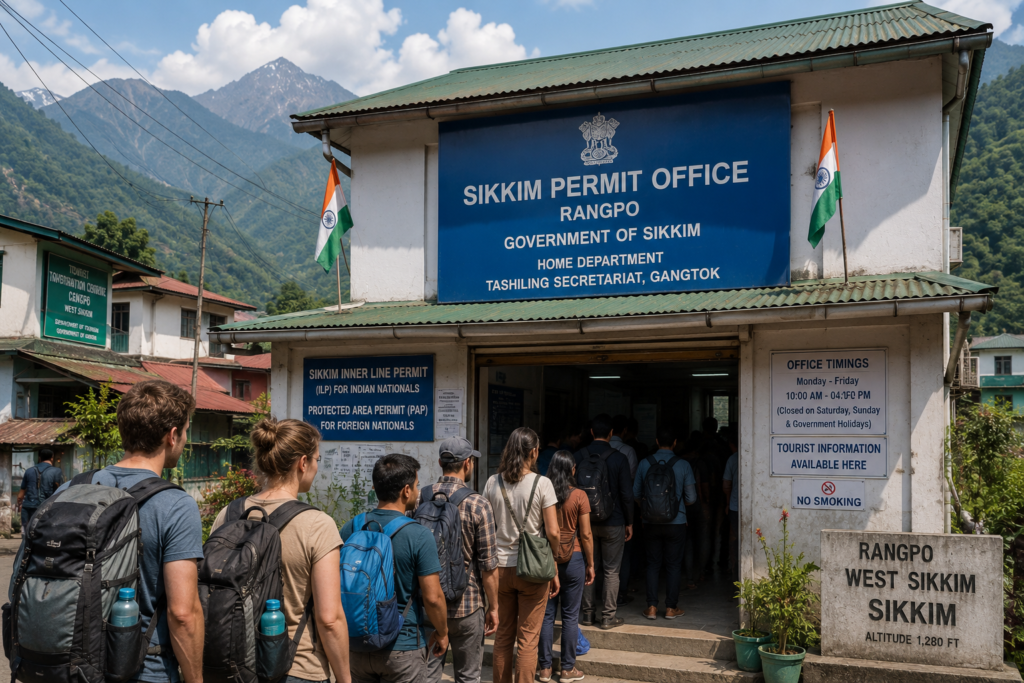
Step 6: Approval typically comes in 24–72 hours. Print your e-Visa — carry printed copy to immigration.
You can now apply up to 120 days in advance of your arrival date, giving you plenty of time to fix any rejected photos before your flight.
Passport requirements: Your passport must be valid for at least 6 months from the date of arrival and have at least 2 blank pages for physical stamping at immigration.
e-Arrival Card — NEW Mandatory Requirement 2026
All foreign travellers must now submit an e-Arrival Card online within 72 hours before arrival in India, per the Bureau of Immigration. This is separate from your visa. Complete it at: indianidc.nic.in/IIDCA/
Entry Points for e-Visa
The 33 designated airports cover all major Indian cities including Delhi, Mumbai, Bengaluru, Chennai, and Kolkata. Other eligible airports include Hyderabad, Goa (Dabolim and Mopa), Jaipur, Cochin, Ahmedabad, Amritsar, Pune, Varanasi, Trivandrum, Lucknow, and Gaya. The full list also includes Bagdogra, Bhubaneshwar, Calicut, Chandigarh, Coimbatore, Guwahati, Indore, Kannur, Madurai, Mangalore, Nagpur, Port Blair, Surat, Tiruchirapalli, Vijayawada, and Vishakhapatnam.
Countries With Restricted/Special Visa Rules
Visa-free: Nepal and Bhutan nationals do not require a visa for India.
Special rules: Pakistani nationals, nationals of countries that don’t maintain diplomatic relations with India, and some others face different or restricted processes — check the Ministry of Home Affairs website (mha.gov.in) for your specific nationality.
Pakistan, Afghanistan, Bangladesh: Different visa process — must apply at Indian Embassy/High Commission in person.
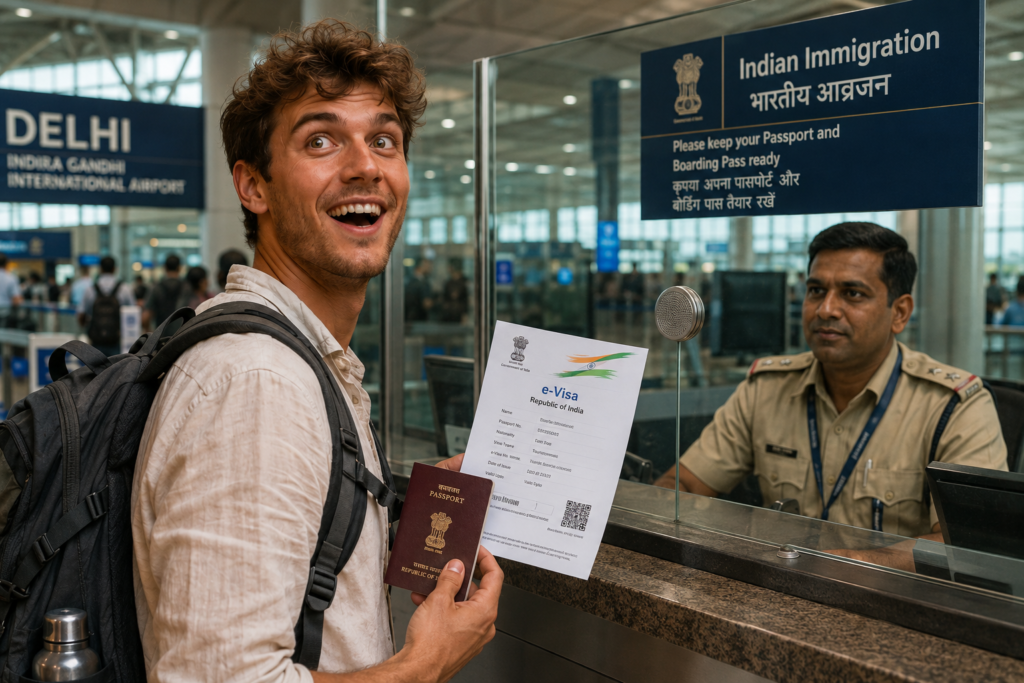
Permits for Restricted Zones — What Foreigners Need
Some areas of India require special permits for foreign nationals — primarily border regions and sensitive areas. Here is the 2026 complete list:
Protected Area Permit (PAP) / Inner Line Permit (ILP)
| Region | Permit Type | Where to Get | Cost |
|---|---|---|---|
| Sikkim (certain areas) | Restricted Area Permit | Online at sikkim.gov.in or ILP counters in Siliguri/Rangpo | Free–₹200 |
| Arunachal Pradesh | Protected Area Permit | eiltarunachalpradesh.gov.in | ₹100–200 |
| Manipur, Mizoram, Nagaland | Protected Area Permit | Ministry of Home Affairs / Foreigners Registration Office | Free |
| Andaman & Nicobar Islands | No permit for most islands (Restricted Islands need RAP) | Andaman Secretariat | Free |
| Spiti Valley (Kinnaur area) | No permit for Indians; foreigners need PAP for some border areas | DC/SDM office locally | Nominal |
| Lakshadweep | Special permit required | Lakshadweep Administration | ₹200–500 |
Note: The rules update regularly. Always verify at least 1 month before travel on the official Ministry of Home Affairs website (mha.gov.in) or the state government portal.
For Mountaineering / High-Altitude Expeditions
Mountaineering in restricted Himalayan zones requires a Mountaineering Permit from the Indian Mountaineering Foundation (IMF). Cost varies by peak height and nationality — from ₹5,000 to ₹1,00,000+ for major peaks. Apply at imfindia.com.
Foreigner Registration (FRRO)
If you plan to stay more than 180 days in India, or if your visa requires it (some research/student visas), you must register with the Foreigners Regional Registration Office (FRRO) within 14 days of arrival. Online registration: indianfrro.gov.in
Money — The Complete 2026 Currency Guide
Exchange Rates & Where to Change
Best rates (2026): Thomas Cook, Moneygram, or authorised exchange bureaus in city centres. Airport exchange rates are 3–5% worse than city rates.
ATMs: Available in all cities and most towns. Accept Visa, Mastercard, Maestro. Fees: Most Indian ATMs charge ₹150–250 per foreign transaction + your home bank’s international fee.
Best cards for India 2026:
- Wise Card (Transferwise): Zero forex markup, real exchange rate, works well in India
- Revolut: Good in India, some ATM limits apply
- Charles Schwab (US travellers): Reimburses all ATM fees globally — exceptional for India
UPI for foreigners: As of 2026, UPI (India’s mobile payment system) is now available to foreign visitors from select countries using their foreign bank cards through the BHIM app or partnered international apps. Check current eligible countries at npci.org.in — this changes frequently and is expanding.
Cash vs digital: Outside major cities, cash is still king. Village markets, chai stalls, local buses, small temples, dhaba restaurants — cash only. Carry ₹5,000–10,000 in mixed denominations at all times.
Tipping culture:
- Restaurants: 10% is generous; 5% is fine at mid-range
- Taxi/auto: Round up, not mandatory
- Hotel porter: ₹50–100 per bag
- Tour guide: ₹500–1,000 for a full day
- Massage: ₹100–200 above service charge
Daily Budget Breakdown — Real 2026 Numbers
The Backpacker (Shoestring Budget)
Budget travelers spend ₹1,200–3,500 ($14–42) daily including hostel dormitories, street food, public transportation, and free activities across India’s cities.
A lean backpacker day in a mid-priced city might look like this: ₹900 for a hostel dorm bed, ₹500 for three simple meals and snacks at local eateries, ₹300 for a mix of metro rides and rickshaws, and ₹300 for a museum entry or small excursion, plus ₹200 for coffee, water and small extras. Total: roughly ₹2,200 for the day.
30-day shoestring budget: $600–1,200 (excluding flights and visa)
Mid-Range Traveller
Mid-range travelers spend $70–120 per day, staying in 3–4 star hotels, hiring occasional private drivers, and enjoying a mix of local and restaurant dining.
30-day mid-range budget: $2,100–3,600 (excluding flights)
Luxury Traveller
A typical luxury daily budget for a solo traveler staying in reputable five-star hotels or luxury heritage properties in 2026 will often start around ₹18,000–25,000 ($215–300) per day outside of extraordinary events.
30-day luxury budget: $6,450–15,000+ (excluding flights)
Complete Daily Cost Breakdown Table
| Expense | Backpacker | Mid-Range | Luxury |
|---|---|---|---|
| Accommodation | ₹400–1,200 ($5–15) | ₹2,500–6,000 ($30–75) | ₹12,000–50,000+ ($145–600+) |
| Food (3 meals) | ₹250–500 ($3–6) | ₹700–1,500 ($8–18) | ₹2,000–6,000+ ($25–75+) |
| Transport (local) | ₹100–300 ($1–4) | ₹500–1,500 ($6–18) | ₹2,000–8,000+ ($25–95+) |
| Entry fees/activities | ₹100–400 ($1–5) | ₹400–1,200 ($5–15) | ₹1,500–5,000+ ($18–60+) |
| SIM/data | ₹50/day avg (₹500 for 30 days) | Same | Same |
| Miscellaneous | ₹200–500 | ₹500–1,500 | ₹2,000–5,000+ |
| TOTAL per day | ₹1,100–2,900 ($13–35) | ₹4,600–11,700 ($54–140) | ₹19,500–74,000+ ($230–880+) |
Part 5: SIM Card — Get This Right on Day One
The Right Way to Get an Indian SIM
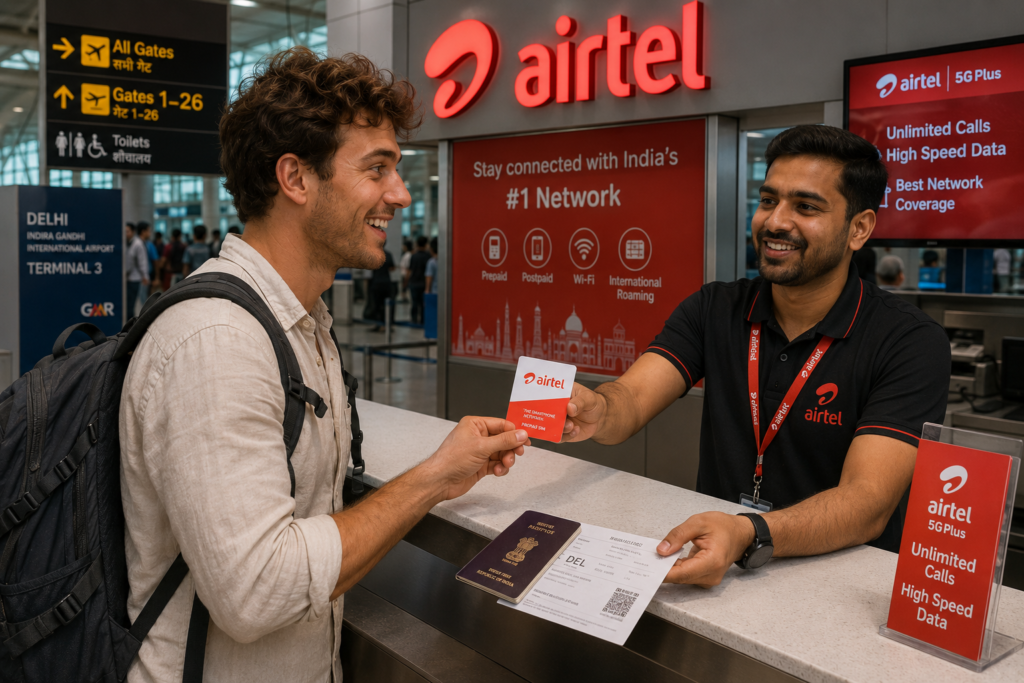
Getting an Indian SIM card as a foreigner is slightly more complex than in other countries but completely doable. The most reliable method is to buy it at the airport arrival hall from an authorised carrier counter.
Best carriers for foreigners 2026:
Airtel: Best overall network, widest 4G/5G coverage, international tourist SIM available.
- Airtel Tourist SIM: ₹499 for 30 days, 6GB data + unlimited calls. Available at airports.
Jio: Cheapest, large network. ₹239–399 for prepaid plans. Good in cities; weaker in remote areas.
BSNL: Best for remote mountains (Spiti, Ladakh, Northeast India) — government network with widest coverage in frontier areas.
Documents needed:
- Passport (original)
- Visa (e-Visa printout)
- Passport photo (2 copies — airport shops can print)
- Local address (your hotel address works)
- Indian contact number (your hotel can provide or the SIM shop can arrange)
Activation time: Airport Airtel counters activate within 30–60 minutes. City shops may take 24 hours. Buy at the airport.
Itinerary 1 — The Golden Triangle (7 Days)
The Classic First-Timer’s Circuit: Delhi → Agra → Jaipur
The Golden Triangle is India’s most popular tourist circuit for good reason — it packs three of the country’s most spectacular destinations into a manageable 7-day route. Perfect for first timers, short-break travellers, and those wanting maximum impact with limited time.
Total distance: 750km circuit | Best transport: Private cab, train, or rented car
Day 1–2: Delhi — India’s Capital and Its Chaos
Delhi is not a gentle introduction to India. It’s an immersion — a 32-million-person city that has been the seat of empires for 1,000 years and wears that history loudly and simultaneously.
Old Delhi (Day 1 morning):
- Jama Masjid: One of India’s largest mosques, commissioned by Shah Jahan in 1644. Entry free for Muslims; non-Muslims ₹300 (camera ₹200). Climb the minaret for the best view over Old Delhi.
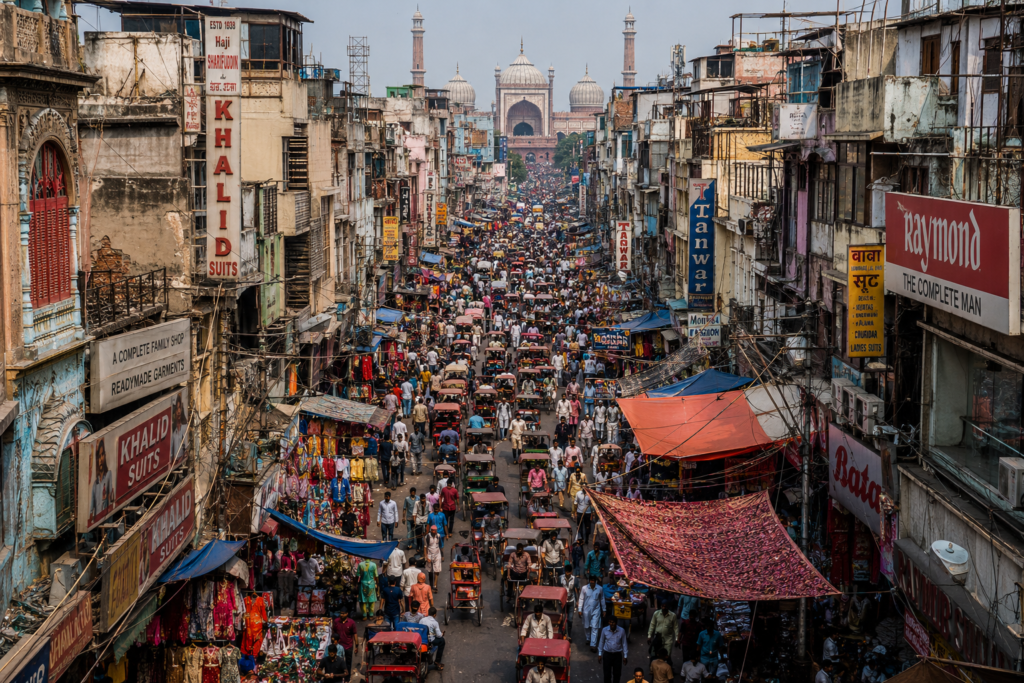
- Chandni Chowk: The legendary market street — spice markets, silver jewellery, wedding goods, street food. Go on foot or by cycle rickshaw (₹100–150 for the full stretch).
- Paranthe Wali Gali: A narrow lane off Chandni Chowk serving nothing but stuffed parathas since the 1870s. A meal with chai: ₹150–250.
New Delhi (Day 1 afternoon):
- Humayun’s Tomb: The precursor to the Taj Mahal — Mughal architecture at its finest. Entry foreigners: ₹600. Best visited late afternoon when the light softens.
- Lodhi Garden: Free public park with 15th-century tombs scattered among gardens. Perfect for an evening walk.
- Connaught Place: New Delhi’s central business hub — good cafés, restaurants, and the underground Palika Bazaar for cheap shopping.
Day 2: Qutub Minar (UNESCO — entry foreigners ₹600), India Gate, Red Fort (entry foreigners ₹600), ISKCON Temple (free, spectacular). Metro to most places: ₹15–50 per journey.
Delhi food to try:
- Karim’s (Old Delhi): Since 1913. Mughlai cuisine — mutton korma, seekh kebabs. ₹400–700 for a full meal.
- Indian Accent (New Delhi): Fine dining, modern Indian cuisine, one of India’s best restaurants. ₹4,000–6,000 per person.
- Paranthe Wali Gali: ₹150–250 for a full stuffed paratha meal.
- Khan Chacha: Famous for mutton rolls at Khan Market. ₹250–350.
Delhi hotels:
| Budget | Hotel | Price/Night | Area |
|---|---|---|---|
| Backpacker | Zostel Delhi, Moustache Delhi | ₹500–1,200 (dorm) | Paharganj/Karol Bagh |
| Budget | Hotel Ajanta, Hotel Shelton | ₹1,500–2,500 | Paharganj |
| Mid | The Lalit New Delhi | ₹7,000–12,000 | Connaught Place |
| Luxury | The Leela Palace New Delhi | ₹35,000–80,000 | Chanakyapuri |
| Luxury | The Imperial New Delhi | ₹28,000–60,000 | Connaught Place |
Day 3: Delhi → Agra (Taj Mahal)
By train: Shatabdi Express (2h 10min, ₹700–1,200) or Gatimaan Express (1h 40min, ₹1,400–2,000) — the fastest. By car: 3.5 hours on the Yamuna Expressway — private cab ₹3,500–5,000.
The Taj Mahal: Built 1632–1653 by Mughal Emperor Shah Jahan as a mausoleum for his wife Mumtaz Mahal. Entry for foreigners: ₹1,300 ($15). Open sunrise to sunset (closed Friday). Best visited at sunrise — gates open 30 minutes before sunrise, crowds are thinner, light is extraordinary.
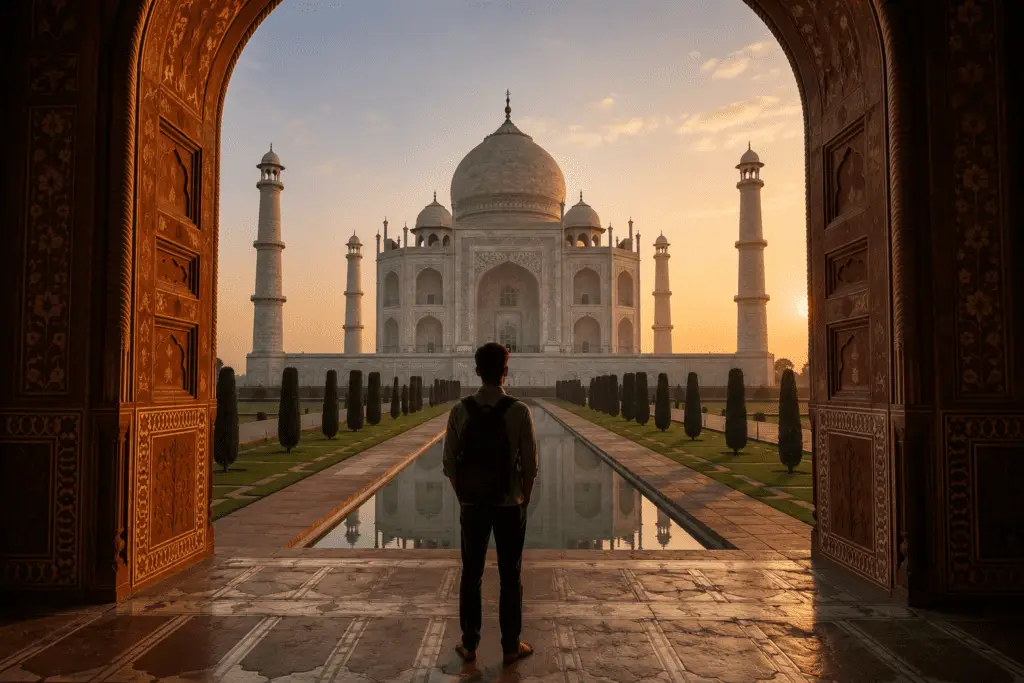
Pro tip on the Taj: Buy your ticket in advance at the Archaeological Survey of India website (asi.payumoney.com) — queues at the ticket counters can take 45–90 minutes in peak season.
Agra Fort: 2km from the Taj. Entry foreigners: ₹650. Mughal fort where Shah Jahan was imprisoned by his son and could see the Taj Mahal from his tower. Poignant, beautiful, worth 2 hours.
Agra food: Petha (white pumpkin sweet) is the Agra speciality — buy from Panchhi Petha near the Taj. Dalmoth (fried lentil snack) from street stalls: ₹50–100.
Agra hotels:
| Budget | Hotel | Price/Night |
|---|---|---|
| Backpacker | Zostel Agra | ₹500–1,500 |
| Budget | Hotel Sheela, Hotel Amar | ₹1,200–2,500 |
| Mid | Courtyard by Marriott Agra | ₹6,000–10,000 |
| Luxury | The Oberoi Amarvilas | ₹60,000–1,20,000 (Taj view from every room) |
Day 4–5: Jaipur — The Pink City
Jaipur to Agra: 240km, 4–5 hours by car or bus. RSRTC buses: ₹350–600. Private cab: ₹3,500–5,000.
Jaipur is the capital of Rajasthan — a city deliberately painted a warm terracotta-pink for a royal visit in 1876. The colour stuck. The city is now UNESCO-listed (2019) for its extraordinary urban planning and architecture.
Amber Fort: 11km from Jaipur. The spectacular hilltop fort — entry foreigners: ₹550. Elephant rides up the ramp have been restricted — take a jeep (₹150 shared) or walk.
City Palace: Still home to Jaipur’s royal family. Entry foreigners: ₹700. The Diwan-i-Khas (Hall of Private Audience) contains two enormous silver urns — the largest sterling silver objects in the world — used to carry Ganga water to London for a royal visit.
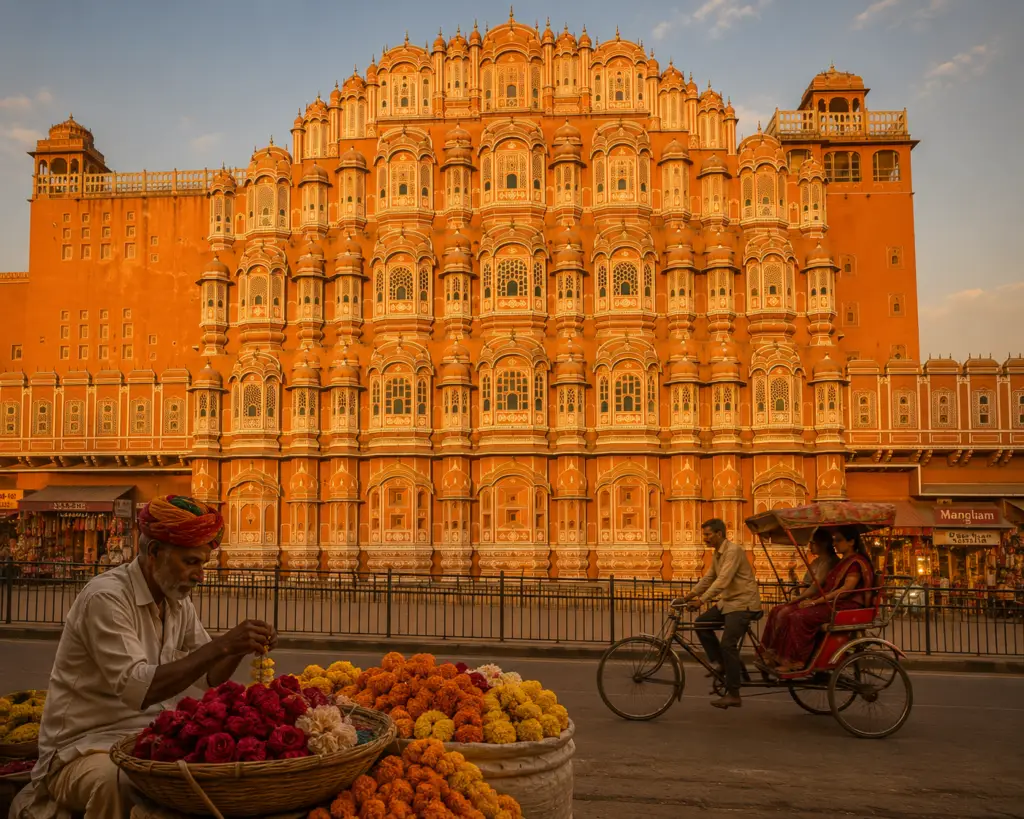
Hawa Mahal (Palace of Winds): The pink sandstone lattice-screen palace facade — entry foreigners: ₹200. Best photographed from the chai shop across the street.
Jaipur food:
- Lassiwala (M.I. Road): The most famous lassi in India. ₹50–80 for a clay pot of thick, cold lassi. Queue expected.
- Thali at Suvarna Mahal (Rambagh Palace): Fine dining thali at a palace hotel — ₹2,500–4,000 per person. Worth one splurge.
- Dal Baati Churma: Rajasthani speciality — baked wheat dumplings with lentils and clarified butter. Available everywhere. ₹150–300 at a dhaba.
Jaipur hotels:
| Budget | Hotel | Price/Night |
|---|---|---|
| Backpacker | Moustache Jaipur, Zostel Jaipur | ₹500–1,500 |
| Budget | Hotel Arya Niwas (legendary among backpackers) | ₹1,500–3,000 |
| Mid | Hotel Diggi Palace (heritage guesthouse) | ₹4,000–8,000 |
| Luxury | Rambagh Palace (Taj Hotels) | ₹45,000–1,50,000 |
| Luxury | Samode Haveli (within old city) | ₹18,000–35,000 |
Day 6: Jaipur → Delhi (return) by train (Shatabdi or Pink City Express) or overnight bus.
Day 7: Departure from Delhi
Golden Triangle Total Budget (7 days, per person excluding flights):
- Backpacker: ₹15,000–25,000 ($175–300)
- Mid-range: ₹50,000–90,000 ($590–1,070)
- Luxury: ₹2,50,000–6,00,000+ ($3,000–7,000+)
Part 7: Itinerary 2 — North to South India Circuit (14 Days)
The Complete India Experience: Delhi to Goa to Kerala
This is the 2-week itinerary that gives you the full sweep of India — from Mughal monuments in the north to Goan beaches to Kerala’s backwaters. The geographic and cultural contrast alone is worth the journey.
Days 1–3: Delhi (as above — cover Old Delhi, Taj Mahal day trip, Jaipur day trip)
Days 4–5: Varanasi — The Ancient City
Fly or take overnight train from Delhi to Varanasi (12–14 hours on Kashi Express, ₹600–1,800 sleeper).
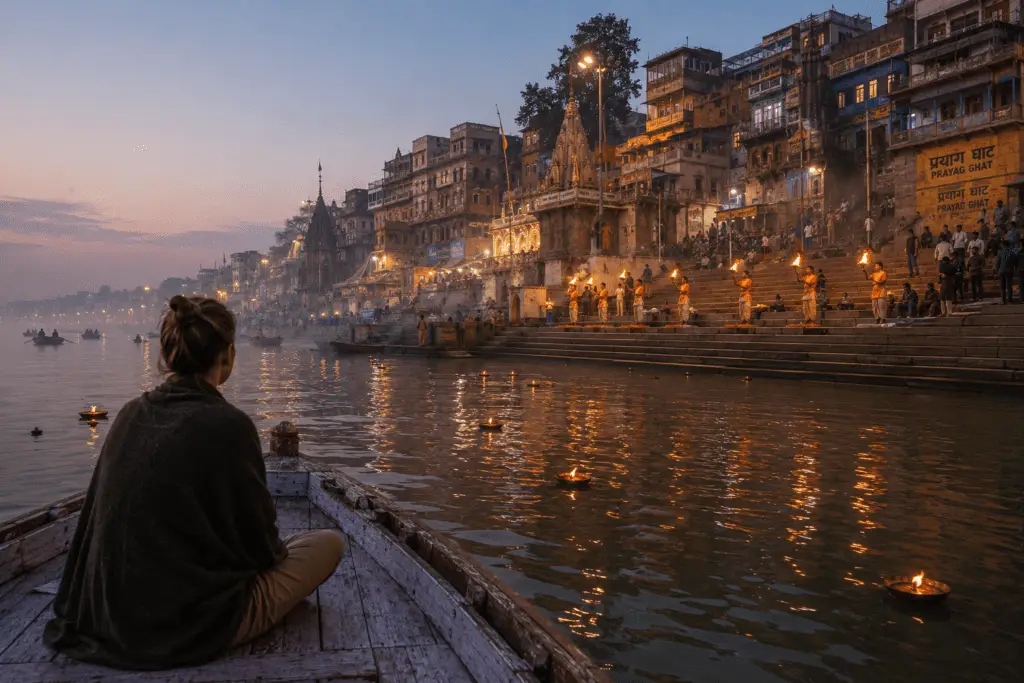
Varanasi is one of the world’s oldest continuously inhabited cities. A sunrise boat ride on the Ganges costs $10–15 per person, while an evening Ganga Aarti experience is usually free.
Varanasi is simultaneously the most intense and most spiritual experience India offers. The ghats (stone steps down to the Ganges) are where life and death coexist without euphemism — pilgrims bathe at dawn in the same river where funeral pyres burn at Manikarnika Ghat 24 hours a day.
Must-do in Varanasi:
- Sunrise boat ride on the Ganges: ₹800–1,500 per boat (negotiate). Row past 84 ghats in the early mist.
- Evening Ganga Aarti at Dashashwamedh Ghat: Free. Arrive by 6:30pm for a good position.
- Walk the old lanes (galis): Get completely, deliberately lost in the medieval lanes behind the ghats. This is the point.
- Blue Lassi shop: Famous for decades. Clay pot of fresh lassi ₹60–100. Try rose or mango.
Varanasi food: Kachori sabzi (fried bread with potato curry) ₹30–50 from street stalls at Godowlia Chowk. Banarasi paan (betel leaf) to end any meal — ₹20–50. Chena dahi vada (yoghurt dumplings) ₹40–80.
Days 6–7: Mumbai — The City That Never Stops
Fly Varanasi to Mumbai (1.5 hours, IndiGo/Air India ₹2,500–6,000).
Mumbai is India’s financial capital, Bollywood’s hometown, and the most international city in the country. The contrast with Varanasi is total and deliberate.
Mumbai must-visit:
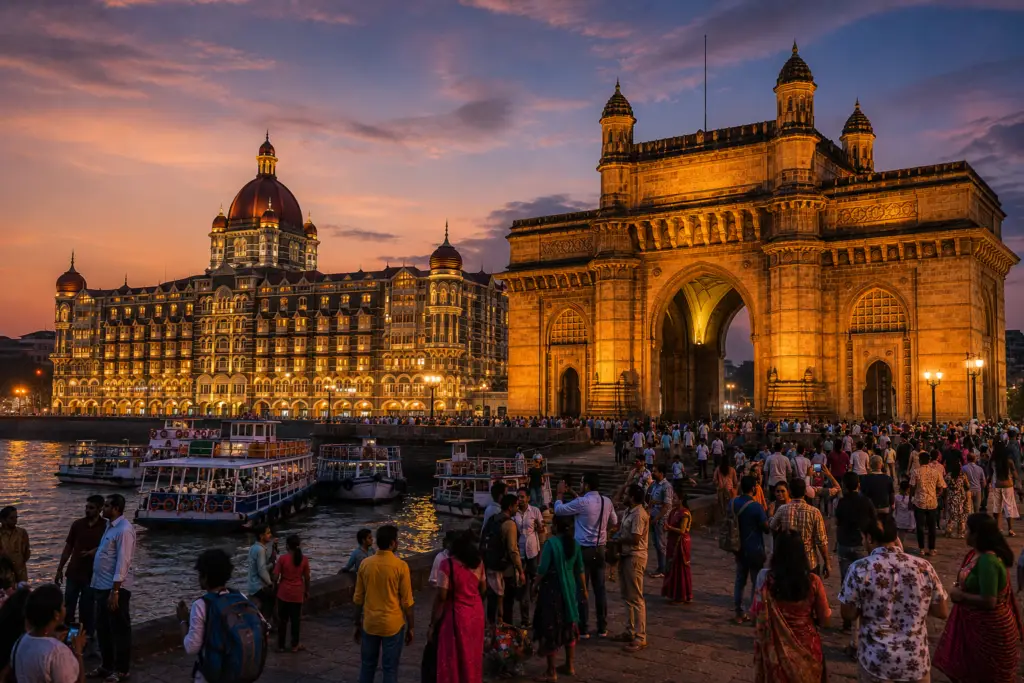
- Gateway of India + Taj Mahal Palace Hotel: Iconic waterfront monuments. Free to visit the area; hotel lobby is accessible if dressed appropriately.
- Dharavi: Asia’s largest urban slum — guided tours available through Reality Tours (₹600–1,000 per person, socially responsible operator). Not poverty tourism — a community of 1 million people with its own thriving economy and culture.
- Crawford Market (Dr. D.N. Road): Colonial-era covered market — spices, fruits, the works. Free.
- Marine Drive (Queen’s Necklace): Evening walk along the sea-facing boulevard. Free.
Mumbai food:
- Vada Pav: From any street cart near a train station ₹15–30 — Mumbai’s signature street food
- Leopold Café, Colaba: Since 1871. Cold coffee, club sandwich. ₹300–600 for a meal.
- Trishna (Fort): Legendary seafood restaurant. Butter garlic crab ₹1,200–1,800.
- Bademiya (Colaba): Seekh kebabs on charcoal grill, midnight snack institution. ₹200–500.
Days 8–9: Goa — Beaches, Portuguese Heritage, Perfect Sunsets
Train Mumbai to Goa: Konkan Kanya Express or Jan Shatabdi (9–12 hours, ₹600–1,800). Or fly (50 minutes, ₹2,000–5,000).
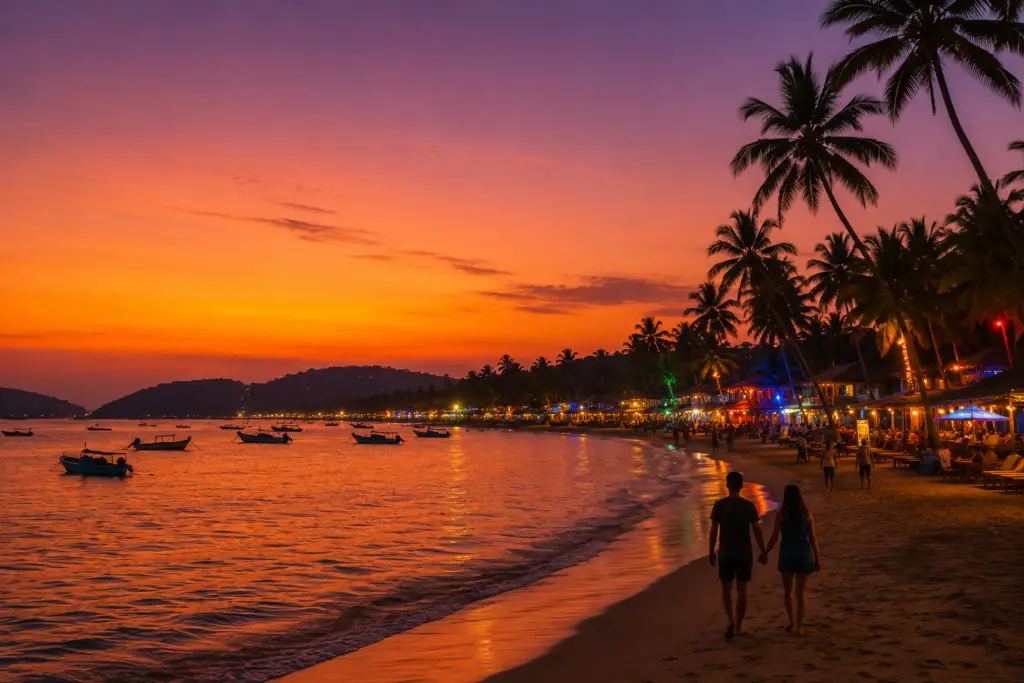
Goa is India’s smallest state and its most beach-forward — 105km of coastline with distinct north and south personalities.
North Goa (Calangute, Anjuna, Arambol): The party beaches. Beach shacks, sunset bars, full-moon parties, flea markets.
South Goa (Palolem, Agonda, Patnem): The quieter beaches. Pristine, less crowded, more relaxed. For those who want sand without speakers.
Heritage Goa (Old Goa, Panjim): The colonial Portuguese heart. Basilica of Bom Jesus (UNESCO — entry free) contains the remains of St. Francis Xavier. Panjim’s Latin Quarter (Fontainhas) is a perfectly preserved Portuguese neighbourhood with tiles, bakeries, and fado music.
Goa food:
- Fish curry rice: The Goan staple. ₹150–300 at a local restaurant.
- Prawn balchão: Spicy pickled prawn preparation — a Goa-Portuguese fusion speciality.
- Bebinca: Layered Goan dessert — coconut, jaggery, egg yolks. ₹80–150 per slice.
- Feni (local cashew spirit): The Goan spirit made from cashew apple or coconut. ₹100–200 for a drink at a local bar.
Days 10–11: Kerala — God’s Own Country
Fly Goa to Kochi (1 hour, ₹2,500–5,500). Or overnight train Goa to Ernakulam (12 hours, ₹600–1,800).
For the full Kerala breakdown, refer to our separate Kerala 7-Day Guide. For this circuit: focus on Alleppey backwaters (houseboat, 1 night, ₹6,000–18,000/boat) and Fort Kochi heritage.
Kerala food you must try:
- Kerala fish curry with red rice: The essential local meal. ₹150–300.
- Appam with stew: Lace-edged rice pancakes with vegetable coconut milk stew. Breakfast ₹80–150.
- Kerala parotta with beef fry: For non-vegetarians — the best pairing in south Indian food. ₹150–250.
- Filter coffee (Kerala style): Dark, strong, served in a steel tumbler and davara set. ₹20–60.
Days 12–13: Chennai or Mysore (Choose One)
Chennai: South India’s largest city — Kapaleeshwarar Temple (free, spectacular), Marina Beach (world’s longest urban beach, free), Mahabalipuram (UNESCO temples, 1h drive south — foreigners ₹600).
Mysore: The city of palaces — Mysore Palace (entry foreigners ₹200, illuminated on Sundays spectacularly), Chamundi Hills, silk and sandalwood shopping.
Day 14: Return to Delhi or Fly Home
14-Day North-to-South Circuit Budget (per person excluding international flights):
- Backpacker: ₹35,000–60,000 ($415–715)
- Mid-range: ₹1,00,000–1,80,000 ($1,190–2,140)
- Luxury: ₹4,00,000–10,00,000+ ($4,750–11,900+)
Itinerary 3 — The Adventure Circuit (21 Days)
Himalayas, Mountain Trains, Bikes & Beyond
For adventure travellers, content creators, and those who want to earn their India.
This is the version that mixes modes deliberately — mountain trains, rented bikes, sleeper trains across the plains, and the Himalayas as the centrepiece.
Delhi → McLeod Ganj (Dharamshala) → Spiti Valley → Manali → Amritsar → Delhi
Delhi to McLeod Ganj:
- Overnight bus from ISBT Kashmiri Gate (10–12 hours, ₹700–1,400)
- Or Pathankot by train, then cab to McLeod Ganj
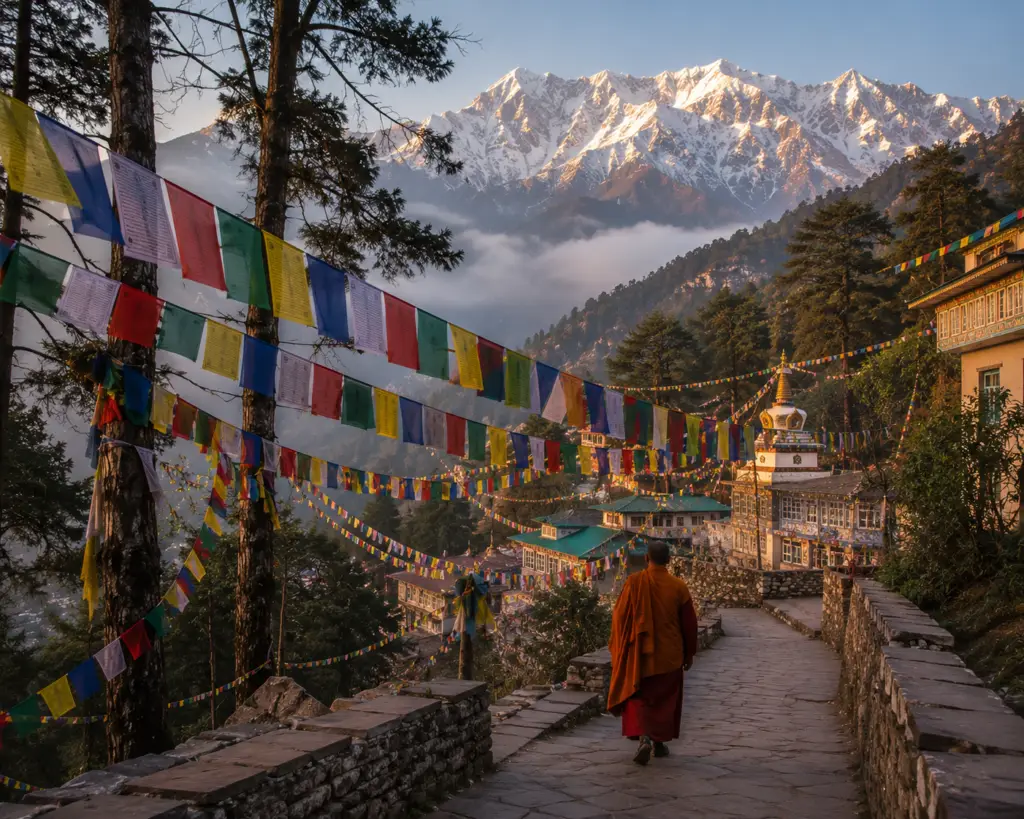
McLeod Ganj (4 days): Home of the Tibetan Government in Exile, the Dalai Lama’s residence, and one of the most interesting cultural confluences in India. Himalayan views from the town, Bhagsu Nag waterfall trek (easy, 3km), Triund Trek (16km, 1 day, no guide needed — ₹500 for camping permit).
Content creator goldmine: Tibetan monks at dawn puja, Himalayan panoramas, Tibetan café culture, Bhagsu waterfall, the Dalai Lama temple complex at prayer time.
McLeod Ganj to Spiti (2 days via Kullu): From Kullu/Manali (bus from McLeod Ganj, ₹500–800), take the Manali route into Spiti via Kunzum Pass. (Full Spiti guide in separate article.)
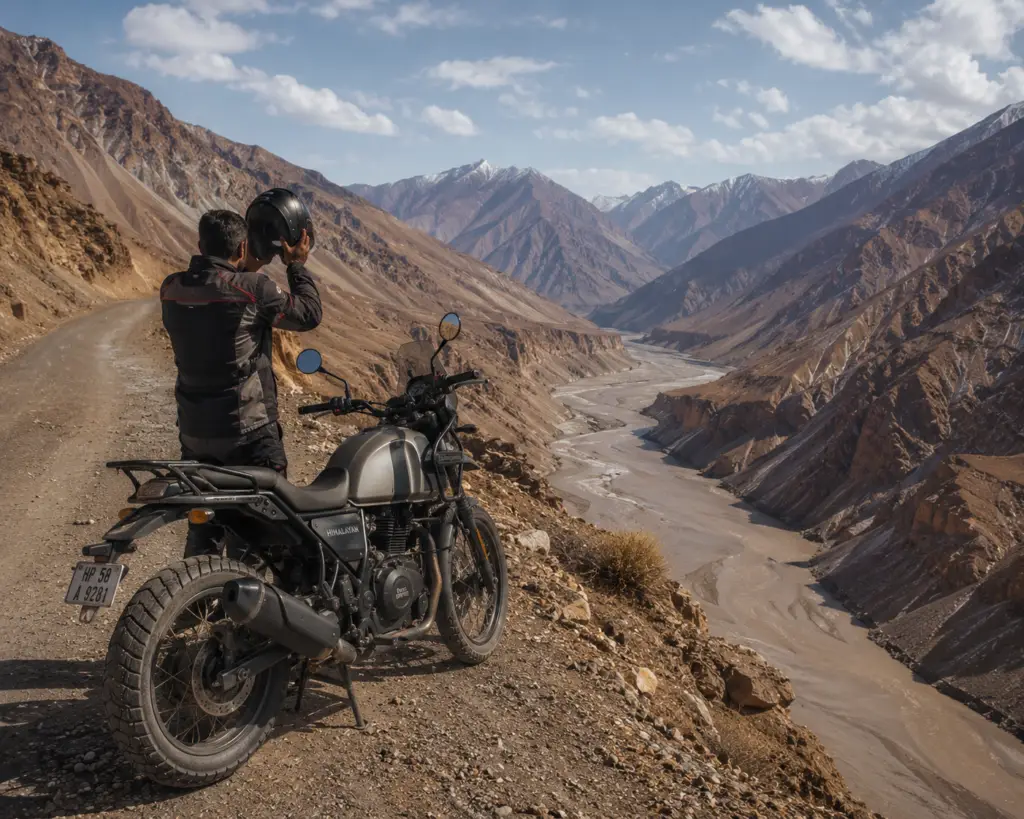
Bike option: Rent a Royal Enfield Himalayan in Manali (₹2,000–2,800/day) — the Manali to Kaza ride is one of India’s classic motorcycle journeys.
Spiti Valley (4 days): Kaza, Key Monastery, Kibber, Langza, Chandratal Lake. Raw, high-altitude, extraordinary. Full guide in our separate Spiti Valley 2026 article.
Manali (2 days): Old Manali cafés, Rohtang Pass excursion (Rohtang permit needed — ₹100 online via manalidevelopmentauthority.com), Solang Valley adventure activities (paragliding ₹2,500–3,500).
Amritsar (2 days): Train or bus from Manali/Delhi to Amritsar.
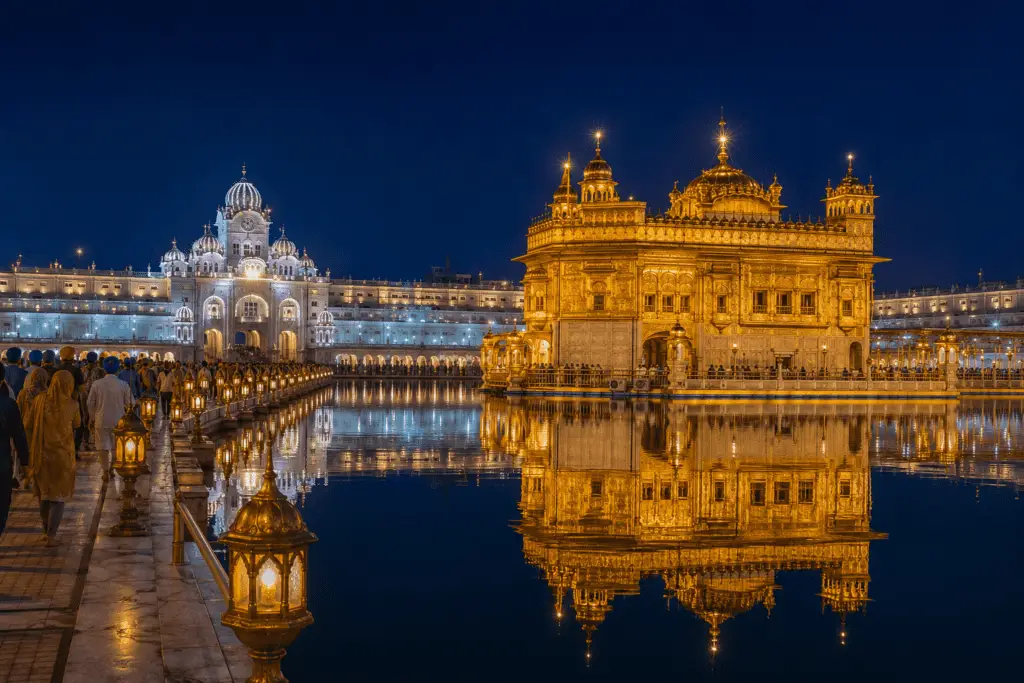
- Golden Temple (Harmandir Sahib): Free entry, always open, the most serene significant building in India. The midnight langar (free community meal) serves 100,000 people daily.
- Wagah Border Ceremony: The India-Pakistan border closing ceremony at sunset — theatrical, nationalistic, genuinely extraordinary. Free entry (get there 1.5 hours before). Bus from Amritsar: ₹30–60.
Toy Train Experience — Kalka to Shimla: The Kalka-Shimla Railway is a UNESCO World Heritage railway — a narrow-gauge toy train through 103 tunnels and over 800 bridges in the Himalayan foothills. Kalka to Shimla: ₹290–420 for foreigners (Shivalik Deluxe). Book at irctc.co.in.
Itinerary 4 — 1–2 Month Content Creator Special
The Route That Gives You Everything Worth Filming
Content creators visiting India in 2026 have an extraordinary canvas — 44 UNESCO World Heritage Sites, 8 climatic zones, 22 scheduled languages, cuisine cultures that change every 200km, and visual contrasts that no algorithm can predict.
The 45-Day Content Creator Circuit:
| Week | Location | Content Focus |
|---|---|---|
| Week 1 | Delhi → Agra → Jaipur | Mughal architecture, street food, Rajput culture |
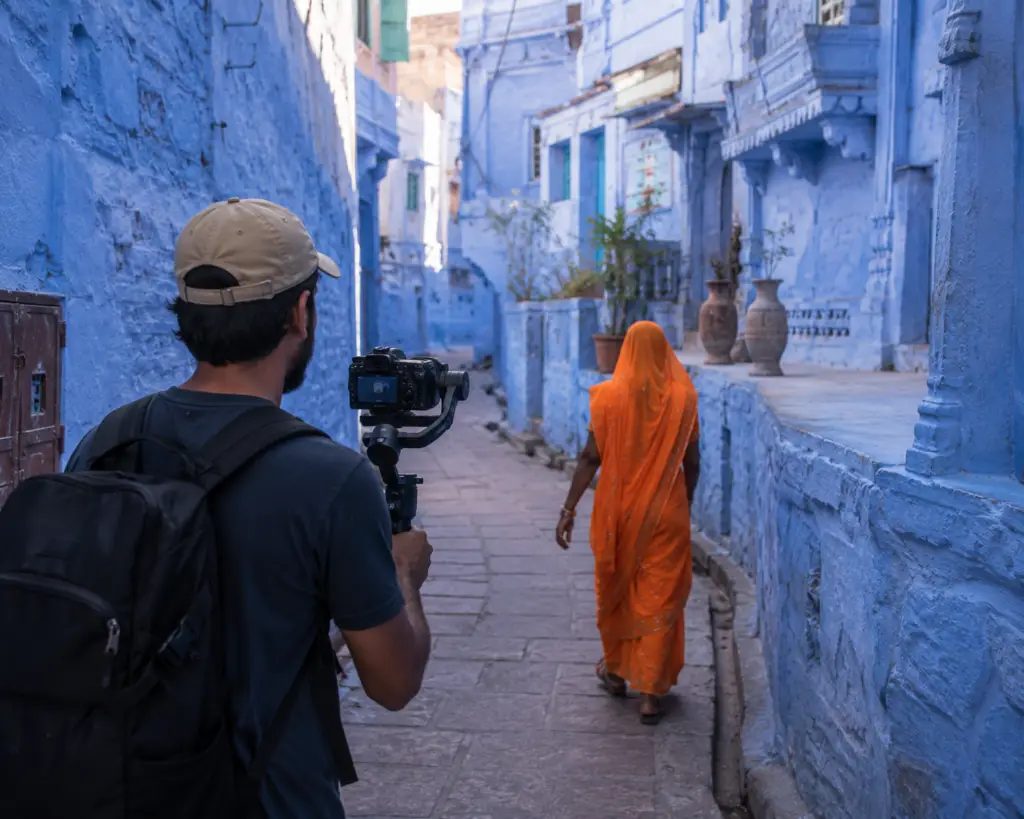
| Week 2 | Pushkar → Jodhpur → Udaipur | Blue City, Blue Lake, Lake Palace, camel fair |
| Week 3 | Varanasi → Rishikesh | Dawn ghats, yoga culture, Himalayan foothills |
| Week 4 | McLeod Ganj → Spiti → Manali | Tibetan culture, high-altitude, motorcycle roads |
| Week 5 | Amritsar → Mumbai | Golden Temple, Wagah, Bollywood city |
| Week 6 | Goa → Kerala | Beaches, Portuguese heritage, backwaters |
| Week 7 | Hampi → Mysore | Ancient ruins, palace city, spice country |
| Week 8+ | Chennai → Andamans OR Northeast India | Beaches, tribal cultures, untouched landscapes |
Content creator tips for India:
Photography rules: Most museums and historical sites allow photography without a tripod for free. Professional tripod and drone use requires written permission from ASI (Archaeological Survey of India) and is rarely granted inside protected monuments. Drone rules are strict — DGCA (Directorate General of Civil Aviation) permits needed for any commercial drone filming. Apply at digitalsky.dgca.gov.in.
Best camera settings for India: The light is extraordinary but contrast is extreme — shoot golden hour and blue hour. The hard midday light between 11am–3pm is challenging. Embrace it for market and street photography; avoid it for architecture.
Permits for filming: Commercial video production in India requires either a “Journalist Visa” (separate from tourist visa) or prior permission from the Information and Broadcasting Ministry. Tourist visa holders filming for personal content creator use (YouTube, Instagram) is generally fine without permits. If you’re producing content for paid brand campaigns in India, consult a local production company about correct compliance.
Offbeat India — For Those Who Have Been Before
Places the Guidebooks Don’t Lead You To
If you’ve done the Golden Triangle, if you’ve seen the Taj and the ghats at Varanasi, if you’ve had the backwater houseboat — here is the India that most foreign tourists never reach.
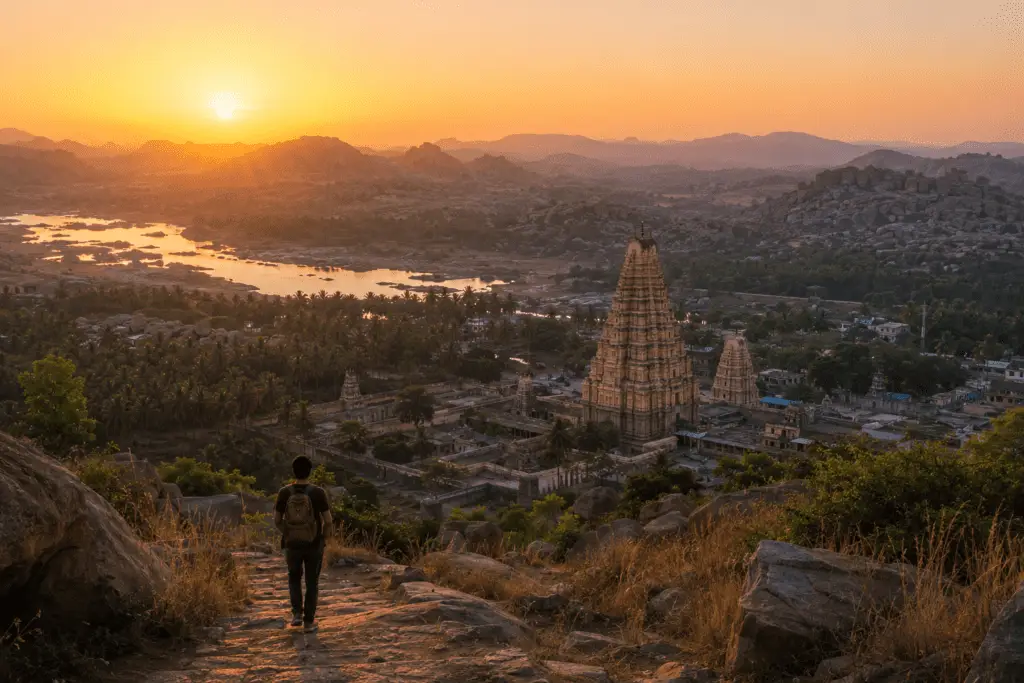
Hampi, Karnataka: The ruins of the Vijayanagara Empire — a 26 sq km complex of temples, boulders, and royal structures spread across a landscape that looks like a painting of itself. UNESCO listed. Almost no signage. Heavily undervisited by international tourists. Foreigners’ entry: ₹600. Stay in guesthouses across the river (Virupapur Gaddi) for ₹800–2,500/night. Best explored by bicycle (rent for ₹100/day).
Majuli, Assam: The world’s largest river island — 30km long, sitting in the Brahmaputra River in Assam. Home to Vaishnavite monasteries (satras), the Mising and Deori tribal communities, and some of the best mask-making traditions in India. Reached by ferry from Jorhat (₹20–30). Guesthouses from ₹600–1,500. Almost no international tourists.
Chettinad, Tamil Nadu: A region of 75 villages in Tamil Nadu containing the finest colonial-era merchant mansions in India — thousands of rooms, imported Italian marble floors, Burmese teak, Belgian glass. Most stand half-empty, maintained by families abroad. Guided tours of Chettinad: ₹500–1,500. The cuisine (Chettinad chicken, kuzhambu) is possibly the most complex regional food in India.
Mawsynram and Cherrapunjee, Meghalaya: The wettest places on earth — living root bridges (naturally grown bridges from rubber tree roots, some over 100 years old), transparent rivers, limestone caves, and Khasi village culture. Fly to Shillong, drive to Mawsynram.
Gokarna, Karnataka: South India’s low-key alternative to Goa — beaches accessible only by boat or on foot, no resort infrastructure, Om Beach and Paradise Beach reachable by 30-minute trek. Backpacker infrastructure from ₹400–1,200/night.
Orchha, Madhya Pradesh: A Bundela Rajput town on the Betwa River — a cluster of palace-temples so well-preserved and completely unfrequented by international tourists that you can spend an afternoon inside a 17th-century palace complex with virtually nobody else around. 3 hours from Jhansi by bus/taxi.
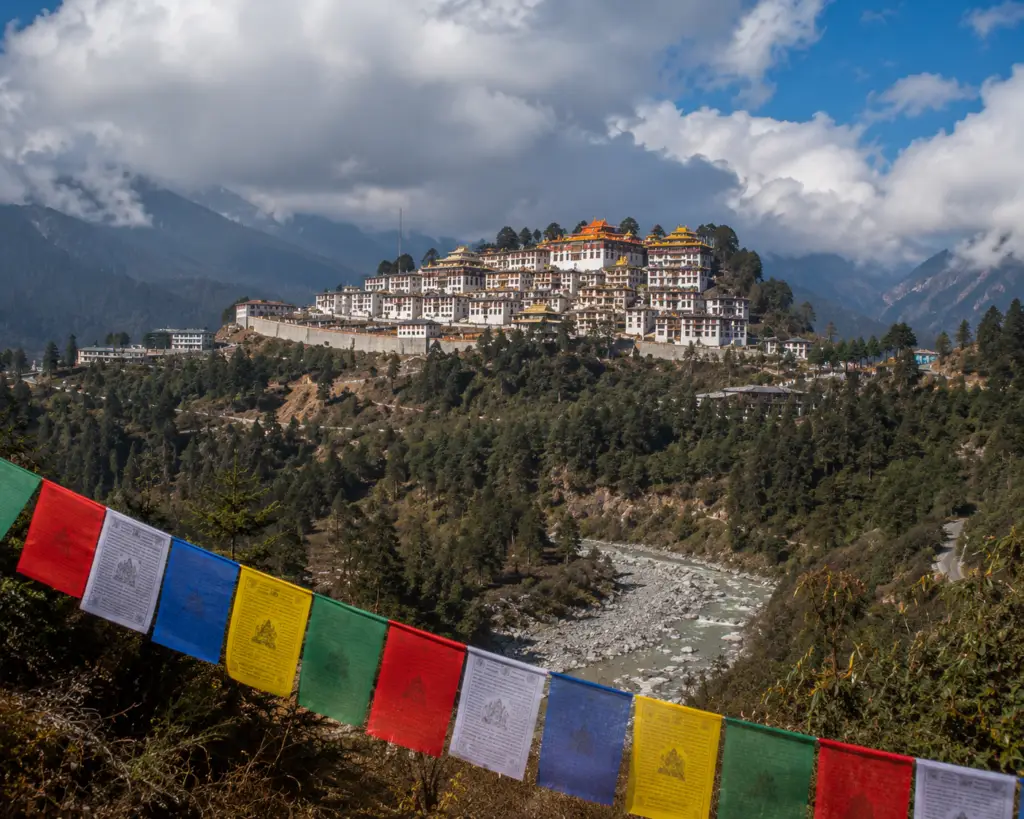
Tawang, Arunachal Pradesh: The largest Buddhist monastery in India (after Hemis in Ladakh), at 3,048m altitude, near the Tibetan border. Requires Inner Line Permit for foreigners. Fly to Tezpur or Guwahati, then a 12–14 hour drive through the Sela Pass. Worth every kilometre.
UNESCO World Heritage Sites — The Complete India List
India has 44 UNESCO World Heritage Sites as of 2026 — the most of any country in Asia. Here are the most significant for travellers:
Cultural Sites (Top 15):
| Site | Location | Foreigner Entry |
|---|---|---|
| Taj Mahal | Agra, UP | ₹1,300 |
| Humayun’s Tomb | Delhi | ₹600 |
| Red Fort Complex | Delhi | ₹600 |
| Qutub Minar | Delhi | ₹600 |
| Agra Fort | Agra | ₹650 |
| Fatehpur Sikri | Near Agra | ₹610 |
| Ajanta Caves | Aurangabad, Maharashtra | ₹660 |
| Ellora Caves | Aurangabad, Maharashtra | ₹660 |
| Sun Temple, Konark | Odisha | ₹600 |
| Mahabalipuram | Tamil Nadu | ₹600 |
| Hampi | Karnataka | ₹600 |
| Pattadakal | Karnataka | ₹600 |
| Khajuraho Temples | Madhya Pradesh | ₹600 |
| Sanchi Stupa | Madhya Pradesh | ₹600 |
| Rani ki Vav | Patan, Gujarat | ₹600 |
Natural Sites: Kaziranga National Park (Assam), Manas Wildlife Sanctuary (Assam), Sundarbans (West Bengal), Western Ghats (Multi-state), Valley of Flowers (Uttarakhand).
Tip for foreign budget travellers: The ASI Composite Ticket at major sites saves 20–30%. Check asi.nic.in for current combo ticket availability.
Food Guide — Eat Your Way Across India
The Regional Food Map
India does not have a single cuisine. It has 28 states and 8 Union Territories, each with culinary traditions as distinct as the landscapes they come from.
North India:
- Dal Makhani: Slow-cooked black lentils with butter and cream. The definitive north Indian comfort food.
- Butter Chicken: Delhi/Punjab’s gift to the world. The original, from Moti Mahal restaurant in Delhi (since 1947).
- Chole Bhature: Chickpea curry with fried puffed bread. Delhi breakfast of champions.
- Biryani (Lucknawi style): Slow-cooked Awadhi dum biryani — subtle, aromatic, nothing like the other versions.
Rajasthan:
- Dal Baati Churma: Baked wheat balls with five-lentil dal and sweet crumbled wheat. The state dish.
- Laal Maas: Fiery red mutton curry with Mathania chillies.
- Ker Sangri: Desert bean pickle — the most Rajasthani thing you can eat.
Gujarat:
- Dhokla: Fermented rice and chickpea flour steamed cake. Breakfast, snack, anytime.
- Thepla: Fenugreek flatbread — the travel food of Gujarat. People carry it on trains across India.
- Undhiyu: Winter vegetable curry cooked upside down underground. Available November-February.
Maharashtra:
- Vada Pav: Mumbai street food — spiced potato fritter in bread with chutneys. ₹15–30.
- Pav Bhaji: Vegetable mash with buttered bread rolls. Mumbai evening staple.
- Kolhapuri Chicken: Fiery chicken curry from Kolhapur — the heat is genuine.
Bengal:
- Machher Jhol: Light fish curry in turmeric broth. Every Bengali home. ₹150–300.
- Rasgulla: Spongy cheese balls in light syrup. The dessert that Odisha and Bengal argue about.
- Kati Roll: Kolkata’s gift — egg and meat wrapped in flaky paratha. ₹80–150.
South India:
- Dosa with sambar and chutneys: The architecture of a perfect breakfast. ₹60–200.
- Idli: Steamed rice cakes. Simple, perfect, underrated outside South India.
- Hyderabadi Biryani: The most famous biryani variant — Dum Pukht method, kacchi gosht style.
- Chettinad cuisine (Tamil Nadu): The most complex spice profile in Indian cooking — stone-ground masalas, kalpasi, marathi mokku.
Kerala:
- Appam with stew, fish curry, prawn moilee, Kerala beef fry — see Kerala guide for full detail.
Northeast:
- Nagaland: Smoked pork with bamboo shoot and Naga chilli (world’s hottest chilli by some rankings). Not for the faint-hearted.
- Assam: Masor Tenga (sour fish curry), Xaadul (fermented bamboo), pork with black sesame.
Street food prices (approximate, 2026):
- Chai: ₹10–30
- Samosa: ₹15–40
- Vada Pav: ₹15–30
- Pani Puri: ₹30–80 per plate
- Paratha with curd: ₹80–150
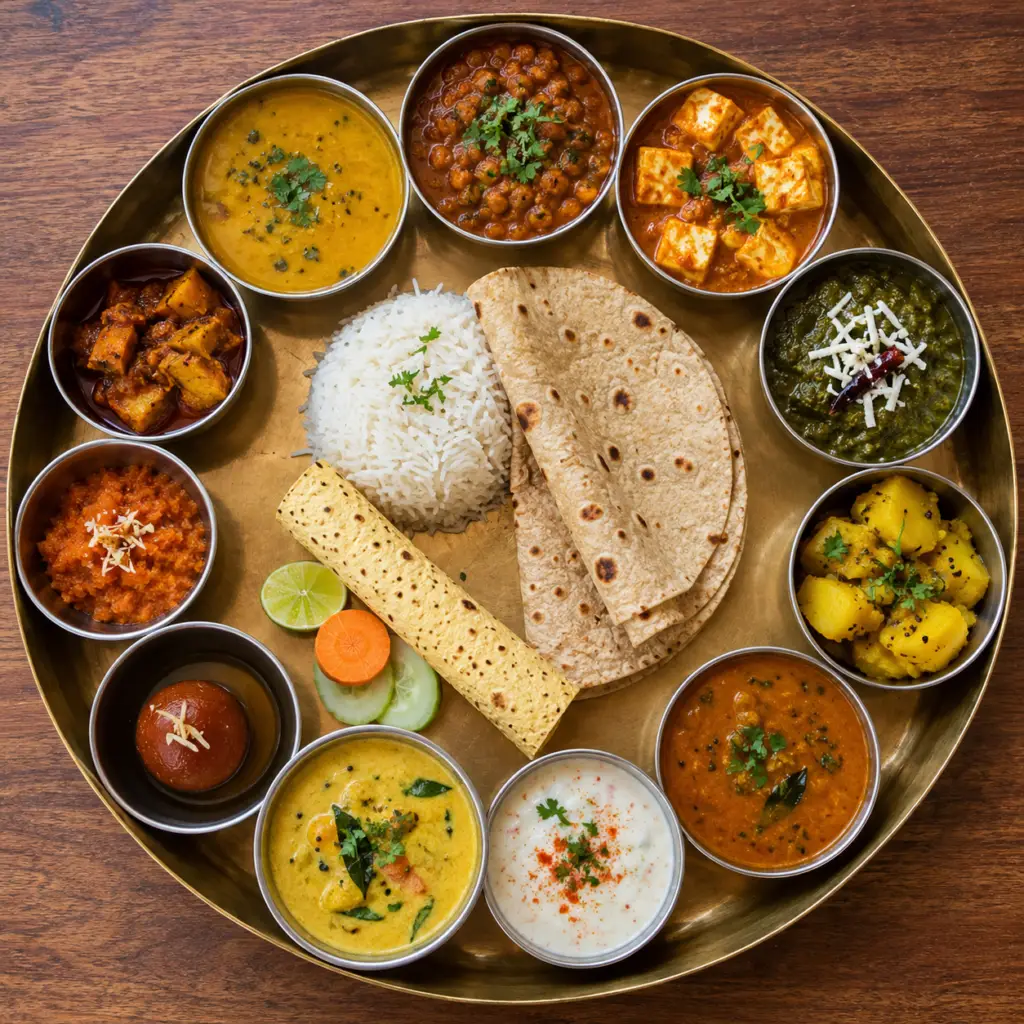
- Thali (full vegetarian): ₹80–250 at local restaurants
Transport in India — The Complete Guide
Trains — The Best Way to Understand India
India’s railway network is the world’s 4th largest — 68,000km of track, 22 million passengers daily, and train classes ranging from “unreserved standing room” (genuinely chaotic) to “First Class Air-Conditioned” (bed, privacy curtain, meals).
Train classes for foreigners:
| Class | Code | What It Is | Price Range (Delhi-Mumbai) |
|---|---|---|---|
| Unreserved (General) | GEN | Any seat, any time, standing allowed | ₹250–400 |
| Sleeper | SL | Unreserved berths, no AC, fans | ₹450–700 |
| AC 3-Tier | 3A | 6 berths per bay, AC, sheets provided | ₹1,200–2,000 |
| AC 2-Tier | 2A | 4 berths per bay, more privacy, AC | ₹2,000–3,500 |
| AC 1st Class | 1A | 2 berths, private compartment | ₹4,000–6,000 |
Recommendation for foreigners: AC 3-Tier (3A) is the sweet spot — comfortable, safe, social, clean sheets provided. Sleeper (SL) class is an authentic experience and fine for confident budget travellers. Avoid General class for long journeys.
Booking trains as a foreigner:
- IRCTC website (irctc.co.in): The official booking system. Foreign credit/debit cards now work with the IRCTC International Payment Gateway — select “International” at payment.
- 12Go.Asia: International-friendly train booking platform for India.
- Tourist Quota: Indian Railways reserves a small quota of tickets for foreign tourists at major stations. If trains show full online, visit the Foreign Tourist Booking Counter at major railway stations (Delhi, Mumbai, Chennai, Kolkata) with your passport.
Most scenic train journeys:
- Darjeeling Toy Train (UNESCO): Siliguri to Darjeeling, ₹400–1,500
- Kalka-Shimla Railway (UNESCO): ₹290–420
- Palace on Wheels (luxury): Delhi circuit, ₹80,000–1,20,000 per person for 7 nights
- Konkan Railway (Goa to Mumbai): Coast, tunnels, bridges — ₹700–2,000
Flights — Domestic
India’s domestic aviation sector is one of the world’s fastest growing. IndiGo is the largest carrier; Air India, SpiceJet, Vistara (now merged with Air India), and Akasa Air round out the major players.
Booking domestic flights:
- Skyscanner: Best for comparing all carriers
- MakeMyTrip / EaseMyTrip: India-specific booking engines, sometimes have exclusive deals
- Direct airline websites: Sometimes cheapest for 24–48 hour advance booking
Typical domestic route prices:
- Delhi to Mumbai: ₹3,000–8,000 (1h 50min)
- Delhi to Goa: ₹3,500–9,000 (2h 20min)
- Mumbai to Kochi: ₹2,500–7,000 (1h 50min)
- Delhi to Varanasi: ₹2,000–5,000 (1h 10min)
Buses
KSRTC, HRTC, RSRTC (state government buses): Reliable, cheap, and the correct way to experience India’s road network. Volvo AC buses connect major cities from ₹400–1,200 for overnight journeys.
Private sleeper buses: Available on popular tourist routes (Goa–Mumbai, Delhi–Manali, Jaipur–Udaipur). More comfortable than government buses, slightly pricier.
Redbus: The main bus booking platform for foreigners. English interface, card payment, covers all operators.
Rickshaws, Taxis, Apps
Ola: India’s Uber equivalent — app-based, metered, safe. Available in all major cities. Uber: Also available in major cities. Slightly pricier than Ola generally. Auto-rickshaws: Negotiate before getting in (or insist on meter). A 3km auto ride should cost ₹40–80 in most cities. Cycle rickshaws: For short distances in Old Delhi, Jaipur old city, Varanasi ghats. ₹20–60.
Safety, Scams & What to Watch For
The Honest Safety Situation in India 2026
India is a safe destination for the overwhelming majority of travellers. Millions visit without incident every year. The risks that do exist are mostly the predictable ones — pickpocketing in crowded areas, transportation scams, and the occasional aggressive tout. Violent crime against tourists is rare and well-reported when it occurs.
For solo female travellers: India requires more planning and confidence than many destinations, but is entirely doable and rewarding. Cities like Delhi, Jaipur, and Mumbai have improved significantly in terms of tourist infrastructure and police presence. Varanasi, Rishikesh, and McLeod Ganj are well-established solo female travel destinations with strong backpacker communities. Avoid isolated areas after dark, use app-based taxis over street taxis alone at night, and trust your instincts.
For families: Excellent destination for families with children — Indians are extraordinarily welcoming to children, and children frequently become social icebreakers with local communities. Medical infrastructure in major cities is good.
For senior travellers: India is physically demanding in many tourist areas (cobblestones, crowds, heat). Air-conditioned private cabs and mid-range to luxury hotels make India very comfortable for seniors who plan carefully.
The Most Common Scams — Specific and Accurate
1. The “Closed Today” Scam (Delhi, Jaipur, Agra) A man (often near a major monument) tells you the site you want to visit is “closed today for a ceremony / holiday / government inspection.” He then offers to take you to another attraction, government emporium, or his brother’s shop. The monument is almost never closed. Walk past him.
2. Gem/Carpet Export Scam A friendly person (often posing as a student who “wants to practice English”) befriends you and eventually leads you to a carpet or gem shop. You are told the goods can be exported and resold at home for 5–10x the price. The goods are overpriced, often poor quality, and the “export profit” is fiction. The “student” receives commission.
3. Auto/Taxi Price Inflation Taxis at Delhi airport, Agra station, and Jaipur old city often quote 3–5x the fair price. Solution: Use Ola/Uber from the airport (exit arrivals, go to the app pickup zone) or book a pre-paid taxi from the official prepaid taxi counter inside the terminal.
4. “Official” Tourism Office Scam Small shops in tourist areas pose as “Government of India Tourist Office” or “Rajasthan Tourism Office.” They are not. The official India Tourism offices have specific addresses — look them up on incredibleindia.org before you visit.
5. Railway Station Touts At major railway stations, men in semi-official looking clothes will tell you your train has been cancelled and offer to take you to a “tourist agency” to rebook. Indian Railways trains are cancelled publicly on the NTES app (irctc.co.in). Check the app. Ignore the man.
6. Fake Monks Particularly in Delhi and tourist areas — a man in saffron robes puts prayer beads or marigold garlands on your wrist and then demands money. Real monks don’t accost tourists on streets.
7. ATM Skimming Use ATMs inside banks, hotels, or shopping malls — not freestanding street ATMs. Cover the keypad when entering your PIN. Report any card issues immediately to your bank.
Theft Prevention
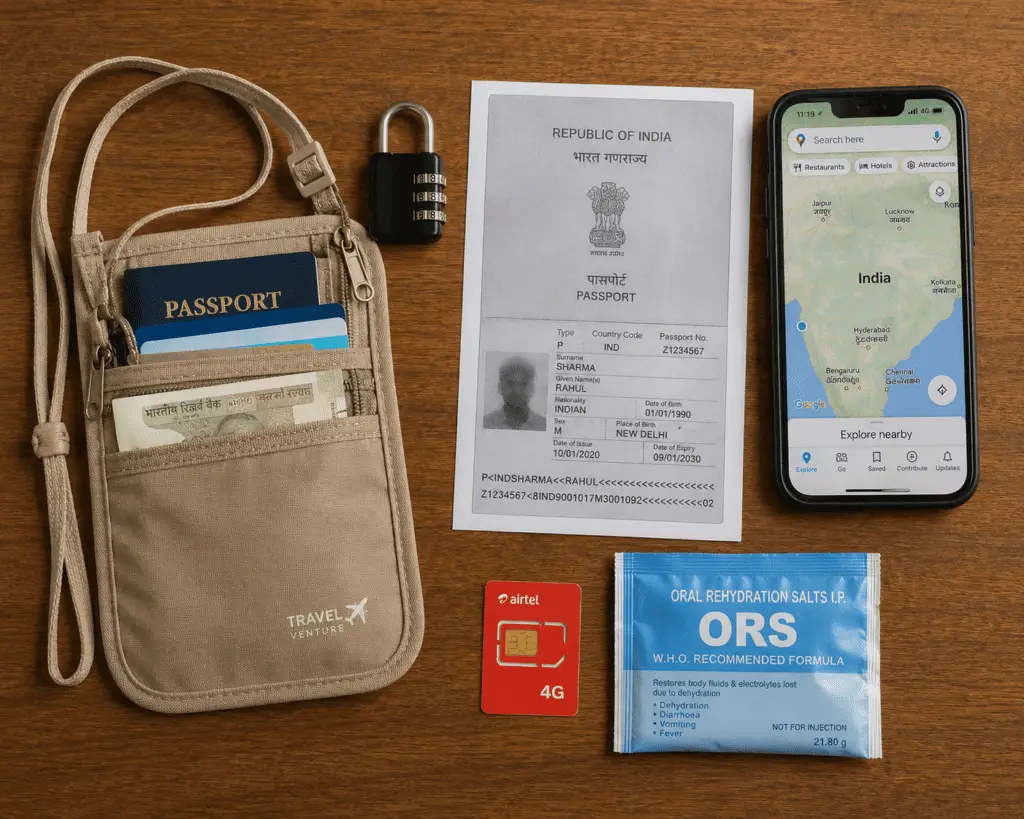
- Use a security wallet (worn under clothes) for passport, cards, and emergency cash
- Keep ₹5,000 in cash accessible in your bag and the rest locked away
- Use the hotel safe for passport (carry a photocopy + phone photo for daily use)
- In crowds (markets, festivals, train stations) — keep bags in front, not on your back
- Don’t leave phones on restaurant tables
- Luggage locks for hostel lockers (bring your own — most hostels have lockers but not locks)
Medical & Travel Insurance
Medical Reality in India 2026
India’s healthcare is a study in extremes. World-class private hospitals in Delhi, Mumbai, and Bengaluru that attract medical tourists from across Asia and the Middle East — and inadequate government facilities in rural areas. The private hospital system is the one that matters for foreign travellers.
Top private hospital networks:
- Apollo Hospitals (nationwide)
- Fortis Healthcare (nationwide)
- Max Healthcare (Delhi, North India)
- Kokilaben Dhirubhai Ambani Hospital (Mumbai)
Common traveller health issues in India:
- Traveller’s diarrhoea: Almost universal at some point. Manage with ORS + rest + Norflox tablet. See a doctor if it persists more than 48 hours or if there’s blood.
- Dehydration: India’s heat + travel exhaustion + spicy food + alcohol = dehydration. Drink 3–4 litres of water daily. ORS is your friend.
- Delhi Belly: See above. Prevention: eat at busy, high-turnover food stalls. Avoid cut fruit from street vendors. Street food that’s cooked to order in front of you is safer than pre-made items sitting out.
- Sunstroke/heat exhaustion: Cover your head, drink water constantly, rest between 11am–3pm in summer.
- Altitude sickness: If you’re going above 2,500m (Manali, Ladakh, Spiti, McLeod Ganj high areas). See our Spiti and Ladakh guides for full altitude protocol.
- Mosquito-borne illness (Dengue, Malaria): Use DEET-based repellent. Dengue is present in cities during and after monsoon. Malaria risk in rural and forested areas.
Vaccinations recommended for India (consult your doctor):
- Hepatitis A and B
- Typhoid
- Tetanus/Diphtheria
- Cholera (if visiting during or post-monsoon in risk areas)
- Japanese Encephalitis (rural / long-term travellers)
- Rabies (if trekking, working with animals)
- Malaria prophylaxis (for risk areas — ask your GP)
Yellow Fever: Nationals of Yellow Fever affected countries or travellers arriving from countries with Yellow Fever risk must carry a Yellow Fever Vaccination Card at the time of arrival in India.
Travel Insurance — Do Not Skip This
Travel insurance is not optional for India. The combination of adventure activities, remote mountain travel, tropical health risks, and potential for theft or trip cancellation makes India one of the highest-risk destinations to be uninsured in.
What your policy must include:
- Emergency medical evacuation (minimum $500,000 coverage)
- Medical treatment (minimum $100,000)
- Trip cancellation and curtailment
- Lost/stolen luggage and valuables
- Adventure activities if you’re trekking, motorcycling, or doing water sports (standard policies often exclude “adventure activities” — read the fine print)
Recommended providers for India travel:
- World Nomads: The most popular among backpackers and adventure travellers. Covers adventure activities, trekking, motorcycle riding. From ~$80–150/month.
- SafetyWing: Good for digital nomads, affordable, adequate basic coverage. ~$42/month.
- Heymondo: Well-reviewed, competitive pricing, good India coverage.
Dress Code & Cultural Etiquette
What to Wear Where
India’s dress codes are location-specific and worth understanding before you pack.
At temples and religious sites:
- Shoulders covered for both men and women
- Legs covered (below the knee minimum)
- Remove shoes before entering all temples, mosques, and gurudwaras
- Cover head at Sikh gurudwaras (head covering provided at entrance if you don’t have one)
- No leather products inside many Hindu temples (especially Jain temples — no leather at all)
- Menstruating women may be asked not to enter certain Hindu temple inner sanctums — respect this if asked
At beaches (Goa, Kerala, Andamans):
- Bikinis acceptable at tourist beaches in Goa and resort beaches elsewhere
- More conservative dress expected at beaches near temples or fishing villages
- Remove bikini tops for temple visits even if 5 minutes from the beach
In cities:
- No specific requirement but modest dress (covered shoulders, non-revealing tops) attracts less unwanted attention, especially for solo female travellers
- Smart casual for upscale restaurants and hotels
What to pack clothing-wise:
- Lightweight cotton or linen for the heat
- One warm layer for AC on trains, buses, and restaurants (Indian AC is aggressive)
- A dupatta (light scarf) — women can use it as a temple cover, shade, and dust protection
- One smart outfit for upscale restaurants or experiences
- Comfortable walking sandals + one pair of closed shoes
- Quick-dry everything — laundry dries fast in India’s heat but space to hang things varies
Traveller Type — Specific Guidance
Solo Travellers
The good news: India has a well-developed solo traveller infrastructure — hostels, traveller cafés, established routes, and a backpacker community that makes meeting people easy.
Best solo cities: Rishikesh (yoga, river, community), McLeod Ganj (Tibetan culture, long-stay community), Goa (beach, social, relaxed), Varanasi (intense but rewarding), Hampi (bicycle + ruins + community).
The hostel network: Zostel (40+ properties across India), Moustache (20+ properties), The Hosteller, Backpacker Panda — all reliable, social, affordable. Dorms from ₹400–800. Book at Hostelworld or directly.
Solo female travellers: Research your specific destinations, use app-based taxis after dark, stay in well-reviewed hostels with female dorms, carry a basic personal alarm (legal in India), and share your daily itinerary with someone back home. India is manageable and rewarding for solo female travellers who are informed.
Couples
Best for couples: Udaipur (the most romantic city in India — Lake Pichola, City Palace, rooftop restaurants), Kerala (houseboats, beaches, Ayurveda), Goa (beach shacks to luxury resorts), Rishikesh (yoga retreats, Ganges views).
Budget couples tip: Sharing a private room in a guesthouse is almost always cheaper per person than two hostel dorms. The couple’s room rate in India is often only 20–40% more than a single room.
Families With Children and Seniors
Best for families: Rajasthan (child-friendly — forts, elephants at Amer Fort area, puppet shows, colourful markets), Kerala (backwaters by houseboat, calm beaches, elephant sanctuaries), Shimla (mountain town, toy train, gentle walking).
With senior travellers: Private cab for the entire trip is the most comfortable option. AC Innova with a driver costs ₹4,500–7,000/day — split between 4–5 people it’s very reasonable and removes all transport stress.
Senior health advisory: Carry a list of current medications and medical conditions in English and have it translated to Hindi (Google Translate works for medical terms). Major cities have world-class private hospitals. Keep a card with your blood type, allergies, and emergency contact.
Groups (6–15 people)
Best value for groups: Private Tempo Traveller (12-seater) for the circuit — ₹8,000–12,000/day split between 10 people = ₹800–1,200/person/day. Negotiate accommodation rates directly at hotels for groups of 6+ (group discount standard 10–20%).
Group tours that work: Rajasthan circuit, Golden Triangle, Kerala-Goa combination. Avoid rushing — group travel is slower than solo and the itinerary needs buffer time.
Packing List for India
The Non-Negotiables
Documents:
- Passport (original)
- Printed e-Visa + e-Arrival Card
- Travel insurance policy document + emergency number
- Copy of all documents (email to yourself + Google Drive)
- Yellow Fever card if applicable
Health:
- Travel insurance with emergency contacts card in wallet
- ORS sachets (10+ packs)
- Paracetamol, Imodium, antacid
- Insect repellent (DEET 30%+)
- Sunscreen SPF 50+
- Any personal medications + prescription copy
- Small first aid kit
Technology:
- Universal travel adapter (India uses Type D primarily — three round pins)
- Power bank (20,000mAh)
- Offline Google Maps downloaded before you arrive
- Ola and Uber apps downloaded
- IRCTC or 12Go.Asia account set up
Practical:
- Padlock (for hostel lockers)
- Security wallet/neck pouch
- Reusable water bottle + purification tablets
- Lightweight rain jacket (monsoon is not a polite drizzle)
- Toilet paper (many budget bathrooms don’t provide it; bum guns often available)
- Small torch/headlamp (for power cuts in budget guesthouses)
- Microfibre towel
Things Most First-Timers Wish They’d Packed
- A scarf/dupatta (multi-use: shade, temple cover, pillow on trains)
- Earplugs (trains, markets, temples — India is loud)
- A combination lock
- Baby wipes (remarkable utility)
- Ginger chews (for nausea on winding mountain roads)
Leave at Home
- Expensive jewellery
- A suitcase (use a duffel or backpack — Indian street navigation favours soft bags)
- Too many clothes (laundry in India is cheap, fast, and available everywhere — ₹100–250/kg)
What Not to Do in India — The Honest List
Don’t photograph people without permission. India is highly photogenic but its people are not props. Ask first, especially with religious figures, women, and children. Learn “photo theek hai?” (is a photo okay?).
Don’t publicly display affection in conservative areas. Holding hands is fine in cities. Kissing in public at temples or rural areas will attract negative attention.
Don’t accept food, drink, or accommodation from extremely insistent strangers. Drug-facilitated robbery — rare but real — typically begins with an over-friendly approach on a train or bus.
Don’t underestimate the sun. The UV index in India, particularly in Rajasthan and South India, is extreme. First-time visitors frequently get sunburned or dehydrated before they realise.
Don’t drink tap water. Ever. Use sealed bottled water or carry a purification bottle. This is non-negotiable.
Don’t eat from places that look empty at mealtimes. High turnover = fresh food = safer. The busiest stall is almost always the safest.
Don’t book anything through a random person at a train station or bus stand. All reputable hotels, hostels, and tour operators have online presence. Book in advance or walk directly to the guesthouse.
Don’t use Bhang (cannabis-infused edibles) casually. Bhang lassi and bhang thandai are sold legally at licensed shops in some states. They are significantly more potent than they appear. Tourist hospitals in Varanasi and Jodhpur see multiple cases of bhang over-consumption annually. If you try it, start with a very small amount.
Budget Summary — What India Costs in 2026
30-Day Trip Budget (Per Person, Excluding International Flights)
| Category | Shoestring | Budget | Mid-Range | Luxury |
|---|---|---|---|---|
| Accommodation | ₹400–800/night | ₹800–2,000/night | ₹3,000–8,000/night | ₹12,000–60,000/night |
| Food | ₹300–500/day | ₹500–1,000/day | ₹1,200–2,500/day | ₹3,000–10,000+/day |
| Transport | ₹200–500/day | ₹500–1,500/day | ₹1,500–4,000/day | ₹4,000–15,000+/day |
| Activities | ₹100–300/day | ₹300–800/day | ₹800–2,500/day | ₹3,000–10,000+/day |
| SIM + Misc | ₹200–400/day | ₹400–800/day | ₹800–2,000/day | ₹2,000–5,000+/day |
| Daily Total | ₹1,200–2,500 | ₹2,500–6,000 | ₹7,300–19,000 | ₹24,000–1,00,000+ |
| 30-Day Total | ₹36,000–75,000 ($430–890) | ₹75,000–1,80,000 ($890–2,140) | ₹2,19,000–5,70,000 ($2,600–6,785) | ₹7,20,000–30,00,000+ ($8,570+) |
FAQ Section
Q: Do I need a visa to visit India as a foreigner?
A: Almost all nationalities require a visa. Most visitors can get an e-Tourist Visa online at indianvisaonline.gov.in — $25 for 30 days, $40 for 1 year, $80 for 5 years (for most nationalities). Apply minimum 4 days before arrival; approval typically takes 24–72 hours. Nepal and Bhutan nationals are visa-exempt. Pakistani nationals and a few others must apply through an Indian Embassy.
Q: Is India safe for solo female travellers?
A: India requires more research and planning than many destinations but is visited safely by hundreds of thousands of solo female travellers annually. Use app-based taxis at night, stay in well-reviewed hostels in established traveller areas, dress modestly outside beach resorts, and share your itinerary with someone you trust. Cities like Rishikesh, McLeod Ganj, Goa, and Kerala’s backwater areas are particularly solo-female-friendly.
Q: How much does it cost to travel India for 30 days?
A: Budget backpackers can manage on $430–890 (₹36,000–75,000) for 30 days excluding international flights. Mid-range travellers spend $2,600–6,785 (₹2,19,000–5,70,000). Luxury travel starts at $8,570+ per person per month. These figures cover accommodation, food, internal transport, and activities.
Q: What is the best time to visit India?
A: October to March is the best season for most of India — pleasant temperatures, dry weather, and active cultural festivals. Monsoon (June–September) is beautiful in Kerala, Goa, and Rajasthan’s hill stations but affects travel logistics. Summer (April–June) is extremely hot in most of India but good for Ladakh and Spiti Valley (mountain areas).
Q: What are the most common tourist scams in India?
A: The most common are: the “monument is closed today” redirection scam; fake government tourism offices; inflated taxi/auto prices (especially at airports); gem/carpet export investment scams; and aggressive touts near major attractions. Prevention: use Ola/Uber apps, book transport from prepaid counters, verify all information from official sources, and ignore anyone who approaches you offering help unprompted near major sights.
Q: What vaccines do I need before visiting India?
A: Consult your doctor or travel health clinic. Recommended vaccinations typically include Hepatitis A, Typhoid, and Tetanus (updated within 10 years). Hepatitis B, Rabies, Japanese Encephalitis, and Cholera may be recommended depending on your itinerary. Malaria prophylaxis for rural and forested areas. Yellow Fever certificate required if arriving from or through a Yellow Fever affected country.
Q: Can I use UPI or digital payments in India as a foreigner?
A: As of 2026, UPI is being expanded to foreign visitors from select countries through partnered apps. However, cash (Indian Rupees) is still essential — most street food vendors, local buses, smaller temples, village markets, and rural areas are cash-only. Carry ₹5,000–10,000 in mixed denominations at all times. Withdraw from ATMs inside bank branches rather than standalone street ATMs.
Q: What should I not miss in India for a first-time visitor?
A: The non-negotiables: Taj Mahal at sunrise (Agra), Varanasi ghats at dawn, Jaipur’s Amber Fort, the evening Ganga Aarti (Haridwar or Varanasi), Hampi ruins, Kerala backwaters (one houseboat night), Golden Temple in Amritsar, and at least one overnight train journey in AC 3-Tier class — the train is where you understand India’s scale.
Conclusion — India Won’t Be Like You Expected. It Will Be Better.
No guidebook, no matter how comprehensive, can fully prepare you for India. The country exceeds its own description in every direction — more chaotic than warned, more beautiful than photographed, more generous than expected, more complex than a month of reading can capture.
What I can tell you, from the data and the real experience both, is this: every traveller who goes to India prepared — with their visa sorted, their insurance active, their scam awareness calibrated, their first few hotel nights booked — spends far less time managing problems and far more time actually being in India.
And being in India is the whole point.
The moment when you’re standing on the ghats in Varanasi at 5am and the river is gold and the bells are ringing from the temples and the smoke from the cremation pyres is mixing with the morning mist and somehow all of it together — the most sacred and the most mortal, the most ancient and the most alive — makes complete sense.
That moment doesn’t happen if you’re arguing with a taxi driver about the price because you didn’t use Ola. It doesn’t happen if you’re lying in a guesthouse with avoidable traveller’s diarrhoea because you drank the tap water. It doesn’t happen if your visa application is rejected at the counter because you didn’t check the passport validity rule.
It happens when you come prepared.
So: come prepared. The rest, India will handle.
Namaste. See you on the other side.
[…] other great monsoon/adventure destinations in Indiainternational visitors discovering Maharashtra […]