

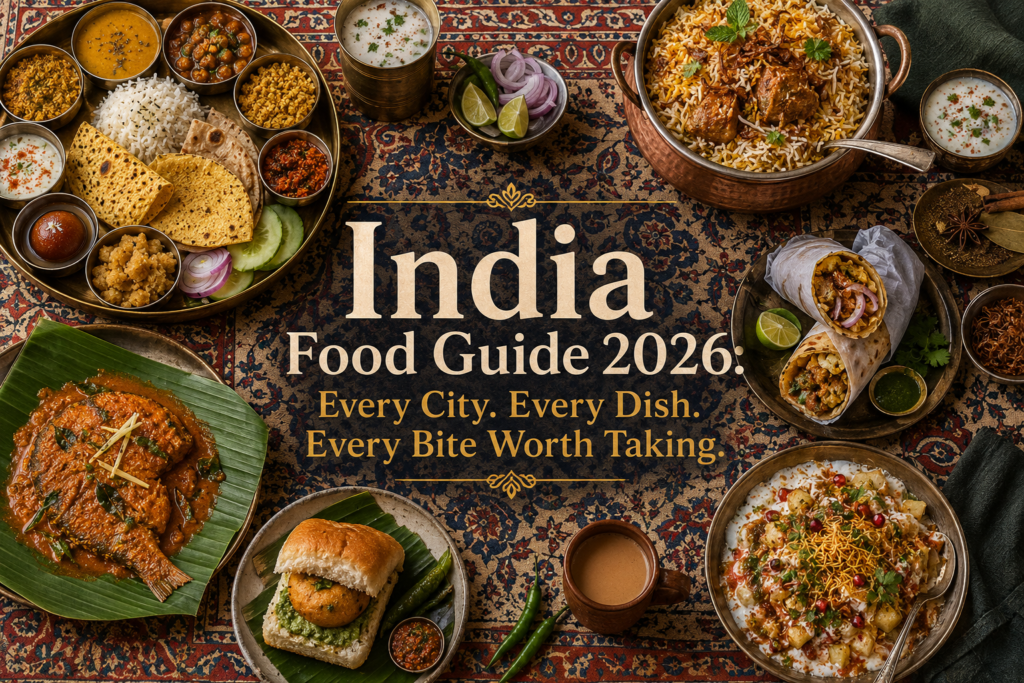
A NOTE BEFORE YOU READ: India does not have a cuisine. It has thirty-five distinct regional food cultures, each with its own spice logic, its own cooking fat, its own relationship with rice versus wheat, its own dessert vocabulary, and its own street food canon that has been perfected over centuries. This guide covers all of them — city by city, dish by dish, restaurant by restaurant, price by price. Come hungry.
There is a moment that happens to every serious food traveller in India.
For me it was in Lucknow, at 7am, sitting on a wooden bench at a hole-in-the-wall place called Rahim’s on Chowk, eating a bowl of mutton nihari — a slow-cooked overnight stew of mutton shank and bone marrow in a broth so layered with ginger, cardamom, and slow-rendered fat that it tasted like someone had been thinking about this dish for days before I arrived — because they had.
The cook had been at it since midnight. The mutton had been braising for seven hours. The spice blend was a recipe that had lived in one family for four generations. And I was eating it on a plastic plate with a torn piece of sheermal bread for about ninety rupees, sitting next to a truck driver who was on his third bowl.
That is India’s food culture. Not the restaurants with the good lighting and the carefully curated menus. Not the palace hotels with the tasting courses. Those exist and some of them are extraordinary. But the heartbeat — the actual, irreplaceable thing — is almost always sitting in a lane somewhere, cooked at 3am for a 7am crowd, perfected over decades, and priced at less than a cup of coffee costs in most Western cities.
This guide covers all of it. The Rahim’s of every city. And the palace restaurants, and the celebrated cafes, and the fine dining tables that are genuinely worth the splurge. All of it. Verified for 2026. With prices, tastes, ingredients, and specific addresses where you need them.
Let’s eat.
Quick Reference: India Food City Map
| City | Food Identity | Signature Dish | Best Food Area |
|---|---|---|---|
| Delhi | Mughlai + Punjabi street food capital | Nihari, Chole Bhature, Daulat ki Chaat | Old Delhi / Chandni Chowk |
| Mumbai | Fast, coastal, democratic | Vada Pav, Pav Bhaji, Keema Pav | Juhu, Mohammed Ali Road, Dadar |
| Kolkata | Colonial + Bengali + street snack culture | Kathi Roll, Puchka, Machher Jhol | Park Street, New Market area |
| Chennai | Deep Tamil tradition | Idli-Sambar, Chettinad dishes, Filter Coffee | Mylapore, Triplicane |
| Hyderabad | Nizami Mughlai + Andhra fire | Biryani, Haleem, Mirchi ka Salan | Charminar area, Old City |
| Lucknow | Awadhi — the most refined Indian cuisine | Tunday ke Kebab, Nihari, Sheermal | Chowk, Aminabad |
| Amritsar | Punjabi — hearty, dairy-rich, celebratory | Amritsari Kulcha, Lassi, Dal Makhani | Golden Temple area |
| Varanasi | Vegetarian + Banarasi specificity | Kachori Sabzi, Tamatar Chaat, Malaiyo | Dashashwamedh Ghat area |
| Jaipur | Rajput royal food heritage | Dal Baati Churma, Pyaaz Kachori, Laal Maas | Johari Bazaar, Station Road |
| Indore | India’s #1 street food city (verified 2026) | Poha-Jalebi, Dahi Bada, Bhutte ka Kees | Sarafa Bazaar, Chappan Dukan |
| Goa | Portuguese-Indian coastal fusion | Fish Curry Rice, Prawn Balchão, Bebinca | Panjim, Margao, beach shacks |
| Kerala / Kochi | Coconut-spice coastal tradition | Fish Curry, Appam, Kerala Sadya | Fort Kochi, Mattancherry |
| Bengaluru | Modern cafe culture + South Indian tradition | Masala Dosa, Bisi Bele Bath, Craft Beer | Indiranagar, Koramangala |
| Pune | Maharashtrian + cafe culture | Misal Pav, Puran Poli, Sabudana Vada | FC Road, Camp area |
Delhi — The Street Food Capital of India
Why Delhi’s Food Scene Is Unmatched
Delhi is often considered the street food capital of India. From the famous lanes of Chandni Chowk to modern food hubs, the variety is unmatched. Popular choices include golgappa, chole bhature, parathas and kebabs that reflect the city’s rich Mughlai and North Indian heritage.
Chandni Chowk in Old Delhi is the single most historically significant street food location in India. Food stalls here have been operating for centuries. The variety spans vegetarian (chole bhature, chaat, paranthas) and non-veg (kebabs, nihari, biryani) with equal excellence.
Delhi Street Food — Dish by Dish
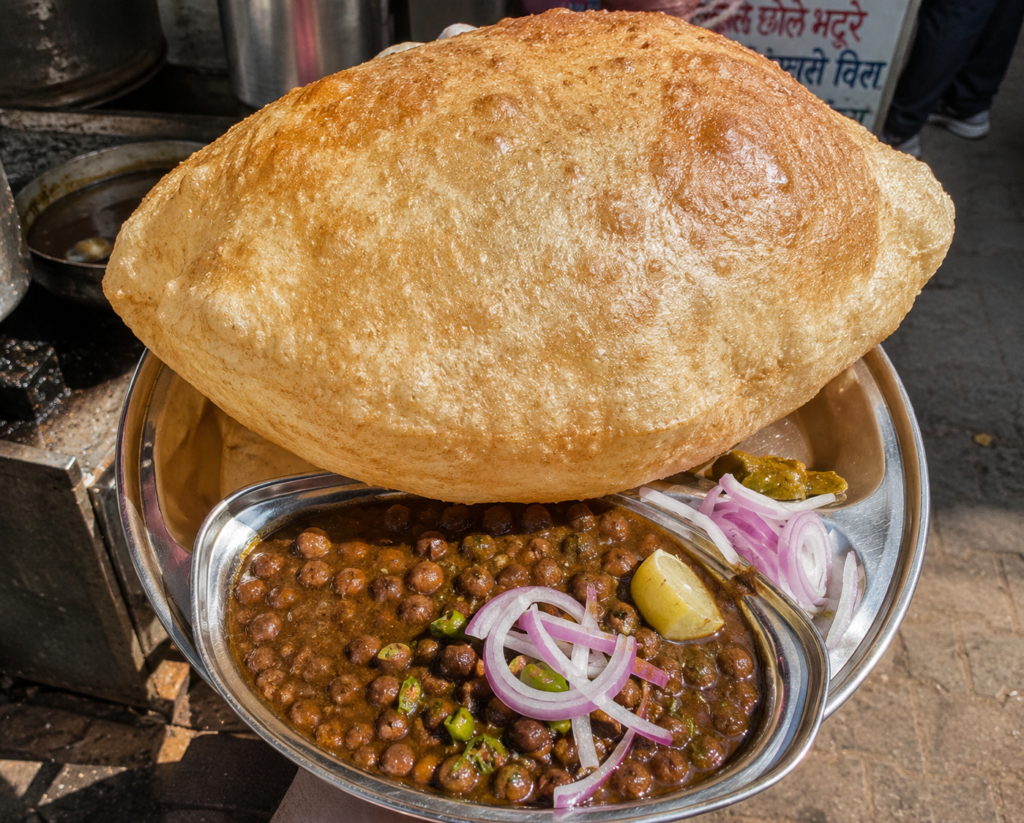
Chole Bhature What it is: Deep-fried puffed bread (bhatura) served with spiced chickpea curry (chole). The bhatura is made from maida (refined flour) with a touch of yoghurt, fried until golden and ballooned. The chole is slow-cooked with onion, tomato, ginger, garlic, and a specific North Indian spice blend including anardana (pomegranate seed powder) for tartness. How it tastes: The bhatura is crisp on the outside, pillowy inside, slightly tangy. The chole is deeply savoury, with a building warmth and a tartness that cuts through the fried richness. Together they are one of the great breakfast experiences in India. When to try: Breakfast only (7am–noon). This is not a dinner dish. Where to find it: Sita Ram Diwan Chand, Paharganj (since 1957) — the most celebrated. Chache di Hatti, Kamla Nagar — equally legendary with a longer queue. Price: ₹80–150 for a full plate Best time: Tuesday–Sunday, arrive before 9am
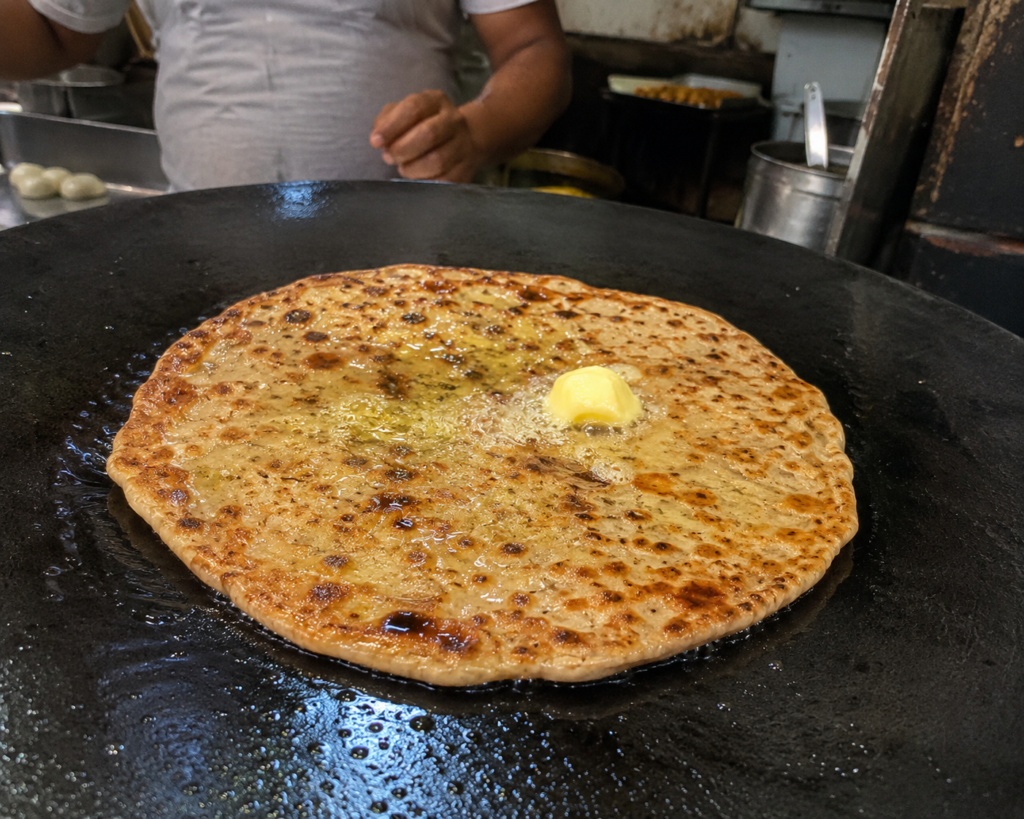
Paranthe Wali Gali (Chandni Chowk) What it is: The lane of stuffed parathas — a narrow alley off Chandni Chowk where three or four shops have been serving nothing but stuffed flatbreads since the 1870s. Fillings: potato (aloo), cauliflower (gobi), paneer, mixed vegetables, dried fruits and nuts, mooli (radish), banana, and combinations thereof. How it tastes: Each paratha is made from whole wheat dough, stuffed generously with the filling of choice, flattened and cooked on a tawa with generous amounts of ghee (clarified butter) until golden on both sides. Served with mint chutney, tamarind chutney, and either curd (yoghurt) or butter. The ghee-soaked paratha with a sharp mint chutney is one of the more deeply satisfying things you can eat in India for ₹150. Where: Paranthe Wali Gali, Chandni Chowk, Old Delhi. Look for Pt. Gaya Prasad Shiv Charan or Kanhaiya Lal — the original shops. Price: ₹80–200 per paratha depending on filling Best time: Morning (8am–noon) is best; open until early evening
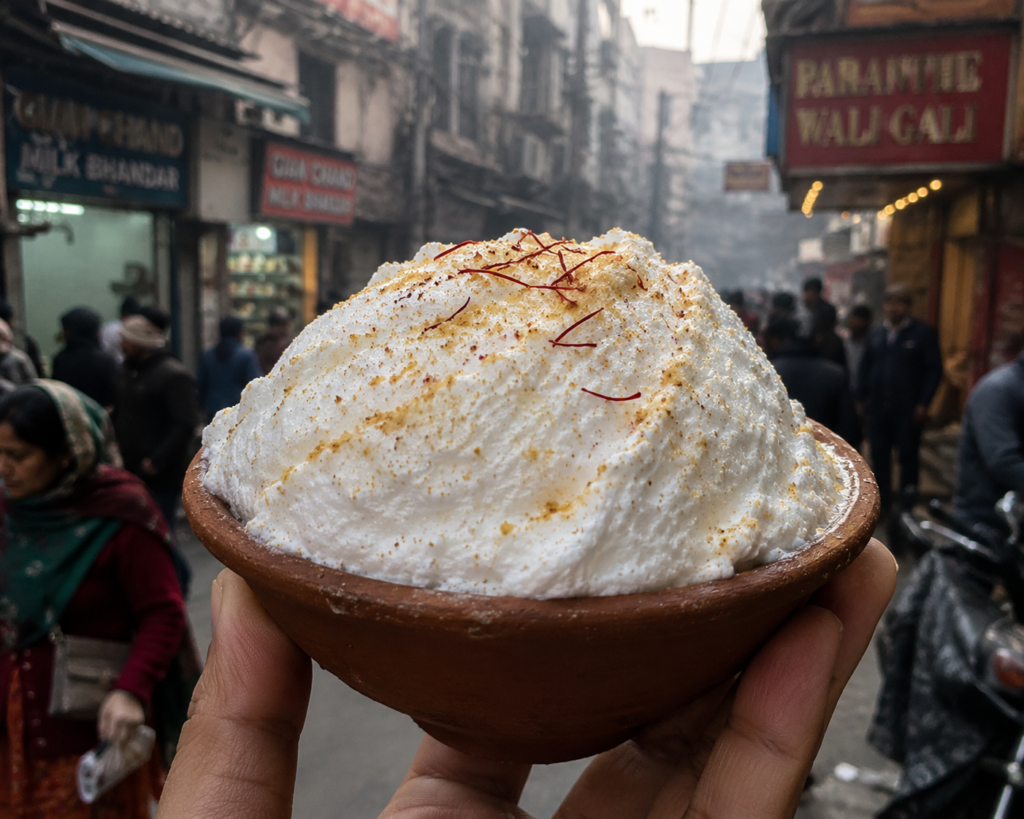
Daulat ki Chaat (Winter Only) What it is: One of the most extraordinary and least-known Delhi street foods — a foam-light dessert made from whipped milk cream, saffron, and rosewater that has been aerated overnight in the cold winter air. It appears in Old Delhi only from November to February and vanishes with the warming weather. How it tastes: Cloud-light, barely sweet, faintly floral with rosewater and saffron. The texture is extraordinary — like eating cold flavoured air. Nothing else in Indian dessert culture is remotely similar. Ingredients: Full-fat milk, cream, rosewater, saffron, sugar, mawa (reduced milk solids) Where: Street vendors in Chandni Chowk and Fatehpuri Masjid area. Ask anyone for “daulat ki chaat wala” — locals know immediately. Price: ₹40–80 for a serving CRITICAL: Winter only — November to February. Don’t go in March expecting this.
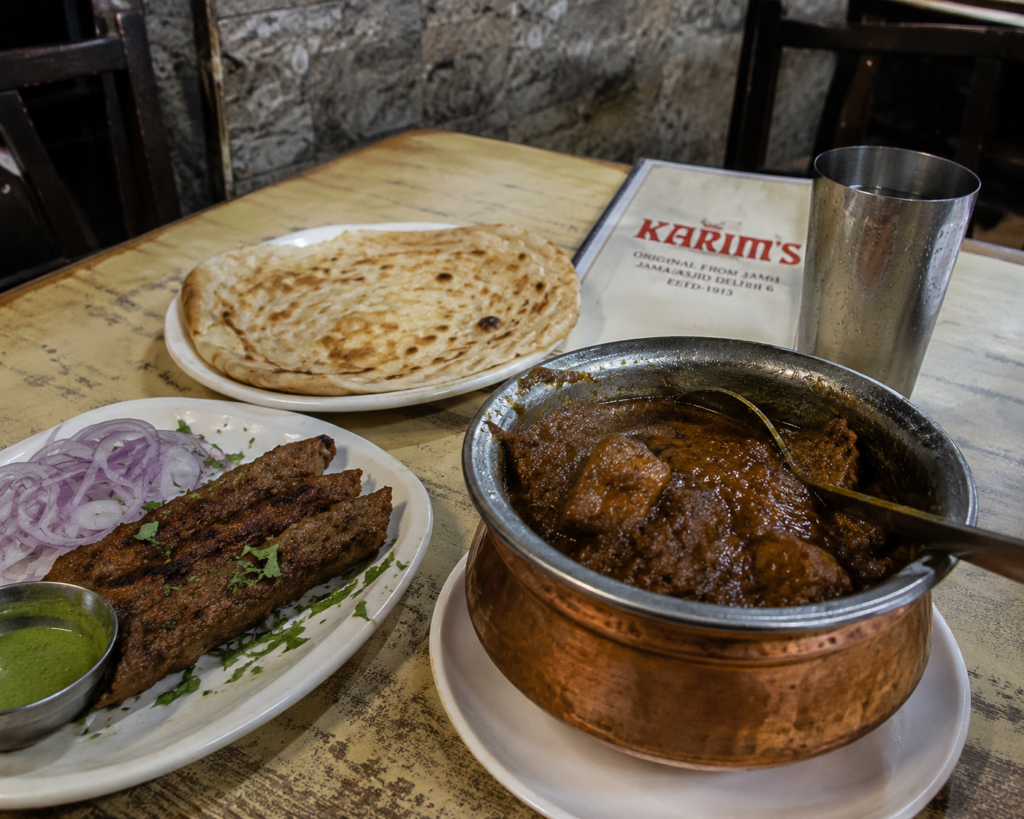
Karim’s — The Mughlai Institution (Since 1913) Address: 16, Gali Kababian, near Jama Masjid, Old Delhi What it is: The most celebrated Mughlai restaurant in India, opened in 1913 by the descendants of royal cooks from the Mughal court. A meal at Karim’s is the closest you can get in 2026 to eating the food of emperors — mutton korma, seekh kebabs, biryani, and nihari that have been made from the same recipes for over a century. What to order:
- Mutton Korma — slow-cooked in a yoghurt-based gravy with whole spices. Deeply aromatic, the meat falling off the bone. ₹380–450
- Seekh Kebab — minced mutton with ginger, garlic, and a house spice blend, cooked on iron skewers over charcoal. ₹300–380 for a plate
- Nihari — the overnight-braised mutton stew. Best at Karim’s on winter mornings. ₹350–450
- Mutton Biryani — fragrant long-grain rice cooked with saffron, fried onions, and braised mutton. ₹400–550 Price for 2: ₹1,200–2,000 Zomato rating: 4.2/5 | TripAdvisor: Certificate of Excellence 2025 Timings: 9am–12:30am daily Note: Non-air-conditioned, crowded, wonderful. Queue expected on weekends.
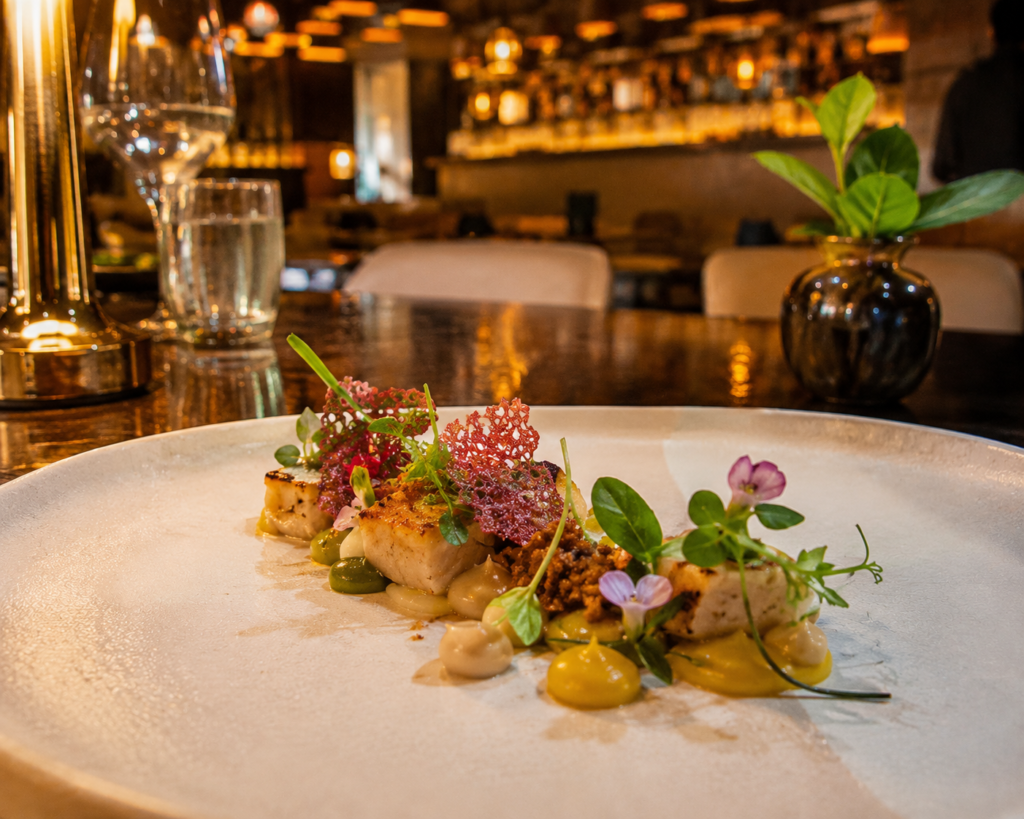
Indian Accent — The Benchmark of Modern Indian Fine Dining Address: The Lodhi Hotel, Lodhi Road, New Delhi Chef: Manish Mehrotra (India’s most internationally recognised chef) What it is: Indian Accent is a culinary gem that redefines traditional Indian cuisine with contemporary flair. Under the expert guidance of renowned chef Manish Mehrotra, this stylish restaurant boasts an inviting atmosphere. Since its inception in 2009 at The Manor and later relocating to The Lodhi hotel in 2017, it has consistently impressed diners with innovative dishes that blend local ingredients and international flavors. What to order:
- Meetha Achar Pork Ribs — pork ribs glazed with Indian sweet pickle (achaar) — the signature dish that put Indian Accent on the global food map. ₹1,400–1,800
- Doda Barfi Treacle Tart — a dessert that reimagines the British treacle tart with Indian milk sweet. ₹900–1,100
- Tasting Menu (7 courses): ₹5,500–7,500 per person (seasonal variation) Price for 2: ₹8,000–15,000 Listings: Consistently on Asia’s 50 Best Restaurants radar; World’s 50 Best Discovery listing 2026; TripAdvisor #1 Fine Dining Delhi Reservations: Essential — book 2–3 weeks ahead. reservations via their website or Dineout.
Delhi’s Best Cafes
Cafe Lota (National Crafts Museum, Pragati Maidan) Vibe: Inside the National Crafts Museum — a beautiful courtyard café serving traditional Indian regional snacks alongside excellent filter coffee. What to order: Aam Panna (raw mango cooler), Moringa dhokla, Rajma Galauti, Uttarakhand-style local snack plates Price: ₹200–600 per dish Best for: Relaxed lunch, design-forward crowd, heritage setting
Blue Tokai Coffee Roasters (multiple Delhi locations) Vibe: India’s best specialty coffee chain — single-origin Indian coffees, excellent pour-overs, good food menu. What to order: Any single-origin pour-over from their current offering, banana bread ₹220, avocado toast ₹380 Price: Coffee ₹200–350, food ₹250–450
Andhra Pradesh Bhawan Canteen, Ashoka Road What it is: Not a café but an insider’s move — the cafeteria at the Andhra Pradesh state government guest house serves an extraordinary vegetarian Andhra thali for ₹200–250. Open to all. Authentic, cheap, one of Delhi’s best-kept food secrets.
Delhi Budget Summary
| Category | Price Range |
|---|---|
| Street food (full breakfast) | ₹80–200 |
| Dhaba meal (lunch/dinner) | ₹150–350 |
| Mid-range restaurant | ₹500–1,500 for 2 |
| Fine dining | ₹3,000–15,000+ for 2 |
| Chai (street) | ₹10–25 |
| Lassi (full glass) | ₹40–100 |
Mumbai — The City That Never Stops Eating
The Mumbai Food Identity
Mumbai’s food culture is democratic in a way that no other Indian city quite matches — the same vada pav that a ₹15,000/day banker eats at the station on the way to work is also the vada pav that feeds the city’s working class. There is no snobbery in Mumbai’s food culture because the best things are on the street and everyone knows it.
Mumbai Street Food — The Essential Guide
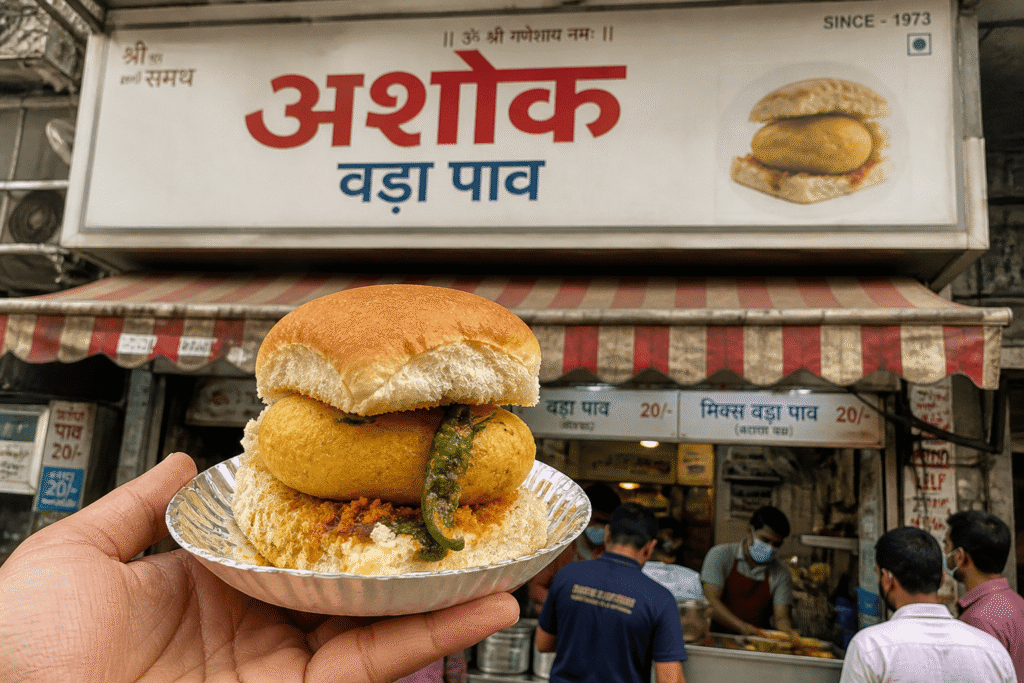
Vada Pav — Full Profile What it is: A deep-fried spiced potato dumpling (vada) in a soft white bread roll (pav), layered with dry garlic chutney, green chutney, and sometimes a fresh green chilli. How it tastes: The vada is crisp-coated in chickpea flour batter, the inside mashed potato flavoured with mustard seeds, curry leaves, turmeric, and green chilli. The dry garlic chutney is the critical element — sharp, garlicky, slightly smoky. Together in the soft pav, it is a remarkably complete flavour package. Main ingredients: Potato, chickpea flour, mustard seeds, curry leaves, turmeric, green chilli, garlic, coriander, white bread roll Where: Every station in Mumbai. Best: Ashok Vada Pav, Dadar Station West (the original, since 1966). Anand Stall, Vile Parle. Price: ₹15–30 Best time: 7:30–10am (morning rush) or 5–8pm (evening rush)
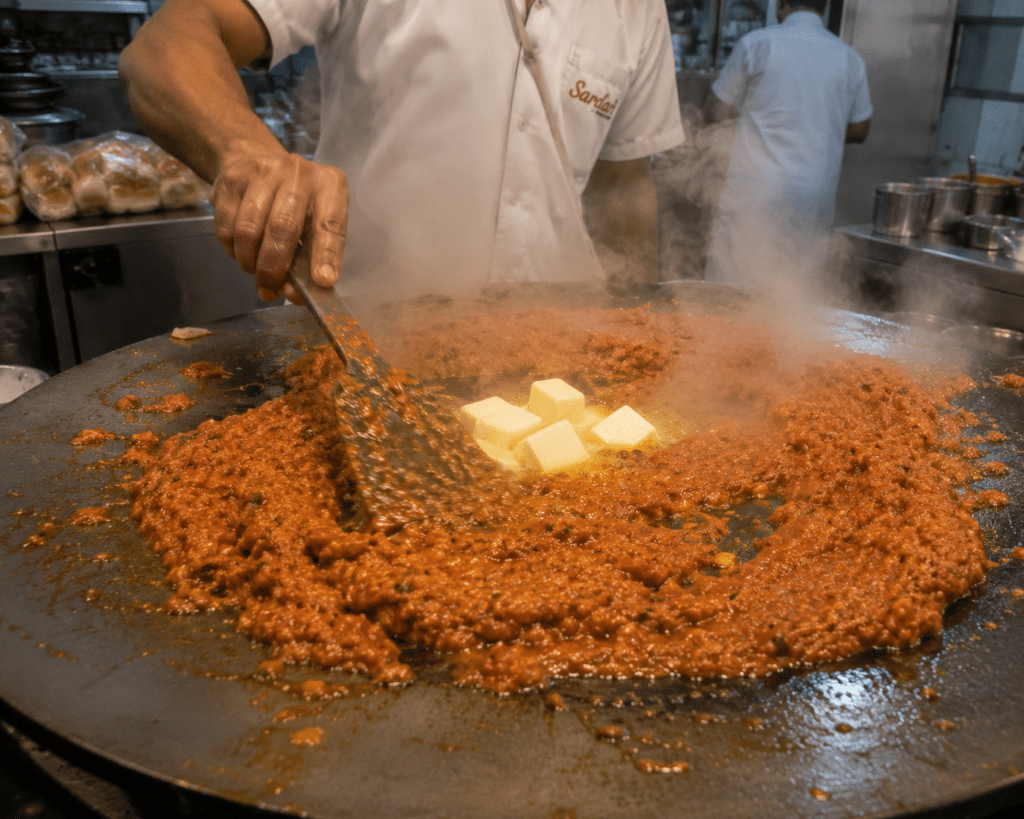
Pav Bhaji — Full Profile What it is: A spiced mashed vegetable curry (bhaji) cooked on a flat iron tawa with industrial quantities of Amul butter, served with toasted pav. How it tastes: The bhaji is deep orange-red, rich from butter, with a complex spice note from pav bhaji masala (a proprietary spice blend combining coriander, cumin, cloves, pepper, cardamom, and dried mango powder). The flavour is intensely savoury, buttery, slightly tangy. The pav is toasted on the same butter-slicked tawa until the base is golden. Main ingredients: Potato, peas, capsicum, tomato, onion, butter (Amul), pav bhaji masala Where: Sardar Pav Bhaji, Tardeo (the gold standard since 1945). Juhu Beach stalls (for the setting). Cannon Pav Bhaji, Fort (lunch only, legendary). Price: ₹130–220 Best time: Evening (6pm–10pm) at Juhu for the sea-breeze version
Keema Pav (Mohammed Ali Road) What it is: Spiced minced mutton cooked with onion, tomato, ginger, garlic, and a house masala, served with soft white pav. How it tastes: Rich, intensely spiced, slightly oily in the best way — the fat from the mutton mince renders into the masala and creates a depth that stays with you. The pav soaks up the keema gravy and becomes something entirely its own. Ingredients: Mutton mince, onion, tomato, ginger, garlic, red chilli, coriander, garam masala, butter Where: Mohammed Ali Road stalls, particularly during Ramzan evenings (but available year-round). Bade Miya’s area, Colaba (seekh kebab variation). Price: ₹150–250
Bhel Puri + Sev Puri + Dahi Puri — The Chaat Trinity
Mumbai’s chaat culture is centred on three dishes that represent different expressions of the same idea: crispy base + soft filling + chutneys + textural toppings.
Bhel Puri: Puffed rice tossed with raw mango, onion, potato, tamarind chutney, green chutney, and sev (crispy chickpea noodles). Must be eaten within 4 minutes of assembly before it goes soft. ₹60–100.
Sev Puri: Flat puris topped with potato, onion, tomato, both chutneys, buried in sev. Each one is a complete unit. Eat in one bite. ₹60–90.
Dahi Puri: Hollow puris filled with potato, boondi, cold sweet yoghurt, tamarind chutney, green chutney, and sev. The cold yoghurt + warm chutneys + crunch of puri = a perfect bite. ₹80–130.
Where: Chowpatty Beach (classic) | Juhu Beach stalls (breezy, sunset) | Elco Market, Bandra (upscale surroundings, same great food)
Mumbai’s Legendary Restaurants
Britannia & Co. (Since 1923) Address: Wakefield House, 11 Sprott Road, Ballard Estate, Mumbai Cuisine: Parsi What to order:
- Berry Pulao: ₹480–550 — Saffron-fragrant basmati rice with chicken or mutton, topped with imported Iranian barberries (tart red berries). The sweet-sour berries against the rich savoury rice is the defining flavour of Parsi cooking.
- Dhansak: ₹400–450 — Lamb slow-cooked with five lentils, served with brown rice and caramelised onions
- Caramel Custard: ₹120 Price for 2: ₹900–1,500 Timings: Mon–Sat, 11:30am–4pm (lunch only) TripAdvisor: 4.5/5 | Consistently rated #1 Parsi restaurant India
Mahesh Lunch Home (Since 1956) Address: Fort branch (Cawasji Patel St) and Juhu branch Cuisine: Coastal Mangalorean/Konkani seafood What to order:
- Butter Garlic Crab: ₹1,000–1,600 (market price, always confirm) — whole crab cooked in a buttery, garlicky, mildly spiced sauce. Requires bibs, newspaper, and complete commitment.
- Pomfret Rechad: ₹800–1,100 — pomfret smeared with Goan rechad masala (red chilli, vinegar, garlic) and pan-fried
- Prawn Gassi: ₹650–800 — Mangalorean coconut curry with generous prawns
- Sol Kadhi: ₹90–130 — the digestive pink drink of kokum and coconut milk. Order it. Always. Price for 2: ₹1,800–3,500 Reservations: Essential for dinner
Bade Miya (Since 1946) Address: Behind Taj Mahal Palace Hotel, Colaba Cuisine: Mughlai street kebabs What to order:
- Seekh Kebab: ₹200–280 for 2 pieces — charcoal-grilled minced lamb on iron skewers
- Bade Miya Roll: ₹200–280 — seekh kebab wrapped in roti with chutney and onion
- Chicken Tikka: ₹250–350 for 4 pieces Price for 2: ₹600–1,500 Timings: 7pm–3am
Mumbai’s Best Cafes
Cafe Mondegar (Since 1932) Address: Metro House, 5A, Shahid Bhagat Singh Road, Colaba Vibe: Mario Miranda murals, jukebox, continental and Goan food, cold beer What to order: Chicken Steak ₹550–650, cold beer ₹280–350, Goulash ₹600–700 Price: ₹1,000–1,800 for 2
Leopold Cafe (Since 1871) Address: Colaba Causeway What to order: Cold Coffee ₹250–320, Club Sandwich ₹400–480, Goan Fish Curry ₹520–620 Price: ₹800–1,800 for 2
Kyani & Co. (Since 1904) Address: JSS Road, Marine Lines Cuisine: Irani café — bun maska, chai, kheema pav What to order: Bun Maska + Irani Chai ₹70–90; Mawa Cake ₹70–80/piece Price: ₹200–500 for 2
Fine Dining Mumbai
Wasabi by Morimoto (Taj Mahal Palace, Colaba) What it is: The brainchild of Masaharu Morimoto. The chef has intelligently designed the restaurant, and the menu served here intricately portrays the fine blend of contemporary style and old-school temperament. Wasabi by Morimoto is a hallmark of taste, quality, presentation, and décor. What to order: Sushi, Sashimi, Lobster, Miso Soup, Tempura Price for 2: ₹10,000–18,000
Trishna (Fort) What it is: Legendary seafood restaurant, consistently rated among India’s finest for coastal Indian food What to order: Butter garlic crab (₹1,400–2,000), prawn koliwada, crab masala Price for 2: ₹3,000–6,000 Reservations: Essential, book 1 week ahead minimum
Kolkata — The City of Kathi Rolls and Communal Joy
Why Kolkata’s Food Scene Is Unique
Kolkata was one of the prominent British colonies, so its street food of every corner tells a story of tradition and exquisite taste. Here, sweets and street eats come together in perfect harmony, making it a paradise for those with a sweet tooth and a hunger for spice or both.
Kolkata Street Food — Dish by Dish
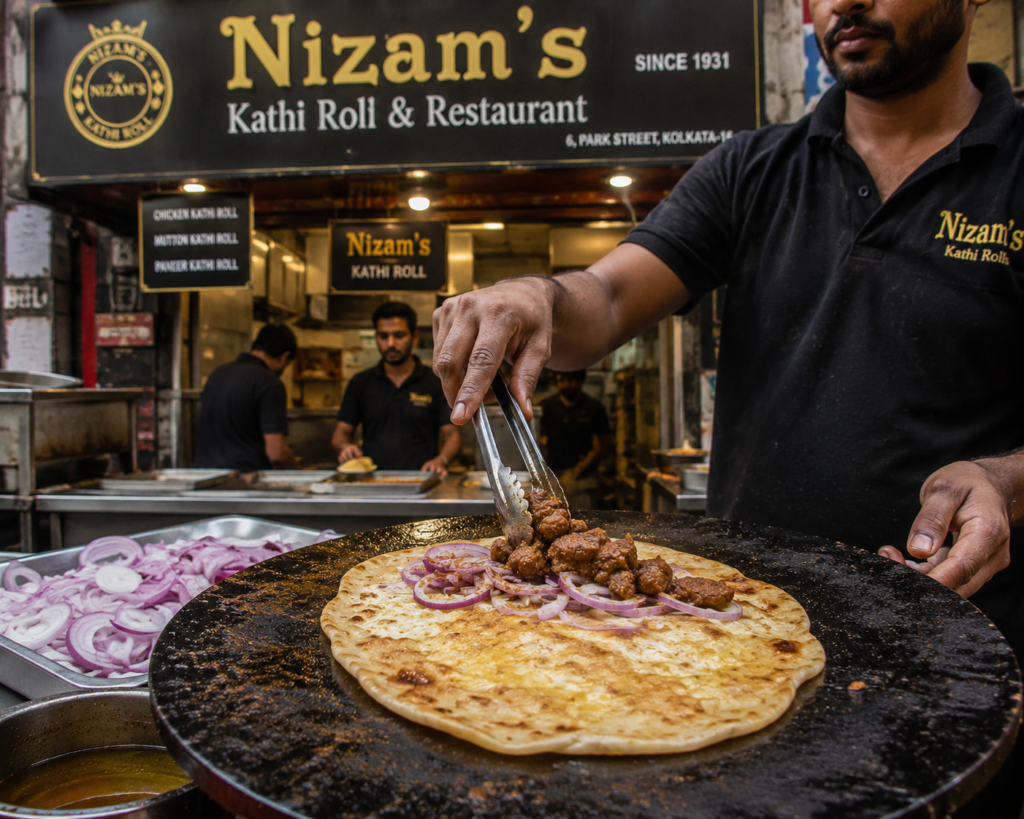
Kathi Roll (Kolkata’s Greatest Export) What it is: A paratha (flaky flatbread) coated with beaten egg on a tawa, wrapped around a filling — mutton, chicken, paneer, egg, or egg-mutton combinations — with raw onion, green chutney, a squeeze of lime, and a dusting of chilli powder. How it tastes: The egg-coated paratha is slightly crispy, slightly chewy, slightly smoky from the tawa. The mutton filling (when ordering the original) is tender, spiced, and contrasted brilliantly by the sharp raw onion and lime. It is a complete, satisfying meal that costs ₹80–180 and needs no accompaniment. Ingredients: Refined flour paratha, egg, mutton/chicken, onion, green chilli chutney, lime, chilli powder Where:
- Nizam’s, New Market (since 1932 — the inventor of the Kathi Roll)
- Kusum Rolls, Park Street (a rival and equally beloved)
- Hot Kathi Roll, Esplanade Price: ₹80–200 depending on filling Best time: 12pm–3pm for lunch; 7pm–10pm for evening
Puchka (Kolkata’s Pani Puri) What it is: Kolkata’s version of pani puri — but distinctly, importantly different. The puchka shell is darker and crispier than Mumbai’s pani puri. The filling is a spiced mashed potato and black chickpea mixture. The water (pani) is tamarind-based, with black salt, roasted cumin, and a hit of green chilli — sharper and more complex than the North Indian version. How it tastes: Each puchka delivers an instantaneous full-mouth flavour explosion — the crisp shell shatters, the cold sharp tamarind water floods in, the spiced potato provides body, the black chickpea adds earthiness. It is genuinely one of the most addictive eating experiences in India. Where: Visit the Maharaja Chaat Centre on Southern Avenue, or Bhawanipore to taste the best puchkas and papdi-chaat in the city. Any roadside puchkawala in South Kolkata is excellent. Price: ₹30–80 for a plate of 6
Jhalmuri — The Wandering Snack What it is: Puffed rice tossed with mustard oil, raw onion, cucumber, tomato, boiled potato, green chilli, roasted peanuts, and a squeeze of lime — assembled on the spot by the jhalmuriwalah who carries his ingredients in a conical basket. How it tastes: The mustard oil is the key — sharp, slightly pungent, deeply savoury. Everything is tossed together and handed over in a small paper cone. The puffed rice goes slightly soft but retains its crunch. It is light, bright, cheap, and endlessly satisfying. Price: ₹20–50 Where: Any street corner in Kolkata
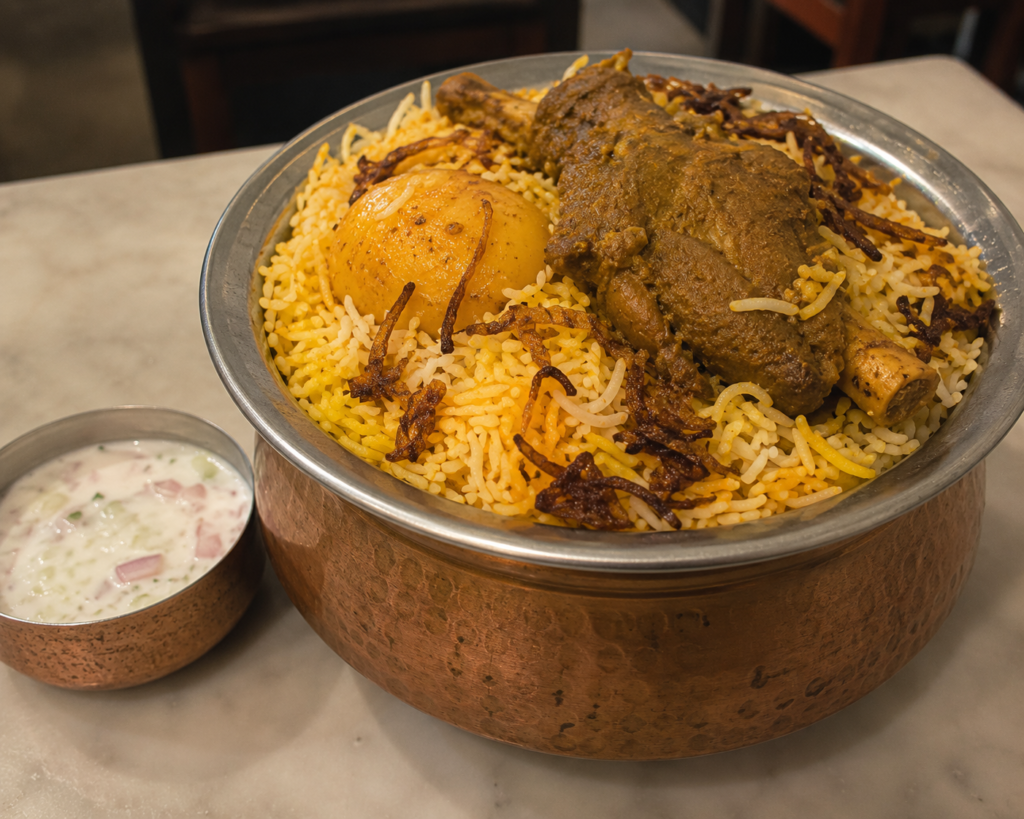
Kolkata Biryani — The Distinct Variant What it is: Kolkata biryani is derived from the Lucknow/Awadhi style but with a crucial addition — a boiled potato in the biryani. The story goes that when Nawab Wajid Ali Shah was exiled to Kolkata by the British, his cooks stretched the expensive mutton by adding potato. The potato absorbed the biryani flavours magnificently and became permanent. How it tastes: Lighter than Hyderabadi biryani, more subtly spiced, with rose water and saffron fragrance. The potato is soft, soaked with the biryani’s flavour, and the meat is tender. Every grain of rice is separate and fragrant. Where:
- Royal Indian Hotel, Chitpur (since 1905 — the most celebrated Kolkata biryani)
- Arsalan, Park Circus (consistently packed, excellent) Price: ₹180–350 per serving
Bengali Sweets — A Category Apart
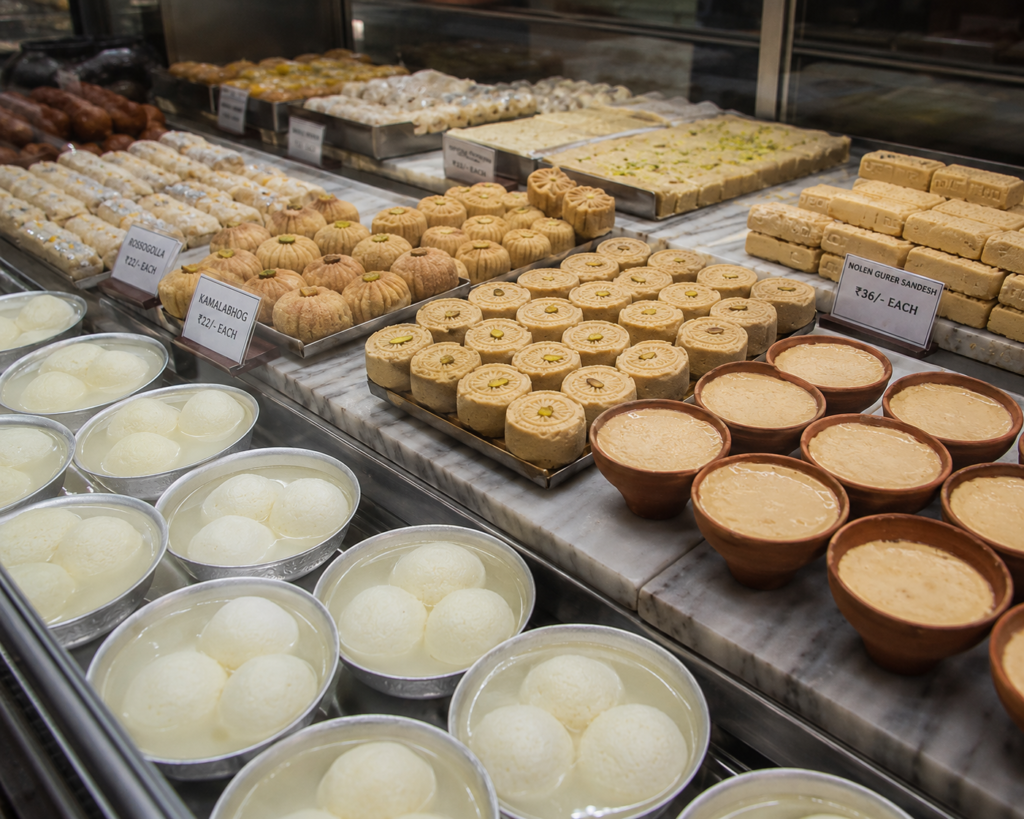
Bengal’s sweet-making tradition is the most sophisticated in India — centuries of refinement in the use of chhena (fresh cottage cheese), sugar syrup, and flavouring agents.
Rosogolla: Soft white sponge balls of chhena in a light sugar syrup. The original, from Kolkata. Light, squeaky when bitten, not too sweet. ₹15–30 per piece. Where: K.C. Das, Bow Bazar (the shop that claims to have invented the Rosogolla in 1868)
Mishti Doi: Sweetened fermented yoghurt set in terracotta pots. The caramelised flavour from the pot and the sweetness of the set curd is uniquely Bengali. ₹40–80 per pot. Where: Balaram Mullick & Radharaman Mullick, Paddapukur Road
Sandesh: Flavoured and shaped chhena sweet — the most versatile Bengali sweet, made in hundreds of varieties. ₹20–60 per piece.
Chanar Jalebi: Chanar Jalebi at College Street will fulfil you with a two-in-one gulab jamun and jalebi surprise! Made from chhena rather than maida — heavier, more complex than the regular jalebi. ₹30–60 per piece.
Kolkata’s Best Restaurants
Bhojohori Manna (Multiple Branches) What it is: The definitive Bengali home-cooking restaurant — traditional recipes, simple presentation, outstanding authenticity. What to order: Ilish Bhapa (steamed hilsa fish in mustard and coconut), Shorshe Bata Maach (mustard fish), Kosha Mangsho (slow-cooked dark mutton curry), full Bengali thali Price for 2: ₹800–1,800 Zomato rating: 4.3/5
Peter Cat (Park Street, Since 1975) What it is: Kolkata’s most beloved restaurant — the inventor of the Chelo Kebab (seekh kebabs served on a sizzler plate over rice with an egg and butter) What to order: Chelo Kebab ₹550–700, Old Monk rum-based cocktails ₹300–450 Price for 2: ₹1,500–2,500 Timings: 12pm–10:30pm
Hyderabad — Biryani Capital of the World
The Hyderabadi Food Identity
Hyderabad’s biryani is the most famous single dish in Indian food. The street biryani scene — from Paradise to smaller local joints — is exceptional. The old city area around Charminar has excellent haleem, kebabs, and Mughlai street food. Irani chai in Irani cafes is a unique cultural experience.
Hyderabadi Biryani — The Full Profile
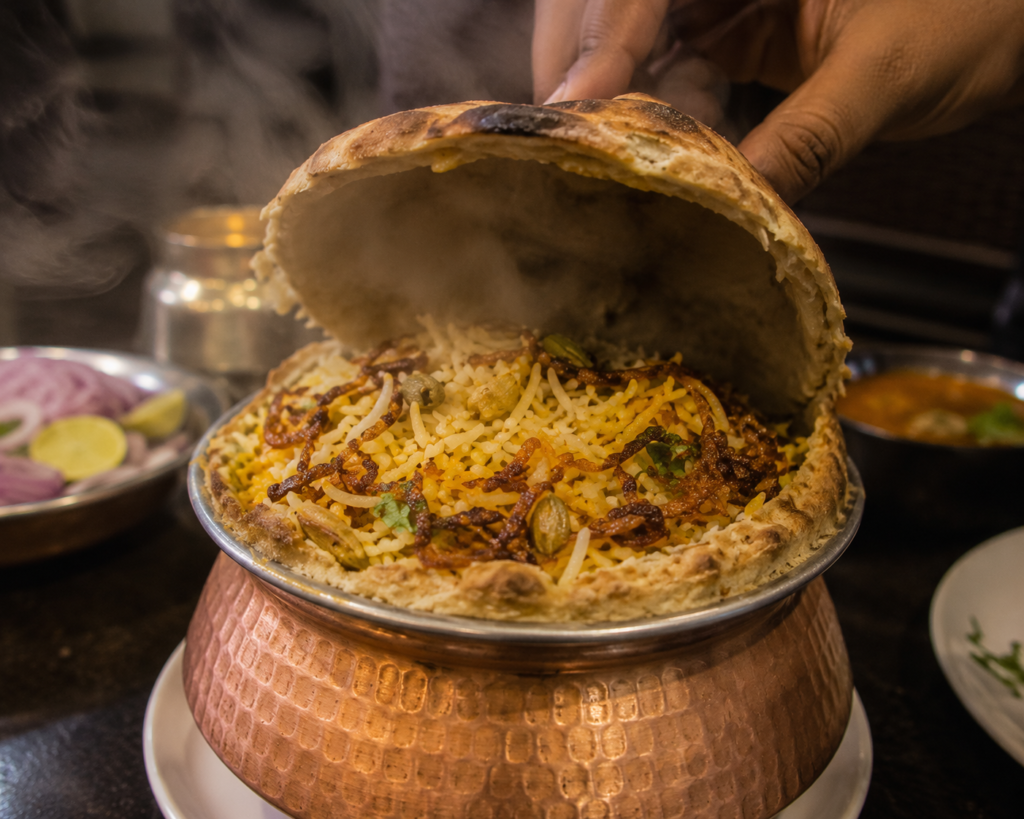
What it is: The most complex and celebrated biryani variant in India. The Hyderabadi biryani comes in two versions — Kacchi (raw meat marinated and cooked together with the rice, sealed in a pot) and Pakki (pre-cooked meat layered with par-cooked rice). The Kacchi method requires extraordinary timing and heat control. How it tastes: Deeply fragrant with whole spices (cardamom, cinnamon, cloves, bay leaf), the saffron giving a golden colour and floral note to the top layer of rice. The meat is juicy, the caramelised onions (beresta) give a sweet crunch, the raita on the side provides cool contrast. It is a complete meal in a single pot that asks nothing of you except time and appreciation. Main ingredients: Long-grain basmati rice, mutton/chicken, whole spices (cardamom, cinnamon, cloves, star anise), saffron, caramelised onions, ghee, curd, rose water When to eat: Lunch (12pm–3pm) — biryani is traditionally a lunch dish in Hyderabad. Evening biryani is a compromise.
Where to eat Hyderabadi Biryani:
- Paradise Restaurant (Secunderabad): The legendary Hyderabad biryani institution since 1953. Queue-worthy. Mutton biryani ₹350–500, Chicken biryani ₹280–380. TripAdvisor: Certificate of Excellence consecutive years.
- Bawarchi Restaurant (RTC X Roads): The local favourite that divides Hyderabad — some say this is better than Paradise. ₹280–450.
- Shah Ghouse Cafe (Tolichowki & Charminar): More authentic Old City version. ₹220–380.
- Hotel Shadab (Old City, near Charminar): Family-run, decades of reputation, excellent kacchi biryani. ₹250–400.
Haleem — Hyderabad’s Winter Signature What it is: A slow-cooked dish of wheat, barley, lentils, and mutton pounded and cooked together until thick and porridge-like. Originally a Ramzan special, now available year-round in Hyderabad. How it tastes: Deeply rich, almost like a savoury porridge with the complexity of meat stock and whole spices. The wheat and meat have been cooked so long they are inseparable. Topped with crispy fried onions (beresta), fresh ginger, lime, and green chilli. One of the most warming, nourishing things you can eat in India. Where: Hotel Shadab, Pista House (the largest haleem operation in India — they export nationally) Price: ₹200–400 per serving
Mirchi ka Salan: What it is: Long green chillies in a peanut-sesame-coconut gravy — the traditional accompaniment to Hyderabadi biryani. How it tastes: Despite the ingredient list, this is not aggressively hot — the chillies are bhavnagri (mild), and the gravy has a nutty, slightly sour flavour from tamarind. It provides the perfect contrast to biryani’s richness. Price: ₹150–250 as a side dish
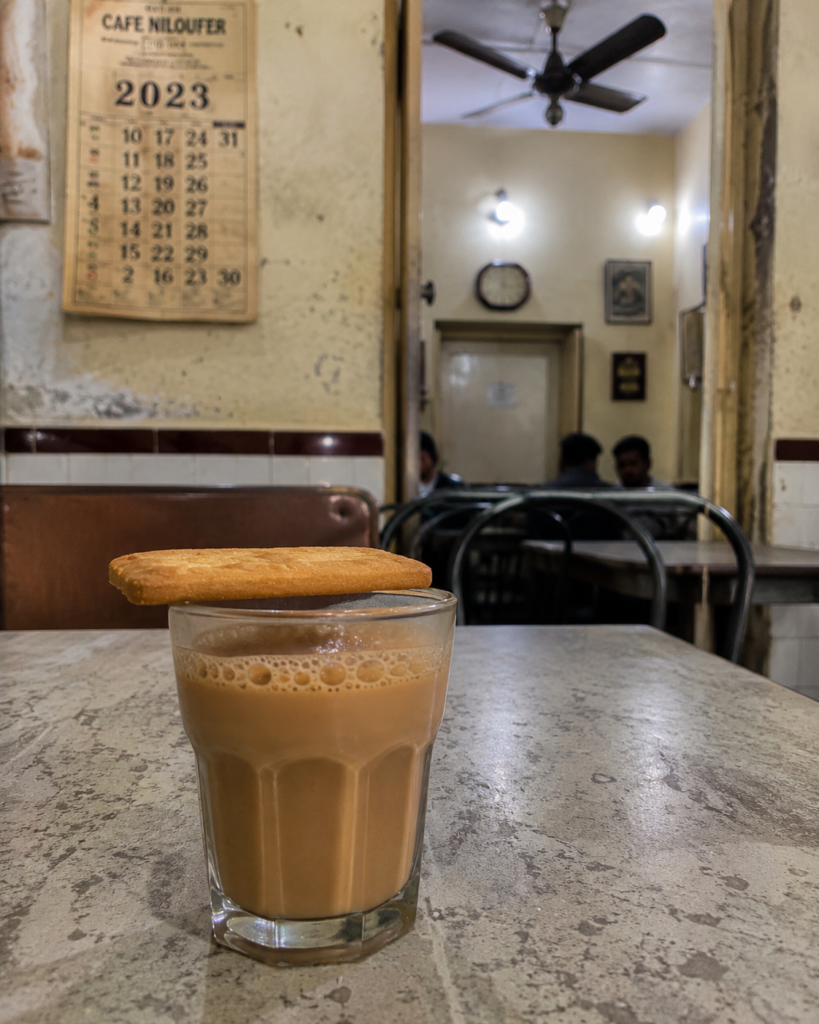
Osmania Biscuit + Irani Chai: What it is: Hyderabad’s signature café experience — a flat, slightly sweet, buttery biscuit (of Persian origin, made by Irani bakers who migrated in the early 20th century) served with the city’s distinctive Irani chai (milk simmered separately and combined with strong tea decoction). Where: Nimrah Café (beside Charminar), Café Bahar (Himayatnagar) Price: Chai ₹20–30; Biscuits ₹15–30 for two
Lucknow — India’s Most Refined Street Food
The Awadhi Difference
Lucknow is the home of dum cooking — the technique of sealing a pot with dough and slow-cooking over low heat. The flavour that results is unlike any other Indian cooking method: the ingredients braise in their own steam, the spices slowly release their aromatic compounds, and the result is a complexity that no amount of high-heat cooking can achieve.
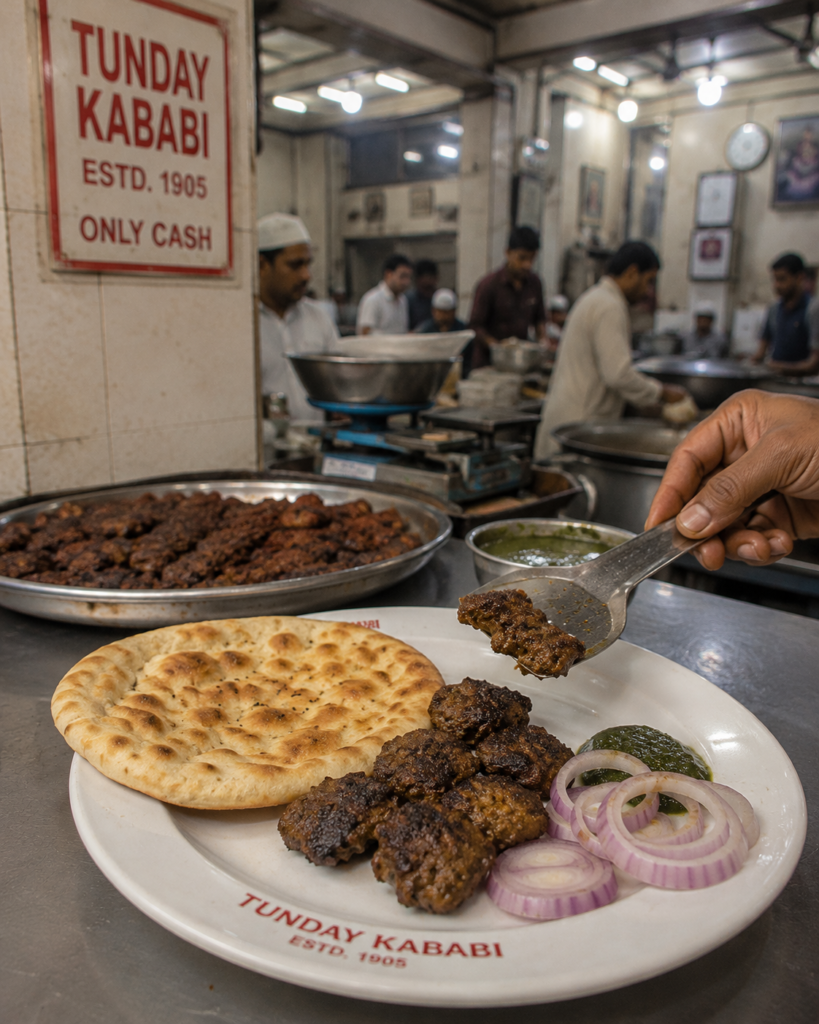
Tunday ke Kebab — The One That Defines a City What it is: Galauti kebabs — melt-in-the-mouth minced mutton patties cooked on a tawa. The original recipe at Tunday Kababi supposedly uses 160 spices. The texture is extraordinary — they dissolve on the tongue rather than requiring chewing. How it tastes: Soft as butter, intensely aromatic, with a warmth that builds rather than hits. The fat from the mutton and the specific spice blend create a depth that is impossible to reverse-engineer. Ingredients: Minced mutton (fine-ground), raw papaya (tenderiser), 100+ spice blend including mace, nutmeg, khus (vetiver) Where: Tunday Kababi, Aminabad (the original, since 1905). Also at Chowk branch. Queue always present. Worth every minute. Price: ₹200–320 per plate (10 small kebabs with sheermal) Best time: Lunch and early evening
Nihari at Rahim’s What it is: Mutton Nihari at Rahim’s in Chowk — the overnight-braised mutton stew that may be the most complex single dish in Indian food. Mutton shanks, bone marrow, and slow-rendered fat braised from midnight until dawn in whole spices including mace, nutmeg, cardamom, and fennel seeds. How it tastes: The broth is deep brown, rich with bone marrow fat and collagen, warmly spiced, served with a scattering of fresh ginger, green chilli, and coriander on top. A torn piece of sheermal (saffron flatbread) soaks up the broth. Nothing in Indian food is quite like it. Price: ₹280–420 per serving Best time: 6am–10am (it runs out; arrive early)
Kulfi Falooda at Prakash ki Mashoor Kulfi What it is: Dense, slow-frozen Indian ice cream (kulfi) served with falooda vermicelli, rose syrup, and sabja seeds. Lucknow’s kulfi is specifically famous for the kesar-pista (saffron-pistachio) variety. Where: Kulfi Falooda at Prakash ki Mashoor Kulfi Price: ₹80–150
Amritsar — Punjab’s Table
The Amritsar Food Identity
Amritsar’s food is defined by dairy, wheat, and the generous hand of Punjabi hospitality. Every dish comes with ghee. Every meal is abundant. The Golden Temple serves 100,000 free meals daily. The food culture of this city is inseparable from the idea that nobody should go hungry.
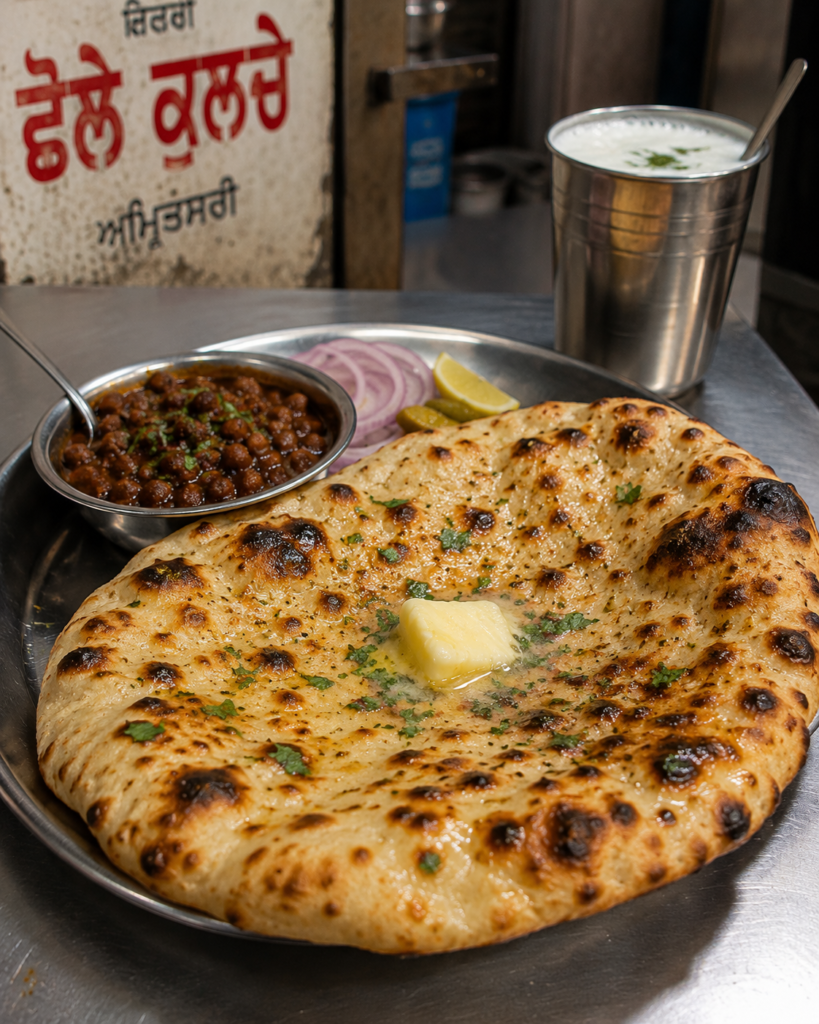
Amritsari Kulcha What it is: Stuffed flatbread (kulcha) baked in a tandoor and served with a chole (spiced chickpea curry) that is dramatically different from Delhi’s version — Amritsari chole is darker, more intensely spiced, cooked with tea leaves for colour. How it tastes: The kulcha is crisp-edged from the tandoor, soft inside, the stuffing (potato, onion, green chilli) fragrant and warm. Torn and dipped into the chole with a knob of butter on top, it is one of the most completely satisfying breakfasts in North India. Ingredients: Refined flour, potato, onion, coriander, green chilli, ghee; chole with chickpeas, tea, whole spices, tamarind Where: Amritsari Kulchas at Harbans Lal Kulche Wala and Kesar da Dhaba (since 1916) Price: ₹100–180 for kulcha + chole Best time: Breakfast (7–10am)
Amritsari Lassi What it is: Thick, full-fat yoghurt blended with cream, sugar, and rose water — served in an enormous steel tumbler or in traditional clay pots. A full-meal drink by itself. How it tastes: Dense, cold, slightly tangy from the yoghurt, sweet, floral from the rose water. A layer of malai (cream) floats on top. Drinking a full glass in one sitting at 9am with kulcha is peak Amritsar. Where: Gian di Lassi, near Golden Temple (iconic); various stalls on the main street Price: ₹80–150 for a full serving
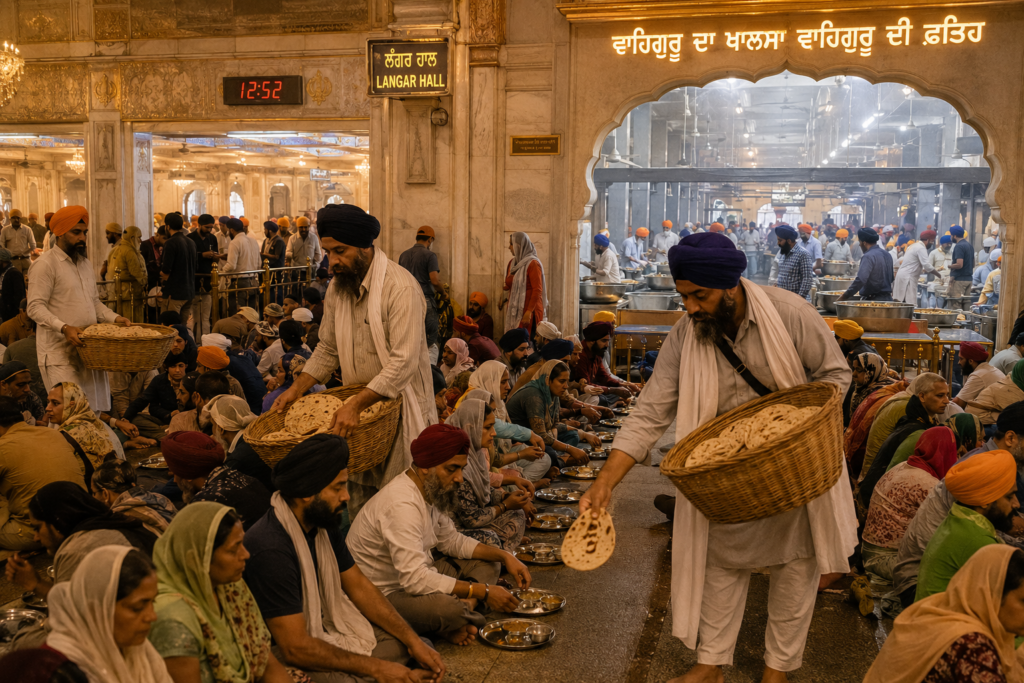
Langar at Golden Temple What it is: The free community meal served continuously at Sri Harmandir Sahib (Golden Temple) — dal (lentil curry), sabzi (vegetable), chapati, and kheer (rice pudding). 100,000 meals daily, to all visitors regardless of religion or background. How it tastes: Simple, nourishing, homely. Dal flavoured with garlic, warm chapati, the kheer sweet and comforting. Eating here at the marble tables, surrounded by the world’s most diverse gathering of people all eating the same humble food, is one of the genuinely moving food experiences available in India. Cost: Free. Donations accepted. Timings: 24 hours a day, every day
Varanasi — Sacred Food in the Oldest City
The Varanasi Food Identity
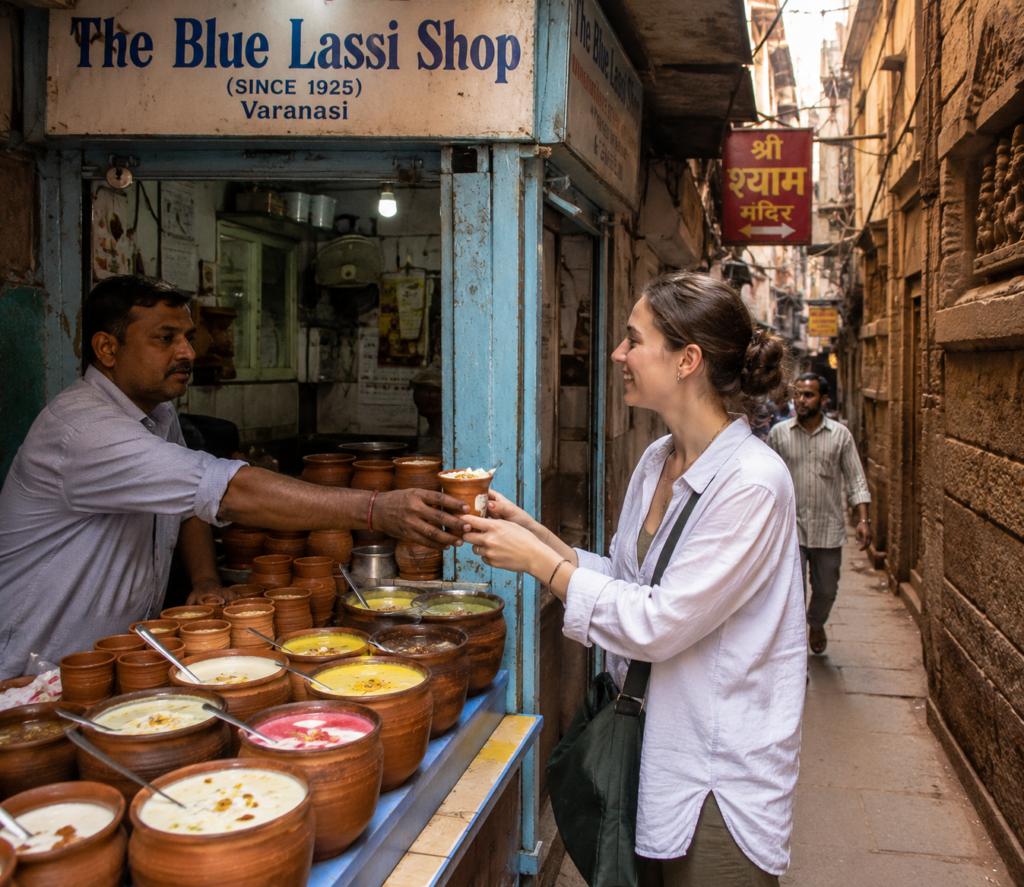
Varanasi is a predominantly vegetarian city — meat is largely absent from the mainstream food culture because of the city’s religious significance. What exists instead is a deeply developed vegetarian street food culture of extraordinary specificity.
Kachori Sabzi (6am at the Ghats) What it is: Deep-fried whole-wheat or lentil-flour kachori (puffed fried bread) served with a thin, intensely spiced potato and tomato curry. How it tastes: The kachori is crisp-shelled, hollow inside, the pastry seasoned with nigella seeds and pepper. The sabzi is poured over and soaks the bread partially — you eat it quickly, tearing pieces of kachori into the liquid. Hot, oily in the best way, intensely spiced, and eaten at 6am while the Ganga fog is still on the river. Where: Street stalls at Godowlia Chowk and near Dashashwamedh Ghat. Kashi Chaat Bhandar on Vishwanath Gali. Price: ₹40–80 Best time: 6–9am only
Tamatar Chaat (Varanasi-Specific) What it is: A dish that exists only in Varanasi — cooked tomatoes seasoned with local spices, topped with sev, coriander, and a squeeze of lime. The tomatoes are cooked until they collapse into a jammy, intensely flavoured base. Where: Deena Chaat Bhandar, Godowlia; Kashi Chaat Bhandar Price: ₹40–80
Malaiyo (Winter Only, November–February) What it is: Varanasi’s version of Delhi’s Daulat ki Chaat — whipped milk foam, aerated overnight in the winter air, served with a sprinkle of saffron and pista. The same impossible, cloud-light texture. Price: ₹40–70
Blue Lassi Shop (Kashi Vishwanath Gali) What it is: One of the most famous lassi shops in India — a tiny, ancient shop serving thick yoghurt lassi in various flavours (mango, rose, saffron, strawberry, banana). The shop itself is barely 6 feet wide. Price: ₹60–100 in a clay pot Queue: Always. Completely worth it.
Indore — India’s #1 Verified Street Food City in 2026
Why Indore Wins
Celebrity chef Vikas Khanna called Indore the ultimate street food destination in India — and once you eat here, you will understand exactly why.
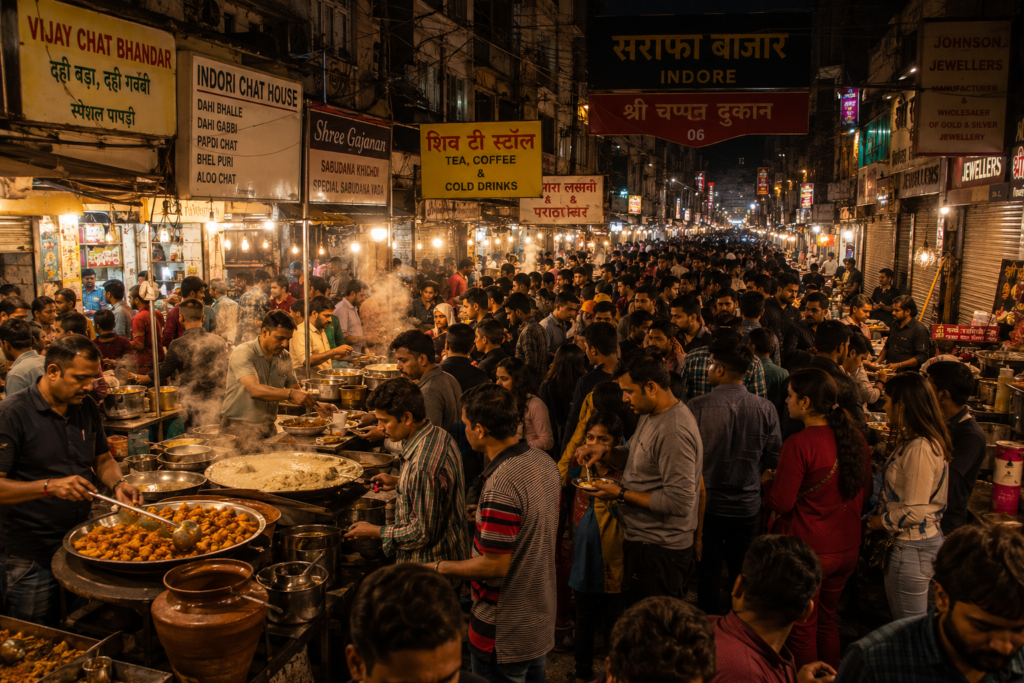
The data is clear: Indore wins on variety, wins on value, and wins on the overall street food experience. A complete street food meal costs Rs 80–120.
Sarafa Bazaar opens at 8pm every evening and reaches peak activity between 9pm and midnight — this is the best window to experience Indore street food at its most vibrant. For morning food, visit Chappan Dukan from 7am to 9am for fresh Poha Jalebi. Sarafa Bazaar is strictly vegetarian — every stall inside serves only vegetarian food.
Poha-Jalebi (Indore’s Breakfast) What it is: Flattened rice (poha) cooked with onion, curry leaves, turmeric, mustard seeds, and peas — served alongside crispy, freshly fried jalebi (pretzel-shaped deep-fried batter soaked in sugar syrup). The hot, savoury poha alternated with hot, sweet jalebi is one of the great morning flavour contrasts in India. How it tastes: The poha is light, fluffy, not overly oily, the mustard seeds and curry leaves fragrant. The jalebi is crisp on the outside, syrup-saturated within, slightly sour from the fermented batter. Together they work better than they have any right to. Where: Johny Hot Dogs, Chappan Dukan for the full morning experience Price: ₹40–80 for a full plate of both Best time: 7–9am strictly
Sarafa Bazaar (India’s Greatest Night Food Market) What it is: A jewellery market during the day, Sarafa transforms after 8pm into a 100+ stall street food paradise. What to eat there:
- Bhutte ka Kees (grated corn cooked with milk, ghee, and spices) ₹60–100
- Garadu (yam fries) ₹60–80
- Dahi Bhalla ₹60–80
- Malpua (sweet fried pancake in sugar syrup) ₹50–80
- Rabdi Jalebi ₹80–120
- Chaat in six varieties ₹50–100 each Best time: 9pm–midnight
Goa — Coastal Portuguese-Indian Fusion
The Goan Food Identity
Goa’s food is the most distinct in India — four hundred years of Portuguese colonial influence have created a cuisine that is genuinely unlike anything else in the country. Coconut, vinegar, and dried red chilli are the three pillars. Pork, seafood, and toddy (coconut palm spirit) are the proteins and the drink.
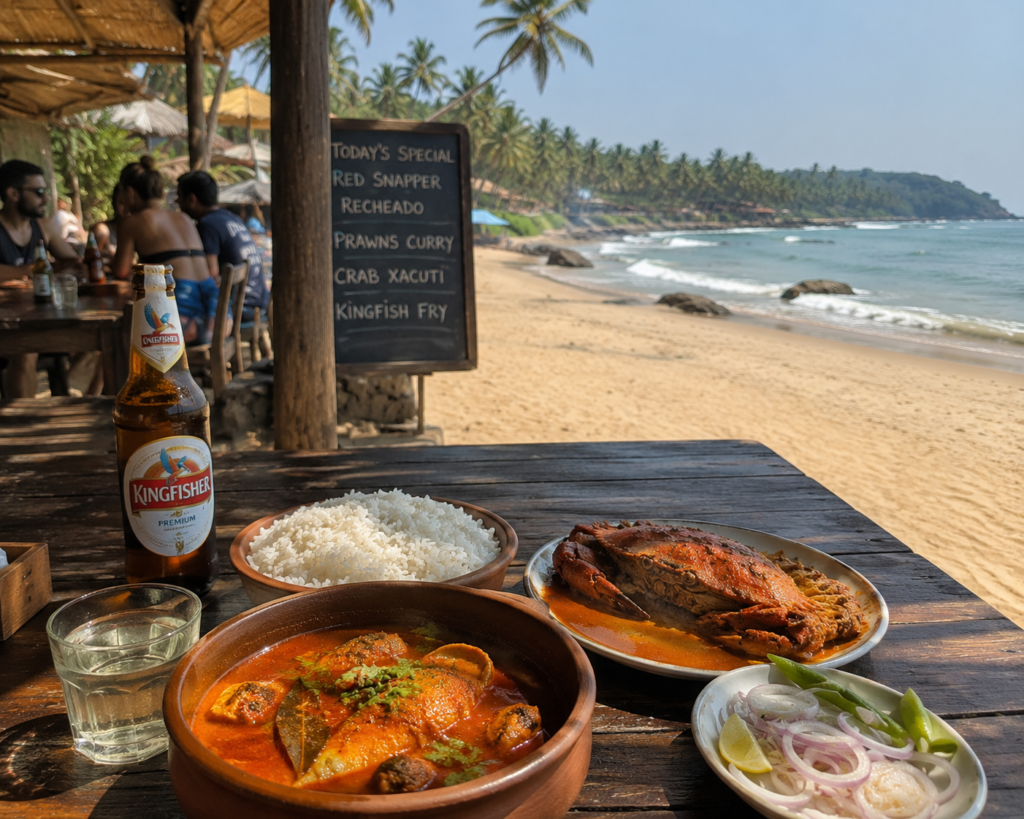
Fish Curry Rice (The Goan National Dish) What it is: A red curry made from dried Kashmiri chillies, freshly grated coconut, kokum (a sour fruit), and a specific Goan spice blend, with fish — typically pomfret, kingfish, or mackerel — cooked in the sauce and served with steamed red or white rice. How it tastes: The curry is tangy from the kokum, rich from the coconut, moderately spiced (not fiery), and deeply aromatic. The fish is fresh and absorbs the curry beautifully. With steamed rice and a papad, this is a complete meal that costs ₹180–350 at a local restaurant. Ingredients: Dried red chillies, coconut (fresh or desiccated), kokum, cumin, coriander, turmeric, ginger, garlic, fish Where: Martin’s Restaurant (Cavelossim), Vinayak Family Restaurant (Assagao), any local Goan home-style restaurant
Prawn Balchão What it is: A fiery pickle-preparation of prawns cooked with a vinegar and red chilli masala — Goa’s most distinctively Portuguese-influenced dish. How it tastes: Sharp, sour from vinegar, intensely spiced, almost pungent — a bold preparation that works brilliantly as a side dish or condiment. Not subtle. Very Goan. Price: ₹350–550 as a side
Bebinca (The Queen of Goan Desserts) What it is: A 7 to 16-layered cake made from coconut milk, egg yolks, ghee, and jaggery — each layer baked separately and assembled. The most technically demanding Goan dessert, traditionally made for Christmas. How it tastes: Dense, slightly chewy, coconut-fragrant, caramelised at the edges of each layer. Served warm or at room temperature. One slice is a full dessert experience. Where: Confeitaria 31 de Janeiro, Panjim | Cafe Bhonsle, Margao Price: ₹100–200 per slice
Goan Beach Shack Dining: The beach shacks of North Goa (Anjuna, Calangute) and South Goa (Palolem, Agonda) serve full seafood meals in an informal beach setting. A complete prawn curry meal with rice, papad, and a local beer runs ₹600–1,200 per person at an honest shack. Double these prices at tourist-facing branded shacks.
Kerala — The Coconut Kingdom
Kerala Food Profile
Kerala’s cooking is defined by three things: coconut (oil, milk, fresh, desiccated), fresh seafood from the coast and backwaters, and a spice tradition born from being the world’s original spice trading destination. Black pepper, cardamom, cloves, and ginger are native to this land.
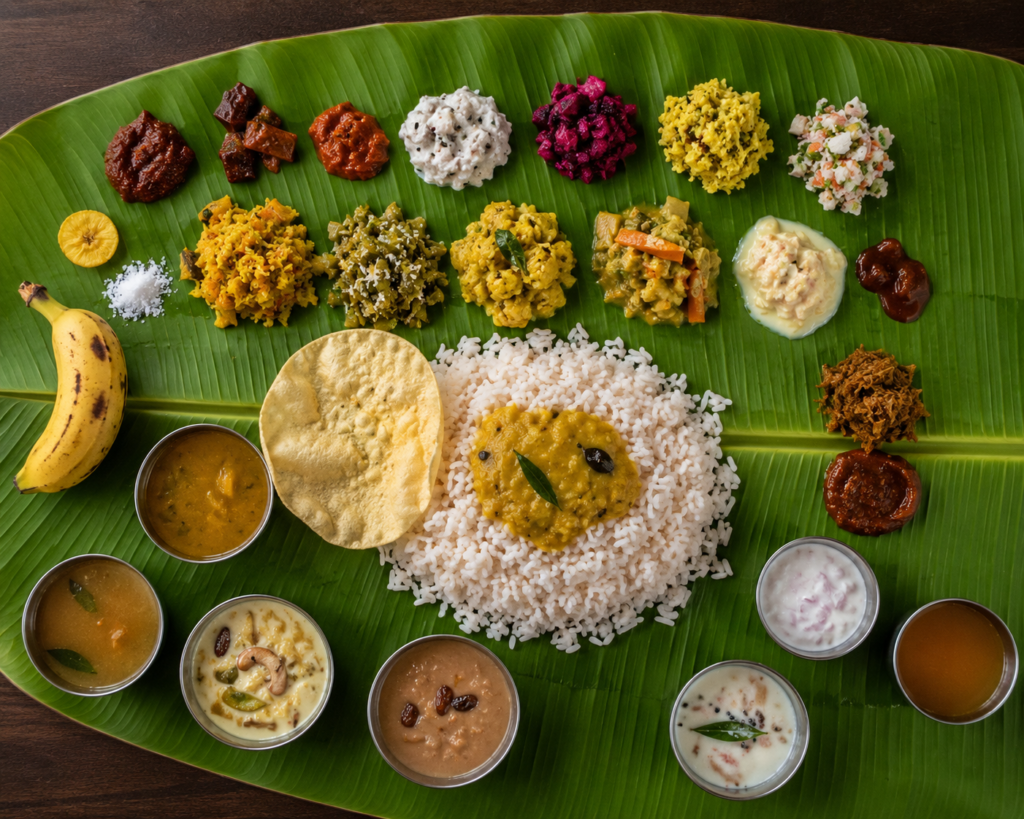
Kerala Sadya — The Grand Vegetarian Feast What it is: A traditional feast served on a banana leaf — over 26 dishes arranged in a specific order, including rice, sambar, rasam, avial (mixed vegetable in coconut and curd), thoran (dry vegetable stir-fry), olan (ash gourd in coconut milk), pachadi (curd-based), pickles, papad, and payasam (dessert). The rice is mounded in the centre, with the small dishes surrounding it. How it tastes: The brilliance of a sadya is how the flavours interact. The rasam (thin, peppery broth) cleanses the palate. The avial (15+ vegetables in coconut-curd gravy) provides complexity. The payasam (rice or lentil sweet) at the end settles everything. Ingredients: Over 50 individual ingredients across the dishes. The connecting thread: fresh coconut oil, fresh coconut, curry leaves, green chilli, black pepper. Where: Any Kerala government canteen, Paragon Restaurant (Kozhikode/Kochi), Dhe Puttu (Kochi for a modern version) Price: ₹150–350 for a full sadya When: Served primarily at lunch. Available daily at established Kerala restaurants; mandatory during Onam festival (August-September).
Kerala Fish Curry with Red Rice What it is: The daily meal of coastal Kerala — kingfish or mackerel cooked in a sour, spiced coconut milk gravy with Kodampuli (Malabar tamarind, also called kudampuli or fish tamarind). The sourness from kudampuli is distinctive — more complex than regular tamarind. How it tastes: Bold, sour, coconut-rich, the fish tender and infused with the curry flavour. With red rice (Kerala’s traditional rice, slightly nutty in flavour) and a papad, it is deeply satisfying. Price: ₹150–350 at a local Kerala restaurant
Appam with Stew What it is: A lace-edged, bowl-shaped rice pancake (appam) made from fermented rice batter — the edges crisp, the centre soft and slightly spongy — served with a white coconut milk stew with vegetables or chicken. How it tastes: The appam is slightly sour from fermentation, delicate, almost lacy at the edges. The stew is mild, creamy, fragrant with whole spices (cardamom, cloves, cinnamon), and provides perfect contrast to the bland appam base. Price: ₹80–180 for a full breakfast Best time: Breakfast (served until noon at most Kerala restaurants)
Chennai and Tamil Nadu — The Deep South Tradition
Tamil Food Identity
Tamil Nadu’s food is defined by rice (in more forms than you thought possible), tamarind (the souring agent rather than yoghurt), and the interplay of five flavours — sweet, sour, salt, bitter, and pungent — in every meal.
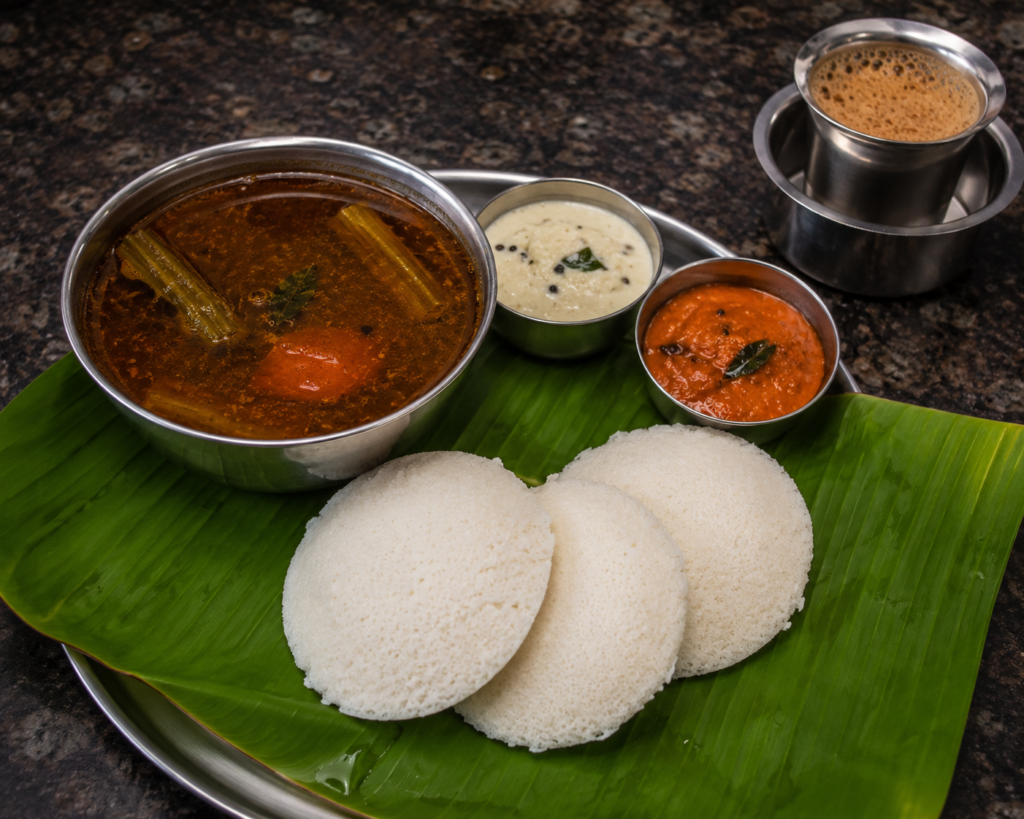
Idli-Sambar — The Benchmark What it is: Steamed rice and lentil cakes (idli) served with sambar (a tamarind-based lentil soup with vegetables) and two chutneys (coconut and tomato). How it tastes: The idli is pillowy-soft, neutral in flavour, the fermentation giving a subtle tang. The sambar is deeply complex — tamarind sour, lentil earthy, drumstick (moringa) fragrant, tomato sweet, tarka of mustard seeds and curry leaves. The coconut chutney adds cool freshness. Main ingredients: Rice, urad dal (fermented), tamarind, toor dal, tomato, drumstick vegetable, curry leaves, mustard seeds, coconut Where: Murugan Idli Shop (multiple Chennai locations — the benchmark for idli in Tamil Nadu), Saravana Bhavan (chain, reliable everywhere) Price: ₹60–120 for a plate of 2 idli with sambar and chutneys Best time: Breakfast (7–11am)
Chettinad Chicken Curry What it is: The most complex regional curry in India — from the Chettinad region of Tamil Nadu, using stone-ground fresh masalas including kalpasi (stone flower lichen), marathi mokku (dried flower pods), and black stone flower. The spice profile is uniquely complex. How it tastes: Deeply aromatic, moderately hot, with a flavour depth that takes several seconds to fully unfold. The freshly ground masala creates a gravy that is completely different from any other Indian curry style. Where: Anjappar Restaurant (Chennai, multiple branches — the most accessible quality Chettinad restaurant) Price: ₹350–600 for a Chettinad curry
Filter Coffee (The Tamil Nadu Religion) What it is: Strong South Indian coffee decoction combined with hot milk and sugar, served in a traditional steel tumbler-davara set. The coffee is poured back and forth between the tumbler and the davara to aerate and cool it, producing a slight froth. How it tastes: Bold, slightly bitter, slightly sweet — nothing like the diluted versions sold elsewhere in India. South Indian filter coffee is a world of its own. Where: Mylapore Filter Coffee (old Mylapore neighbourhood), Saravana Bhavan for the chain version, any traditional “military hotel” in Chennai Price: ₹20–60
Bengaluru — Modern Cafe Capital + Dosa Culture
The Bengaluru Food Duality
Bengaluru is India’s most food-progressive city in 2026 — the craft beer scene, specialty coffee culture, and farm-to-table restaurant wave all have their Indian origins here. But simultaneously, the traditional South Indian breakfast culture is alive and extraordinary.
Masala Dosa at CTR (Central Tiffin Room) Address: 7th Cross, Malleshwaram, Bengaluru (since 1920) What it is: A crispy-edged fermented rice and lentil crepe filled with a spiced potato filling (masala), served with coconut chutney and sambar. How it tastes: The CTR dosa is characteristically thick-edged and thin in the centre, crisp without being brittle, the fermentation giving a distinct sourness. The potato masala is well-spiced with turmeric and mustard seeds. Dipped into the coconut chutney — a fresh, bright, slightly sweet chutney made from fresh coconut, green chilli, and coriander — it is a perfect breakfast. Price: ₹80–150 Queue: Always. Go early or be patient.
Bisi Bele Bath What it is: A one-pot dish unique to Karnataka — rice, toor dal, vegetables, and a special spice blend (bisi bele bath powder) cooked together until thick and fragrant, served with ghee and papad. How it tastes: Comforting, warm, complex — the spice powder adds a specific aromatic note (with dried coconut, cinnamon, cloves) that distinguishes Karnataka’s version from all imitations. Where: Vidyarthi Bhavan, Gandhi Bazaar (since 1943 — one of Bengaluru’s oldest and most beloved breakfast spots) Price: ₹100–180
Bengaluru’s Craft Beer and Cafe Scene
Bengaluru has India’s most developed craft brewery culture — over 40 microbreweries in the city as of 2026.
- Toit Brewpub (Indiranagar): The pioneer — consistently excellent craft beer, good food. The Toit Hefeweizen is the benchmark wheat beer in India. Pints from ₹400–550.
- The Biere Club (Lavelle Road): Upscale brewing, excellent food menu, Bengaluru’s most celebrated craft beer venue.
- Windmills Craftworks (Whitefield): The largest craft brewery venue in Bengaluru — 8 taps, excellent Belgian and German styles.
- Arbor Brewing (Indiranagar): The American brewpub style that started Bengaluru’s craft revolution.
Specialty Coffee:
- Corridor Coffee (HSR Layout): Bengaluru’s best single-origin pour-over bar. Indian estate coffees from Coorg and Chikmagalur. Pour-over ₹180–280.
- Maverick and Farmer (Multiple): Third-wave coffee done well, all Indian beans.
- Blue Tokai (Multiple): See Delhi section — also excellent in Bengaluru.
Fine Dining Bengaluru:
Karavalli at the Taj — a memorable experience that beautifully showcases coastal Indian cuisine. The Malabar prawns were absolutely amazing — perfectly cooked, flavourful. The true star was the Crab Curry — rich, aromatic, and packed with authentic coastal flavours.
- Karavalli (Taj West End): The best coastal Indian fine dining in Bengaluru. ₹3,500–6,000 for 2.
- Ssaffron (Shangri-La Hotel): An elegant North Indian restaurant on the 18th floor, offering panoramic views. Known for its mustard salmon tikka and grilled kebabs. ₹4,000–8,000 for 2.
Jaipur — Royal Rajasthani Food
The Rajasthani Food Identity
Rajasthan’s food evolved under the constraints of a desert landscape — minimal water, extreme temperatures, and the need for food that could sustain warriors and travellers across long distances. The result is a cuisine of dried, sun-preserved, and intensely spiced food that is more delicious than the circumstances of its creation would suggest.
Dal Baati Churma What it is: The state dish — wheat dumplings (baati) baked in a tandoor or over cow dung fire until hard-crusted, served with a five-lentil dal and a sweet crumbled wheat dish (churma). The baati is crushed at the table, drowned in ghee, and eaten with the dal. How it tastes: The baati is crisp-shelled, dense inside, the wheat slightly nutty. Flooded with ghee, it becomes rich and satisfying. The five-lentil dal has a warmth and depth from a specific Rajasthani spice blend. The churma (sweet, crumbly wheat with ghee and jaggery) provides the dessert element. Where: Chokhi Dhani (tourist-facing but authentic) | Laxmi Mishthan Bhandar, Johari Bazaar | Any roadside dhaba outside Jaipur Price: ₹200–400 at a restaurant; ₹100–150 at a roadside dhaba
Pyaaz Kachori at Rawat Mishthan Bhandar What it is: Rawat Mishthan Bhandar on Station Road has been serving legendary Pyaaz Kachori since 1954 — and in 2026 the queue still stretches around the corner every morning by 9am. A deep-fried, crispy pastry shell filled with a spiced onion mixture. How it tastes: Crisp and flaky on the outside, the filling has a sweet-savoury onion quality enhanced by fennel seeds and dry mango powder. Served with tamarind chutney that provides the sour counter. Price: ₹50–80 per piece Best time: Morning only (7am–noon, sells out)
Laal Maas What it is: The fiery Rajasthani mutton curry — red from Mathania chillies (a local Jodhpur variety, intensely coloured and moderately hot), slow-cooked with whole spices and ghee. How it tastes: Deep red, intensely coloured, the chilli providing both heat and flavour rather than just fire. The mutton is fall-apart tender, the gravy rich. Not for heat-avoiders; extraordinary for those who appreciate chilli as a flavour rather than a punishment. Where: Niro’s Restaurant, MI Road (since 1949 — Jaipur’s most established restaurant) Price: ₹450–650
Pune — The Maharashtrian Breakfast Capital
Misal Pav at Bedekar Tea Stall (Since 1932) What it is: Sprouted moth bean curry in a fiery red gravy, topped with farsan (crispy fried mix), onion, coriander, lime — served with pav. Address: Bedekar, Narayan Peth, Pune Price: ₹90–150 Queue: Always by 8am. Arrive by 7:30.
FC Road Vada Pav Culture: Pune’s college strip (Fergusson College Road) has its own vada pav culture — different from Mumbai’s version, slightly larger, with a different chutney profile. Price: ₹20–35.
Sabudana Vada (Fast food for Maharashtra’s fasting days) What it is: Deep-fried patties of soaked tapioca pearls (sabudana) with peanuts, potato, green chilli, and cumin. Made traditionally on religious fasting days when grains are avoided. How it tastes: Crispy outside, chewy-sticky inside, the peanuts providing crunch, the green chilli heat. Distinctly Maharashtrian. Price: ₹60–100 per plate
The National Food Overview — Dishes to Know
India’s Food by Category
Biryani Variants Ranked:
- Hyderabadi Kacchi Biryani (mutton)
- Kolkata Biryani (with potato)
- Lucknowi (Awadhi) Dum Biryani
- Malabar Biryani (Kerala, with coconut milk)
- Chettinad Biryani (Tamil Nadu, intense spice)
- Sindhi Biryani (aloo, prune, sour note)
- Delhi Mughlai Biryani
India’s Top Sweets by Region:
- Bengal: Rosogolla, Mishti Doi, Sandesh, Rasgulla
- Rajasthan: Ghevar, Malpua, Churma Ladoo
- Gujarat: Mohanthal, Basundi, Jalebi with Rabdi
- Karnataka: Mysore Pak, Dharwad Pedha
- Maharashtra: Puran Poli, Modak, Shrikhand
- UP/Lucknow: Shahi Tukda, Balai (clotted cream sweet), Malai ki Gilori
- Punjab: Pinni, Gajar Halwa
- Tamil Nadu: Payasam (rice pudding), Adhirasam, Palkova
Fine Dining India — The Complete 2026 Guide
India’s Highest Ranked Restaurants
Important note: India does not yet have a Michelin Guide covering the country — the guide covers Mumbai and Delhi only in select listings but has not released a comprehensive India guide as of May 2026. The closest equivalents are the TripAdvisor Travellers’ Choice Awards, Zomato Top Ratings, and the EazyDiner Prime Awards.
Top Fine Dining Restaurants in India — 2026 Verified
Indian Accent (Delhi) Listing: World’s 50 Best Discovery | TripAdvisor #1 Fine Dining Delhi | Winner EazyDiner Prime Award 2025 Cuisine: Progressive Indian Price: Tasting menu ₹5,500–7,500/person (Full details in Delhi section)
Wasabi by Morimoto (Mumbai — Taj Mahal Palace) Listing: TripAdvisor Excellence | Conde Nast Traveller Top Pick Cuisine: Japanese-contemporary Price: ₹8,000–18,000 for 2 (Full details in Mumbai section)
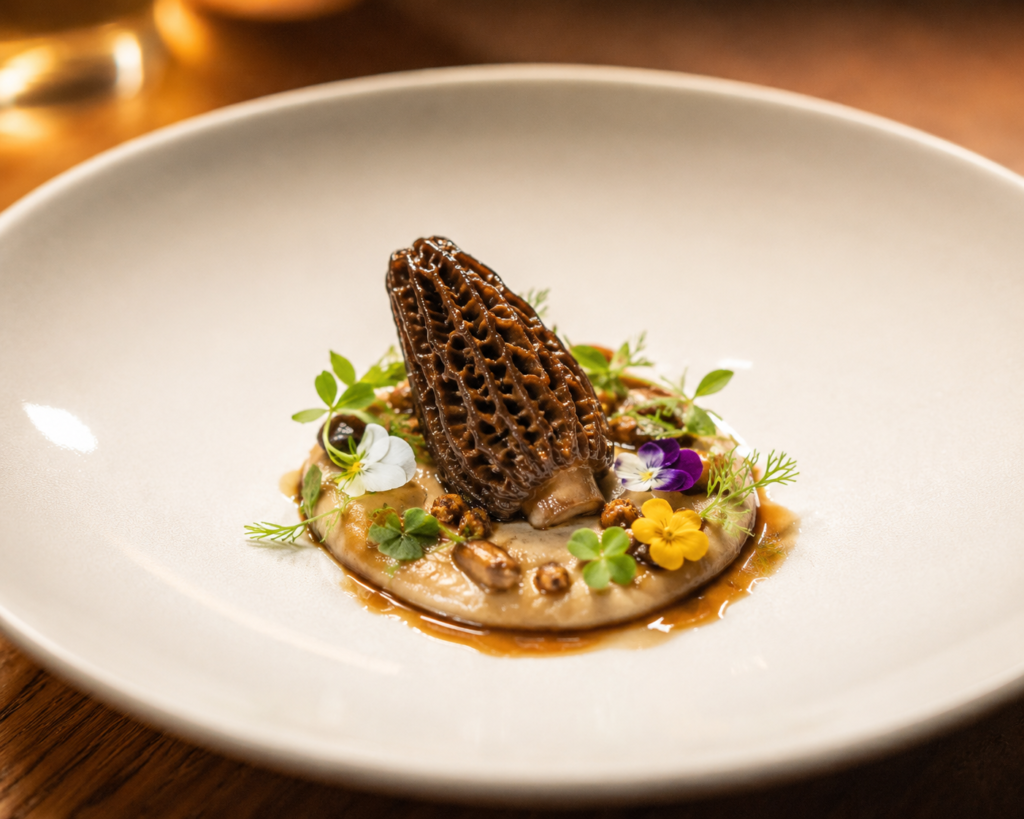
Masque (Mumbai) Address: Laxmi Woollen Mills, Dr. E Moses Road, Mumbai Chef: Prateek Sadhu What it is: India’s most celebrated farm-to-table, hyperlocal Indian restaurant. Uses ingredients sourced exclusively from small farmers and forgotten regional produce — morels from Kashmir, black rice from Manipur, sea greens from Goa. What to order: 7-course tasting menu (₹5,500–7,000/person) — changes monthly based on seasonal availability Listings: Asia’s 50 Best Restaurants 2025; TIME Magazine’s Top 100 World Restaurants Reservations: Book 3–4 weeks ahead minimum
Gaggan Anand (Bangkok-based Indian chef, mentioned for context) Note: India does not yet have any restaurant in the World’s Top 50 — the country’s finest chefs (Manish Mehrotra, Prateek Sadhu, Vineet Bhatia) are globally celebrated but the recognition structures are still developing.
Bukhara (ITC Maurya, New Delhi) Address: ITC Maurya Hotel, Sardar Patel Marg, New Delhi What it is: Since 1977, Bukhara has been considered the finest North Indian tandoor restaurant in the world — Bill Clinton called it his favourite restaurant in the world. Unchanged menu since opening. What to order:
- Dal Bukhara: Black lentils slow-cooked for 18 hours, ₹1,400–1,800
- Sikandari Raan: Whole marinated leg of lamb, serves 2–3, ₹4,500–6,500
- Burra Kebab: Marinated mutton chops from the tandoor, ₹1,600–2,200 Price for 2: ₹6,000–12,000 Reservations: Essential
Dum Pukht (ITC Maurya, New Delhi) What it is: The only restaurant in India dedicated entirely to the Dum Pukht (sealed pot slow-cooking) tradition of Awadhi cuisine. The chef, Imtiaz Qureshi, is considered a National Living Treasure of Indian cuisine. What to order:
- Gosht Dum Biryani: ₹2,200–2,800 for 2
- Murgh Musallam: Whole marinated chicken, ₹3,500–4,500 Price for 2: ₹7,000–14,000
Food Tours — The Best Guided Food Experiences
Why a Food Tour in India Is Worth It
India’s best food is often in places that are confusing to navigate, in lanes with no signage, at stalls with menus in Hindi or regional languages. A good food tour guide is not just showing you what to eat — they are translating a culture, explaining the history of a dish, knowing which specific vendor’s version is the definitive one.
Top Food Tour Operators by City:
Delhi:
- Delhi Food Walks: The most established food tour operator in Old Delhi. Chandni Chowk walking tour: ₹2,500–3,500/person (3 hours, 8–10 stops)
- Salaam Baalak Trust Food Tour: Run by former street children now trained as guides — social enterprise, extraordinary human story alongside the food. ₹1,800–2,500/person.
Mumbai:
- Khaki Tours: Dharavi food tour and Old Mumbai food trail. ₹1,500–2,500/person.
- Mumbai Magic Tours: Specific Irani café trail, street food by neighbourhood. ₹2,000–3,000.
Varanasi:
- Varanasi Food Tour (GetYourGuide/Klook): Morning ghats + street food combination. ₹1,800–3,000/person.
Kolkata:
- Calcutta Walks: Heritage + food combination. ₹2,000–3,000/person.
Jaipur:
- Rajasthan Food Safari: Heritage walk + cooking class combination. ₹2,500–4,500.
Food Safety & Practical Eating Tips for India
How to Eat Safely Without Missing Anything
The two extremes of advice on Indian street food — “never eat anything from the street” and “eat everything everywhere” — are both wrong. Here is the calibrated, honest guide:
Eat freely at: High-turnover stalls (long queues = fresh food = lower risk), stalls where you can see the food being cooked to order in front of you, places where locals are eating (not just tourists).
Be cautious with: Pre-assembled food sitting in open containers, cut fruit from carts (especially in summer), cream-based or dairy-based foods that have been sitting out in heat.
Avoid: Water that isn’t sealed or from an obviously trusted source (use your purification bottle or buy sealed), raw salads unless you know the establishment, ice (in local dhabas — most use unfiltered water).
The truth: Most foreign travellers to India experience some degree of digestive adjustment in the first 3–5 days. This is normal. Carry ORS sachets, a probiotic supplement, and one course of Norflox. Don’t let the fear of “Delhi Belly” stop you from eating India’s extraordinary food — just eat it with information.
The best protection: Probiotic food — eat curd (yoghurt), lassi, and raita regularly from the beginning of your trip. The live cultures build digestive resilience faster than you’d expect.
Must-Try Drinks Across India
Hot Drinks
| Drink | Region | Description | Price |
|---|---|---|---|
| Masala Chai | Nationwide | Spiced black tea with milk, cardamom, ginger, cloves | ₹10–40 |
| Filter Coffee | South India | Strong decoction + hot milk in tumbler-davara | ₹20–60 |
| Irani Chai | Hyderabad, Mumbai | Milk simmered separately, strong tea — unique sweetness | ₹20–40 |
| Kahwa | Kashmir | Green tea with saffron, cardamom, almond | ₹60–150 |
| Sulaimani | Kerala/Malabar | Black lemon tea, spiced, digestive | ₹30–80 |
Cold Drinks
| Drink | Region | Description | Price |
|---|---|---|---|
| Lassi (Sweet) | Punjab/Nationwide | Thick beaten yoghurt with sugar | ₹60–150 |
| Aam Panna | North India | Raw mango cooler — sweet-tart-spiced | ₹40–100 |
| Jaljeera | North India | Cold spiced water with cumin, mint, tamarind | ₹30–60 |
| Buttermilk (Chaas) | Gujarat/Rajasthan | Thin spiced yoghurt drink, savoury | ₹30–80 |
| Tender Coconut Water | Coastal India | Direct from the coconut, chilled | ₹40–80 |
| Sugarcane Juice | Nationwide | Fresh-pressed, seasonal variations | ₹30–60 |
| Bael Sherbet | UP/Bihar | Wood apple fruit drink, cooling | ₹30–60 |
| Falooda | Nationwide | Rose milk + vermicelli + basil seeds + ice cream | ₹80–150 |
Budget Eating Guide — All India Prices 2026
Eating in India at Every Budget
The Zero Budget Meal: Free langar at any Sikh gurudwara. Free bhandara (community meals) near major Hindu temples. Available in every city. No registration, no religion requirement. Simply respectful behaviour.
₹100 Day (Extreme Budget):
- Breakfast: Chai + 2 idli ₹30–50
- Lunch: Dal-roti at a dhaba ₹50–70
- Evening: Chai ₹15 Total: Under ₹140
₹300 Day (Budget Traveller):
- Breakfast: Paratha + chai ₹80
- Lunch: Thali at a mid-range restaurant ₹120
- Snacks: Chaat or street food ₹50–80
- Dinner: Dal + sabji + roti at dhaba ₹100 Total: ₹350–380
₹1,000 Day (Mid-Range):
- Full meals at proper restaurants with variety
- One experience dish (biryani, kebab plate)
- Coffee at a cafe Total: ₹800–1,200
₹3,000+ Day (Restaurant + Fine Dining):
- One fine dining meal per day
- Breakfast at hotel
- Afternoon café Total: ₹2,500–5,000
FAQ Section
Q: What is the best street food city in India in 2026?
A: By most verified food rankings and chef endorsements, Indore in Madhya Pradesh is India’s top street food city in 2026 — winning on variety, affordability, and quality. Sarafa Bazaar (night market, 8pm–midnight) and Chappan Dukan (morning, 7–9am) are the two essential food experiences. Delhi’s Old Delhi (Chandni Chowk) is the most historically significant, and Mumbai has the most democratic and diverse street food culture.
Q: What should I definitely eat in India as a first-time visitor?
A: The non-negotiable list: Hyderabadi Biryani in Hyderabad, Vada Pav in Mumbai, Kathi Roll in Kolkata, Chole Bhature for breakfast in Delhi, Kerala Fish Curry on a banana leaf, a full Masala Dosa in Chennai or Bengaluru, and Dal Baati Churma in Rajasthan. Add Tunday ke Kebab in Lucknow if you eat meat — it is one of the most extraordinary things in Indian food.
Q: Which restaurants in India are on international food lists?
A: Indian Accent (New Delhi) consistently appears on Asia’s 50 Best and World’s 50 Best Discovery lists. Masque (Mumbai) is on Asia’s 50 Best as of 2025. Bukhara (ITC Maurya, Delhi) has been recognised internationally as one of the world’s great North Indian restaurants since 1977. India does not yet have a Michelin Guide for domestic restaurants as of 2026.
Q: Is street food in India safe to eat?
A: Generally yes, at high-turnover stalls where you can see food being cooked to order. Most travellers experience some digestive adjustment in the first few days — carry ORS sachets, eat yoghurt/lassi regularly, avoid pre-assembled foods sitting out in heat, and drink only sealed or treated water.
Q: What is the most expensive food experience in India?
A: A tasting menu at Masque (Mumbai) or Indian Accent (Delhi) runs ₹5,500–7,500 per person. The Sikandari Raan at Bukhara (ITC Maurya, Delhi) is ₹4,500–6,500 for a whole leg of lamb. Palace hotel dining in Rajasthan (Rambagh Palace, Udaipur’s Taj Lake Palace) can reach ₹6,000–12,000 for two.
Q: What vegetarian food is best in India?
A: India is a paradise for vegetarians. Best cities: Gujarat (the most complete vegetarian cuisine in India — Dhokla, Thepla, Undhiyu, the greatest variety of vegetarian food in the country), Rajasthan (Dal Baati Churma, Pyaaz Kachori, Ghevar), Tamil Nadu (Masala Dosa, Idli, full South Indian thali), and Varanasi (entirely vegetarian city, extraordinary kachori and chaat culture).
Q: When is the best time for food tourism in India?
A: October to March is the peak food season — most festivals involving elaborate food preparation fall in this window (Diwali, Dussehra, Pongal, winter specialities like Daulat ki Chaat and Malaiyo). The Pushkar Camel Fair (November) has extraordinary Rajasthani food. Onam in Kerala (August–September) features the grand Sadya feast.
Conclusion — India Will Feed You Better Than Anywhere Else
This is not a boast. It is a data point supported by five thousand years of accumulated cooking knowledge, thirty-five distinct regional food cultures, the world’s largest vegetarian food tradition, and a street food culture that is priced for everyone and perfected by no one who is in a hurry.
India will make you eat things you didn’t know you wanted. It will introduce you to flavours that don’t have analogues in any other cuisine. It will serve them to you on a banana leaf, in a clay pot, on a plastic plate in a lane that smells like cardamom and diesel — and the context will somehow make every bite better.
The dal at Bukhara and the dal at a truck-stop dhaba on the highway both have their place in this. Both are worth eating with full attention. Both will tell you something true about this country and the people who live in it.
Eat everything. Ask what’s in it after. Ask for extra ghee.
Khana khao. Enjoy.