

I didn’t expect Kerala to stay with me the way it did.
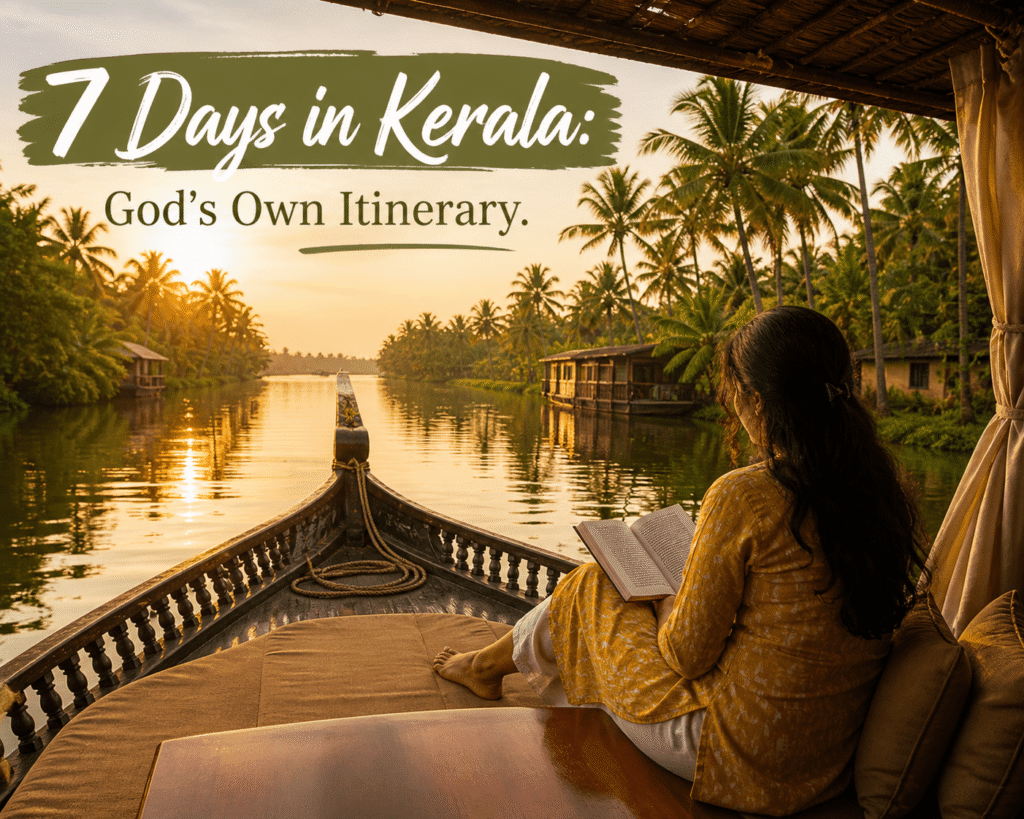
I’ve done the Rajasthan circuit. I’ve navigated Bangkok solo at midnight. I’ve eaten my way through Penang and pretended to understand wine in Tuscany. But there was something about standing on the deck of a houseboat in Alleppey at 6am — mist still sitting on the water, a kingfisher doing something impossibly precise in the reeds, the smell of coconut oil and cardamom drifting from the boat’s kitchen — that made me feel like I’d finally found a place that wasn’t trying too hard.
Kerala doesn’t perform for tourists. It just is. And somehow, that’s more disarming than any postcard could prepare you for.
This itinerary is the one I wish I’d had before I went — not a clipboard checklist of monuments, but a route that actually lets you feel the place. Seven days. Real food. Honest logistics. And a few moments where you’ll forget to check your phone.
Let’s go.
Quick Summary Table
| Day | Location | Highlight | Accommodation Type |
|---|---|---|---|
| Day 1 | Kochi (Cochin) | Fort Kochi streets, Chinese fishing nets, seafood dinner | Heritage guesthouse |
| Day 2 | Kochi → Munnar | Tea estates, mountain drive, Eravikulam NP | Plantation stay / homestay |
| Day 3 | Munnar | Mattupetty Dam, Top Station, tea factory visit | Homestay |
| Day 4 | Munnar → Thekkady | Periyar Wildlife Sanctuary, spice plantation tour | Jungle resort / eco-stay |
| Day 5 | Thekkady → Alleppey | Arrive by noon, board houseboat, backwater cruise | Houseboat |
| Day 6 | Alleppey Backwaters | Slow morning, village walk, fish curry lunch | Houseboat / heritage hotel |
| Day 7 | Alleppey → Kovalam or Kochi | Beach, Ayurveda, departure | Beach resort / airport hotel |
Best time to visit: September to March (post-monsoon freshness or cool winter months) Base budget (7 days, per person): ₹25,000–₹45,000 (excluding flights) Flying in: Kochi International Airport (COK) is your entry point
Day 1: Kochi — Where History Forgot to Leave
Arrive, Slow Down, Let the City Find You
Most people land in Kochi and immediately try to “do” it. Rush to the Chinese fishing nets. Tick the Jew Town antique shops. Grab a coffee at a café that has good lighting for Instagram. Done by 2pm, already bored.
Don’t do that.
Kochi — specifically Fort Kochi — rewards the traveler who wanders without a plan. The streets here carry four hundred years of colonial layering: Portuguese churches, Dutch cemeteries, British bungalows, and Jewish synagogues all existing within a ten-minute walk of each other. It sounds like too much history in too little space. Somehow it works.
Morning: Check into your guesthouse in Fort Kochi — ideally something in a converted heritage property. The Brunton Boatyard is the splurge option (₹8,000+/night, genuinely beautiful). For mid-budget travelers, Eighth Bastion (~₹3,500–₹5,000/night) sits inside a restored 18th-century fortification. Budget travelers: look for homestays in the ₹1,200–₹2,000/night range — Fort Kochi has plenty, most with breakfast included.
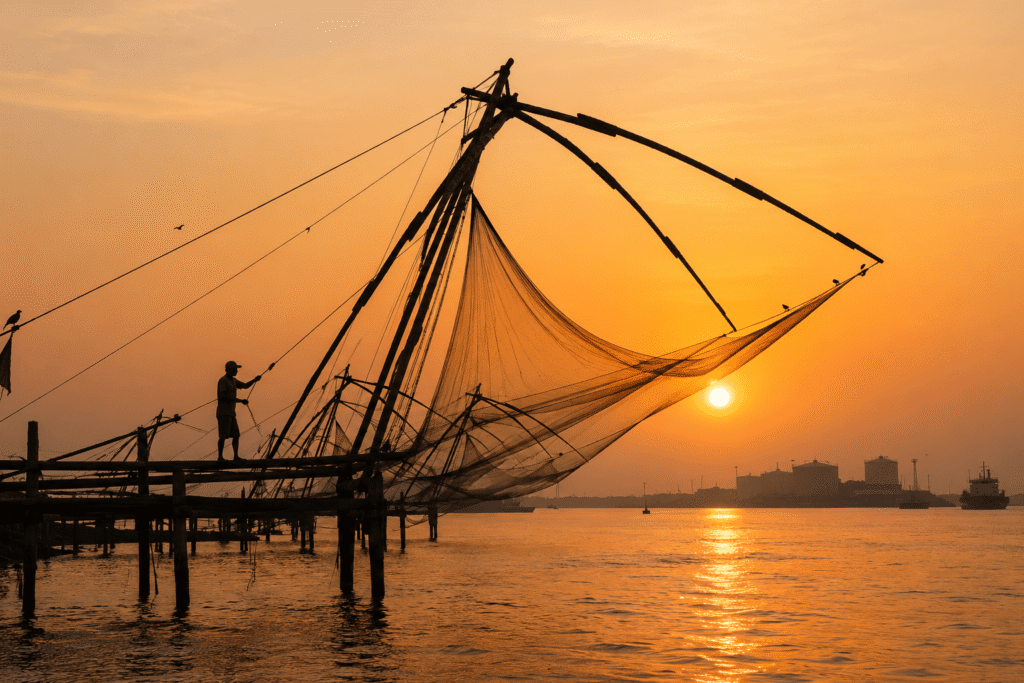
Late morning: Walk to the Chinese Fishing Nets (Cheena Vala) — yes, every tourist goes, but go early (before 9am) and you’ll catch the fishermen actually working, hauling the nets in coordinated rhythm, selling the morning catch right there on the stone jetty. Stay long enough to buy some fresh prawns from a fisherman and hand them to the nearest fry stall, who’ll cook them for ₹50–₹80 in spiced coconut oil.
That is your breakfast. You’re welcome.
Afternoon: Wander through Jew Town (Mattancherry) — not just for the antiques and spice shops but for the Paradesi Synagogue, the oldest active synagogue in the Commonwealth. Then walk the five minutes to the Dutch Palace (Mattancherry Palace), which has some of the best-preserved Kerala murals you’ll see anywhere.
Evening: Kerala Kathakali performance at the Kerala Kathakali Centre (~₹250–₹400 entry). Arrive 45 minutes early to watch the performers apply makeup — the transformation is as theatrical as the performance itself.
Dinner: Head to Dhe Puttu for one of Kerala’s greatest street food inventions — puttu and kadala curry, but elevated. Or walk along Calvathy Road for fresh grilled fish at any of the informal stalls. Budget ₹300–₹600 for a proper meal.

Day 2: Kochi to Munnar — The Drive That Changes Everything
130 Kilometres of Reasons to Stop the Car
The drive from Kochi to Munnar takes 3.5 to 4.5 hours depending on traffic and how many times you pull over for photographs — and you will pull over, repeatedly, with increasing frequency as the road climbs into the Western Ghats.
Rent a cab for this leg. Don’t attempt a self-drive unless you’re comfortable on ghat roads (tight hairpin bends, shared with trucks, genuinely spectacular views). A private cab from Kochi to Munnar runs ₹2,500–₹3,500 and is worth every rupee for the flexibility it buys you.
Stop 1 — Cheeyappara Waterfalls: About 2 hours from Kochi, the road suddenly reveals a multi-tiered waterfall tumbling down the hillside. Pull over. Spend twenty minutes. The mist is cold. It’s good.
Stop 2 — Valara Falls: Another 10 minutes up the road. Smaller, more intimate. The tea stalls here sell ginger tea that tastes like it was brewed specifically for this altitude.
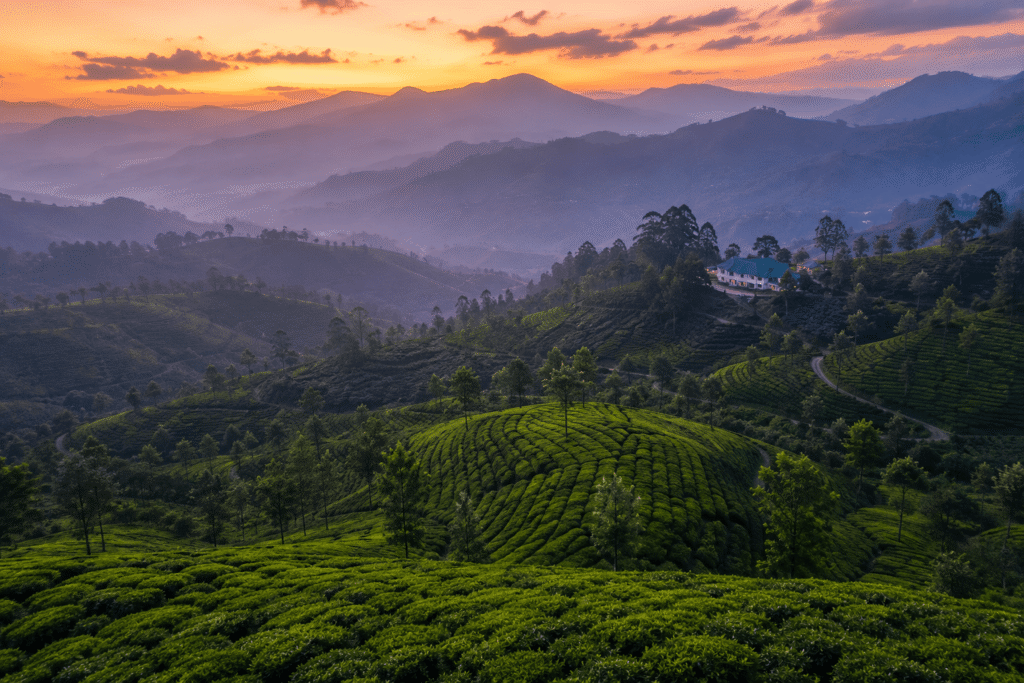
By the time you arrive in Munnar, the air is noticeably cooler and the landscape has shifted entirely — you’re in tea country now, and the endless rolling green of the plantations is not something you fully process until you’re standing inside it.
Afternoon: Check in. If your budget allows, stay at a plantation homestay rather than a regular hotel — properties like Windermere Estate (~₹5,000–₹7,000/night) sit directly inside working tea estates and wake you up to a view that doesn’t feel real. Budget option: homestays in town from ₹1,200–₹2,000/night are clean and homely, often with the owner’s family cooking dinner for guests.
Evening: Just sit. Watch the mist roll in over the tea hills. Have tea — obviously.
Day 3: Full Day in Munnar — Slow Is the Right Speed
Tea, Altitude, and One Endangered Species
Munnar mornings are cold. Wake up early anyway.
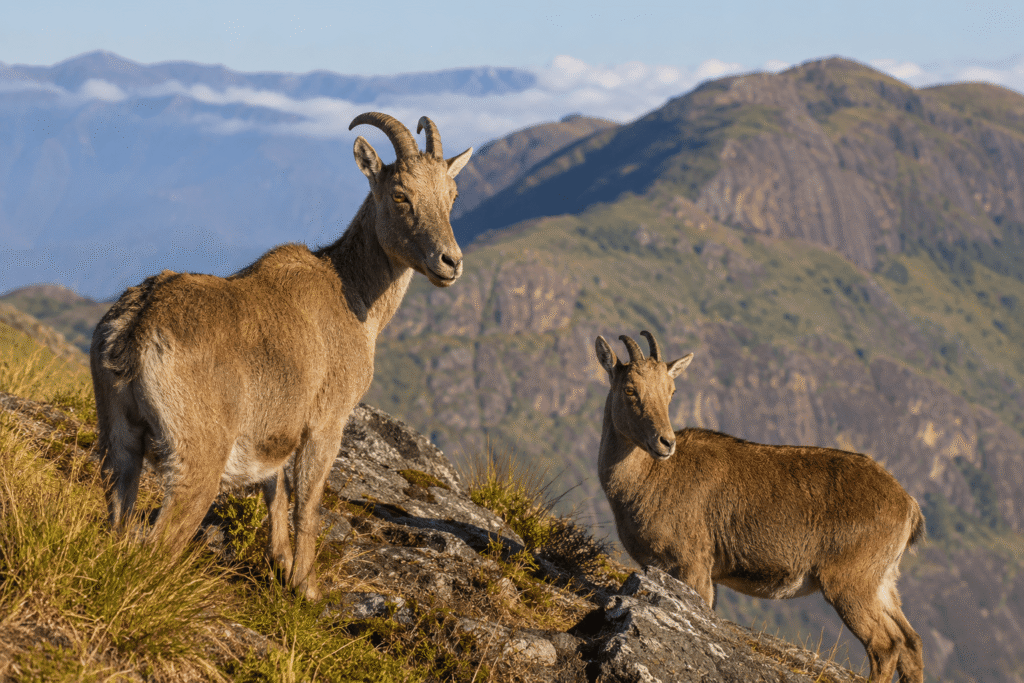
Morning: Drive to Eravikulam National Park — home to the endangered Nilgiri Tahr, a mountain goat that looks permanently startled and has no concept of personal space. The park opens at 8am; go early before tour groups arrive. A government bus takes you up to the viewing point (entry ~₹125 for Indians). On a clear morning, the Anamudi Peak — South India’s highest point — is visible.
Midday: Visit the Tata Tea Museum in Munnar town (~₹75 entry) — a genuinely interesting history of how tea cultivation transformed these hills. Then have lunch at Saravana Bhavan or any local restaurant in town. A full South Indian meal here costs ₹120–₹200. Eat the Kerala parotta with beef curry if you eat meat. It’s essential fieldwork.
Afternoon: Drive to Mattupetty Dam and Lake — boat rides available (₹100–₹150 per person). Then push on to Top Station, the highest point in Munnar with views across into Tamil Nadu on a clear day. The road is narrow and sometimes shared with jeeps that operate with alarming confidence. It’s fine.
Evening: Back in town, hunt for a tea factory with evening tours — several estates offer them for ₹150–₹300. Watching tea go from leaf to packaging in a single building, guided by someone who’s worked there for twenty years, is oddly meditative.
Day 4: Munnar to Thekkady — Spice Country
Where the Air Smells Like Everything at Once
The drive from Munnar to Thekkady is 90 kilometres, roughly 3 hours, and it marks the descent from tea hills into spice territory. The vegetation changes. The temperature rises slightly. The roadside shops start selling fresh pepper, cardamom, and cinnamon in quantities you didn’t know you needed.
Morning: Check out and make a stop at a spice plantation tour in Thekkady — outfits like Abraham’s Spice Garden (~₹300–₹500 per person) walk you through pepper vines, cardamom groves, nutmeg trees, and vanilla orchids. The guide will break open a cardamom pod and have you smell it fresh. It’s the kind of sensory moment that makes you deeply suspicious of the cardamom sitting in your kitchen at home.
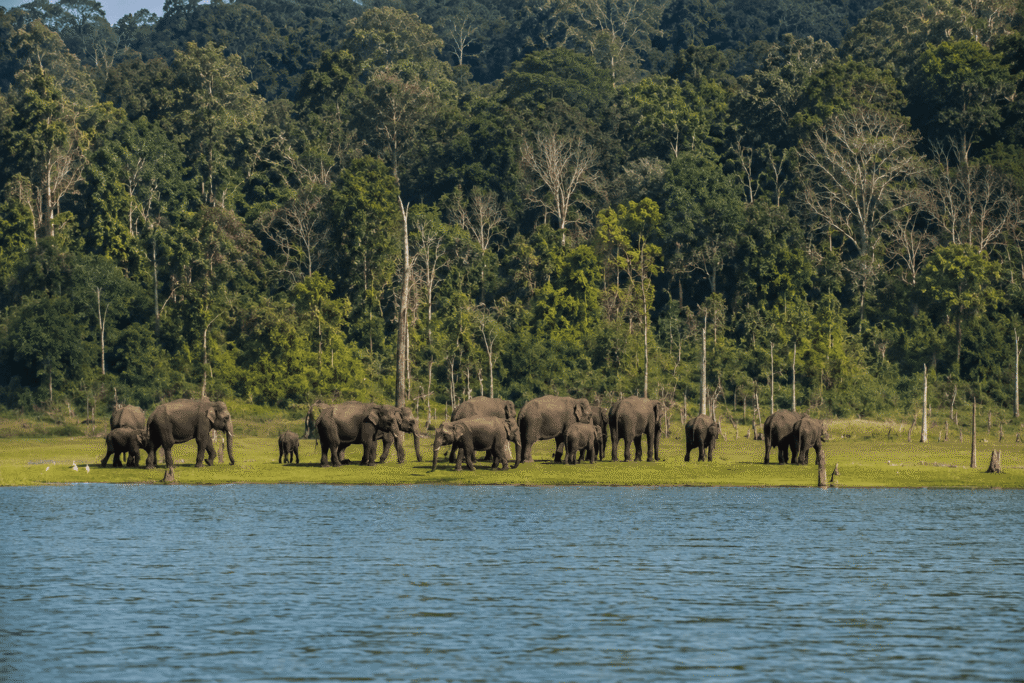
Afternoon: Periyar Wildlife Sanctuary — the main draw in Thekkady. The boat ride on Periyar Lake (~₹200 for a 2-hour government boat ride) passes through jungle where elephants, bison, and deer come to the water’s edge. Sighting frequency varies, but the landscape alone justifies the trip.
Evening: Thekkady’s Kumily town has a good street food scene. Try ela sadam (banana leaf rice) at a local restaurant. Budget ₹150–₹250. If you’re staying at an eco-resort, they’ll often include a traditional Kerala dinner — eat it. All of it.
Stay: Eco-stays and jungle lodges near Periyar range from ₹1,800 (basic but atmospheric) to ₹8,000+ for proper resort comfort. The Spice Village by CGH Earth (~₹10,000/night) is the indulgent choice and architecturally stunning. Mid-budget: Wildernest Nature Resort at ₹3,500–₹5,000/night is excellent value.
Day 5: Thekkady to Alleppey — The Backwaters Await
You’ve Been Looking Forward to This Since You Booked the Trip
It takes about 3.5 hours to drive from Thekkady to Alleppey (Alappuzha). Arrange a private cab (₹2,800–₹3,500) or take the KSRTC bus if you’re budget-traveling and don’t mind the longer, stop-heavy journey.
Try to reach Alleppey by noon. You’ll need time to board your houseboat, get oriented, and settle in before the boat moves.
The Houseboat: Managing Expectations Honestly
Let’s be real about something. The “houseboat” as shown in travel brochures — gleaming teak deck, chef preparing a 10-course meal, lotus flowers floating past — is the aspirational version. The reality, especially on budget houseboats, can be a little… intimate. The beds are fine. The bathroom is small. The generator runs on a schedule.
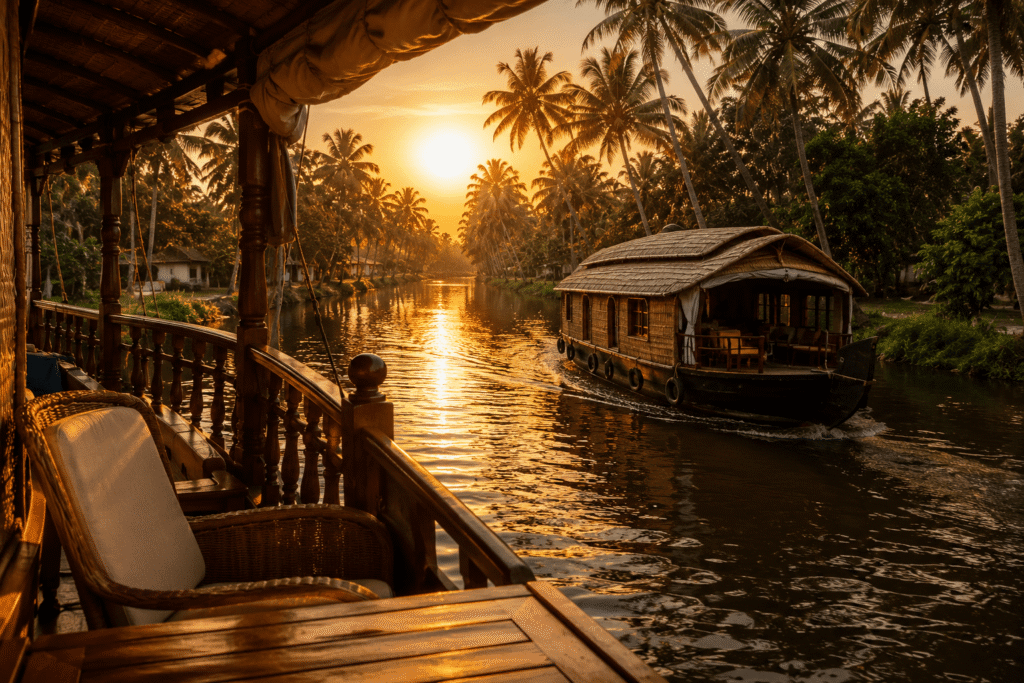
And yet: the backwaters at sunset from the deck of even a modest houseboat are magnificent. This is the truth that survives all expectation management.
Budget houseboat (₹6,000–₹9,000/night, all meals included): Standard, functional, gets the job done. Meals are simple but authentic — fish curry, rice, coconut chutney, and a vegetable dish.
Mid-range (₹12,000–₹18,000/night): More space, better quality wood, attentive crew, sometimes a rooftop deck. Worth it if you’re celebrating something or traveling as a couple.
Premium (₹25,000+/night): Private houseboat, chef, sometimes a second boat as a support vessel. For those to whom budgets are someone else’s concern.
Evening: The houseboat drifts through narrow canals where village life happens at the water’s edge — children swimming, women washing clothes, fishermen setting nets as the light turns amber. No one is performing for you. You’re just passing through their evening.
It’s the most unhurried thing I have ever done in my life.
Day 6: Alleppey — The Morning After the Backwaters
Slower Than Yesterday, Somehow
Wake up before 7am. The early light on the backwaters — the lotus flowers open, the birds doing their morning business, a distant temple bell — is the kind of thing that makes you feel briefly but sincerely glad to be alive.
Morning: Most houseboats include a morning boat ride through smaller channels before returning to the main wharf by 9am. Don’t rush this. Put the phone down for at least 20 minutes.
Late morning: After checkout, take a village walk through the backwater communities near Alleppey. Ask your houseboat operator or hotel to arrange a local guide (₹500–₹800 for a 2-hour walk). You’ll see coir-making workshops, small rice farms, and kitchens that smell better than most restaurants.
Lunch: Find a local Kerala restaurant — order the Kerala fish curry and rice on a banana leaf. If it costs more than ₹250, you’re somewhere aimed at tourists. Budget ₹150–₹200 at a local hotel (that’s what they call local restaurants in Kerala — hotels).
Afternoon: If you have an extra night, consider staying at a heritage villa in Alleppey — Raheem Residency (~₹5,000–₹8,000/night) is a beautifully restored 1868 British bungalow that’s worth it just for the architecture and the garden breakfast.
Day 7: Kovalam or Kochi — Ending Well
The Last Day Rule: Don’t Waste It Packing
If your flight is from Kochi and leaves in the evening, you have options:
Option A: Drive directly to Kochi (3.5 hours from Alleppey), spend the day in Fort Kochi revisiting anything you missed on Day 1, then head to the airport.
Option B: Drive to Kovalam (~2.5 hours from Alleppey), spend half a day at the lighthouse beach — the light and the cliffs are best in the morning — then head up to Thiruvananthapuram airport (TRV) if you’re flying from there.
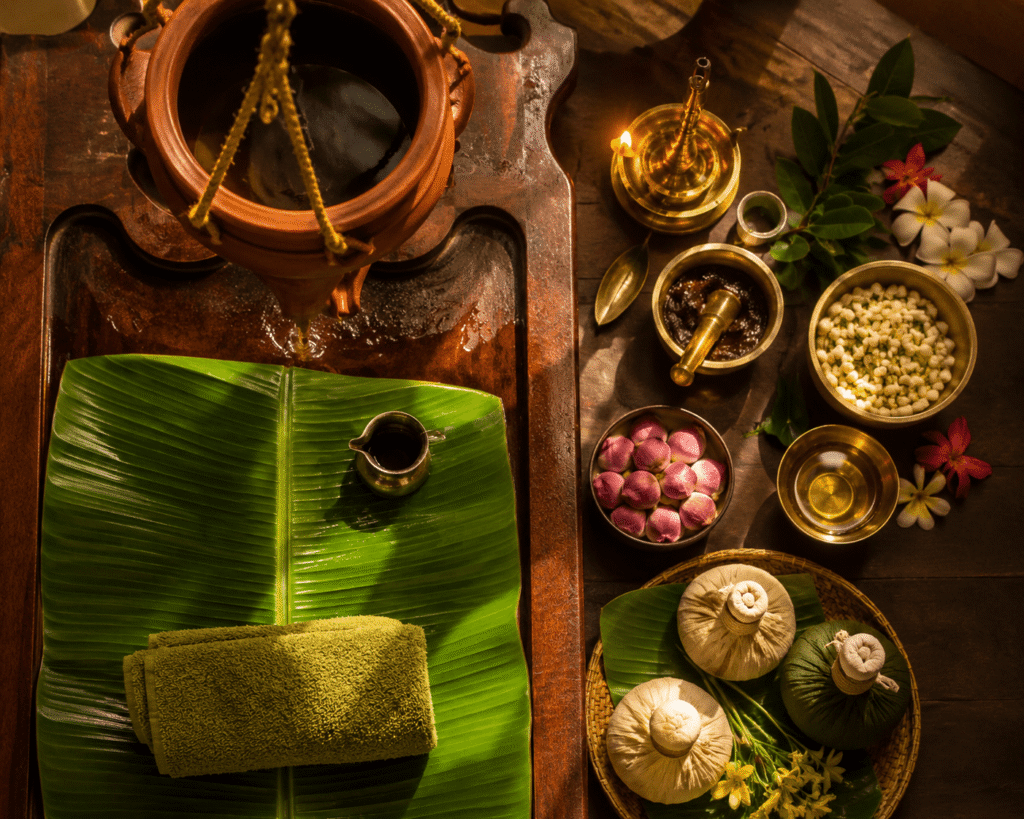
If you have time for one thing on your last day: an Ayurveda massage. This is Kerala, and ignoring Ayurveda here is like going to Darjeeling and skipping the tea. A proper Kerala Abhyanga (oil massage) runs ₹1,500–₹3,000 for 60–90 minutes at a legitimate Ayurveda centre. Avoid “Ayurveda spas” in tourist hotels that charge ₹8,000 for a glorified Swedish massage with sesame oil.
My Personal Style Recommendations
I’ll be honest about what I’d do differently and what I’d do exactly the same.
Same: The houseboat night, even on a budget boat. The spice plantation tour — go with Abraham’s, skip the resort-run ones. Eating at local hotels (restaurants) for every meal except one special dinner. The Kathakali performance in Kochi.
Differently: I’d skip Kovalam unless I had 9–10 days. It’s a good beach but it doesn’t add something irreplaceable to a 7-day Kerala trip. I’d use that time for another day in the backwaters or a morning drive up to Vagamon near Thekkady.
Upgrade worth making: One night at a plantation stay in Munnar. The view when you wake up justifies the price difference from a town hotel almost every time.
Save money here: Intercity transport (KSRTC buses between major stops are excellent), eating local at every opportunity, and skipping the big-resort Ayurveda packages in favour of standalone Ayurveda clinics.
Pro Tips
- Download offline Google Maps for Kerala before you land. Mobile signal in Munnar’s higher elevations and some backwater areas is patchy at best.
- Carry light cottons for Kochi and Alleppey; pack a layer for Munnar. The temperature difference between the coast and the hills is 8–12°C. Most people underprepare for how cold Munnar evenings get.
- Kerala’s monsoon (June–August) is beautiful if you’re chasing waterfalls, but houseboats are often cancelled and Eravikulam National Park closes. Plan accordingly.
- Hire local guides for Periyar and Eravikulam — they know where the animals move and what you’re actually looking at. It’s ₹500–₹800 and categorically worth it.
- Book houseboats directly with operators or via verified platforms — not through hotel concierges who take 20–30% commission and send you to whichever boat gives them the biggest cut.
- The best Kerala meals are always inside people’s homes. If a homestay offers dinner, say yes. Always say yes.
Mistakes to Avoid
Spending too many days in Kochi: Fort Kochi is beautiful for a day and a half. After that, you’ve seen it. People sometimes allocate three or four days here and regret not spending that time in the hills or backwaters.
Booking a houseboat that doesn’t include an overnight stay: Day houseboat rides exist and they’re not the same experience. You want the overnight — the morning on the water is the thing.
Visiting only the “tourist belt” in Thekkady: The Periyar boat ride and spice plantation are on every itinerary for a reason, but the real Thekkady is in its quieter village trails and sunrise trekking routes. Ask your accommodation to help you access these.
Underestimating Kerala driving times: Google Maps optimistically estimates road times in Kerala. The ghat roads have their own definition of “speed.” Always add 30–45 minutes to any estimated drive time.
Going to the most Instagrammed tea viewpoints in Munnar on weekends: They’re packed. Ask your homestay owner for the quieter roads — there are always quieter roads.
Budget Tips for Kerala
- KSRTC buses between cities are reliable, safe, and roughly 60–70% cheaper than private cabs. The Kochi to Alleppey route, for instance, costs ₹80–₹120 on a bus vs ₹2,500–₹3,000 by cab.
- Government boat services in Alleppey (₹10–₹25 for a journey) are the budget alternative to houseboats if you really need to cut costs — they’re slower and less comfortable but you’re still on the backwaters.
- Homestays over hotels in every destination save money and gain experience. Most Kerala homestays include breakfast; many include dinner by request.
- Eat at meals restaurants (establishments that serve a fixed South Indian thali) — banana leaf meals with unlimited rice, sambar, four or five curries, and papad for ₹120–₹180. This is where Kerala’s food culture lives.
- Temple entry in Kerala is free at most sites. The exceptions are some wildlife area permits and national park entry fees, which are very reasonable for Indian nationals.
FAQ Section
Q: Is 7 days enough for Kerala?
A: Seven days is a solid, well-paced first Kerala trip if you focus on the classic triangle — Kochi, Munnar, Thekkady, and Alleppey. You won’t cover everything (Wayanad, Kozhikode, Varkala, and Kovalam all deserve their own visits), but you’ll leave with a genuine sense of the state rather than a rushed highlight reel.
Q: What is the best time to visit Kerala?
A: September to March is ideal. October to February offers the most reliable weather — clear skies, no rain, and post-monsoon lushness still visible. December and January are peak season with higher prices. For waterfalls and lush greenery, the edge of monsoon (September–October) is spectacular.
Q: How much does a Kerala trip cost for 7 days from India?
A: Budget travelers can manage ₹25,000–₹35,000 per person (excluding flights) — using homestays, KSRTC buses, and local restaurants. A comfortable mid-range trip runs ₹45,000–₹70,000 per person. Add ₹10,000–₹20,000 for flights from major Indian cities.
Q: Is Kerala safe for solo female travelers?
A: Kerala consistently ranks among the safer Indian states for solo women travelers. Fort Kochi, Munnar, and the backwater areas are generally relaxed and tourist-friendly. Standard precautions apply — arrange accommodation before arriving, avoid isolated areas after dark, and trust your instincts.
Q: How much does a houseboat in Alleppey cost?
A: Budget houseboats with all meals included start at ₹6,000–₹9,000 per night for a standard one-bedroom. Mid-range boats run ₹12,000–₹18,000/night. Premium private houseboats start at ₹25,000/night. Prices are typically per boat, not per person, which makes them better value for couples or groups.
Q: What food should I try in Kerala?
A: The non-negotiables: Kerala fish curry with red rice, puttu and kadala curry, appam with stew, prawn moilee, banana leaf meals (sadya), and Kerala beef fry if you eat meat. For dessert: ada pradhaman (rice flakes in jaggery and coconut milk) is the kind of thing you’ll dream about later.
Q: Do I need to book Munnar and Thekkady accommodation in advance?
A: For peak season (November to January) and long weekends, yes — book at least 2–3 weeks ahead, especially for plantation homestays and eco-lodges that have limited rooms. Off-season travel (February to May, September to October) has more walk-in availability.
Conclusion
Seven days in Kerala doesn’t feel like enough while you’re there. That’s not a complaint — it’s a feature.
There are places you visit and places that visit you back. Kerala is the second kind. The kind where you find yourself googling flight prices back home while you’re still technically on the trip. Where the fish curry you had on a banana leaf in Alleppey becomes the benchmark against which every other fish curry is quietly judged. Where a kingfisher landing on the bow of your houseboat at 6am becomes a memory that surfaces randomly and inconveniently for years.
Go slow. Eat everything. Talk to your homestay hosts. Say yes to the dinner they offer to cook. Take the road that doesn’t have a viewpoint marked on Google Maps.
God’s Own Country earns the title. But only if you let it.