

The ₹25,000 Phone That Made Me Question Everything
My mother called me last October and said, very matter-of-factly, that her phone had died. Could I help her buy a new one? Budget: ₹25,000. She wanted good camera for video calls with relatives, decent battery — she charges exactly once a day and expects it to survive — and nothing that would “confuse her with too many settings.”
I spent three days researching. Not because it was complicated, but because the market under ₹30,000 in India in 2026 is genuinely overwhelming — in the best possible way. There are at least fifteen phones I could confidently recommend in this range. The problem is every single one is better than what she was replacing (a four-year-old Samsung that had been living on borrowed time for at least eighteen months).
She ended up with an iQOO Neo 9. She has since taken better photos than I have with my phone. I’m not saying anything about that.
This guide is for everyone in that situation — the person buying for themselves, the person buying for a parent, the person who’s been using the same phone for three years and finally cracked the screen enough times that it’s become a philosophical question about when to let go. Under ₹30,000 in India right now is an extraordinary market. Let me show you exactly what you’re getting.
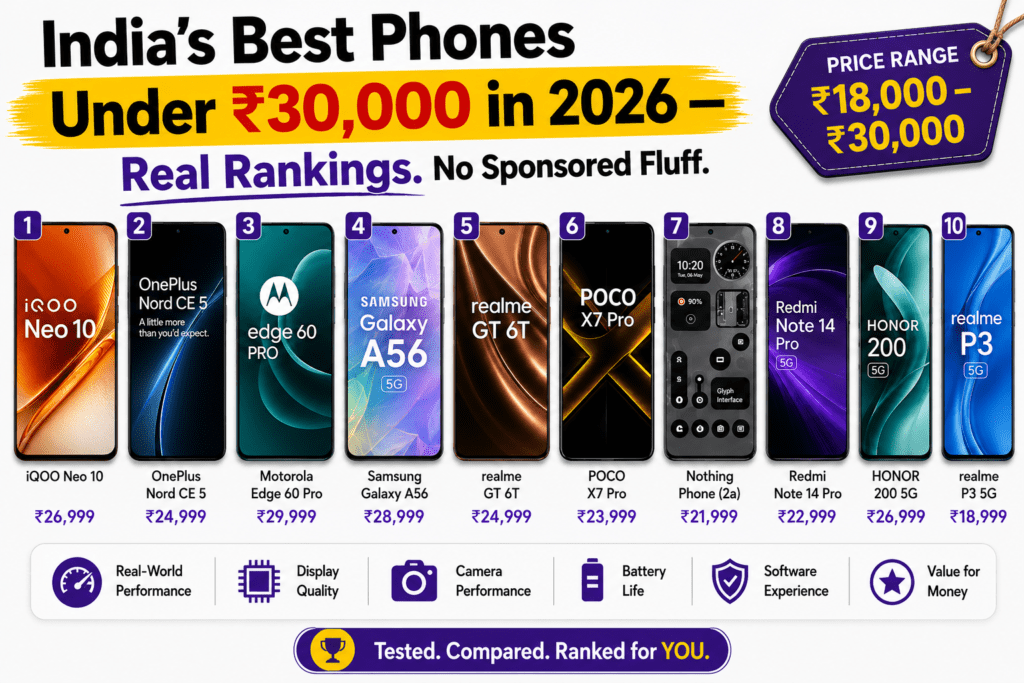
Quick Comparison Table — All 10 Phones at a Glance
| Rank | Phone | Price (₹) | Processor | RAM/Storage | Battery | Camera (Main) | Best For |
|---|---|---|---|---|---|---|---|
| #1 | iQOO Neo 10 | ₹24,999–27,999 | Snapdragon 8s Gen 4 | 8/12GB + 128/256GB | 6,400mAh + 80W | 50MP | Gaming + performance |
| #2 | OnePlus Nord CE 5 | ₹21,999–24,999 | Snapdragon 7s Gen 3 | 8/12GB + 128/256GB | 5,500mAh + 80W | 50MP | All-rounder |
| #3 | Motorola Edge 60 Pro | ₹26,999–29,999 | MediaTek Dimensity 8350 | 12GB + 256GB | 5,000mAh + 68W | 50MP | Camera + design |
| #4 | Samsung Galaxy A56 5G | ₹26,999–29,999 | Exynos 1580 | 8/12GB + 128/256GB | 5,000mAh + 45W | 50MP | Samsung ecosystem + updates |
| #5 | Redmi Note 15 Pro | ₹22,999–25,999 | Snapdragon 7s Gen 3 | 8/12GB + 128/256GB | 6,580mAh + 90W | 200MP | Battery + camera |
| #6 | POCO X7 Pro | ₹23,999–26,999 | Dimensity 8400 Ultra | 8/12GB + 256GB | 6,000mAh + 90W | 50MP | Gaming + battery |
| #7 | Realme GT 6T | ₹25,999–28,999 | Snapdragon 7+ Gen 3 | 8/12GB + 128/256GB | 5,500mAh + 120W | 50MP | Fastest charging |
| #8 | Nothing Phone (3a) | ₹24,999–27,999 | Snapdragon 7s Gen 3 | 8/12GB + 128/256GB | 5,000mAh + 50W | 50MP | Design + software |
| #9 | Vivo T5 Pro | ₹20,999–23,999 | Dimensity 8300 | 8/12GB + 128/256GB | 9,020mAh + 80W | 50MP | Battery life king |
| #10 | Samsung Galaxy M56 5G | ₹23,999–25,999 | Exynos 1580 | 8/12GB + 128/256GB | 6,000mAh + 45W | 50MP | Reliable budget Samsung |
THE TOP 10 — COMPLETE REVIEWS
#1 — iQOO NEO 10
“The Phone That Doesn’t Know It’s Supposed to Be Budget”
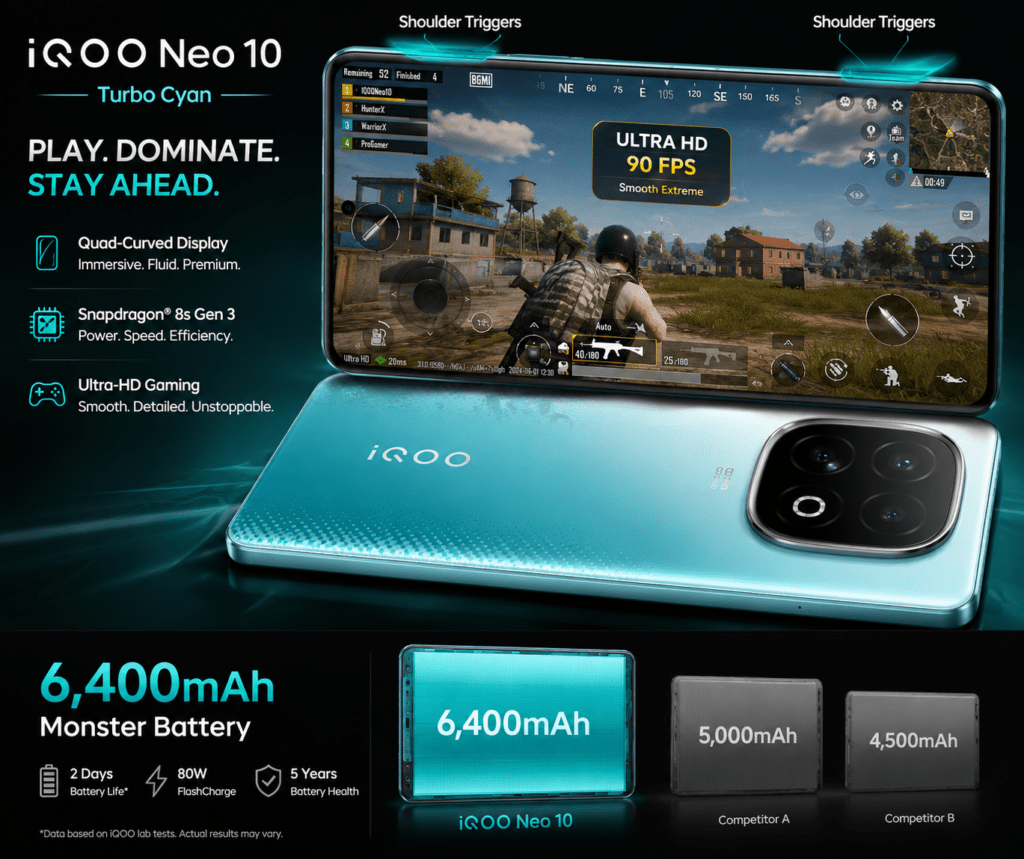
Price: ₹24,999 (8GB/128GB) | ₹27,999 (12GB/256GB) Processor: Qualcomm Snapdragon 8s Gen 4 Display: 6.78-inch AMOLED, 144Hz, 3000 nits peak Battery: 6,400mAh + 80W fast charging Camera: 50MP main (OIS) + 8MP ultrawide + no telephoto OS: FunTouch OS 15 (Android 15) Available: Amazon India 91mobiles Spec Score: 91/100
The Story: The iQOO Neo 10 is the phone that makes other phones at this price feel slightly embarrassed. Snapdragon 8s Gen 4 — yes, the chipset from last year’s flagship range — in a ₹25,000 phone. Not a watered-down version. Not the “lite” variant. The actual 8s Gen 4.
This is because iQOO (a sub-brand of Vivo) competes on raw specification value, and in May 2026, the Neo 10 is winning that argument comprehensively.
Performance: The Snapdragon 8s Gen 4 handles anything you throw at it — BGMI on ultra-HD with max frame rate? Done. Call of Duty Mobile at extreme settings? Smooth. Twelve apps open simultaneously while streaming a YouTube video? Not even a stutter. The iQOO Neo 9 was already strong; the Neo 10 takes it to a level that embarrasses phones at ₹40,000.
Gaming Specifically: iQOO phones are built for gaming as the primary use case. The 144Hz AMOLED display, the shoulder trigger buttons (haptic, mapped in games), the vapour chamber cooling — all of this exists because iQOO understands that the person buying a ₹25,000 phone in 2026 expects to game on it. The phone delivers. The 6,400mAh battery means you can game for 7–8 hours without anxiety.
Camera: The 50MP main camera with OIS is excellent for daily photography. Portrait mode is reliable, daylight photos are sharp and well-exposed. The limitation: no telephoto lens. For zoom shots, you’re using digital zoom, which shows at 5x and beyond. The ultrawide camera at 8MP is adequate but not remarkable.
In good light, the cameras are genuinely impressive for the price. In low light, the OIS helps significantly for stills. Video is 4K/60fps on the main camera with good stabilisation.
Battery: 6,400mAh is exceptional. In real-world use — 4 hours screen-on-time, gaming session, navigation, music — you’ll end the day above 40%. The 80W fast charging fills it from flat in about 45 minutes. iQOO’s charging technology is efficient and doesn’t noticeably degrade battery health at the same rate as some competitors.
Display: 3,000 nits peak brightness. This number matters for outdoor use in Indian summer — where most phones struggle with visibility in direct sunlight, the Neo 10’s display remains readable. 144Hz AMOLED with 1.5K resolution looks genuinely premium.
What real users are saying: Consistent praise for gaming performance, battery life, and the display. The most common criticism: FunTouch OS (iQOO’s skin over Android) has more bloatware than OnePlus or Nothing. The camera is good-but-not-great for photography enthusiasts.
PROS: ✅ Snapdragon 8s Gen 4 — flagship-level chip at mid-range price ✅ 144Hz AMOLED, 3000 nits — best display in this budget range ✅ 6,400mAh battery + 80W charging — lasts all day, charges fast ✅ Gaming-optimised hardware (shoulder triggers, cooling) ✅ 4K/60fps video ✅ IP64 dust and water resistance
CONS: ❌ No telephoto camera ❌ FunTouch OS has more bloatware than competitors ❌ Camera performance behind Motorola Edge 60 Pro in low light ❌ iQOO’s software updates have been inconsistent historically
Alternate (if slightly over budget): iQOO Neo 10 Pro at ₹32,999 — adds telephoto camera and better cooling. Worth the ₹5,000 jump if you’re a serious gamer or photographer.
#2 — ONEPLUS NORD CE 5
“The Phone That Gets Everything Right Without Showing Off”
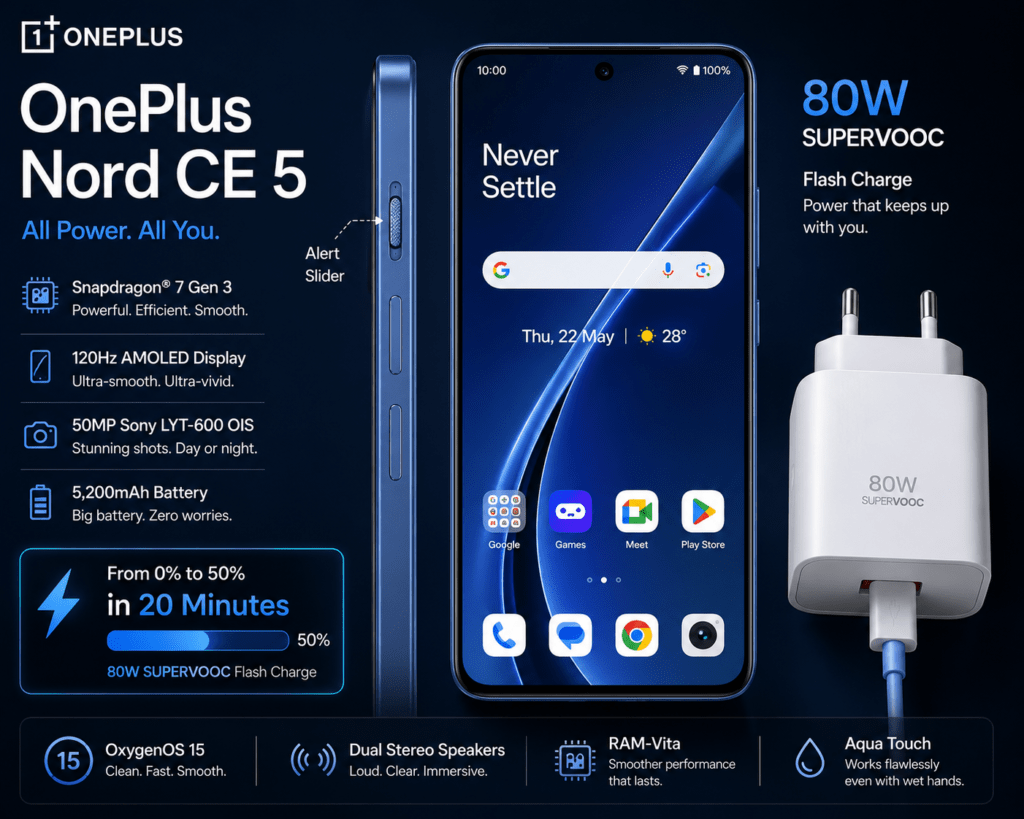
Price: ₹21,999 (8GB/128GB) | ₹24,999 (12GB/256GB) Processor: Qualcomm Snapdragon 7s Gen 3 Display: 6.74-inch AMOLED, 120Hz, 2000 nits Battery: 5,500mAh + 80W SuperVOOC Camera: 50MP main (OIS) + 8MP ultrawide OS: OxygenOS 15 (Android 15) Available: Amazon India
The Story: There’s a reason OnePlus sells consistently well in India even when the specs on paper don’t always win the numbers game. OxygenOS is genuinely the best Android skin in India — clean, fast, consistently updated, respectful of the user’s intelligence. You buy a OnePlus and you’re buying the software experience as much as the hardware.
The Nord CE 5 continues this tradition. Snapdragon 7s Gen 3 is a solidly capable mid-range chip — not flagship territory like the iQOO Neo 10, but fast, efficient, and handles daily use and gaming without complaint. The 80W SuperVOOC charging is among the fastest in this price range. The OxygenOS experience is the cleanest Android you’ll find under ₹25,000.
Performance: Snapdragon 7s Gen 3 handles BGMI on high settings smoothly. Not the sustained ultra-HD gaming performance of the Neo 10, but genuinely comfortable for all daily apps and casual to moderate gaming. Multitasking with 12GB RAM is smooth.
Software — The Real Selling Point: OxygenOS 15 on Android 15 is the best-optimised Android skin in India at this price. Three years of OS updates + four years of security patches (OnePlus commitment). No bloatware beyond a few OnePlus apps. Fast, consistent updates. The alert slider — a physical mute/vibrate/ring switch on the side — is one of those features you don’t know you need until you have it, and then you can’t live without it.
Camera: The 50MP main camera with OIS delivers reliable, natural-colour photography. OnePlus tends to process images with less aggressive AI enhancement than Samsung or Xiaomi — some people love the natural output, some prefer the more punchy processing of competitors. Video at 4K/30fps is stable and good.
Battery: 5,500mAh is comfortable for a full day. The 80W SuperVOOC charging is the highlight — from flat to 80% in about 30 minutes. This is genuinely fast and means morning-charging anxiety is not a concern.
What real users are saying: Overwhelmingly positive reviews for the software experience and charging speed. Photography enthusiasts note the camera is good but not segment-leading. Some users report the frame occasionally running warmer during sustained gaming.
PROS: ✅ OxygenOS — best software experience under ₹25,000 ✅ 3 years OS + 4 years security updates ✅ 80W SuperVOOC — charges from 0-80% in ~30 minutes ✅ Alert slider (physical switch) ✅ 5,500mAh — comfortable all-day battery ✅ Clean, premium-feeling design ✅ Consistent brand reliability and service network
CONS: ❌ Snapdragon 7s Gen 3 — behind iQOO Neo 10’s 8s Gen 4 in raw performance ❌ No telephoto ❌ 120Hz (vs 144Hz on Neo 10) ❌ No headphone jack
Who should buy it: Anyone who wants the cleanest software experience. Parents who need a reliable, uncluttered phone. Professionals who want a phone that stays out of their way.
Who should skip: Heavy gamers who want the absolute best performance — the iQOO Neo 10 at a similar price is the better choice.
#3 — MOTOROLA EDGE 60 PRO
“The Best Camera Phone Under ₹30,000. Not Even Close.”
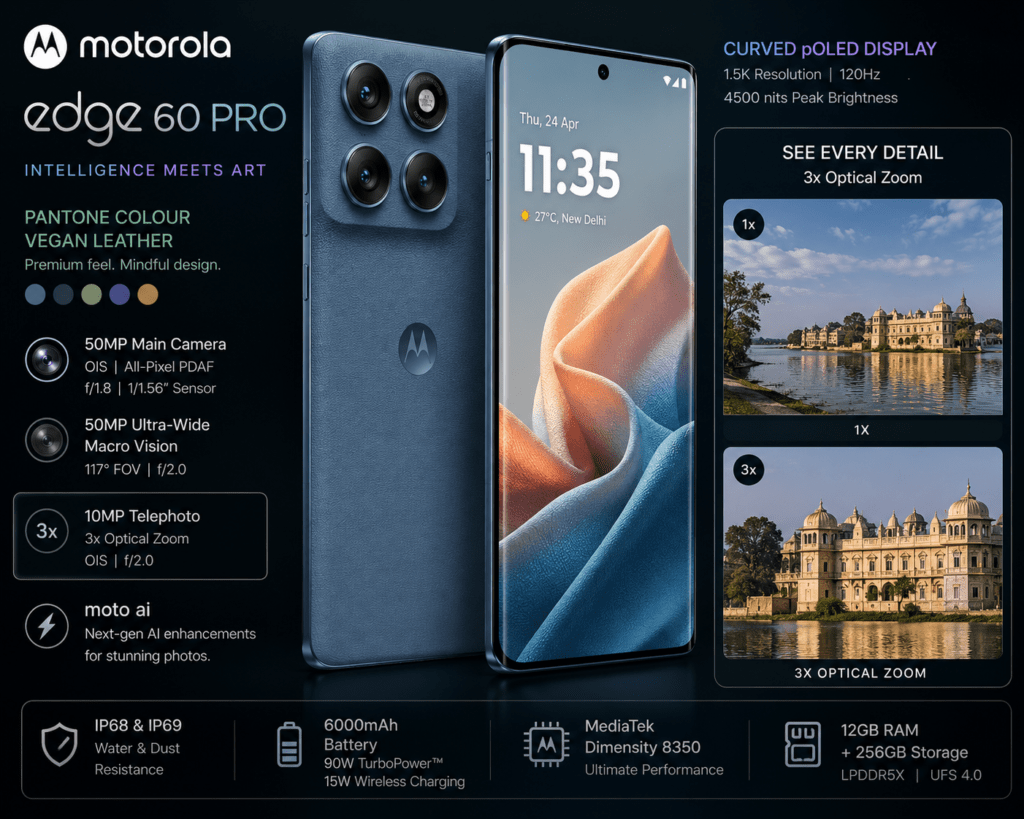
Price: ₹26,999 (12GB/256GB) Processor: MediaTek Dimensity 8350 Display: 6.7-inch pOLED, 144Hz, 3000 nits, curved Battery: 5,000mAh + 68W TurboPower Camera: 50MP main (f/1.7, OIS) + 13MP ultrawide + 10MP telephoto (3x) OS: Hello UI (Android 15) with 3 years OS updates Available: Amazon India, Flipkart
The Story: The Motorola Edge 60 Pro is a well-rounded phone which looks and feels premium, delivers excellent everyday performance, has a large, bright display, the cameras perform reliably across the board, and the battery easily lasts a full day.
That summary from Beebom’s review is precise. The Edge 60 Pro is not the performance champion of this list — the iQOO Neo 10 handles that. It is not the software champion — OnePlus takes that. What it is: the most complete camera system under ₹30,000, period.
The Camera System — Three Cameras That Actually Work: The triple camera setup here is what distinguishes the Edge 60 Pro from most competitors at this price. Most phones under ₹30,000 give you a 50MP main camera and an 8MP ultrawide that exists primarily to check the “ultrawide” box in the spec sheet. The Edge 60 Pro gives you:
- 50MP f/1.7 main camera with OIS — the wide aperture is excellent for low light
- 13MP ultrawide — genuinely useful, not a token addition
- 10MP telephoto with 3x optical zoom — the differentiator
That 3x optical zoom is rare under ₹30,000. Most competitors in this range use digital zoom for anything beyond 1x, which means quality drops sharply. The Edge 60 Pro’s telephoto delivers real optical magnification — portraits from a comfortable distance, detail shots at an event, food photography without hovering over the plate.
Design: Motorola makes some of the best-designed phones in the sub-₹30,000 range. The vegan leather back options are distinctive, the curved pOLED display feels premium, and the build quality is consistently above what the price suggests.
Performance: Dimensity 8350 handles daily use and moderate gaming without issue. Not iQOO Neo 10 level for sustained gaming, but comfortable for casual to regular gaming and excellent for everything else. The phone doesn’t heat up during photography sessions — important for the camera-focused buyer.
The honest caveat: 5,000mAh battery with 68W charging is the weakest battery + charging combination on this list. In a segment where 6,000–7,000mAh is becoming standard, 5,000mAh is adequate but not reassuring. Heavy users may need a top-up during the day.
PROS: ✅ Best camera system under ₹30,000 — including a real telephoto ✅ 50MP f/1.7 main — best low-light aperture in the range ✅ 3x optical zoom — genuinely rare at this price ✅ 144Hz pOLED curved display — beautiful ✅ Excellent design (vegan leather back option) ✅ 3 years OS updates (Motorola commitment) ✅ IP68 dust and water resistance (best on this list)
CONS: ❌ 5,000mAh battery — smaller than competitors ❌ 68W charging — slower than OnePlus 80W and POCO 90W ❌ Dimensity 8350 — behind Snapdragon 8s Gen 4 in gaming ❌ Software (Hello UI) not as clean as OnePlus OxygenOS
Alternate (if over budget): Motorola Edge 70 Fusion at ₹19,999 — step down in camera and display but same Motorola design quality at a lower price.
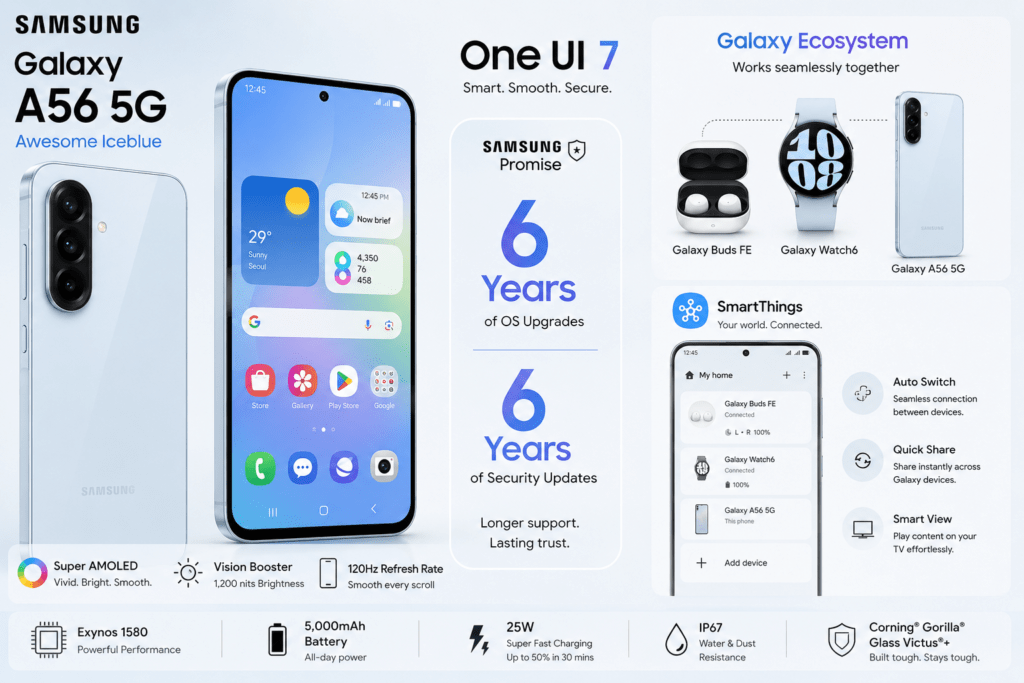
#4 — SAMSUNG GALAXY A56 5G
“The Safe Choice — and Sometimes That’s Exactly Right”
Price: ₹26,999 (8GB/128GB) | ₹29,999 (12GB/256GB) Processor: Samsung Exynos 1580 Display: 6.7-inch Super AMOLED, 120Hz, 1000 nits Battery: 5,000mAh + 45W fast charging Camera: 50MP main + 12MP ultrawide + 5MP macro OS: One UI 7 (Android 15), 6 years OS updates Available: Amazon India, Samsung.in
The Story: Samsung sells more phones in India than any other brand. That fact is not an accident. The Galaxy A-series represents a specific value proposition that Indian buyers trust: Samsung service centres everywhere, the Samsung ecosystem (SmartThings, Galaxy Watch, Galaxy Buds), a UI that feels familiar from phone to phone, and the single best software update commitment in Android — six years of OS updates.
The Galaxy A56 is not the performance champion at this price. The Exynos 1580 is a capable processor that handles daily use well, but it doesn’t match the Snapdragon 8s Gen 4 in the iQOO Neo 10 for gaming. The 45W charging is the slowest on this list. The 1000-nit display is noticeably dimmer than the 3000-nit Neo 10 in direct sunlight.
But the six years of software updates changes the calculation. A phone that gets security patches and Android updates until 2032 is a phone that remains useful and secure for a much longer period than most competitors. For parents, for those who don’t upgrade every two years, for businesses buying phones for employees — the A56’s update commitment is the differentiator.
Camera: Samsung’s camera processing is the most recognisable in the Android world — bright, saturated, with aggressive AI scene detection. Portrait mode on the A56 is excellent. The macro camera (5MP) is genuinely useful for close-up photography — food, flowers, product shots. The main camera delivers reliable results across conditions.
Software: One UI 7 on Android 15 is Samsung’s most refined version yet. Extensive AI features (Galaxy AI), Samsung DeX connectivity, excellent multi-window multitasking, and Secure Folder for privacy. For those already in Samsung’s ecosystem (Galaxy Watch, Samsung TV, Buds), the integration is seamless.
PROS: ✅ Six years of OS + security updates — the best commitment on this list ✅ Samsung ecosystem integration ✅ Reliable camera with excellent portrait mode ✅ 5MP macro camera — genuinely useful ✅ Strong service network across India ✅ One UI 7 — feature-rich and mature ✅ IP67 water resistance
CONS: ❌ Exynos 1580 — behind Snapdragon competition at similar price ❌ 45W charging — slowest on this list ❌ 1000-nit display — noticeably dimmer than 3000-nit competitors outdoors ❌ Expensive for the hardware spec vs competitors
Who should buy it: Anyone who prioritises long-term reliability, service availability, and the Samsung ecosystem. Parents, business users, those who hold phones for 3+ years.
Who should skip: Gamers (choose iQOO Neo 10). Camera enthusiasts (choose Motorola Edge 60 Pro). Those who want maximum value for performance (choose OnePlus Nord CE 5 or iQOO Neo 10).
#5 — REDMI NOTE 15 PRO
“The Battery Monster That Also Takes Surprisingly Good Photos”
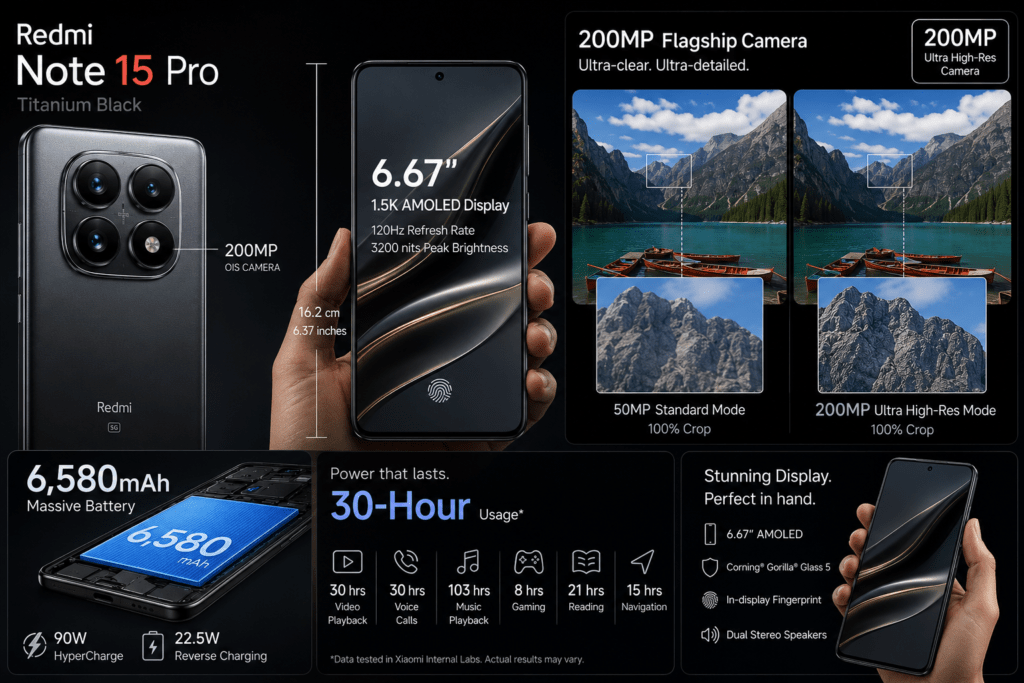
Price: ₹22,999 (8GB/128GB) | ₹25,999 (12GB/256GB) Processor: Qualcomm Snapdragon 7s Gen 3 Display: 6.83-inch AMOLED (1280×2772), 120Hz Battery: 6,580mAh + 90W HyperCharge Camera: 200MP main + 8MP ultrawide + 2MP macro OS: HyperOS 2 (Android 15) Available: Amazon India, Mi.com
The Story: Redmi Note 15 Pro was launched last month. I reviewed this phone and found excellent battery life, performance, and camera quality for daily use. Buy the Redmi Note 15 Pro if you want a long-lasting phone with a smooth AMOLED display, reliable everyday performance, and excellent endurance thanks to its giant 6580 mAh battery.
The 6,580mAh battery with 90W charging is the combination that makes the Note 15 Pro stand out. In 2026, even 6,000mAh batteries are becoming the floor rather than the ceiling in this segment — and Redmi is consistently at the top of the battery game.
The 200MP Camera — What Does It Actually Mean? The 200MP sensor is the headline feature. In practice: the default shooting mode uses pixel-binning to deliver 12.5MP or 50MP shots with improved light gathering. The 200MP mode is available for maximum-detail photography where file size doesn’t matter — landscape photography, product shots for print use.
The camera results in daylight are excellent. Natural colours, good detail retention, and the OIS makes handheld photography significantly more stable. In low light, the larger sensor helps — better than most in this range.
Performance: Snapdragon 7s Gen 3 handles everything from daily apps to moderate gaming. BGMI on high settings runs smoothly. Not iQOO Neo 10 territory for sustained heavy gaming, but entirely capable for all practical use.
The honest caveat: HyperOS (Xiaomi/Redmi’s Android skin) is more bloatware-heavy than OnePlus or Nothing. Ad notifications from system apps are a recurring complaint. The 2MP macro camera is largely useless. The ultrawide at 8MP is adequate.
PROS: ✅ 6,580mAh — genuinely all-day-and-then-some battery ✅ 90W charging — fast enough that the big battery doesn’t slow your morning ✅ 200MP main camera — segment-leading resolution ✅ 6.83-inch AMOLED — large, excellent display ✅ Snapdragon 7s Gen 3 — reliable daily performance ✅ Value pricing — the best spec-per-rupee ratio on this list
CONS: ❌ HyperOS bloatware and ad notifications ❌ No optical image stabilisation on ultrawide ❌ 2MP macro is a spec-sheet camera, not a useful camera ❌ Software update commitment behind Samsung and OnePlus
Who should buy it: Heavy users, travellers, anyone who can’t charge midday, buyers who prioritise battery life above everything else.
#6 — POCO X7 PRO
“The Gaming Phone That Doesn’t Say Gaming Phone on the Box”
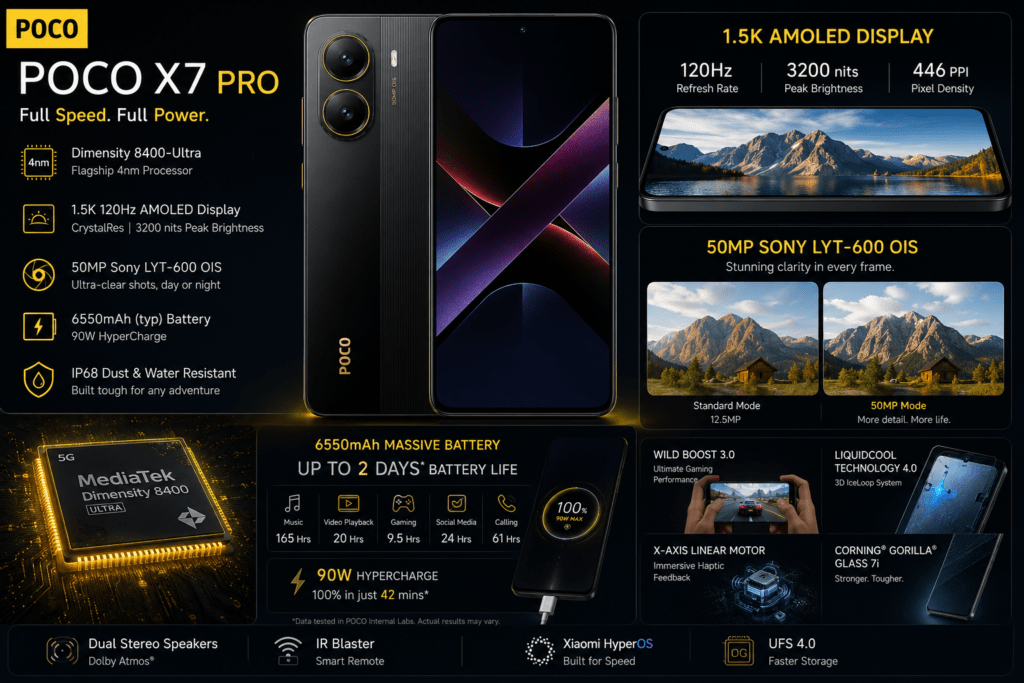
Price: ₹23,999 (8GB/256GB) | ₹26,999 (12GB/256GB) Processor: MediaTek Dimensity 8400 Ultra Display: 6.67-inch AMOLED, 144Hz, 3000 nits Battery: 6,000mAh + 90W HyperCharge Camera: 50MP main (OIS) + 8MP ultrawide OS: HyperOS 2 (Android 15) 91mobiles Spec Score: 91/100
The Story: POCO X7 Pro 12GB RAM has a spec score of 91 — joint top with the iQOO Neo 10 on 91mobiles’ ranking system. The Dimensity 8400 Ultra is a genuinely capable gaming chip — MediaTek’s answer to the Snapdragon 8s Gen 4, and the contest between the two is close.
The X7 Pro is, like everything POCO makes, an exercise in cramming maximum hardware into minimum price. 6,000mAh battery. 90W charging. 144Hz AMOLED with 3000 nits. The Dimensity 8400 Ultra. All under ₹27,000.
Gaming Performance: BGMI at Ultra HD, CODM at maximum settings, Genshin Impact at the highest quality — the X7 Pro handles all of these. The Dimensity 8400 Ultra competes directly with the Snapdragon 8s Gen 4 in most gaming benchmarks. The vapour chamber cooling helps sustain performance in longer sessions.
The honest caveat: POCO’s software (HyperOS, shared with Redmi) is the weakest point. Same bloatware complaints, same ad notification issues. The camera, while good, is behind the Motorola Edge 60 Pro which offers a real telephoto at a similar price.
PROS: ✅ Dimensity 8400 Ultra — flagship-adjacent gaming performance ✅ 6,000mAh + 90W — big battery, fast charging combination ✅ 144Hz AMOLED, 3000 nits — excellent display ✅ 256GB storage standard — no 128GB option (good) ✅ Vapour chamber cooling for sustained gaming ✅ IP66 water resistance
CONS: ❌ HyperOS — same bloatware issues as Redmi ❌ No telephoto camera ❌ Camera behind Motorola Edge 60 Pro ❌ POCO brand = limited software update history
Alternate: At ₹26,999, the Motorola Edge 60 Pro is ₹3,000 more but offers significantly better cameras including a telephoto. If gaming is primary, choose X7 Pro. If camera matters, choose Edge 60 Pro.
#7 — REALME GT 6T
“The Charging Speed Champion — Because Sometimes You Have 15 Minutes”
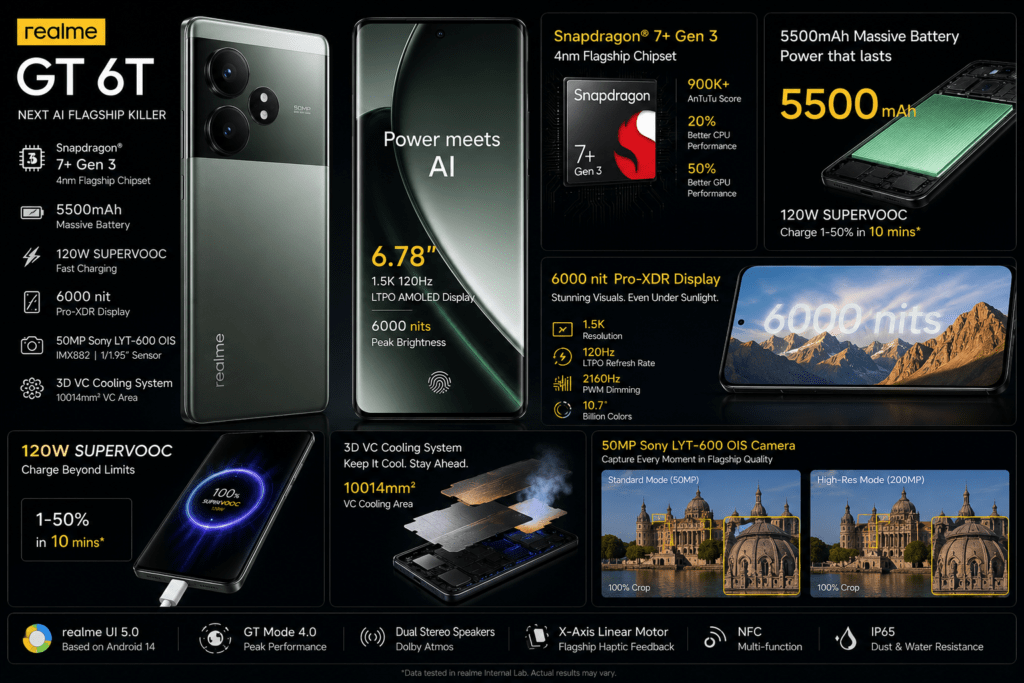
Price: ₹25,999 (8GB/128GB) | ₹28,999 (12GB/256GB) Processor: Qualcomm Snapdragon 7+ Gen 3 Display: 6.78-inch AMOLED, 144Hz, 4500 nits (peak) Battery: 5,500mAh + 120W SuperVOOC Camera: 50MP main (OIS) + 8MP ultrawide OS: realme UI 5.0 (Android 15)
The Story: The GT 6T’s claim to fame is the 120W charging. That number means 0-100% in approximately 28 minutes. Twenty-eight minutes. For context: you wake up late, your phone is at 10%, you jump in the shower and plug in, you come back — your phone is full. This is the specific scenario 120W charging was invented for and it delivers it every single time.
The Snapdragon 7+ Gen 3 is also the strongest mid-range chip in realme’s lineup — solidly capable for gaming, daily use, and sustained performance. The 4500-nit peak brightness display is the highest on this list — in direct sunlight, this screen is readable when others struggle.
The honest caveat: 120W charging degrades battery health faster than slower charging. realme’s software update commitment has historically been inconsistent — typically 2 years of OS updates vs Samsung’s 6 and OnePlus’s 3. The camera system is good but not differentiated.
PROS: ✅ 120W charging — fastest on this list (0-100% in ~28 minutes) ✅ 4500-nit peak display — best outdoor visibility ✅ Snapdragon 7+ Gen 3 — strong daily + gaming performance ✅ 144Hz AMOLED ✅ 5,500mAh — adequate all-day battery
CONS: ❌ 120W charging degrades battery health faster ❌ Software update commitment (2 years typically) ❌ realme UI — more bloatware than OnePlus ❌ No telephoto camera
#8 — NOTHING PHONE (3a)
“The Phone That Started a Design Philosophy”
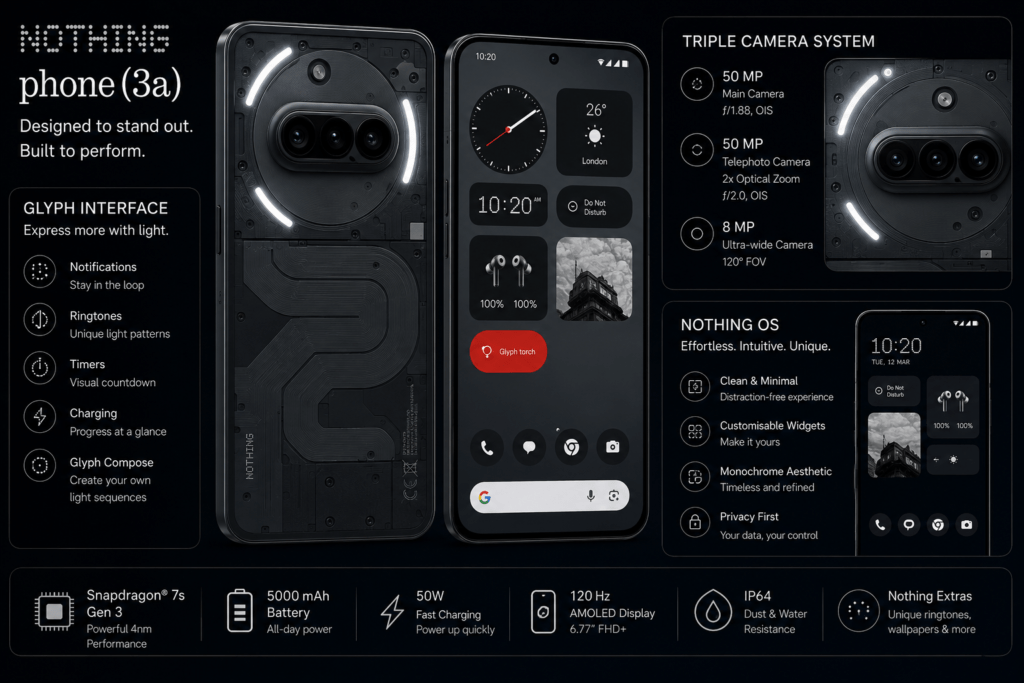
Price: ₹24,999 (8GB/128GB) | ₹27,999 (12GB/256GB) Processor: Qualcomm Snapdragon 7s Gen 3 Display: 6.77-inch AMOLED, 120Hz, 2000 nits Battery: 5,000mAh + 50W Camera: 50MP main + 50MP telephoto (2x) + 8MP ultrawide OS: Nothing OS 3.0 (Android 15) Available: Amazon India
The Story: Nothing Phone (3a) is OnePlus Nord 6 vs Nothing Phone (4a): Will You Choose Performance Or Personality? That headline from Smartprix tells the story. The Nothing Phone (3a) is personality-forward — the transparent back with the Glyph Interface LED system, the Nothing OS that is as clean as OxygenOS, and a triple camera system that includes a genuine 2x telephoto.
Nothing OS is the dark horse software experience on this list — clean, minimal, fast, and genuinely beautiful. No bloatware. No ad notifications. Fast updates. Carl Pei’s team has built the most aesthetically considered Android experience since the original OnePlus.
Camera: The triple camera system — 50MP main + 50MP telephoto + 8MP ultrawide — is surprisingly capable. The 2x optical telephoto is useful for portrait photography (more reach than the default lens without digital degradation) and general photography. Not Motorola Edge 60 Pro’s 3x, but real optical zoom nonetheless.
Glyph Interface: The LED strip on the back that lights up for notifications, charging status, and music visualisation is either the feature that sells you on the phone or the feature you disable in settings on day one. Either way, it’s distinctive and genuinely unique.
The honest caveat: 50W charging is the slowest on this list alongside Samsung’s 45W. 5,000mAh battery is adequate but not generous. Nothing has a smaller service network in India than Samsung, OnePlus, or Xiaomi — support availability varies by city.
PROS: ✅ Nothing OS — cleanest software on this list (alongside OxygenOS) ✅ Distinctive transparent design + Glyph Interface ✅ 50MP telephoto camera (2x) — rare in this range ✅ Triple camera system that actually delivers ✅ Consistent software updates ✅ IP54 water resistance
CONS: ❌ 50W charging — slowest on this list ❌ 5,000mAh — not the biggest battery ❌ Smaller India service network ❌ Snapdragon 7s Gen 3 — not the fastest chip here
Who should buy it: Design enthusiasts, those who prioritise software experience, photography hobbyists who want a telephoto without compromising on aesthetics.
#9 — VIVO T5 PRO
“The Phone That Makes ‘Battery Life’ Mean Something Different”
Price: ₹20,999 (8GB/128GB) | ₹23,999 (12GB/256GB) Processor: MediaTek Dimensity 8300 Display: 6.78-inch AMOLED, 144Hz, 2800 nits Battery: 9,020mAh + 80W FlashCharge Camera: 50MP main (OIS) + 8MP ultrawide OS: FunTouch OS 15 (Android 15)
The Story: Vivo T5 Pro review: Big 9,020mAh battery, lighter footprint. That review headline says it all. 9,020mAh. Nine thousand and twenty milliamp hours. This is not a phone battery. This is a small power bank that also makes calls.
In real-world use, the T5 Pro lasts two full days for moderate users. Heavy users with aggressive gaming and social media use will still end the day comfortably above 40%. This phone is specifically for the person who charges once every two days and refuses to feel anxious about battery percentage.
The 80W charging fills this enormous battery in about 90 minutes — which sounds slow but you’re charging from a much longer baseline use cycle. In practice, most users charge this phone every other night.
The honest caveat: A 9,020mAh battery adds weight and thickness. This phone is heavier than most on this list. The Dimensity 8300 is a solid chip for daily use but not the gaming performance champion. FunTouch OS has bloatware. The camera, while good, doesn’t lead the category.
PROS: ✅ 9,020mAh — the largest battery on this list by far ✅ 80W FlashCharge — fills even this giant battery in ~90 minutes ✅ 144Hz AMOLED display ✅ Best phone for two-day battery life in India 2026 ✅ Dimensity 8300 — reliable daily performance ✅ Most affordable entry on this list
CONS: ❌ Heavier and thicker than most competitors ❌ FunTouch OS bloatware ❌ No telephoto camera ❌ Dimensity 8300 — behind Snapdragon 8s Gen 4 for heavy gaming
Who should buy it: Travellers, field workers, anyone who genuinely cannot charge midday and wants zero battery anxiety. The most specific use-case winner on this list.

#10 — SAMSUNG GALAXY M56 5G
“The Samsung Budget Option That Doesn’t Feel Budget”
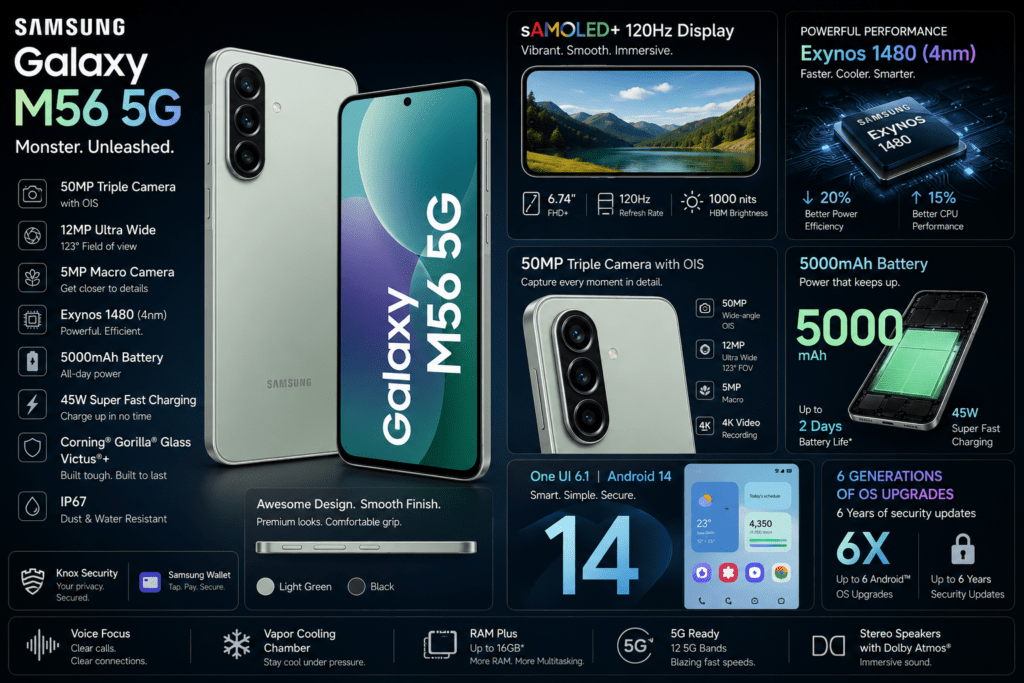
Price: ₹23,999 (8GB/128GB) | ₹25,999 (12GB/256GB) Processor: Samsung Exynos 1580 Display: 6.7-inch Super AMOLED, 120Hz Battery: 6,000mAh + 45W Camera: 50MP main + 8MP ultrawide + 5MP macro OS: One UI 7 (Android 15), 4 years OS updates
The Story: The Galaxy M56 is the Galaxy A56’s slightly more affordable sibling — same Exynos 1580 processor, same camera system, similar display, but ₹3,000–4,000 cheaper and with a larger 6,000mAh battery.
The M-series is Samsung’s volume driver in India — these phones sell enormously well because they carry the Samsung name, the One UI experience, and the service network trust at prices that are genuinely accessible.
Where M56 beats A56: Larger battery (6,000mAh vs 5,000mAh). Lower price.
Where A56 beats M56: IP67 water resistance vs no IP rating on M56. Slightly better build quality. 5MP macro vs same.
For pure value, the M56 is the better Samsung buy. For reliability and longevity, the A56’s IP67 and six-year update commitment justify the premium.
PROS: ✅ Samsung One UI + 4 years OS updates ✅ 6,000mAh battery — better than A56 ✅ Samsung service network ✅ Lower price than A56 for similar specs ✅ Reliable daily performance
CONS: ❌ No IP rating ❌ 45W charging — slowest in class ❌ Exynos 1580 — not the strongest gaming chip ❌ Fewer update years than A56 (4 vs 6)
The Specialist Guide — Which Phone for Which Use?
For Heavy Gamers
| Rank | Phone | Why |
|---|---|---|
| #1 | iQOO Neo 10 | Snapdragon 8s Gen 4, 144Hz, shoulder triggers |
| #2 | POCO X7 Pro | Dimensity 8400 Ultra, 144Hz, vapour cooling |
| #3 | Realme GT 6T | Snapdragon 7+ Gen 3, 120W (quick charge between sessions) |
For Camera Enthusiasts
| Rank | Phone | Why |
|---|---|---|
| #1 | Motorola Edge 60 Pro | Only phone with 3x optical telephoto under ₹30,000 |
| #2 | Redmi Note 15 Pro | 200MP main camera, best for detail photography |
| #3 | Nothing Phone (3a) | 2x optical telephoto, natural colour rendering |
For Battery Life
| Rank | Phone | Why |
|---|---|---|
| #1 | Vivo T5 Pro | 9,020mAh — two full days, no contest |
| #2 | Redmi Note 15 Pro | 6,580mAh — all day and more |
| #3 | POCO X7 Pro | 6,000mAh + 90W — big and fast |
For Software Experience
| Rank | Phone | Why |
|---|---|---|
| #1 | OnePlus Nord CE 5 | OxygenOS — cleanest Android in India |
| #2 | Nothing Phone (3a) | Nothing OS — equally clean, more distinctive |
| #3 | Samsung Galaxy A56 | One UI — most features, 6-year updates |
For Long-Term Reliability (3+ Year Use)
| Rank | Phone | Why |
|---|---|---|
| #1 | Samsung Galaxy A56 | 6 years OS updates — the only real choice |
| #2 | OnePlus Nord CE 5 | 3 years OS + 4 years security |
| #3 | Motorola Edge 60 Pro | 3 years OS updates |
Slightly Over Budget — Worth the Extra?
If your budget is flexible to ₹32,000–₹35,000, these options are genuinely worth considering:
iQOO Neo 10 Pro (₹32,999): Adds telephoto camera and better cooling over the Neo 10. For ₹5,000 more, you fix the Neo 10’s camera weakness. Worth it.
OnePlus Nord 6 (₹29,999–₹32,999): The latest Nord flagship. Upgraded everything vs Nord CE 5. Snapdragon 8 Gen 3, better cameras, cleaner design.
Nothing Phone (3) (₹34,999): The flagship Nothing — significantly better cameras and processor than the (3a). If Nothing OS appeals to you, the upgrade is substantial.
Realme GT 7 (₹31,999): Snapdragon 8 Gen 3 at ₹32,000 — flagship processor approaching the mid-range price band. Remarkable value.
Full Comparison Table — All Features Side by Side
| Phone | Chip | RAM | Battery | Charging | Main Cam | Telephoto | OS Updates | IP |
|---|---|---|---|---|---|---|---|---|
| iQOO Neo 10 | SD 8s Gen 4 | 8/12GB | 6,400mAh | 80W | 50MP OIS | No | 2yr | IP64 |
| OnePlus Nord CE 5 | SD 7s Gen 3 | 8/12GB | 5,500mAh | 80W | 50MP OIS | No | 3yr OS | Yes |
| Motorola Edge 60 Pro | D8350 | 12GB | 5,000mAh | 68W | 50MP OIS | 10MP 3x | 3yr | IP68 |
| Samsung Galaxy A56 | Exynos 1580 | 8/12GB | 5,000mAh | 45W | 50MP | 5MP macro | 6yr | IP67 |
| Redmi Note 15 Pro | SD 7s Gen 3 | 8/12GB | 6,580mAh | 90W | 200MP OIS | No | 2yr | No |
| POCO X7 Pro | D8400U | 8/12GB | 6,000mAh | 90W | 50MP OIS | No | 2yr | IP66 |
| Realme GT 6T | SD 7+ Gen 3 | 8/12GB | 5,500mAh | 120W | 50MP OIS | No | 2yr | Yes |
| Nothing Phone (3a) | SD 7s Gen 3 | 8/12GB | 5,000mAh | 50W | 50MP | 50MP 2x | 3yr | IP54 |
| Vivo T5 Pro | D8300 | 8/12GB | 9,020mAh | 80W | 50MP OIS | No | 2yr | Yes |
| Samsung Galaxy M56 | Exynos 1580 | 8/12GB | 6,000mAh | 45W | 50MP | No | 4yr | No |
Things to Know Before You Buy
5G vs 4G: Every phone on this list supports 5G. If you’re in a city with 5G coverage, you’ll benefit from faster downloads and streaming. If you’re primarily in a non-5G area, 5G still means future-proofing.
RAM and Storage: Under ₹30,000, the sweet spot is 12GB RAM + 256GB storage. The 8GB/128GB variants are often ₹3,000–4,000 cheaper — worth it if you don’t need maximum storage. Most phones on this list don’t have expandable storage.
Processor hierarchy (roughly): Snapdragon 8s Gen 4 > Dimensity 8400 Ultra ≈ Snapdragon 7+ Gen 3 > Snapdragon 7s Gen 3 ≈ Dimensity 8350 > Dimensity 8300 > Exynos 1580
Camera megapixels are not camera quality: The 200MP Redmi Note 15 Pro doesn’t automatically take better photos than the 50MP Motorola Edge 60 Pro. Sensor size, aperture, OIS, and processing matter more.
Software updates matter more than you think: A phone that stops receiving security updates in two years is a security risk. Samsung’s 6-year commitment is genuinely unique and valuable for long-term ownership.
Bank offer discounts: Several phones on this list (particularly Samsung A56 and Motorola Edge 60 Pro) are available under ₹30,000 with HDFC/ICICI/Axis card offers during sale events. The note marked “*” on Cashify’s list refers to these bank-offer prices.
FAQ Section
Q: Which is the best smartphone under ₹30,000 in India in 2026?
A: The iQOO Neo 10 at ₹24,999–27,999 is the overall best smartphone under ₹30,000 in India in 2026 — offering Snapdragon 8s Gen 4 (flagship-adjacent performance), 144Hz AMOLED at 3000 nits, 6,400mAh battery with 80W charging, and a camera that covers daily needs reliably. For those prioritising camera specifically, the Motorola Edge 60 Pro is the better choice with its 3x optical telephoto.
Q: Which phone under ₹30,000 is best for gaming?
A: The iQOO Neo 10 (Snapdragon 8s Gen 4, 144Hz, shoulder triggers) is the clear gaming champion under ₹30,000. The POCO X7 Pro (Dimensity 8400 Ultra) is a strong alternative at ₹23,999. Both offer vapour chamber cooling for sustained gaming sessions.
Q: Is Samsung Galaxy A56 worth buying in 2026?
A: Yes — specifically if you plan to use the phone for 3+ years. The Samsung Galaxy A56’s six-year software update commitment (until 2032) is genuinely unique in the Android market. The hardware isn’t the strongest for the price, but for longevity, service network access, and the Samsung ecosystem, the A56 justifies its premium over spec-comparable competitors.
Q: Which phone has the best camera under ₹30,000 in India?
A: The Motorola Edge 60 Pro is the best camera phone under ₹30,000 — the only device in this range with a genuine 3x optical telephoto, combined with an f/1.7 main camera for excellent low-light performance. For high-resolution photography (prints, professional use), the Redmi Note 15 Pro’s 200MP sensor is the alternative.
Q: Which is the best phone for battery life under ₹30,000?
A: The Vivo T5 Pro with a 9,020mAh battery is the undisputed battery life champion — lasting two full days for moderate users. The Redmi Note 15 Pro (6,580mAh) and POCO X7 Pro (6,000mAh + 90W charging) are the alternatives.
Q: OnePlus Nord CE 5 vs iQOO Neo 10 — which to buy?
A: The iQOO Neo 10 wins on raw performance and display (Snapdragon 8s Gen 4, 144Hz at 3000 nits, better battery). The OnePlus Nord CE 5 wins on software experience (OxygenOS — cleaner, less bloatware), alert slider, and 3-year OS update commitment. For gaming, choose Neo 10. For daily use with the best software experience, choose Nord CE 5.
Conclusion — The Best Budget Isn’t Always the Lowest Price
I bought my mother the iQOO Neo 9 (predecessor to the Neo 10 in this guide). She’s been using it for seven months. She has taken approximately 4,000 photographs of her garden. The battery hasn’t caused a single problem. She has not called me to say it’s confusing.
That’s the thing about this segment in India in 2026. These are not “budget” phones in the sense of compromised. They are fully capable daily drivers with flagship-adjacent performance, professional-grade camera systems, and batteries that outlast most people’s patience.
The iQOO Neo 10 for performance. The Motorola Edge 60 Pro for cameras. The OnePlus Nord CE 5 for software. The Samsung A56 for longevity. The Vivo T5 Pro for the person who wants to never think about charging again.
Every single phone on this list will make you feel like you got more than you paid for. That’s the promise the Indian smartphone market at ₹30,000 makes in 2026.
It keeps it.