
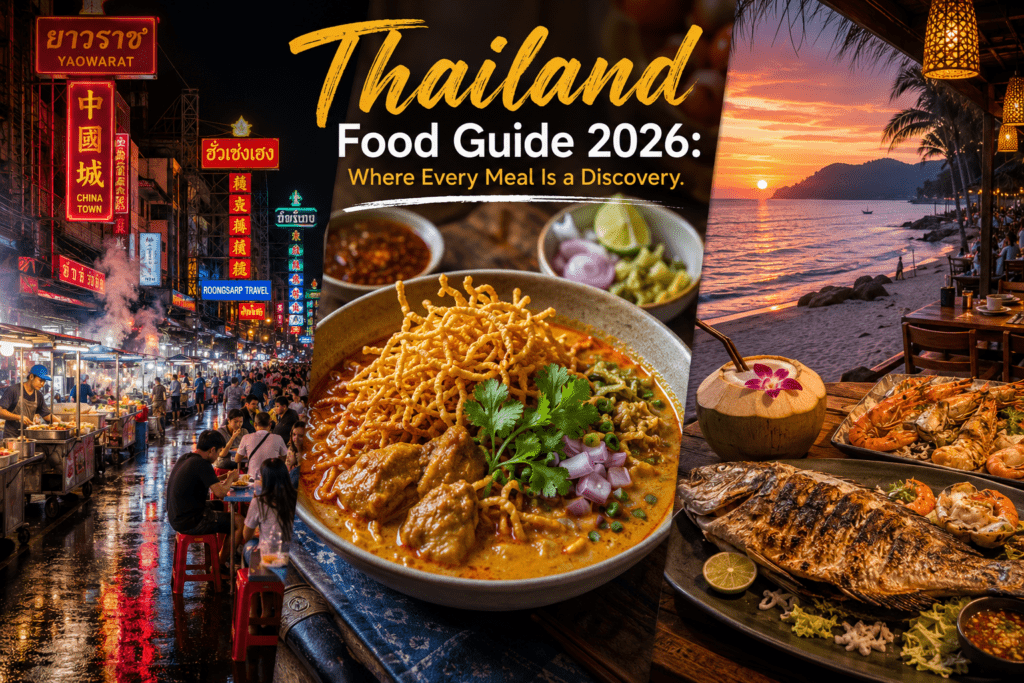
A NOTE FOR 2026 VISITORS: Thailand's street food scene has shifted in major cities — many vendors have moved into organised night markets and food courts. Bangkok's Chinatown and Chiang Mai's Sunday Walking Street remain the gold standard for authentic street food. The Water Rule is unchanged: tap water is still off the menu in 2026. Stick to bottled water, and ice in major cities is generally safe (made from purified water). Rural areas — skip the ice if it looks like it came off a big block.
The Noodles That Changed My Travel Philosophy
I had a plan for my first day in Bangkok. Temple of the Dawn. Grand Palace. Maybe the National Museum if time allowed.
I ended up spending the entire day in Chinatown eating.
Not because the temples weren’t worth seeing — they absolutely are. But because I made one wrong turn off Yaowarat Road at 8am, found myself in front of a woman who had been making boat noodles since before I was a legal adult, ordered a bowl for 50 baht, and experienced something that rearranged my internal priority system.
The broth was dark and deep and complex, the noodles were silky, the pork was braised and falling apart, and there was a herb on top that I couldn’t identify but needed more of immediately. I ordered three bowls. I cancelled the Grand Palace. I found four more food stalls. I went back the next day.
That is Thailand’s food culture. It will do this to you. It is not subtle about it.
The north keeps it rugged with Khao Soi or Chiang Mai sausage. The south cranks the heat to the max with seafood-heavy dishes that show no mercy to your palate. In 2026, the southern “Jungle Curry” (Kaeng Pa) is becoming a favourite for those who want heat without the creamy coconut milk buffer.
This guide covers all of it — Bangkok, Chiang Mai, Phuket, Koh Samui, Krabi, and the islands. Street food. Fine dining. Legendary stalls. Vegetarian and vegan options. Drinks. Apps to find everything. Transport to get there.
Bring your appetite. You’re going to need it.
Quick Reference: Thailand Food by City
| City | Famous For | Must-Try Dish | Best Food Street/Market |
|---|---|---|---|
| Bangkok | Everything — it’s the food capital | Boat Noodles, Pad Thai, Mango Sticky Rice | Yaowarat (Chinatown), Chatuchak |
| Chiang Mai | Northern Thai cuisine | Khao Soi, Sai Oua, Nam Prik Ong | Sunday Walking Street, Warorot Market |
| Phuket | Seafood, Peranakan, Southern Thai | Hoi Tod, Massaman Curry, Moo Hong | Old Town Sunday Market, Ranong Road |
| Koh Samui | Fresh seafood, coconut-based curries | Goong Pao (Grilled Prawns), Pad Cha | Fisherman’s Village, Nathon Market |
| Krabi | Southern seafood, spicy curries | Crab Curry, Satay, Roti | Krabi Town Night Market |
| Koh Phi Phi | Tourist-accessible Thai food | Pad Thai, Fresh Grilled Seafood | Ton Sai Pier Market |
| Pai (North) | Hippie café culture + northern dishes | Khao Soi, Fresh fruit smoothies | Walking Street, Saturday Market |
| Ayutthaya | Historical city, central Thai | Roti Sai Mai (cotton candy roti) | Hua Ro Night Market |
THE ESSENTIAL THAI DISHES — START HERE
Understanding Thai Flavour — Four Things Before You Order
Before you walk into any Thai restaurant or approach any street cart, understanding the four flavour pillars of Thai cooking will help you order better and appreciate more.
Spicy (Pet): Chillies are used fresh, dried, roasted, and as paste. Tell your vendor your spice level: mai pet (not spicy), pet nit noy (a little spicy), pet (spicy), pet mak (very spicy). Saying pet mak to a Thai street vendor is either the best or worst decision you’ll make all trip.
Sour (Priao): Lime juice, tamarind, and fermented shrimp paste (kapi) are the sour elements. Sourness is not an accident in Thai food — it’s structural.
Sweet (Wan): Palm sugar is the traditional sweetener — more complex than cane sugar, with a slight caramel note. Fish sauce + palm sugar is the backbone of multiple dishes.
Salty (Kem): Fish sauce (nam pla) rather than salt. Fish sauce smells confrontational and tastes extraordinary once cooked. Trust the process.
The mastery of Thai cooking is the simultaneous balance of all four in a single bite. When it works — and in the best Thai food, it always works — it is one of the most sophisticated flavour combinations in world cooking.
BANGKOK FOOD GUIDE
Bangkok — Where to Eat What, and Exactly Where to Find It
LEGENDARY STREET FOOD STALLS — BANGKOK
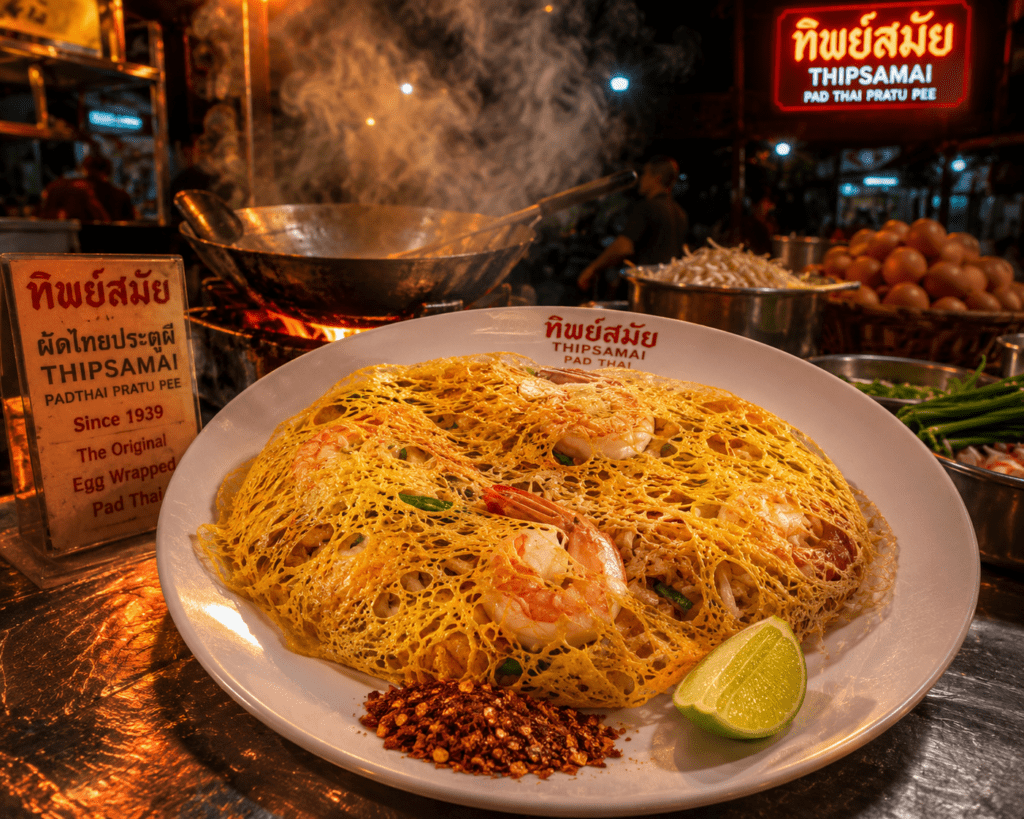
1. THIP SAMAI — The Pad Thai Benchmark
Address: 313-315 Mahachai Road, Samranrat, Phra Nakhon, Bangkok 10200 Timings: 5pm–2am (closed Wednesday) Price: 100–350 THB ($2.80–9.80)
One of the best places to try Pad Thai is Thip Samai, often considered the most famous Pad Thai restaurant in Bangkok.
What it is: Rice noodles with eggs, shrimp, tofu and peanuts — a perfect balance of sweet, sour and salty flavours. At Thip Samai specifically, the Pad Thai is wrapped in an egg omelette — the egg netting is cooked separately and the Pad Thai is stuffed inside, creating a package that is simultaneously crispy outside and perfectly soft within.
How it tastes: The tamarind-fish sauce balance is deeper and more complex than most Pad Thai you’ll encounter. The shrimp are sweet and fresh. The peanuts add crunch. The egg wrapping adds richness. The version with river prawns (goong mae nam) at 350 THB is the splurge order — large river prawns visible through the egg wrapping, the sweetness of the prawn against the tamarind-sour noodles.
Preparation: Wok-cooked at extremely high heat, rice noodles soaked and added to smoking-hot oil with garlic, then egg, then tamarind paste, fish sauce, and palm sugar. The egg net is cooked separately — beaten egg poured through a strainer over hot oil to create a lacy golden net, then the noodles are wrapped inside.
Key ingredients: Rice noodles, tamarind paste, fish sauce, palm sugar, egg, dried shrimp, tofu, bean sprouts, garlic chives, roasted peanuts, fresh lime
Queue: Always. Arrive before 6pm for a shorter wait. The queue moves reasonably fast.
2. VICTORY MONUMENT BOAT NOODLES — Bangkok’s Broth Obsession
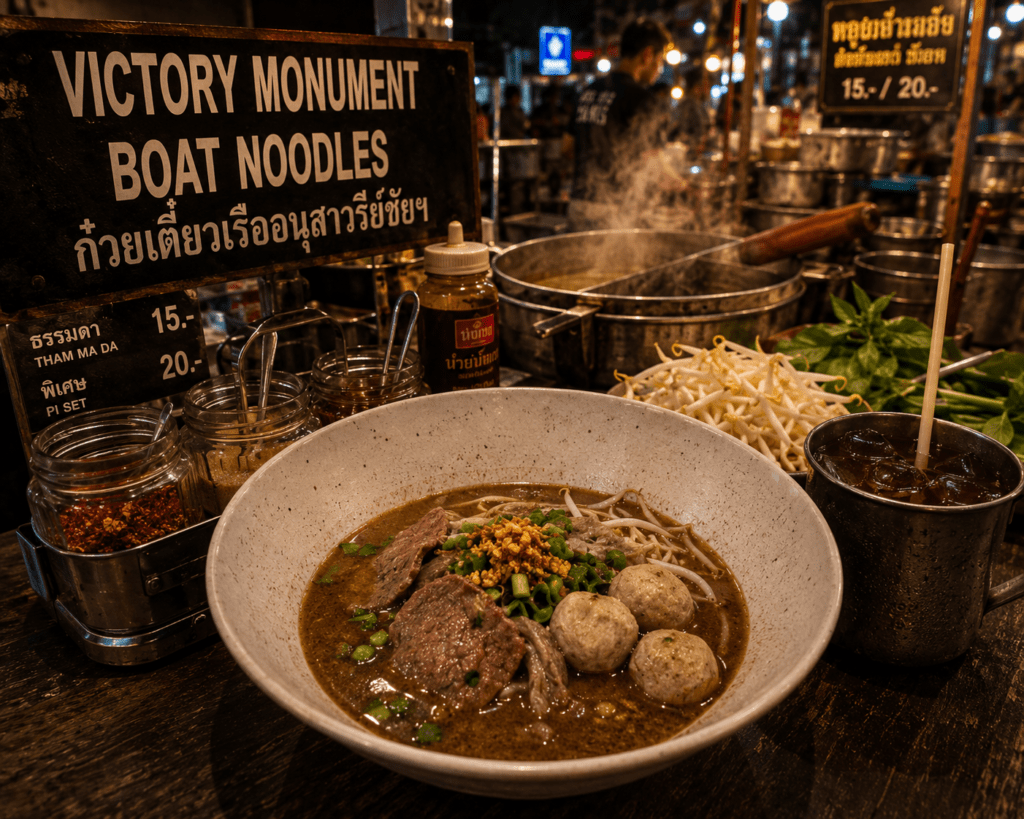
Address: Victory Monument BTS station area, Phaya Thai Road, Bangkok Timings: 9am–5pm (lunch-focused) Price: 50–80 THB per bowl ($1.40–2.25)
Boat noodles are small bowls of intensely flavoured noodle soup, traditionally served along canals. The broth is rich and aromatic, often made with beef or pork. You can find some of the best versions at Victory Monument Boat Noodles, where multiple shops specialise in this dish.
What it is: Small shallow bowls of noodle soup — the small size is traditional, from the days when they were served from canal boats. The broth is deeply coloured and intensely flavoured with pork or beef blood (which thickens it and adds depth), star anise, cinnamon, and a specific Thai herb blend. You order 5–8 bowls and stack them as you go.
How it tastes: The broth is the darkest, most complex noodle broth in Thai cooking. Earthy, slightly sweet, intensely meaty. The blood thickening makes it silkier than a clear broth. The pork or beef is tender from slow cooking. The bean sprouts and morning glory add freshness against the rich broth.
Preparation: Stock from pork/beef bones slow-cooked 6+ hours, seasoned with soy sauce, fish sauce, palm sugar, star anise, and cinnamon. Blood is added during cooking to thicken. Noodles added fresh to each bowl, topped with meat, herbs, and crispy garlic.
Key ingredients: Rice noodles or flat noodles, pork/beef broth, pork blood, pork/beef (braised), bean sprouts, morning glory, dried chilli, crispy garlic, fresh coriander
Tip: Order both beef and pork versions — different flavour profiles. Ask for extra dark soy sauce and vinegar on the table.
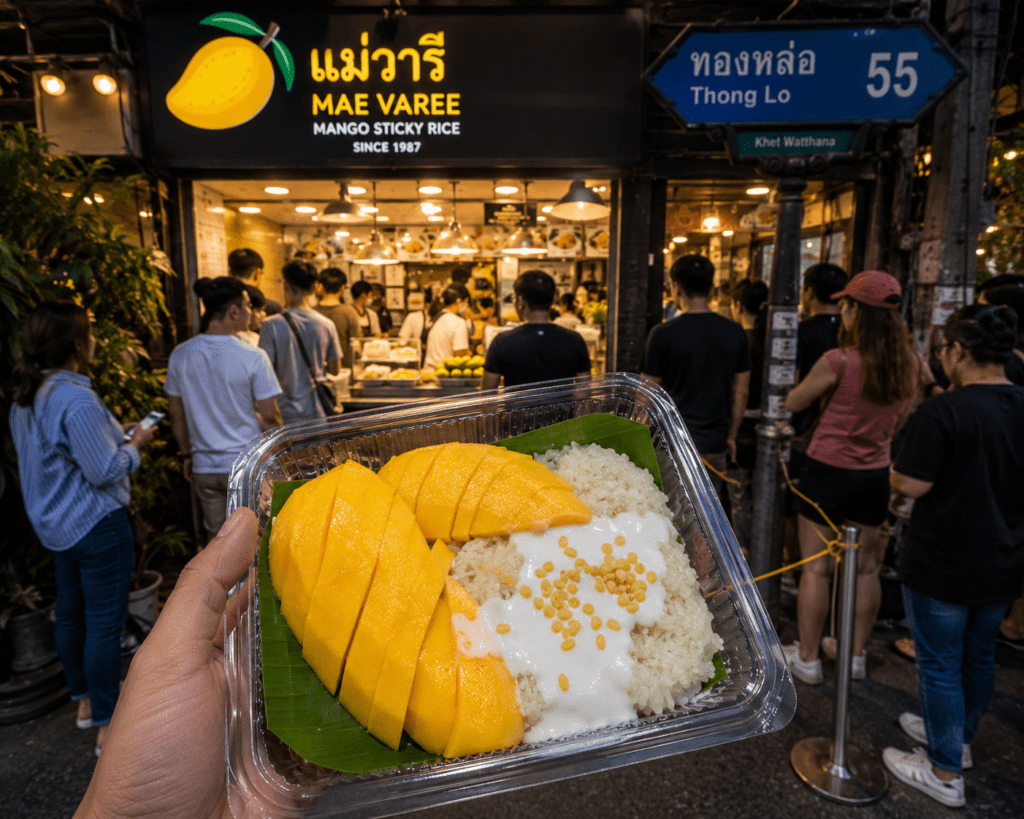
3. MAE VAREE MANGO STICKY RICE — The Dessert Destination
Address: 1 Thong Lo 5, Khlong Toei Nuea, Watthana, Bangkok 10110 Timings: 9am–10pm daily Price: 120–180 THB ($3.35–5)
A must-visit spot for Mango Sticky Rice is Mae Varee, famous for high-quality mangoes.
What it is: Thailand’s most beloved dessert that perfectly blends ripe mangoes with sticky rice cooked in rich coconut milk.
How it tastes: The sticky rice is glutinous, slightly salty from the coconut milk cooking (the salt is deliberate — it balances the mango’s sweetness), warm and fragrant. The mango is room temperature, perfectly ripe, sliced carefully. A drizzle of thick coconut cream on top finishes everything. The combination of warm salty-sweet rice and cold ripe mango is one of Thailand’s most perfect flavour experiences.
Preparation: Glutinous rice soaked 4+ hours, then steamed in a bamboo basket over water. Warm coconut milk with salt and a touch of sugar poured over while hot, absorbed into the rice. Coconut cream thickened separately for the topping. Nam Dok Mai mangoes are the preferred variety — smaller, more fragrant, sweeter than commercial varieties.
Key ingredients: Glutinous sticky rice, coconut milk, salt, palm sugar, ripe Nam Dok Mai mango, thick coconut cream
Best season: April–June when Nam Dok Mai mangoes are at peak ripeness. Available year-round at Mae Varee but the April–June version is extraordinary.
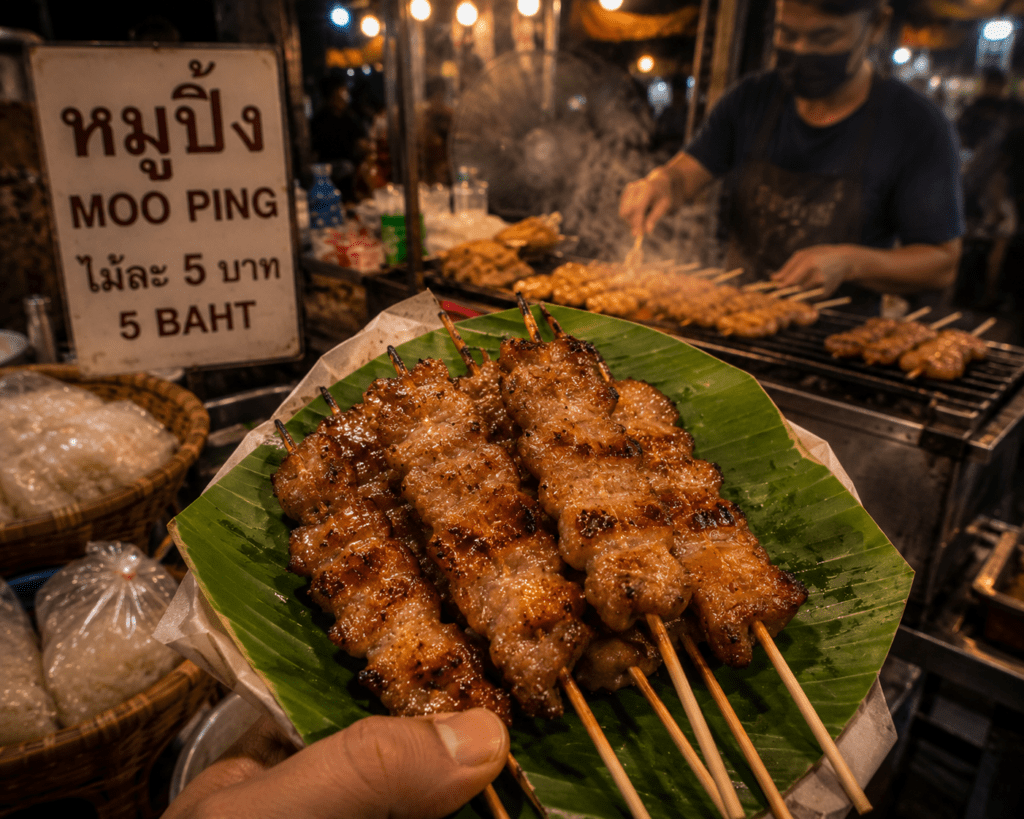
4. MOO PING — Bangkok’s Morning Ritual
Address: Throughout Bangkok, particularly near BTS stations, fresh markets, and temple areas every morning Timings: 6am–10am (morning street food) Price: 15–25 THB per skewer ($0.40–0.70)
Moo Ping is a popular street food snack made from marinated pork grilled over charcoal. It’s slightly sweet, smoky, and incredibly addictive – often served with sticky rice. You’ll find it everywhere in the morning, especially from street vendors across Bangkok.
What it is: Pork skewers marinated in coconut milk, fish sauce, palm sugar, and garlic — grilled over charcoal until caramelised and slightly charred. Served with sticky rice in a small plastic bag.
How it tastes: The coconut milk marinade caramelises on the outside, creating a slightly sweet, smoky, tender pork that is genuinely addictive at 7am. The fat from the pork renders into the char. The sticky rice absorbs the juices. This is the correct Bangkok breakfast.
Key ingredients: Pork shoulder (fatty cut), coconut milk, fish sauce, palm sugar, garlic, coriander root, white pepper
Where specifically in Bangkok: Near Ari BTS station morning market, Chatuchak Weekend Market early morning, Phra Khanong area fresh market.
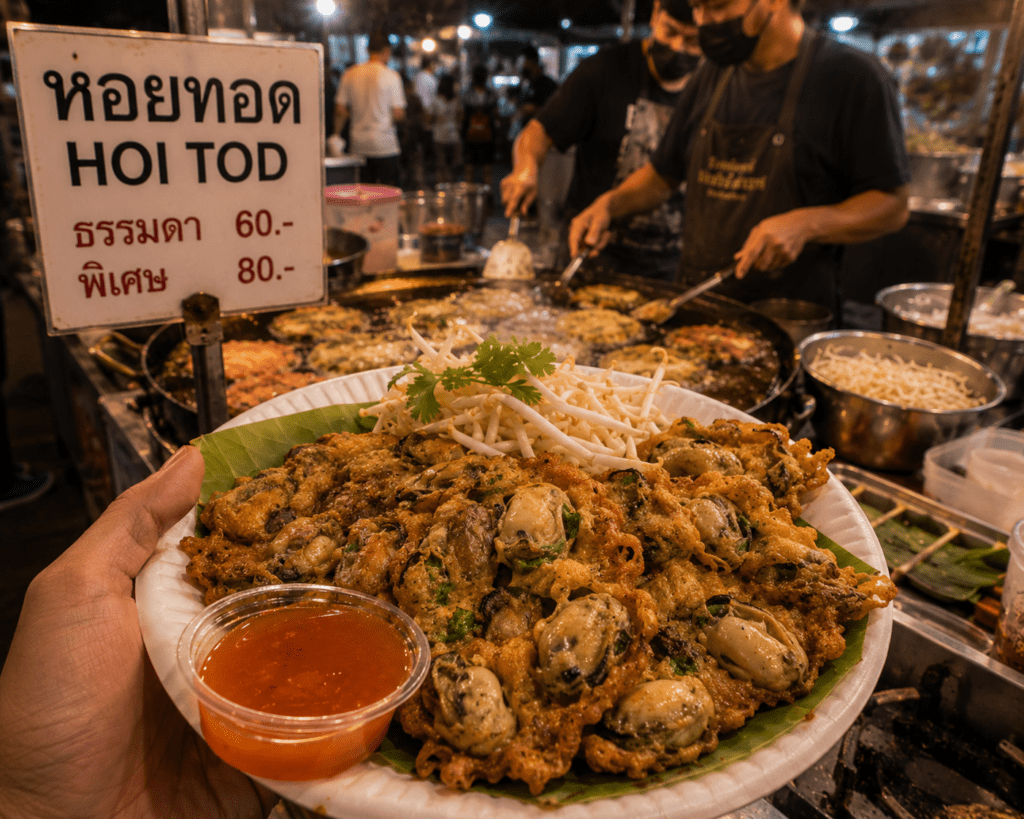
5. HOI TOD — Bangkok’s Crispy Oyster Omelette
Address: Chinatown (Yaowarat Road) stalls, Chatuchak Market Price: 40–80 THB ($1.10–2.25)
You can find Hoi Tod served in almost any night market in Thailand, from the Chinatown in Bangkok to the food market in Chiang Mai. They are often priced at around 40–60 THB.
What it is: Fresh oysters (or mussels) cooked in a batter of rice flour and tapioca starch on a very hot cast-iron pan until crispy, then egg is poured over and cooked — creating something between an omelette and a pancake with crispy edges and soft-chewy centre. Served with bean sprouts and a sweet chilli sauce.
How it tastes: The outside edges are crispy and slightly smoky from the hot iron pan. The inside is soft and slightly gooey from the tapioca starch. The oysters are briny and fresh. The sweet chilli sauce on the side provides contrast. The texture combination — crispy-soft-chewy-fresh — is unique to this dish.
Key ingredients: Fresh oysters or mussels, rice flour, tapioca starch, egg, bean sprouts, spring onion, oyster sauce, sweet chilli sauce
BANGKOK FOOD STREETS AND MARKETS — COMPLETE GUIDE
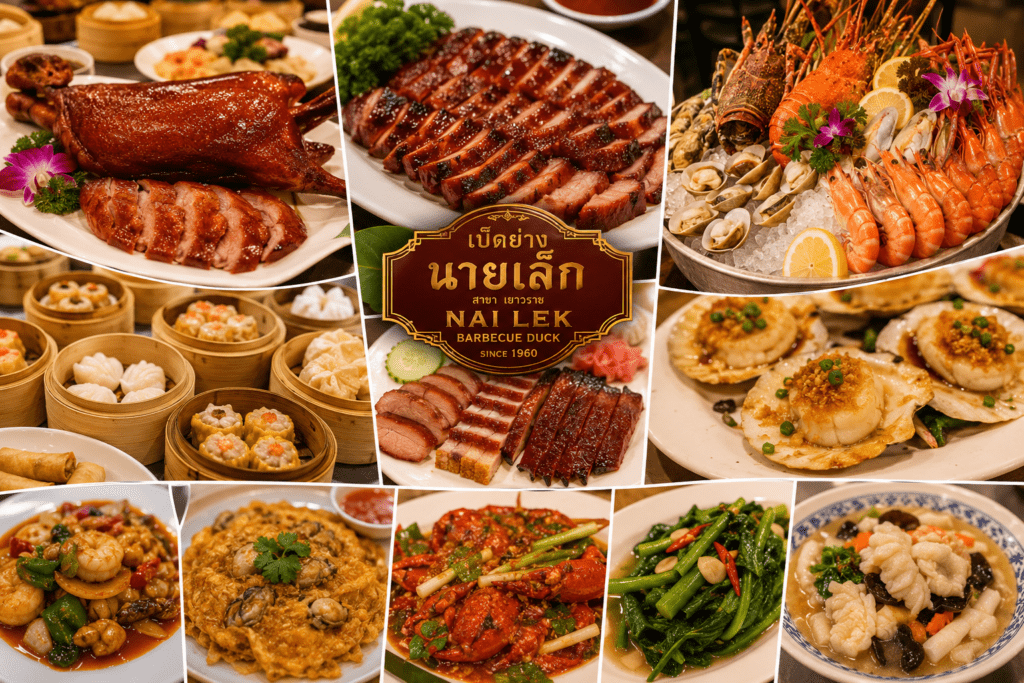
Yaowarat Road (Bangkok Chinatown): The most celebrated food street in Bangkok. Open all day but best from 6pm–midnight. Chinese-Thai food dominates — roast duck, char siu pork, seafood, dim sum, shark fin (avoid), and Thai-Chinese fusion that’s uniquely Bangkok.
Specific eats: TJ Seafood (famous grilled scallops), Nai Lek Barbecue Duck, T&K Seafood (prawns, crab, lobster — market price).
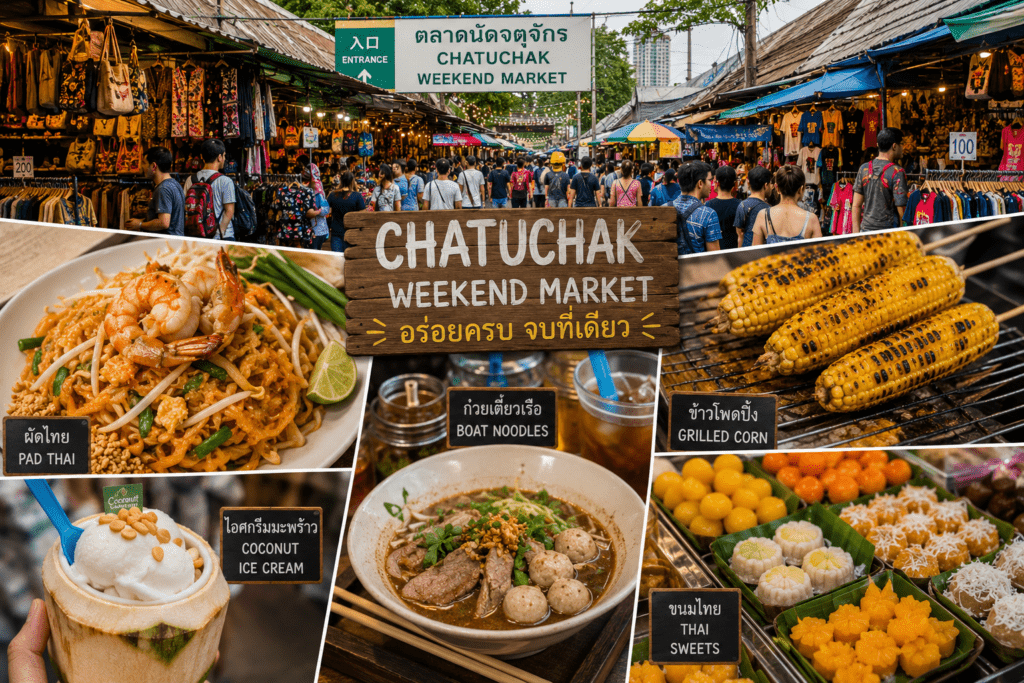
Chatuchak Weekend Market: Open: Saturday–Sunday, 9am–6pm Food zone: Section 27, 26 (food court area) Best for breakfast Pad Thai, boat noodles, grilled corn, fresh coconut ice cream, traditional Thai sweets.
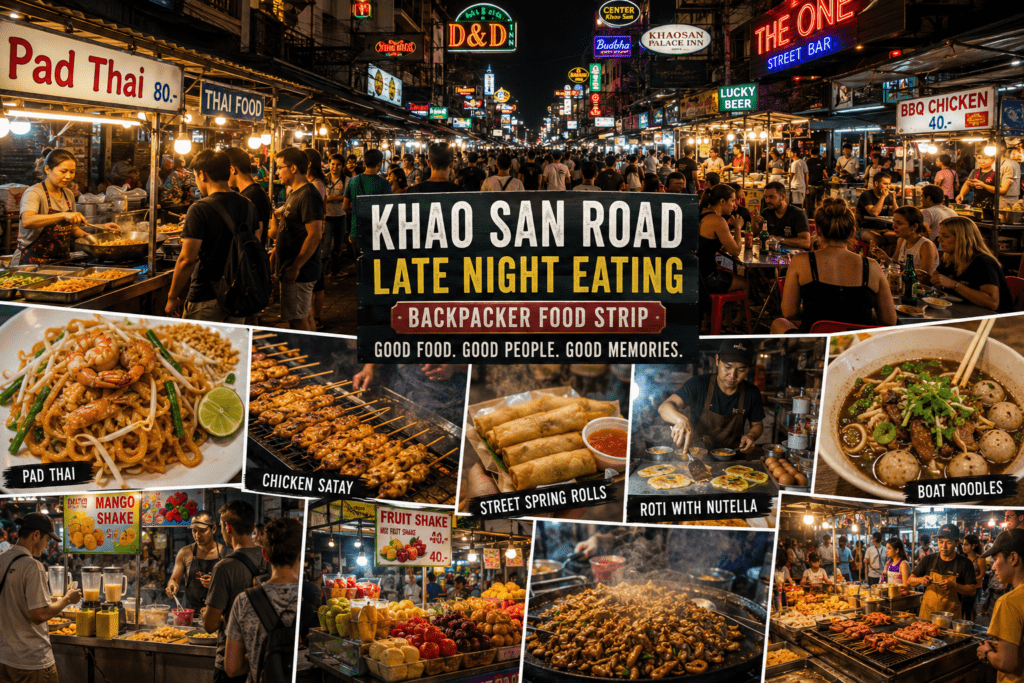
Khao San Road: The backpacker food strip — good for late night eating but not the most authentic Thai food. The Pad Thai here is tourist-adjusted (less fish sauce, more sweet). Worth it at 2am when nothing else is open.
Or Tor Kor Market (Kamphaeng Phet): BTS: Kamphaeng Phet station, walk 5 minutes. Open: Daily 6am–6pm The premium fresh market — where Bangkok’s best home cooks and restaurants buy their produce. The mango sticky rice, durian (seasonal), fresh-cut fruit, and ready-to-eat Thai dishes here are the highest quality available in Bangkok.
Bang Rak District (Sri Phraya area): Old Bangkok riverside — the best old-school Thai restaurants and noodle shops. Less tourist pressure, better prices, more authentic.
BANGKOK FINE DINING
Gaggan Anand Restaurant Address: 68/1 Soi Langsuan, Lumphini, Pathum Wan, Bangkok 10330 Price: 7,000–9,000 THB ($195–250) per person for the full experience Cuisine: Progressive Indian — yes, in Bangkok, this is the right recommendation What it is: The most famous restaurant in Asia run by an Indian-origin chef. Chef Gaggan Anand’s emoji tasting menu — each course represented by an emoji rather than text — is the most theatrical fine dining experience available in Thailand. The food is extraordinary — modern Indian flavour profiles executed with Japanese precision. Reservations: Months ahead, online only
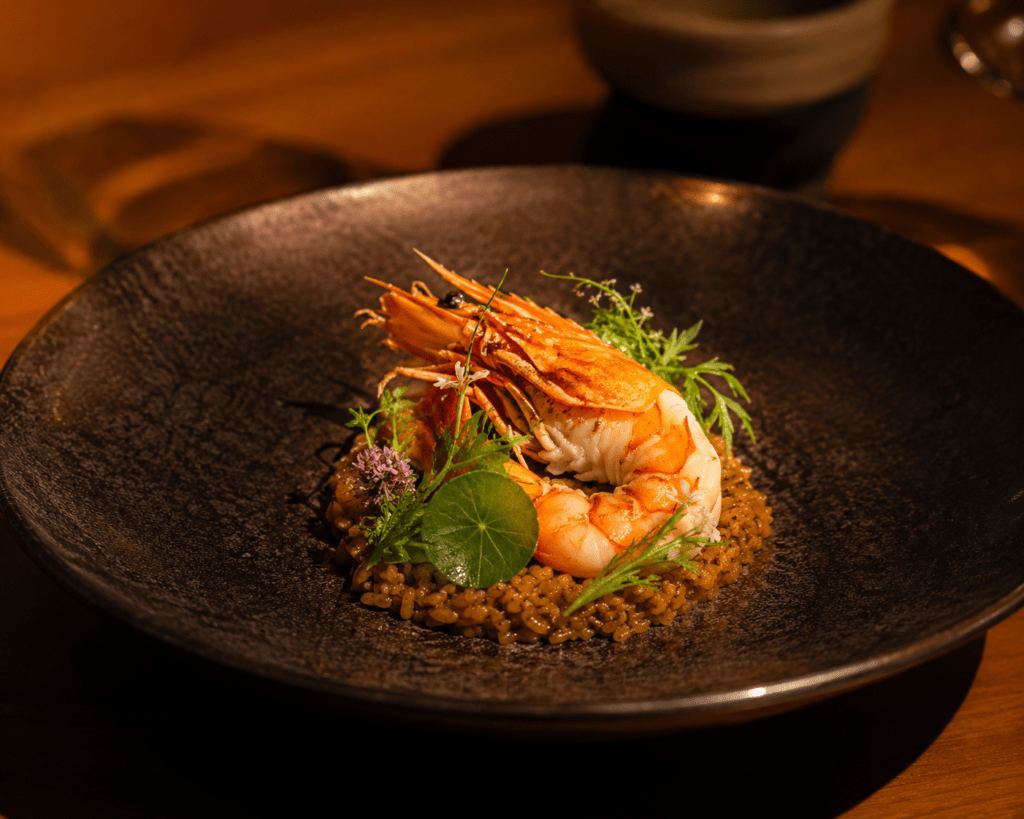
Le Du (Bangkok) Address: 399/3 Silom Road, Bangrak, Bangkok 10500 Price: 3,500–5,000 THB ($97–140) per person Cuisine: Modern Thai What it is: Chef Thitid “Ton” Tassanakajohn’s restaurant — consistently on Asia’s 50 Best Restaurants list. Modern Thai tasting menu that uses indigenous Thai ingredients with French technique. The best high-end Thai fine dining currently available. Famous dishes: Aged rice with river prawn, fermented chilli and pork fat; Southern-style crab curry with local herbs
Nahm (Bangkok) Address: COMO Metropolitan Bangkok, 27 South Sathorn Road, Bangkok 10120 Price: 2,500–4,000 THB ($70–111) per person Cuisine: Traditional Thai (the real version) What it is: Chef David Thompson’s landmark restaurant — one of the world’s foremost authorities on Thai cuisine. The menu features dishes from old Thai manuscripts that have been all but forgotten elsewhere. This is Thai food as it was eaten by royalty.
The Dining Room at The House on Sathorn Address: W Bangkok Hotel, 106 North Sathorn Road, Bangkok 10500 Price: 2,000–3,500 THB ($55–97) per person Cuisine: Contemporary Thai/International What it is: The most beautiful restaurant room in Bangkok — a heritage colonial mansion used as the dining room. The food is refined Thai with Western technique. The Sunday brunch here is Bangkok’s most celebrated hotel meal.
CHIANG MAI FOOD GUIDE
Chiang Mai — Northern Thai Food Is Its Own Universe
Chiang Mai’s food is not a variation of Bangkok food. It is a completely distinct regional cuisine — influenced by Burma, Yunnan China, and Laos — with its own ingredient logic, preparation methods, and flavour priorities. Less fish sauce. More fresh herbs. Pork-heavy. Sticky rice rather than jasmine rice.
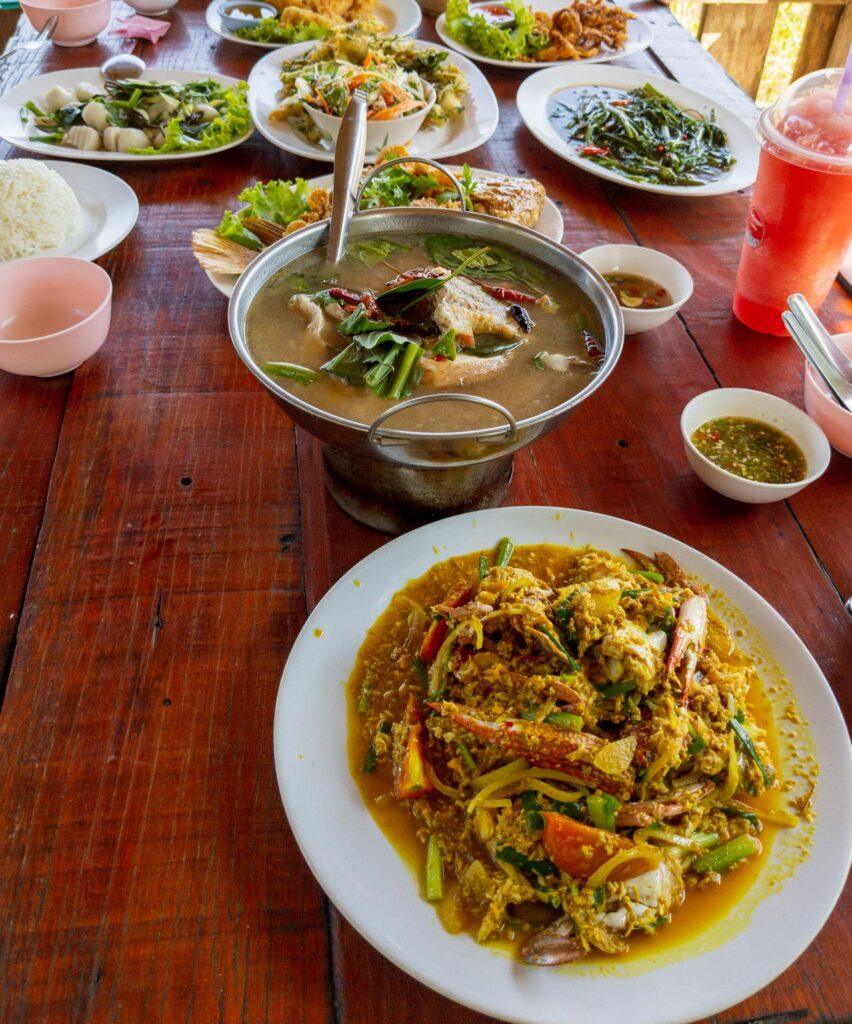
I’ve slurped noodles in Bangkok’s Chinatown, tucked into northern curries in Chiang Mai, braved fiery salads in Isaan. Some dishes I’ll never get tired of — Khao Soi tops the list.
ESSENTIAL CHIANG MAI DISHES
1. KHAO SOI — Chiang Mai’s Crown Jewel
Where to find it: Multiple locations throughout Chiang Mai Price: 60–100 THB ($1.70–2.80)
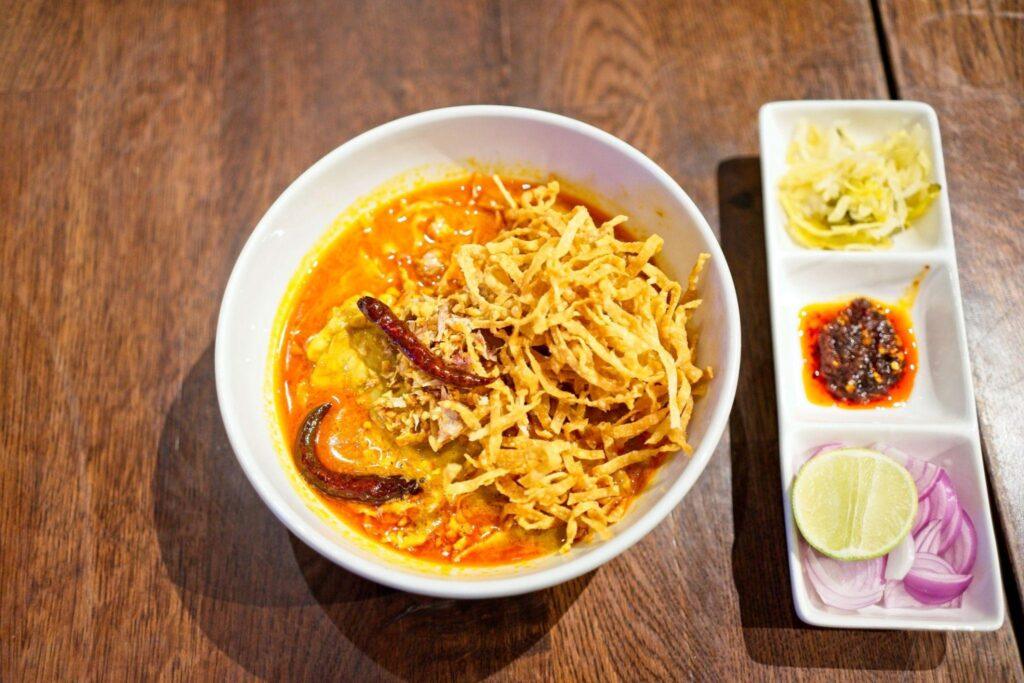
Khao Soi is a soup-like dish made with a mix of boiled egg noodles and sprinkled deep-fried crispy egg noodles, pickled mustard greens, shallots, lime, and coconut milk curry broth. Available with chicken, beef, or crispy tofu (vegetarian version).
How it tastes: The broth is the revelation — coconut milk moderates the heat of the red curry paste, creating a rich, creamy, slightly spiced base with fragrant notes from the lemongrass and galangal in the paste. The soft egg noodles sit in the broth absorbing flavour. The crispy deep-fried noodle nest on top adds crunch and textural contrast. The pickled mustard greens on the side — squeeze lime juice, add pickled greens — cut through the richness beautifully.
Preparation: Red curry paste (with dried chillies, shallots, galangal, turmeric, and dried spices specific to northern Thailand) is fried in oil until fragrant, then coconut milk is added in stages. Chicken is braised in the broth. Fresh egg noodles are added and cooked. A portion of noodles is deep-fried separately for the crispy topping.
Key ingredients: Egg noodles, coconut milk, northern Thai red curry paste, chicken/beef/tofu, turmeric, lemongrass, galangal, pickled mustard greens, shallots, lime
Best places in Chiang Mai:
- Khao Soi Khun Yai: 90/1 Sirimangkalanajarn Road, Chiang Mai — the benchmark. No English menu. Point at the pot. Always worth it.
- Khao Soi Islam: Near Charoenrat Road bridge — the beef version made by the Muslim community. Different spice profile, equally extraordinary.
- Maejo Khao Soi: Old Chiang Mai area — the most traditional version.
2. SAI OUA — Northern Thai Sausage
Where: Night Bazaar, Sunday Walking Street, Warorot Market Price: 60–100 THB for a large sausage
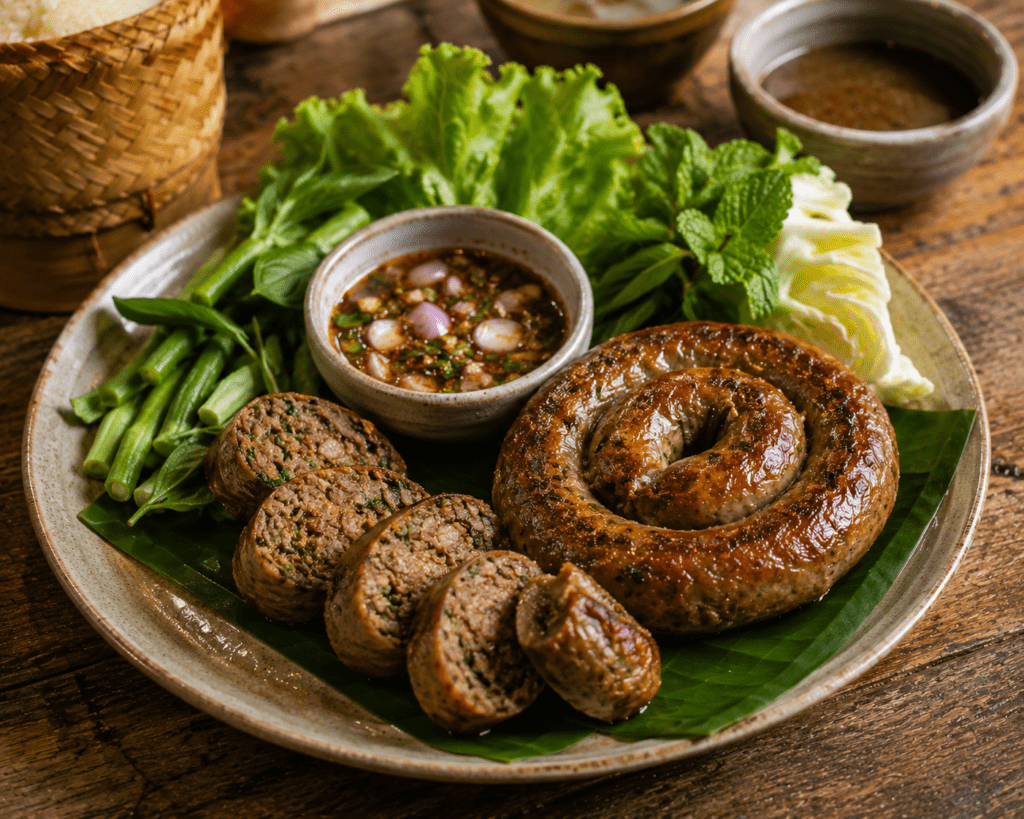
Sai Oua is a flavourful sausage from Northern Thailand packed with herbs and spices. It consists of minced pork, lemongrass, kaffir lime leaves, galangal, and red curry paste. Sai Oua comes with sticky rice and a spicy dipping sauce and is quite filling all on its own.
How it tastes: Intensely aromatic — the lemongrass and kaffir lime leaves are unmistakeable in every bite. The pork is coarsely ground, keeping texture. The galangal adds a slightly piney, citrus note. Served grilled over charcoal, the outside has a slightly charred casing and the herbs caramelise slightly. Eaten with sticky rice and the accompanying jeow (spicy dipping sauce).
Key ingredients: Minced pork, lemongrass, kaffir lime leaves, galangal, red curry paste, shallots, garlic, coriander root
3. NAM PRIK ONG — The Northern Dipping Sauce
Where: Local restaurants, Sunday Walking Street Price: 60–100 THB
In Chiang Mai, people in northern Thailand tend to eat lots of pork and have this tasty dish called Nam Prik Ong, which is a tomato-based spicy sauce served with crispy, fried pork.
What it is: A thick tomato-based sauce with minced pork, dried chillies, fermented soybean, and a specific northern spice blend — served with raw vegetables (long beans, cabbage, cucumber), crispy pork rinds, and sticky rice for dipping.
How it tastes: Deeply savoury, slightly sour from the tomato and tamarind, with a building chilli heat. The crispy pork rinds add texture. The raw vegetables provide freshness and cut the richness. This is northern Thai comfort food — hearty and complex.
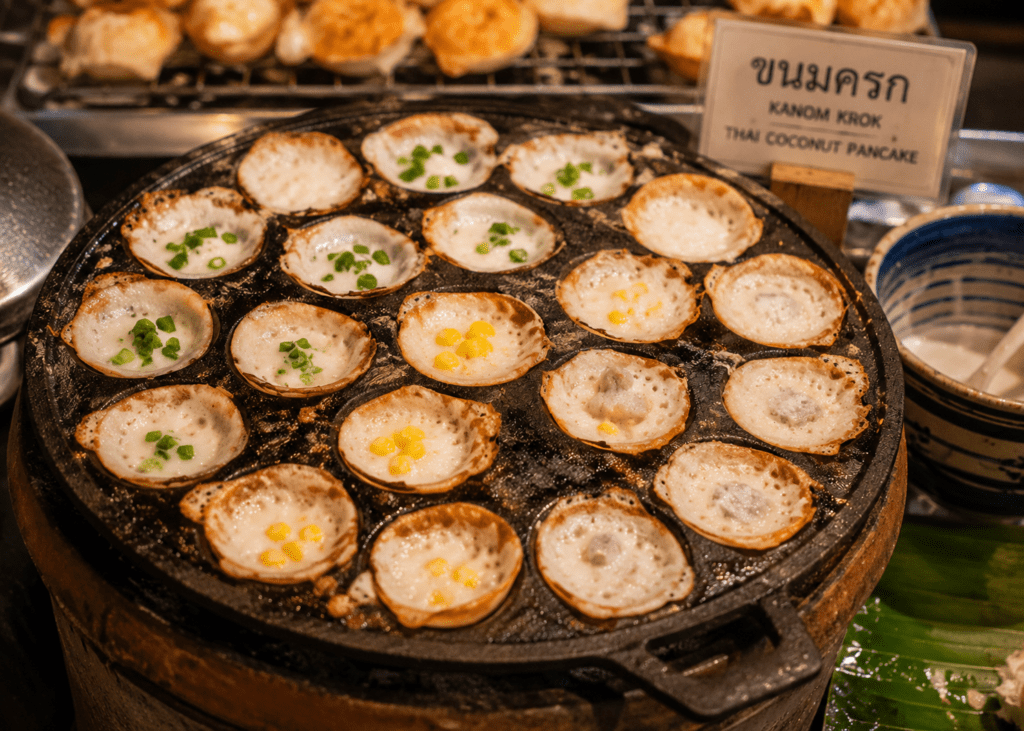
4. KANOM KROK — Coconut Pancakes
Where: Throughout Chiang Mai morning and evening markets Price: 30–50 THB for a portion of 6–8
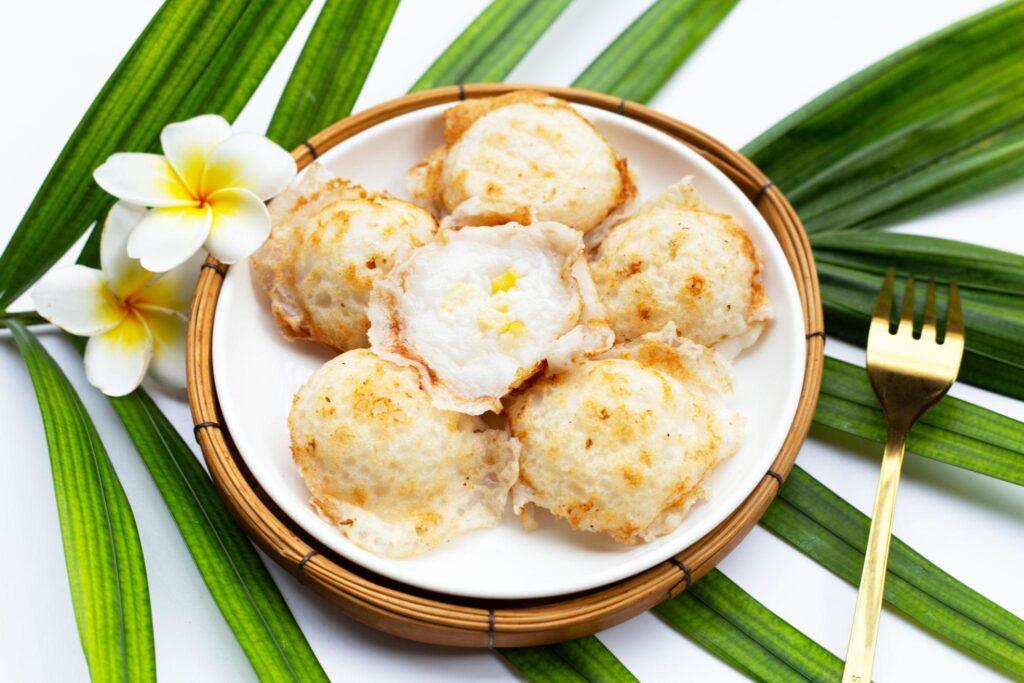
Kanom Krok, or coconut rice pancakes, is a popular street food snack made from rice flour, coconut milk, and sugar. These bite-sized pancakes are cooked in a special cast-iron pan, resulting in a crispy exterior and a soft, creamy interior. Common toppings usually include sweet corn, green onions, or taro.
How it tastes: The exterior is thin and crispy from the cast-iron. The interior is soft, creamy, and coconut-sweet with a slight saltiness. The contrast between the crispy shell and the custard-like interior is delightful. Eating them hot from the pan while the coconut milk filling is still slightly liquid is the correct experience.
CHIANG MAI FOOD STREETS AND MARKETS
Sunday Walking Street (Wualai Road): Open: Sunday evenings, 5pm–midnight Best for: Khao Soi, Sai Oua, Kanom Krok, Mango Sticky Rice, coconut ice cream served in a coconut shell Chiang Mai’s Sunday Walking Street is basically dinner on legs. You can stroll with a skewer in one hand and coconut ice cream in the other, and nobody bats an eye.
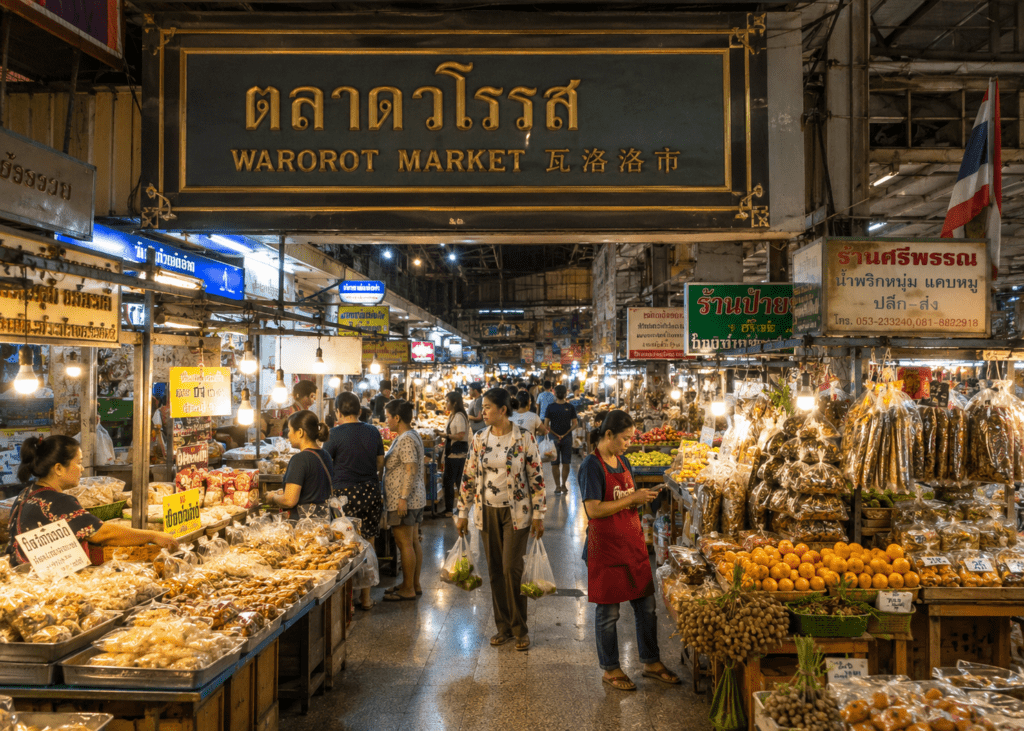
Warorot Market (Kad Luang): Open: Daily, 6am–6pm Best for: Northern Thai ingredients, dried herbs and spices, local sausages, fresh produce. The upstairs floor has an excellent food court for local lunches. ₹30–100 per dish.
Saturday Night Market (Wualai Walking Street): A separate market from the Sunday Walking Street — slightly smaller, equally excellent for Chiang Mai-specific food.
Chiang Mai Night Bazaar (Chang Khlan Road): More commercial than the walking streets but has a good food section with northern dishes. Open nightly.
CHIANG MAI FINE DINING
The House by Ginger Address: 199 Moon Muang Road, Chiang Mai 50200 Price: 800–1,800 THB ($22–50) per person What it is: The most elegant Thai restaurant in Chiang Mai — a restored colonial house with a menu that elevates northern Thai dishes without losing authenticity. Famous dishes: Northern Thai set meal with Khao Soi, Nam Prik Ong, and Sai Oua — the full northern experience in a single set.
Rachamankha Hotel Restaurant Address: 6 Rachamankha 9, Phra Sing, Chiang Mai 50200 Price: 1,200–2,500 THB ($33–70) per person What it is: Fine dining in a beautifully restored Lanna-style property. The menu features traditional northern Thai and Lanna cuisine — dishes that have been researched from old northern Thai cookbooks.
PHUKET FOOD GUIDE
Phuket — Three Food Cultures in One Island
Phuket’s food reflects its history — Chinese-Hokkien immigrants (the Peranakan/Baba-Nyonya culture), the Thai Muslim community of the south, and the original Thai Buddhist population have created a food culture that is distinct from both Bangkok and Chiang Mai.
ESSENTIAL PHUKET DISHES
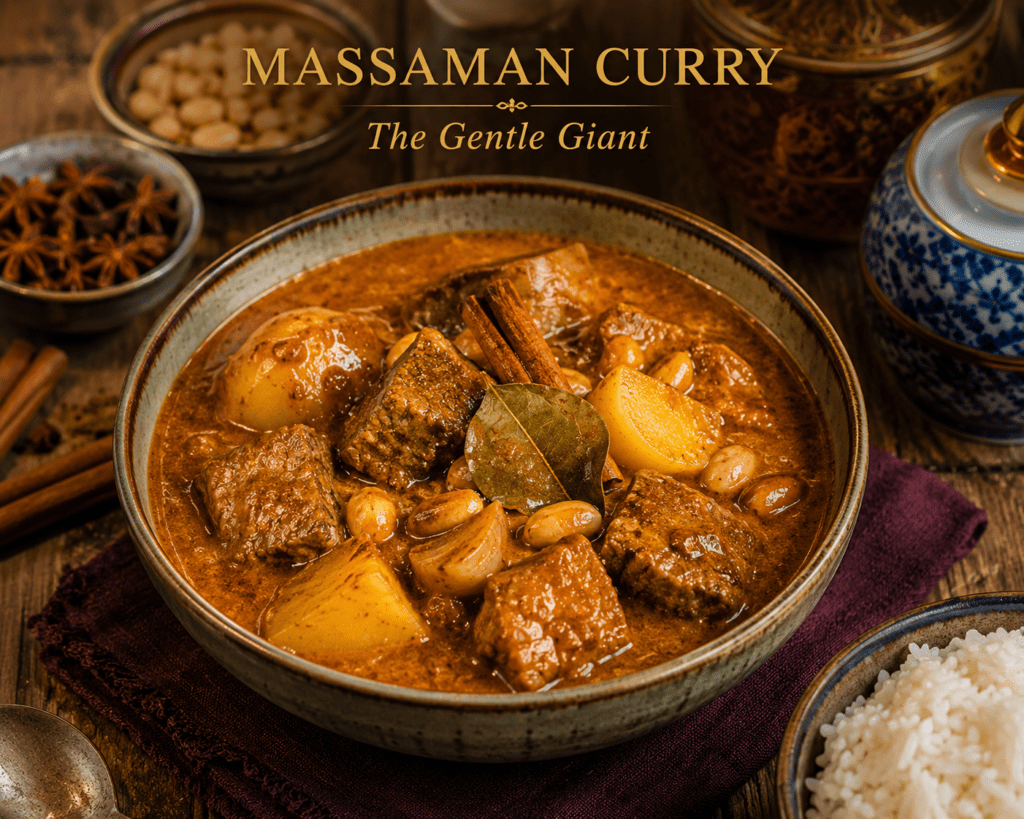
1. MASSAMAN CURRY — The Gentle Giant
Where: Throughout Phuket restaurants Price: 150–350 THB ($4.20–9.80)
What it is: The mildest of Thailand’s major curries — Massaman is influenced by Persian-Muslim traders who came to southern Thailand centuries ago. Slow-cooked beef or chicken with potato, onion, and peanuts in a coconut milk base with an unusually warm spice profile: cinnamon, cardamom, star anise, cloves alongside the usual Thai aromatics.
How it tastes: Rich, warming, slightly sweet from the palm sugar and the peanuts, with a complexity from the Persian-influenced spice blend that is unlike any other Thai curry. The meat is fall-apart tender. The potato has absorbed the curry completely. It is the Thai curry for people who think they don’t like Thai curry.
Key ingredients: Beef chuck/chicken thigh, coconut milk, Massaman curry paste (dried chillies, lemongrass, galangal, cinnamon, cardamom, star anise, cloves, coriander), potato, peanuts, onion, palm sugar, tamarind, fish sauce
2. HOI TOD (PHUKET STYLE) — Oyster Omelette
Best address in Phuket: Ranong Road Night Market, Phuket Old Town Price: 60–120 THB ($1.70–3.35)
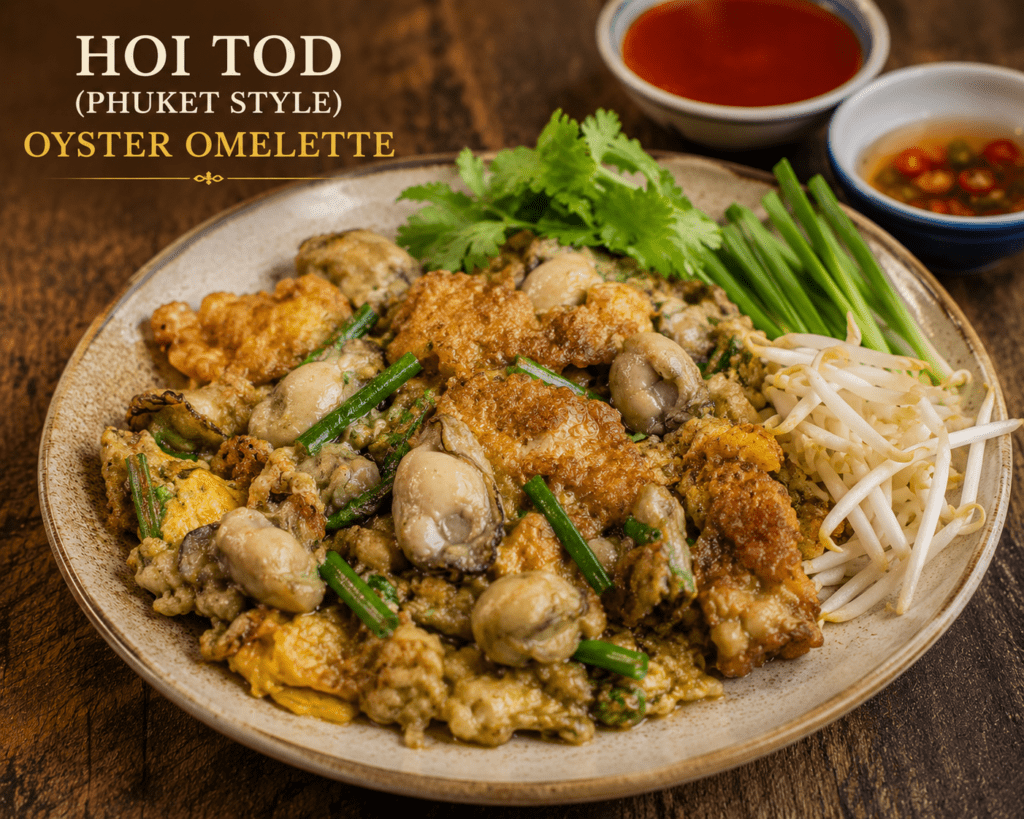
The Phuket version of Hoi Tod uses larger, plumper oysters from local Phuket waters — the result is richer and more briny than the Bangkok version. The cast-iron pan here is typically older and more seasoned, adding a specific smoky note.
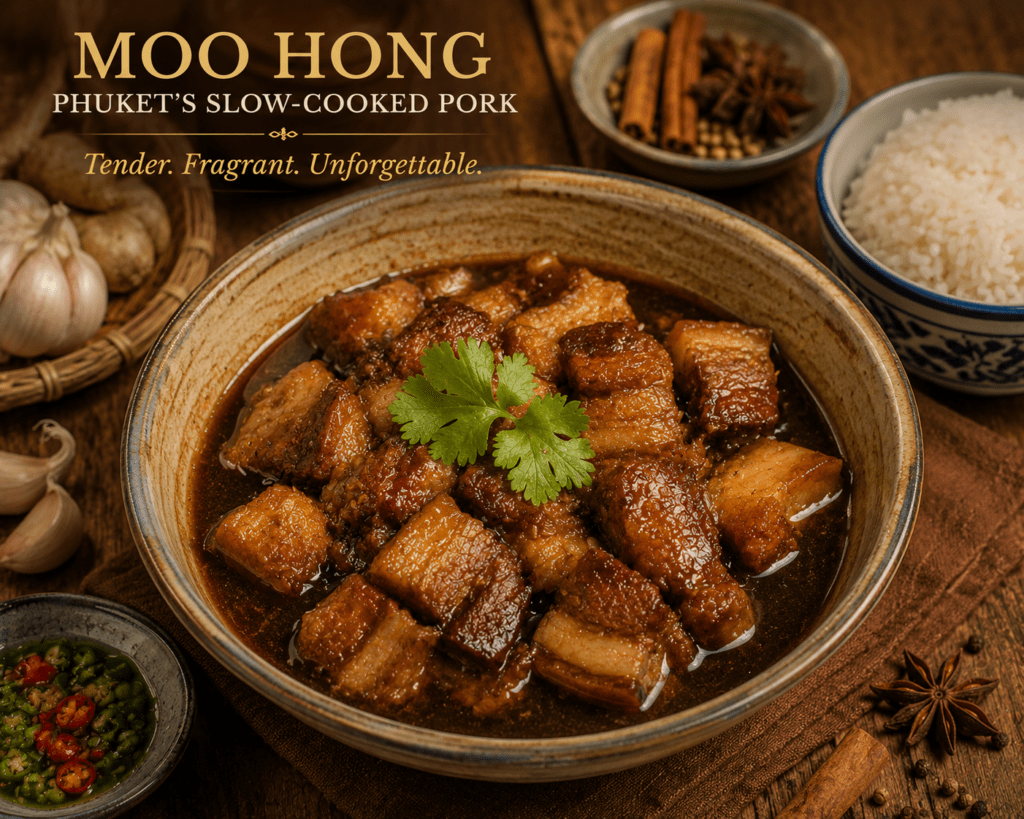
3. MOO HONG — Phuket’s Slow-Cooked Pork
Where: Old Town Phuket restaurants, Ranong Road area Price: 150–280 THB ($4.20–7.80)
What it is: Phuket’s signature Peranakan dish — pork belly slow-braised for 4–6 hours in a sauce of soy sauce, palm sugar, pepper, and five-spice until deeply caramelised and falling apart. Served with preserved mustard greens and steamed rice.
How it tastes: The pork belly is meltingly tender, the fat having rendered completely into the braising liquid. The sauce is dark, sweet, and deeply savoury — the five-spice giving it a slightly anise warmth. The mustard greens provide acidity that cuts through the richness. This is Phuket’s comfort food.
4. ROTI — Phuket’s Street Bread
Where: Muslim street vendor carts throughout Phuket Price: 30–60 THB ($0.85–1.70)
What it is: A flaky, layered flatbread of Indian origin — the roti here is unique to southern Thailand, brought by Muslim traders. Available sweet (banana-egg, condensed milk, Nutella) or savoury (egg, cheese). The roti vendor’s performance — stretching, folding, and slapping the dough on the hot plate — is theatre.
How it tastes: Crispy and buttery at the edges, layered and slightly chewy in the centre. The banana version — sliced banana inside, egg on top, condensed milk drizzled over — is rich and satisfying. The plain with condensed milk is the traditional version.
PHUKET FOOD STREETS AND MARKETS
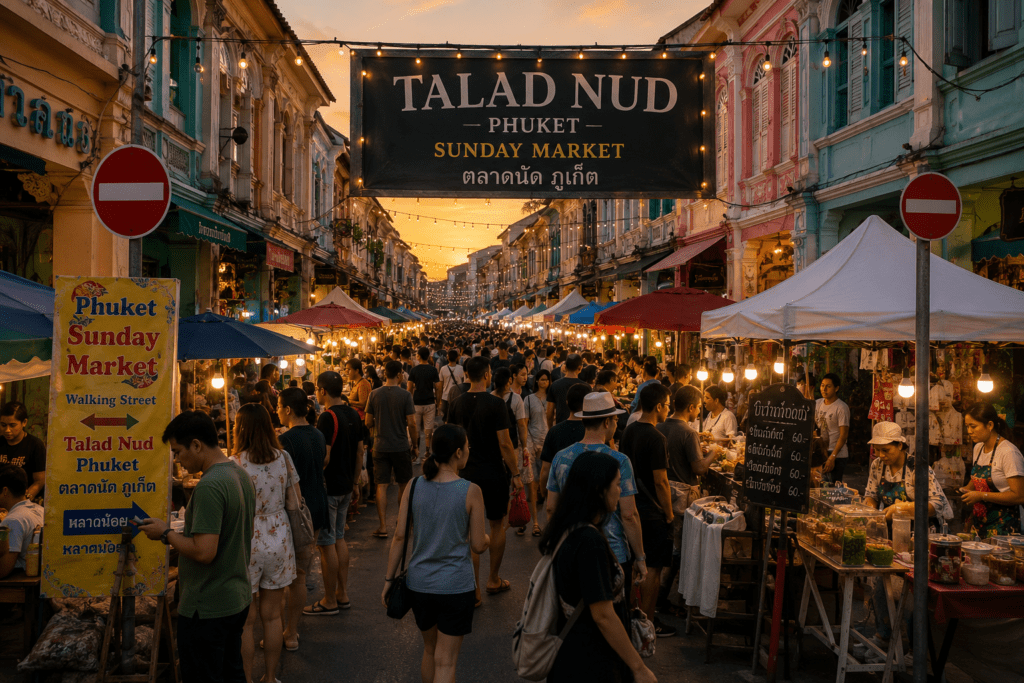
Old Town Phuket Sunday Market (Talad Nud): Open: Sunday evenings, 5pm–10pm Where: Thalang Road, Old Town Phuket Phuket’s Old Town Sunday market is a wonderland of snacks: grilled squid, little coconut pancakes, and endless fresh juices.
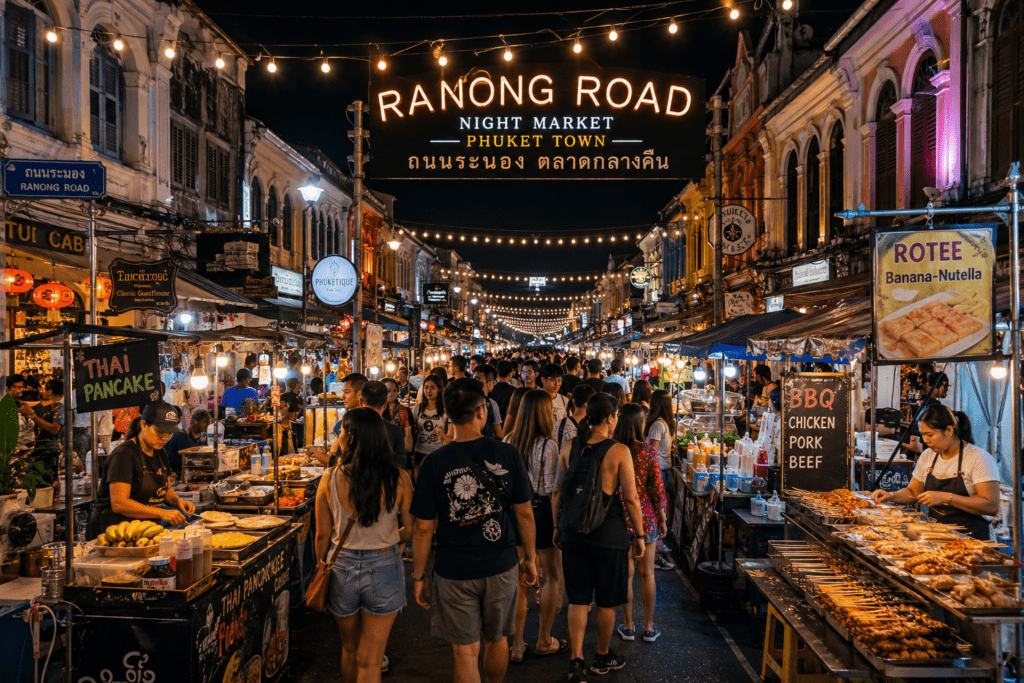
Ranong Road Night Market: Open: Daily evenings Phuket’s most authentic local market — less tourist-facing than the Old Town market. The best Hoi Tod, Moo Hong, and fresh seafood in Phuket.
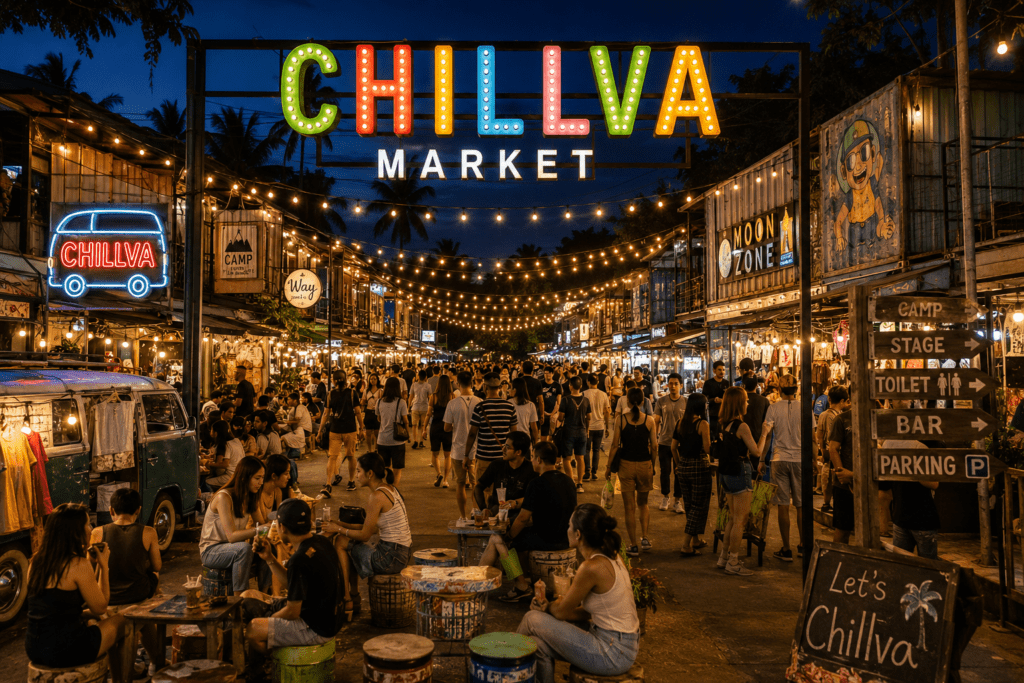
Chillva Market: Modern, organised, open-air market in the Phuket Town area. More street food stalls, cleaner environment, good mix of tourist and local food.
PHUKET FINE DINING
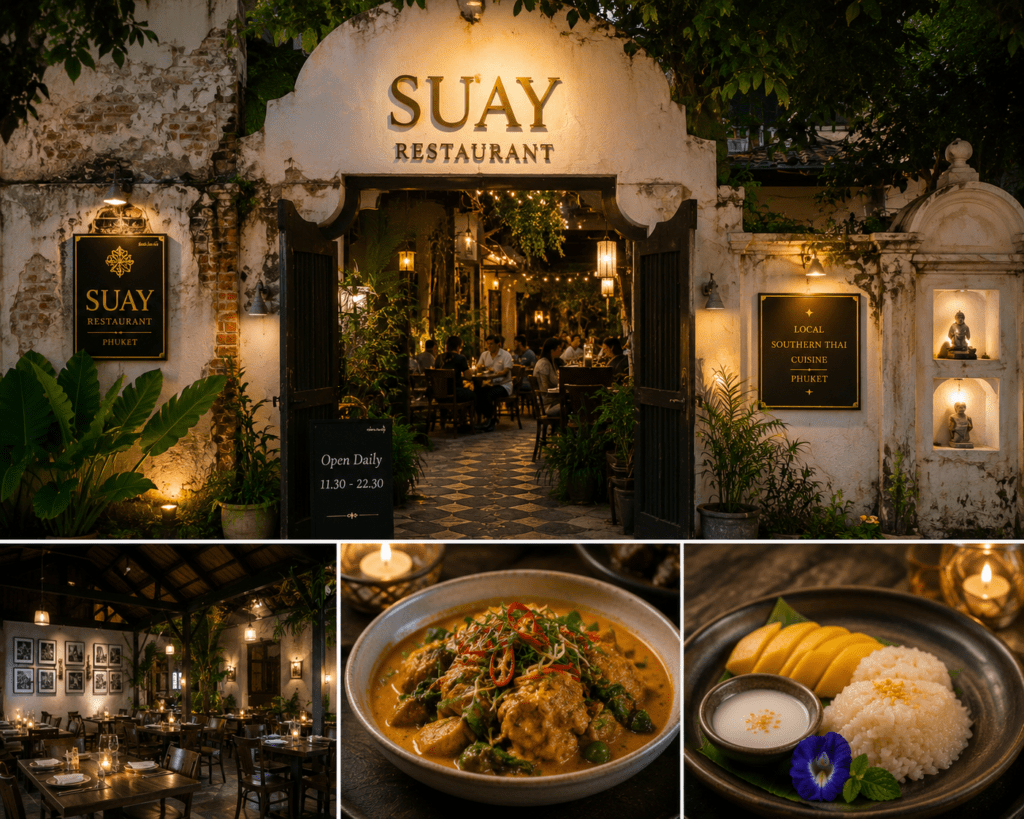
Suay Restaurant Address: 50/2 Takuapa Road, Phuket Town 83000 Price: 800–2,000 THB ($22–55) per person What it is: The finest Thai restaurant in Phuket — Chef Noi Tammasak creates contemporary Thai food using Phuket-specific ingredients (local Phuket lobster, Andaman seafood, southern Thai spice profiles).
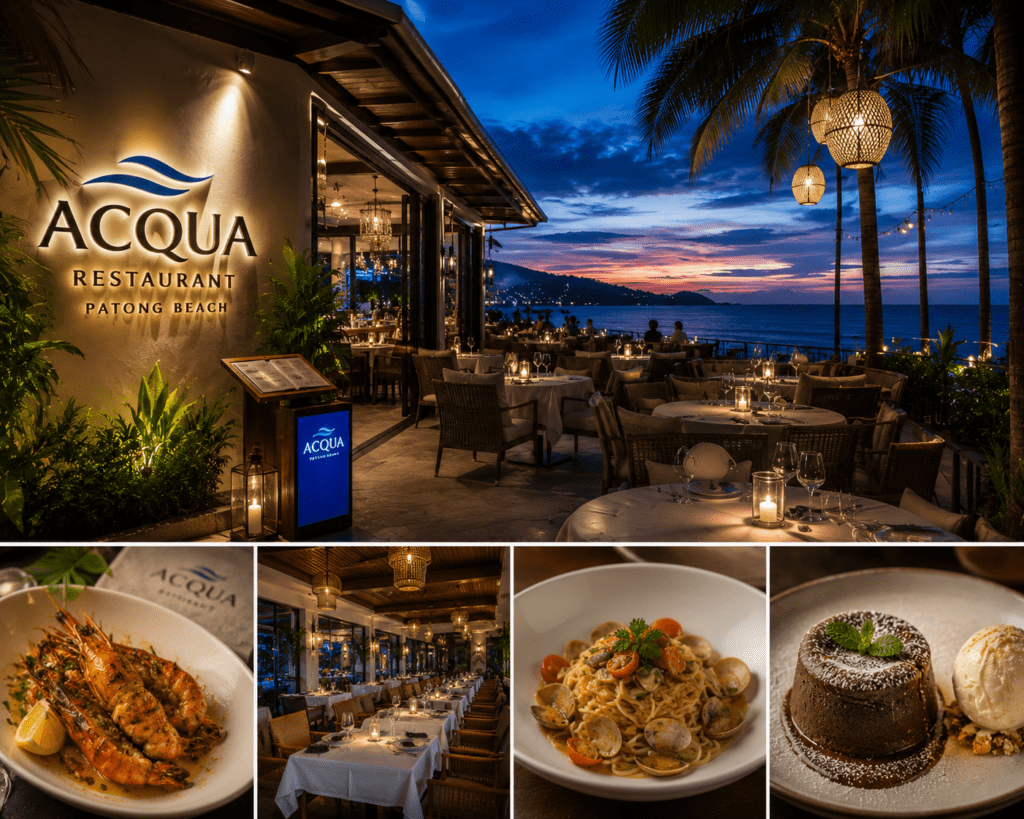
Acqua Restaurant (Patong Beach) Address: 324/15 Prabaramee Road, Patong, Phuket 83150 Price: 1,500–3,500 THB ($42–97) per person Cuisine: Italian-Mediterranean with local seafood What it is: Phuket’s best non-Thai fine dining — the fresh Andaman seafood treated with Italian technique. The whole grilled Andaman lobster here is extraordinary.
ISLANDS — KOH SAMUI, KRABI & PHI PHI
Koh Samui Food Guide
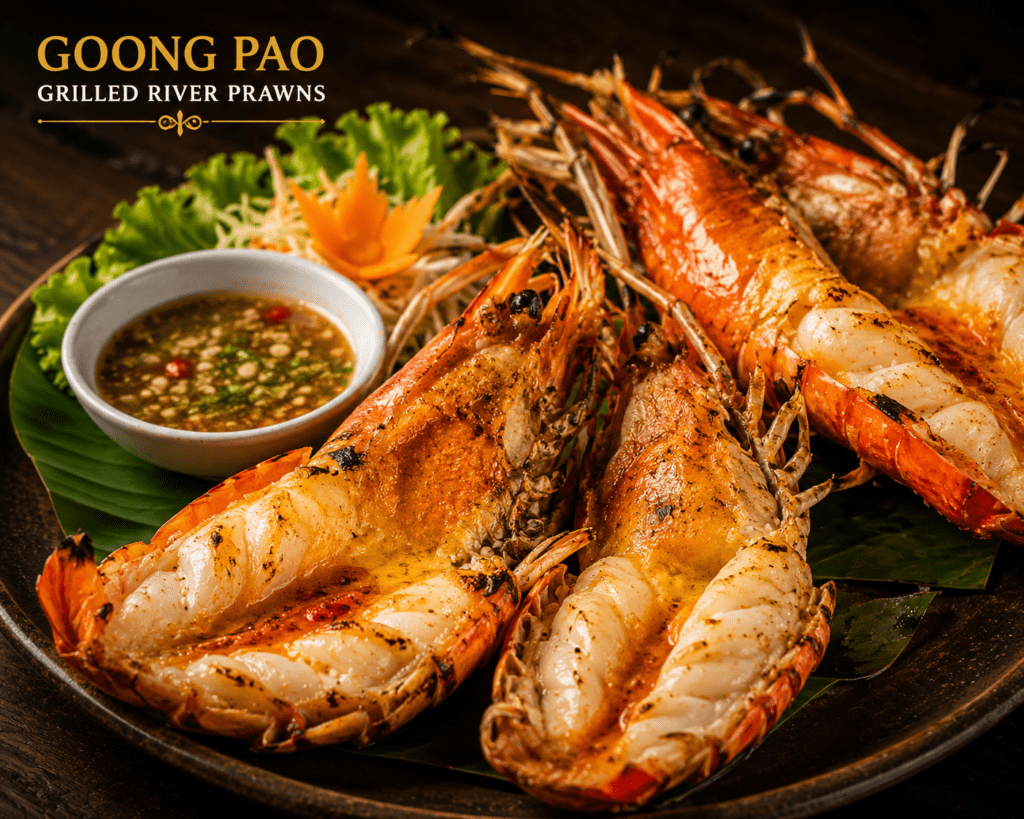
Goong Pao (Grilled River Prawns): The Koh Samui speciality — freshwater prawns grilled over charcoal, the blue-green roe visible at the head, the meat sweet and fresh. Served with a spicy seafood sauce. Price: 300–600 THB ($8.40–16.80) per portion at beachside restaurants.
Where: Fisherman’s Village, Bophut — the most authentic beach dining on Koh Samui. Friday night walking street with seafood stalls. Avoid the full-moon party tourist strip for food.
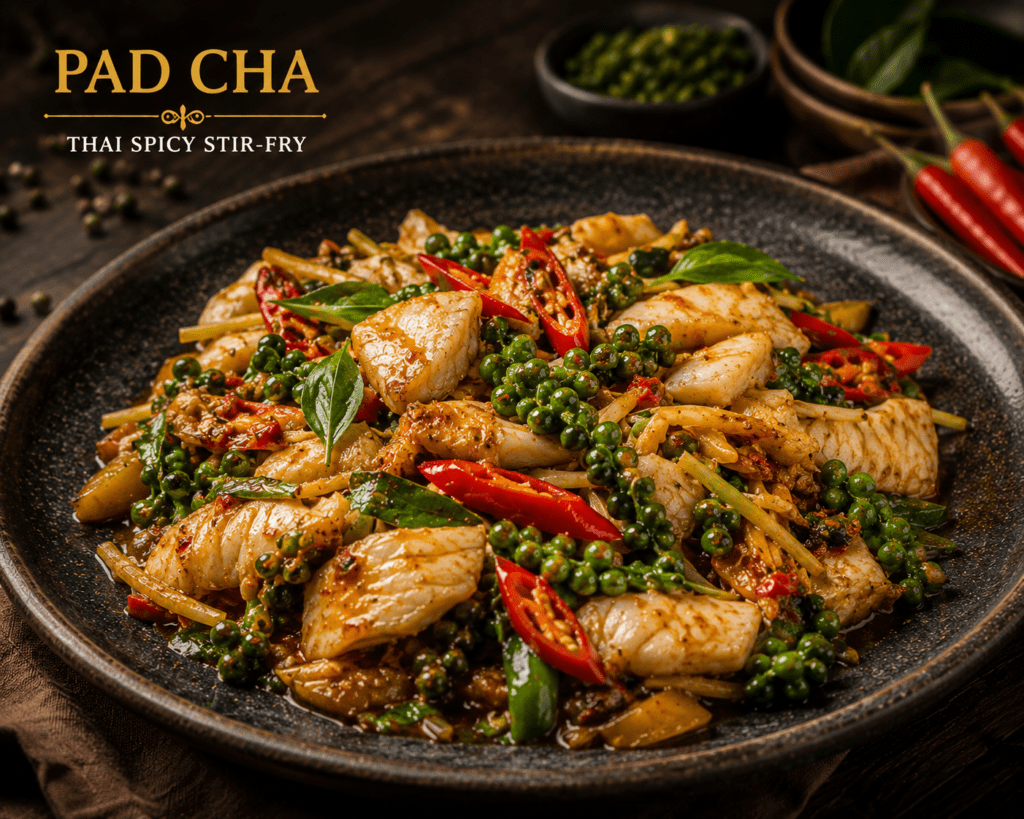
Pad Cha: Stir-fried seafood (squid, clams, or mixed) with roasted chilli paste, finger root ginger, green peppercorns, and Thai basil. Extremely fragrant, moderately spicy, uniquely southern Thai. Price: 200–400 THB at local restaurants.
Krabi Food Guide
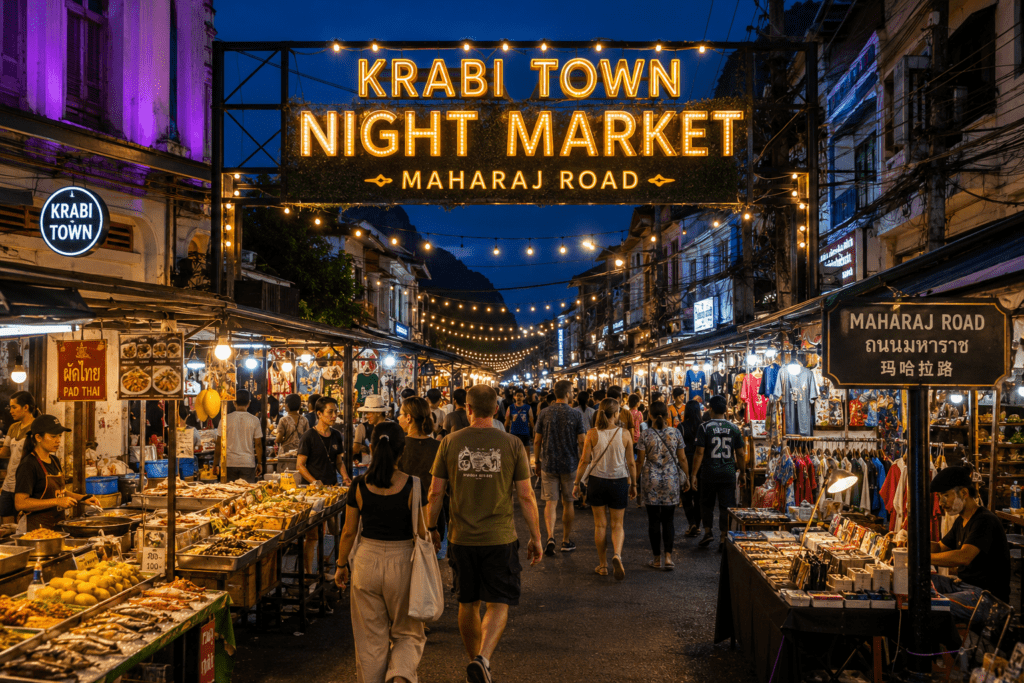
Krabi Town Night Market (Maharaj Road): Open: Daily evenings, 5pm–10pm The main food destination in Krabi — fresh seafood, grilled meats, and southern Thai curries. The crab curry here (Gaeng Poo) is the reason to visit Krabi Town rather than heading straight to the islands.
Rotee (Krabi Muslim Roti): Same as Phuket’s roti but Krabi’s vendors have been doing it longer. The banana-egg version at Rotee Khanom Buang stalls near the river pier is excellent.
VEGETARIAN FOOD IN THAILAND — THE COMPLETE GUIDE
The Vegetarian Situation in Thailand — Important Context
Thailand has a complex relationship with vegetarianism. Most Thai dishes contain fish sauce, shrimp paste, or oyster sauce as foundational ingredients — often invisibly. Dishes that appear vegetarian (pad Thai, green curry, tom yum) typically contain these animal products.
The solution: Use the phrase “kin jay” (กินเจ) — this refers to the Thai Buddhist vegetarian tradition that is well understood by locals. Jay food is strictly vegan (no fish sauce, no meat, no dairy, no garlic, no onion). Many restaurants in tourist areas now display a yellow flag or “J” sign indicating jay food.
Alternatively: “mai sai nam pla, mai sai kung haeng” (no fish sauce, no dried shrimp) is specific and understood.
BEST VEGETARIAN DISHES IN THAILAND
1. Khao Soi Jay (Vegetarian Khao Soi) Available in Chiang Mai at multiple restaurants — the curry paste is made without shrimp paste and the broth uses vegetable stock with coconut milk. The flavour is slightly less deep than the meat version but still outstanding. Price: 70–100 THB | Where: Chiang Mai’s Sunday Walking Street has multiple jay food stalls
2. Som Tum Thai (Green Papaya Salad — Vegetarian Version) The standard Som Tum contains dried shrimp and fish sauce. Ask for Som Tum Thai Jay — the vegetarian version uses soy sauce instead of fish sauce and skips the dried shrimp. Still has all the crunch, sourness, and chilli heat. Price: 50–80 THB
3. Pad Pak Boong Fai Daeng (Stir-Fried Morning Glory) Water spinach stir-fried at high heat with garlic, chilli, and soy sauce (instead of fish sauce when requested). The high-wok-heat char on the vegetables is the technique — the dish is simple, nutritious, and available everywhere. Price: 60–100 THB
4. Tofu Tom Kha (Coconut Milk Soup with Tofu) Tom Kha Gai (coconut milk chicken soup) made with firm tofu instead. The galangal-lemongrass-kaffir lime leaf broth with coconut milk is the flavour vehicle — the protein is secondary. Confirm no fish sauce. Price: 100–180 THB
5. Mango Sticky Rice: Fully vegetarian and vegan as standard. One of Thailand’s most reliably plant-based dishes. Price: 60–150 THB
6. Kanom Krok (Coconut Pancakes): Naturally vegetarian/vegan — rice flour, coconut milk, sugar. Available at most markets. Price: 30–50 THB
7. Pad Thai Jay: The vegetarian version of Pad Thai — substitutes tofu for protein, uses soy sauce instead of fish sauce. Available at most tourist-area restaurants and at specific jay food stalls. Price: 80–150 THB
BEST VEGETARIAN RESTAURANTS BY CITY
Bangkok:
- May Veggie Home (Silom): The gold standard Bangkok vegetarian restaurant — extensive menu, everything clearly marked, excellent pad Thai jay and mock meat dishes. Price: 100–250 THB per dish.
- Ethos Restaurant (Khao San Road): Backpacker-friendly vegetarian and vegan menu. Good value, international options alongside Thai. Price: 150–300 THB.
- Chamlong’s Asoke Vegetarian Food (Asoke): Thai Buddhist vegetarian restaurant — enormous variety, buffet-style, extremely affordable. Price: 40–60 THB per item.
Chiang Mai:
- Pun Pun Organic Vegetarian Restaurant (Wat Suan Dok): Inside a temple compound — organic, local ingredients, northern Thai vegetarian dishes. The most peaceful lunch in Chiang Mai. Price: 100–200 THB.
- Anchan Vegetarian Restaurant: Multiple locations in Chiang Mai — consistent, reliable, well-priced.
Phuket:
- Kin Dee Restaurant, Old Town: Jay food stalls throughout Old Town during the Phuket Vegetarian Festival (October) — the entire city goes vegetarian for nine days.
- Morningsong Vegetarian, Patong: Tourist-accessible vegetarian/vegan menu.
VEGAN FOOD IN THAILAND
Going Vegan in Thailand — Easier Than You Think (With Some Navigation)
Many major cities have moved vendors into organised markets in 2026, which means better hygiene and better navigation for dietary requirements.
The jay food (เจ) system is your friend — jay food is fully vegan and recognised everywhere in Thailand. Look for the yellow flag.
Essential phrases for vegans:
- “Pom/Chan kin jay” — I eat jay (Buddhist vegan) food
- “Mai sai nam pla” — No fish sauce
- “Mai sai nam man hoi” — No oyster sauce
- “Sai tofu thaen neua” — Substitute tofu for meat
- “Tao hoo” — Tofu
Reliably vegan Thai dishes:
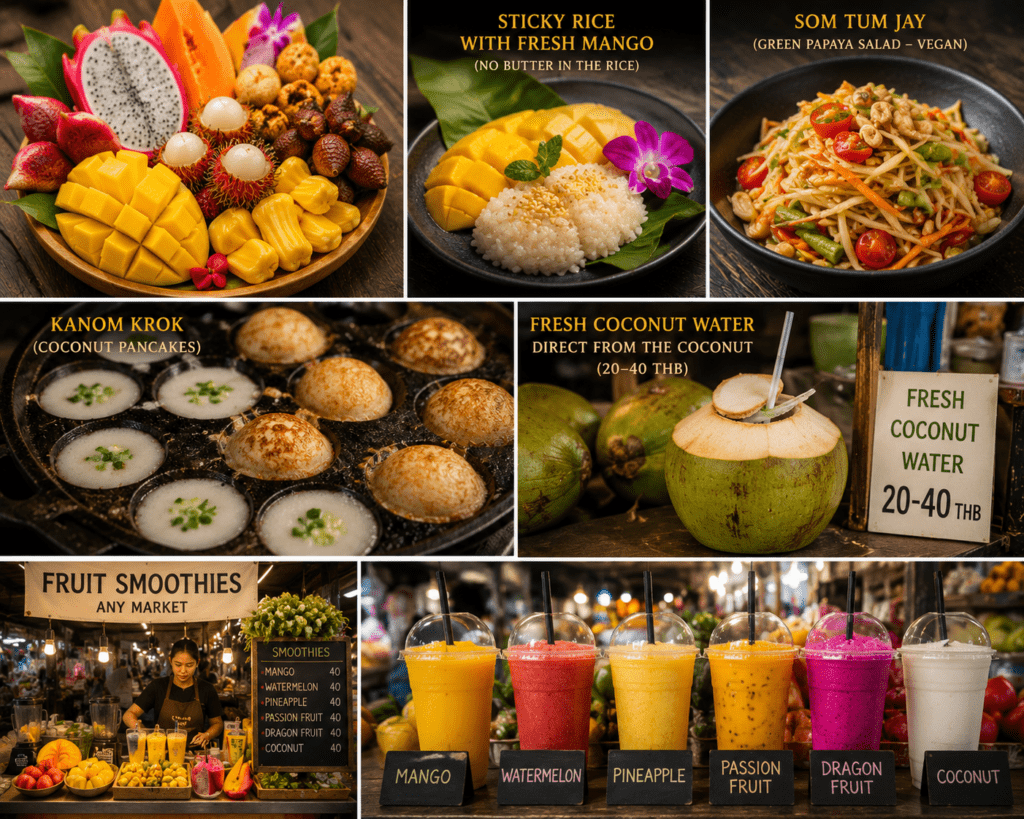
- Fresh fruit (Thailand has extraordinary tropical fruit — papaya, mango, dragonfruit, rambutan, longan, sala, jackfruit)
- Sticky rice with fresh mango (confirm no butter in the rice)
- Som Tum Jay (green papaya salad — vegan version)
- Kanom Krok (coconut pancakes)
- Fresh coconut water direct from the coconut (20–40 THB)
- Fruit smoothies at any market
Apps for finding vegan food:
- HappyCow: The best international app for finding vegetarian and vegan restaurants in Thailand. Available iOS and Android. Free to browse, subscription for full features.
- Grab Food: Delivery app with vegetarian/vegan filter available in Bangkok, Chiang Mai, and Phuket.
DRINKS IN THAILAND — WHAT TO ORDER AND WHERE
Essential Thai Drinks
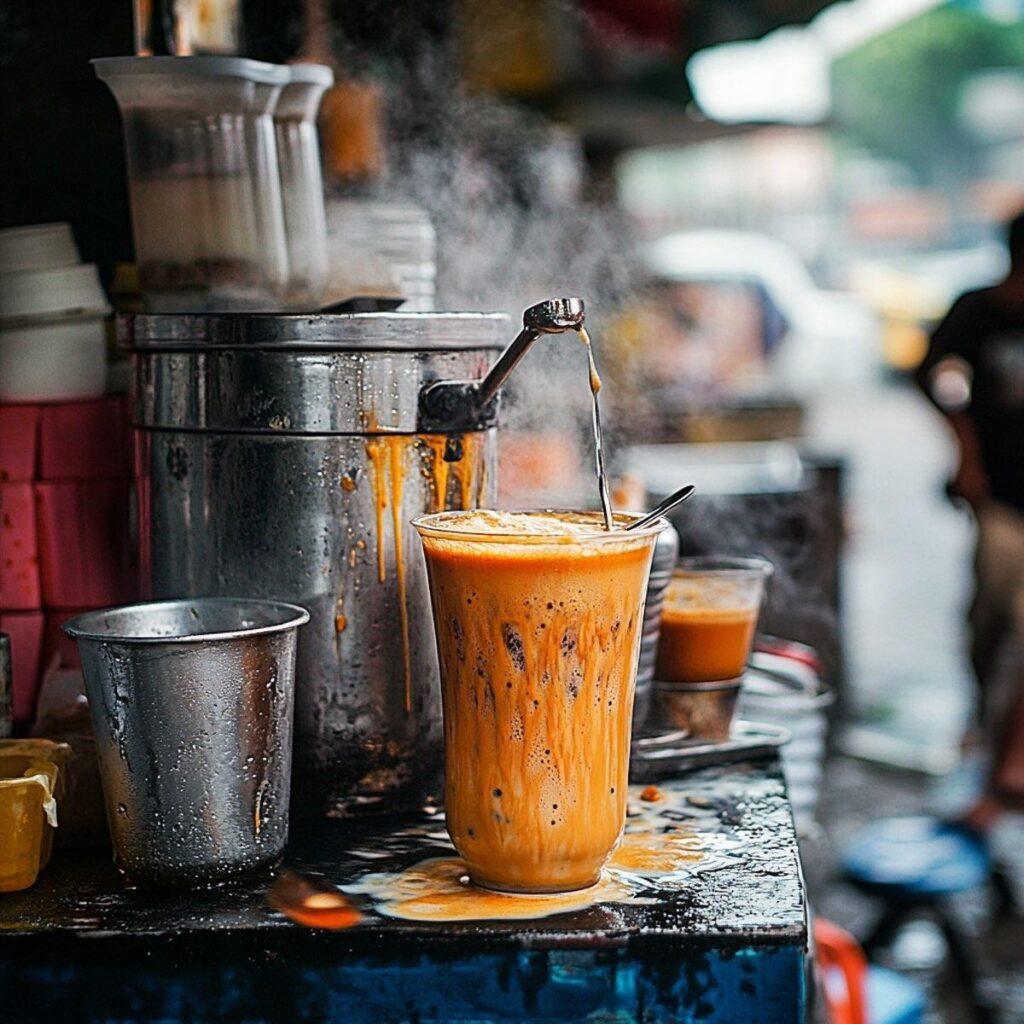
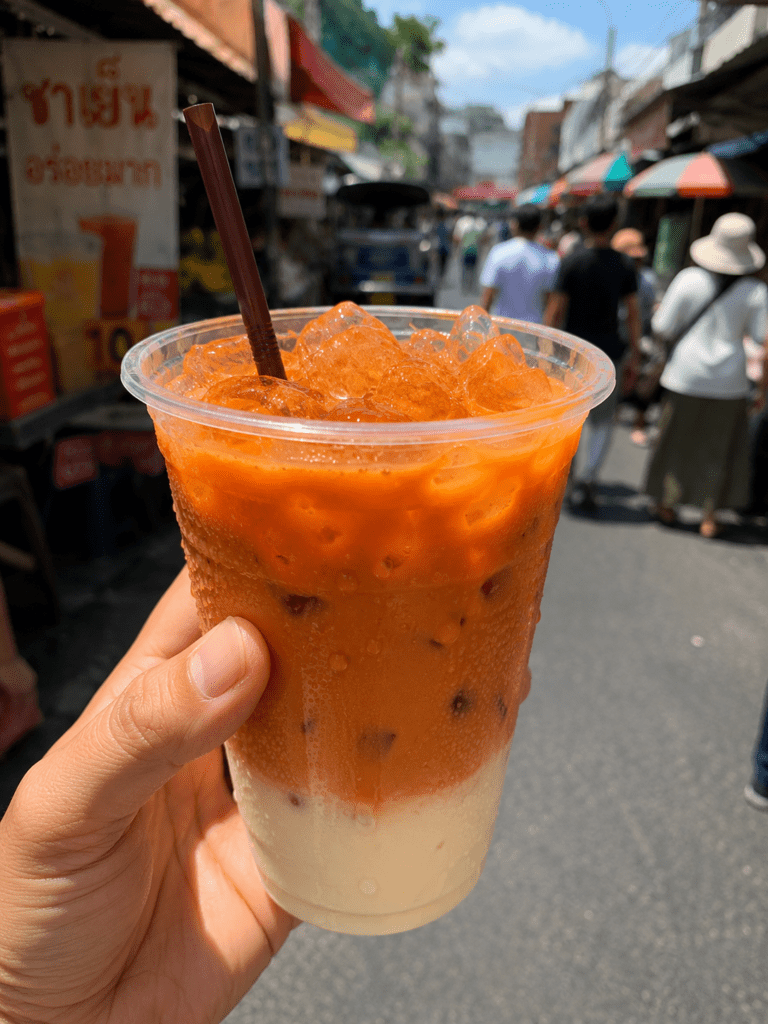
1. Cha Yen (Thai Iced Tea) The orange-coloured, strong black tea brewed from a specific Thai tea blend, mixed with condensed milk and evaporated milk over ice. The orange colour comes from the tea blend (which includes a food colouring, traditionally). Sweet, creamy, refreshing in the heat. Price: 25–60 THB | Where: Every street stall, every café
2. Oliang (Thai Iced Coffee) Strong Thai coffee — a blend of coffee with corn, sesame, and soybeans — brewed through a cloth filter (similar to Vietnamese coffee) and served over ice with condensed milk. Darker and more bitter than Cha Yen. Excellent with sweet breakfast foods. Price: 25–50 THB
3. Nam Manao (Fresh Lime Soda) Freshly squeezed lime juice served over ice with soda water and the choice of salt or sugar (or both — the Thai version comes with a small dish of both for self-adjustment). The most refreshing non-alcoholic drink in hot weather. Price: 30–60 THB
4. Fresh Coconut Water (Nam Ma Prao) Direct from the green coconut, chilled, with a straw. Not the processed coconut water from a box — the real thing, from a vendor who cuts the top with a machete. Naturally sweet, slightly nutty, the best natural hydration in Thailand. Price: 20–50 THB at markets and beach vendors
5. Singha / Chang / Leo Beer Thailand’s three major domestic beers. Singha is the most bitter and malty. Chang is lighter and sometimes sweeter. Leo is the budget option. All served extremely cold. A large bottle at a local restaurant: 80–130 THB. At a beach bar: 150–200 THB.
6. Pad Thai Chang (Local Beers): At a proper local restaurant (not tourist-facing), beer is served with food in a ritual — large bottle shared across the table, poured into small glasses with ice. The ice in the glass is standard in Thailand for beer.
7. Thai Whisky (Ruang Khao, Sang Som): Thai rum (Sang Som, technically) is cheaper than beer by volume and used as the spirit base for most nightlife drinking. Typically served in buckets (a bucket = a mixer of soft drink + Sang Som + ice) at tourist nightlife venues. 150–300 THB per bucket.
8. Fresh-pressed fruit juices (night markets): Watermelon juice, passion fruit, guava, roselle (hibiscus) — Thailand’s night markets all have fresh fruit juice stalls. 30–60 THB for a large cup.
WHERE TO DRINK IN EACH CITY
Bangkok:
- Octave Rooftop Lounge (Marriott, Thong Lo): 360° view from 45th floor, cocktails 400–800 THB. The best view bar in Bangkok.
- The Speakeasy Rooftop (Hotel Muse, Langsuan): More intimate rooftop, better cocktail programme.
- Sky Bar (State Tower, Silom): The most famous Bangkok bar from “The Hangover Part II” filming location. 600–1,200 THB cocktails. Worth one visit.
Chiang Mai:
- North Gate Jazz Co-Op: Live jazz nightly, relaxed, local crowd, reasonably priced drinks.
- Zoe in Yellow: Backpacker bar strip — cheap, cheerful, loud.
Phuket:
- Baba Nest (Sri Panwa Resort): Best sunset bar in Phuket — 360° views from the Cape Panwa headland. Cocktails 450–900 THB.
- Illuzion Phuket (Patong): Phuket’s biggest nightclub — see the Nightlife guide for details.
THINGS TO KNOW BEFORE YOU EAT
The Rules That Save You
Rule 1: Busy stalls are safe stalls. Safety is key when eating street food — choose busy stalls with high turnover and observe proper food handling practices. High turnover means fresh ingredients replaced frequently. The empty stall at 8pm in a busy market is empty for a reason.
Rule 2: Eat where locals eat. If you’re the only tourist at a stall, you’re probably in the right place. If the menu is in five languages with photos, you’re in the tourist zone.
Rule 3: The water rule. Tap water is still a no in 2026. Stick to bottled or boiled water. Ice in major cities like Bangkok or Chiang Mai is usually made from purified water and is safe. In rural areas, skip the ice.
Rule 4: Spice negotiation. Always state your spice preference upfront: mai pet (not spicy), pet nit noy (a little spicy). Thai cooks will use their default spice level if you don’t specify, and the default is often significantly hotter than visitors expect.
Rule 5: Morning markets are the freshest. My all-time favourite experience in Thailand was waking up early to explore the Bangkok floating markets. Morning food — Moo Ping, fresh noodle soups, Kanom Krok — is at its best before 9am when ingredients are freshest and the vendor is still energised.
Rule 6: Don’t negotiate at food stalls. Prices at Thai street food stalls are fixed and fair. Negotiating a 20 THB bowl of noodles is not the correct use of your energy in this country.
Rule 7: Carry small change. Most street food stalls don’t give change for 500 or 1,000 THB notes. Keep 20–100 THB notes available.
Rule 8: Night markets — arrive early or late. The most popular stalls sell out. Arrive before 7pm or after 9pm to avoid the peak hour competition for the best items.
HOW TO FIND FOOD — APPS AND NAVIGATION
The Apps Every Food Traveller Needs in Thailand
Google Maps: Search any dish name + city (“khao soi Chiang Mai”) and Google Maps will surface the most highly-rated local restaurants. Reliable for Bangkok and Chiang Mai; slightly less comprehensive for smaller towns and islands.
Wongnai (วงใน): Thailand’s local version of Yelp/Zomato — in Thai, but Google Translate handles it on mobile. Reviews from actual Thai locals rather than tourists. The most reliable rating system for authentic local food. iOS and Android.
HappyCow: Vegetarian and vegan restaurant finder — excellent coverage in Bangkok, Chiang Mai, and Phuket. Filter by fully vegan, vegetarian, or vegan-friendly. iOS and Android.
Grab: Southeast Asia’s Uber — handles both transportation and food delivery (Grab Food). In Bangkok, Chiang Mai, and Phuket, Grab Food delivers from most restaurants to your accommodation. iOS and Android.
Michelin Guide Thailand: The official Michelin app — filters to Michelin-starred and Bib Gourmand (excellent value, not necessarily starred) restaurants. Bib Gourmand listings are the best resource for quality food at reasonable prices. iOS and Android.
Agoda/Booking.com: For restaurants attached to hotels — the Gaggan, Le Du, and Nahm reservations system is also accessible through Google’s restaurant booking integration.
HOW TO GET TO THE FOOD — TRANSPORT GUIDE
Bangkok Public Transport for Food Touring
BTS Skytrain (BTS): The most reliable way to navigate Bangkok’s food locations. Single journey: 17–62 THB. Day pass: 140 THB. Rabbit Card (stored value): Available at any BTS station.
- Chatuchak Market: Mo Chit station (Exit 1)
- Or Tor Kor Market: Kamphaeng Phet station (Exit 3)
- Yaowarat (Chinatown): Take the MRT (subway) to Hua Lamphong or Wat Mangkon
- Thip Samai: Best by taxi/Grab from Sanam Chai MRT (10-minute ride)
MRT (Subway): Interconnects with BTS at several points. Useful for:
- Chinatown: Wat Mangkon station (new Yaowarat line) or Hua Lamphong station
- Lumpini area restaurants: Lumpini or Si Lom station
Grab (App-Based Taxi): The most practical way to reach specific food locations not near BTS/MRT. Open the app, set destination, confirm price upfront. No negotiation. Available throughout Bangkok, Chiang Mai, and Phuket. Set the destination in Thai if the driver appears to not speak English.
Tuk-Tuk: Iconic but use judiciously — tuk-tuks near tourist areas operate “gem shop” scams where they offer cheap rides but route through commission-paying shops. In Chiang Mai, tuk-tuks (technically red songthaews — red trucks with bench seating) are the standard local transport at 20–30 THB per person for short hops.
Chiang Mai: Red songthaew (red truck/shared taxi): Hail one going your direction, state your destination, 20–30 THB per person. The main local transport option. Grab also operates in Chiang Mai.
Phuket: No reliable public transport. Grab or agree on price with a tuk-tuk/taxi. Renting a scooter is the most practical way to explore food locations across the island — 200–350 THB/day.
Islands (Koh Samui, Koh Phi Phi, Krabi): Koh Samui has taxis and songthaews (trucks). Koh Phi Phi is car-free — walk everywhere or take a longtail boat. Krabi Town is walkable; Ao Nang and beaches require tuk-tuk or songthaew.
FAQ Section
Q: What is the must-try food in Thailand in 2026?
A: The 2026 rundown of must-try dishes includes Pad Thai, Khao Soi, Tom Yum Goong, Som Tum, Mango Sticky Rice, and the new favourite Jungle Curry (Kaeng Pa) for those who want heat without coconut milk. Add Boat Noodles in Bangkok, Sai Oua in Chiang Mai, and Massaman Curry in Phuket to complete the essential list.
Q: Is Thailand food good for vegetarians?
A: Thailand can be excellent for vegetarians if you know what to say. Use the phrase “kin jay” to indicate Buddhist vegetarian food — this is well understood across Thailand. Look for yellow flags indicating jay food stalls. The Phuket Vegetarian Festival in October transforms the entire island. Many dishes can be adapted — confirm no fish sauce and no dried shrimp when ordering.
Q: Where is the best street food in Bangkok?
A: Bangkok’s Chinatown (Yaowarat Road) and the night markets in Phuket remain goldmines of smoke and noise for street food. In Bangkok specifically: Yaowarat for Chinese-Thai, Chatuchak Weekend Market for variety, Or Tor Kor for premium quality, and the area around Victory Monument for boat noodles.
Q: How much does food cost in Thailand in 2026?
A: Street food ranges from 30–150 THB ($0.85–4.20) per dish. A full street food meal with a drink costs 100–200 THB ($2.80–5.60). Mid-range restaurant meals run 300–800 THB ($8.40–22) for two people. Fine dining at Bangkok’s best restaurants (Le Du, Nahm, Gaggan) runs 3,500–9,000 THB ($97–250) per person for a tasting menu.
Q: What is the best food city in Thailand?
A: Bangkok is the overall food capital — the most diverse, the highest concentration of excellent stalls and restaurants, and the most internationally recognised. Chiang Mai wins for regional specificity — northern Thai food is a completely distinct cuisine worth travelling for. Over the years, slurping noodles in Bangkok’s Chinatown and tucking into northern curries in Chiang Mai are two of the most distinct food experiences Thailand has to offer.
Q: Is it safe to eat street food in Thailand?
A: Yes — with reasonable precautions. Choose busy stalls with high turnover and observe proper food handling practices. Stick to bottled or purified water, avoid raw shellfish from unknown sources, and eat cooked food that’s served hot. Millions of travellers eat Thai street food daily without incident — it is one of the world’s safest street food cultures.
Conclusion — Go Hungry. Come Back Full of Something More Than Food.
I first visited Thailand in 2019, spending two weeks in Phuket, Bangkok, and Chiang Mai. I fell hard for the stunning scenery — golden temples, turquoise water, lush jungles — but from the first bite, it was the food that had me hooked.
That experience — the food being the thing that hooks you rather than the backdrop you expected it to be — is what every first-time Thailand visitor encounters. And what every return visitor is secretly coming back for, no matter what they claim about temples and beaches.
The boat noodles at Victory Monument. The Khao Soi at the unnamed shop in Chiang Mai where the owner recognised me on day three. The mango sticky rice from Mae Varee at 10am when the Nam Dok Mai mangoes were perfect and the coconut cream was still warm. The Pad Thai wrapped in egg at Thip Samai at 11pm after the queue had finally shortened enough to be worth joining.
These are not tourist experiences. They’re just eating — the same thing that Bangkok office workers, Chiang Mai market traders, and Phuket fishing families do every day, within reach of anyone who shows up with 50 baht and hunger.
That’s the gift Thailand’s food culture offers. The best meal doesn’t cost more than a cup of coffee back home. It just requires showing up, pointing at something that smells good, and trusting the cook.
Trust the cook.
กินข้าวยัง? — Have you eaten yet?