

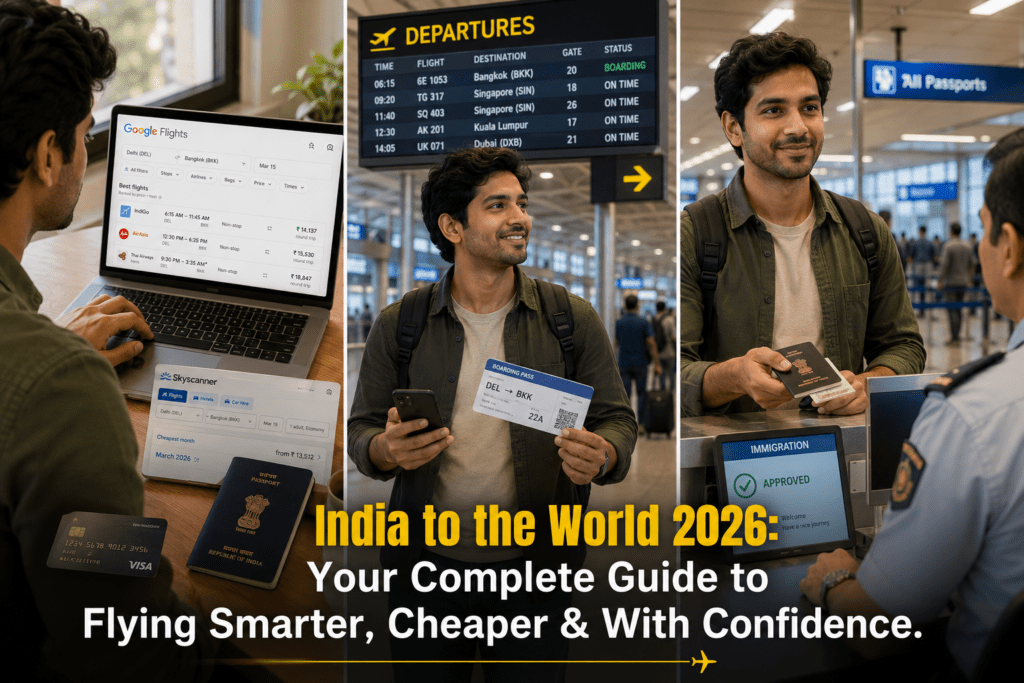
The Flight I Almost Missed Because I Didn’t Know Things
My first international flight was to Singapore. I was 24. I had booked the cheapest ticket I could find (IndiGo from Chennai, non-stop, ₹14,500), packed everything I owned into a 25kg checked bag and a backpack that I was about to learn was 4kg overweight, and arrived at Chennai airport approximately 45 minutes before departure feeling extremely calm about this arrangement.
I was not calm for long.
The check-in queue took 25 minutes. The baggage overweight fee was ₹3,800. The security queue was long because it was 6am and everyone else also had the same idea about arriving late. I reached the gate 8 minutes before boarding closed, having jogged through Terminal 1 with a backpack that now felt like a personal punishment system.
I made the flight. Barely.
The Singapore immigration officer looked at my arrival card (which I hadn’t filled out because I didn’t know there would be one), handed me a blank form, and waited with the patience of someone who has seen this exact situation many times.
Singapore was extraordinary. The flights home and back were fine. But the first three hours — the chaos of not knowing what to do or when to do it — could have been avoided entirely if someone had explained it to me.
This guide is that explanation. For every Indian traveller booking their first international trip, or their tenth but wanting to do it smarter, or anyone who’s been paying too much for flights for too long.
Let’s go from the beginning.
How to Book Cheap Flights — The Honest Guide
The Single Most Important Rule: Book at the Right Time
The cheapest domestic fares in India typically appear 5–8 weeks before departure, according to booking pattern data. The difference between booking 8 weeks out versus 3 days out on a popular route like Delhi–Mumbai can be over ₹4,000 per ticket.
For international flights, the window is different: 8–12 weeks ahead for international routes is the sweet spot. Airlines release seats in batches — the first release is often expensive (early bookers who’ll pay), the middle period is the best pricing, and the last two weeks spike again as inventory fills.
The booking timing rule:
- Domestic India: Book 5–8 weeks ahead
- International budget: Book 8–12 weeks ahead
- International peak season (December–January, summer): Book 12–16 weeks ahead
- International last-minute (within 2 weeks): Very expensive unless you get lucky with unsold seats
The Best Platforms for Indian Travellers — Compared Honestly
May 2026 verified data — platform comparison:
| Platform | Convenience Fee | Best For | Special Feature |
|---|---|---|---|
| Google Flights | ₹0 | Price comparison, date flexibility | Price calendar, fare tracking alerts |
| Skyscanner | ₹0 | Global comparison, “cheapest month” | Flexible date search, price history |
| HappyFares | ₹0 | Indian domestic, no fee | Zero convenience fee — lowest total price |
| ixigo | Low | Train + flight combo, domestic | AI fare prediction, Assured cancellation |
| MakeMyTrip (MMT) | ₹249–499/pax | Hotel + flight bundles | Full fare type visibility, HDFC/SBI offers |
| EaseMyTrip | ₹149–349 | Budget domestic, no convenience fee on some | Bank card discounts, group booking |
| Cleartrip | ₹200–399 | International routes, Flipkart users | FlexiMax cancellation cover |
| Goibibo | Similar to MMT | GoStays bundling | Go Cash rewards, flight + hotel |
The honest verdict:
For pure price comparison before booking: start with Google Flights. Zero fee, the best flexible date calendar in the business, and price tracking that sends you an email when your route drops. Then cross-check on Skyscanner.
For booking with zero convenience fee: HappyFares for domestic. This is verified May 2026 data — no other major Indian flight booking platform currently charges zero convenience fee on all domestic bookings.
For international: MakeMyTrip or Goibibo for the full fare ladder visibility and bank offer integration. Skyscanner for the global comparison before committing.
For train + flight combination planning: ixigo remains the most integrated platform for this specific use case.
The Tricks That Actually Work in 2026
1. The Flexible Date Search — The Most Powerful Tool You’re Not Using
Google Flights’ “Date Grid” and Skyscanner’s “Cheapest Month” features show you the price for every date in a calendar view. Moving your travel by 2–3 days can save ₹3,000–8,000 on international routes. This is not a trick — it’s an algorithm reading, and it works consistently.
2. The Incognito Mode Myth — Stop Wasting Energy on This
Airfare pricing has evolved. Airlines price dynamically based on seat inventory and real-time demand, not your browser cookies. The incognito mode flight booking advice is mostly a myth in 2026. What works better: clearing your approach entirely and using a single reliable comparison platform rather than multiple open tabs showing cached results.
3. The Midweek Departure
Shifting from a weekend to a midweek departure can save ₹1,500–₹3,000 per ticket. Tuesdays and Wednesdays consistently have lower fares than Fridays and Saturdays across most routes. Zero extra effort for a meaningful saving.
4. Set Price Alerts — Then Actually Wait
Google Flights price tracking sends you an email when your watched route changes price. Set it. Then wait. If the fare is already at a reasonable level and the alert shows it declining, you’ve found the right moment to book. If it’s going up, you now know to book before it gets worse.
5. The Nearby Airport Search
For international trips, check nearby airports. Flying from Delhi, Mumbai, and Bengaluru to the same destination can show price differences of ₹8,000–15,000 for the same date. If connecting through a hub (flying Chennai → Bengaluru → Singapore vs Chennai → Singapore direct), sometimes the connection saves significantly.
6. The Connecting Flight Saving
Non-stop flights charge a premium for convenience. A Mumbai → Bangkok with a 2-hour connection in Colombo or Kuala Lumpur can be 30–40% cheaper than the non-stop. For long-haul routes (India to USA, India to Europe), the connection via Dubai, Doha, or Istanbul is often the most economical option.
7. Use the Airline’s Own Website After Comparison
After comparing on Skyscanner or Google Flights, go directly to the airline website to book. Reasons: lower or zero booking fees, direct relationship with the carrier for changes/refunds, and loyalty points accrual. For IndiGo, Air India, and international carriers — the direct website booking often matches the aggregator price without the middleman fee.
Credit Cards and Debit Cards — Perks Worth Knowing
This is where Indian travellers consistently leave money on the table.
HDFC Bank Credit Cards:
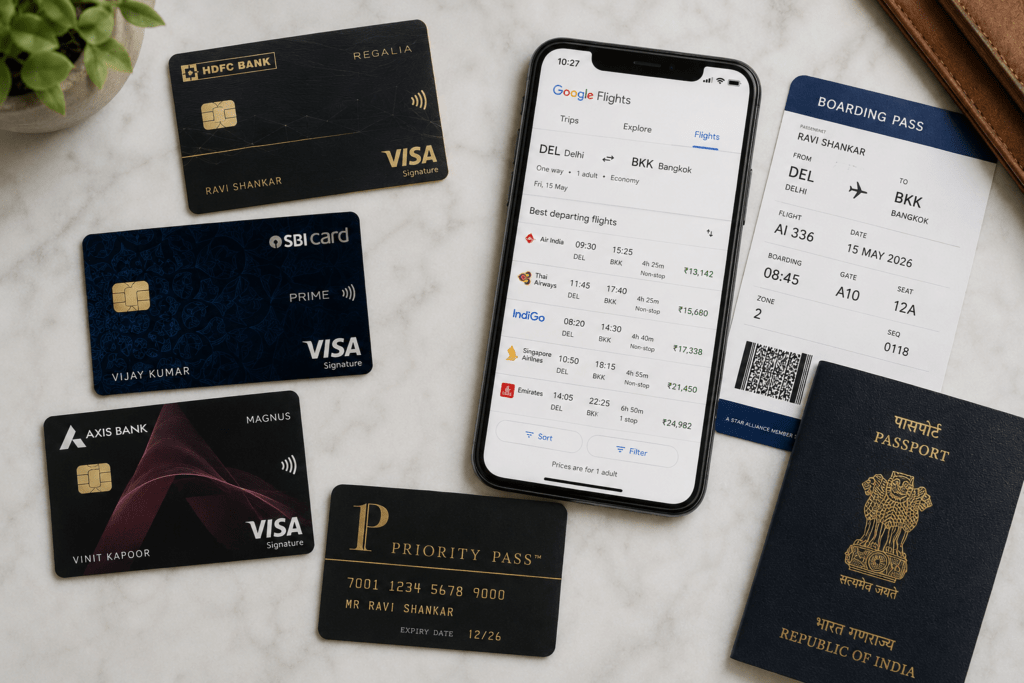
- HDFC Regalia, HDFC Infinia, HDFC Diners Club Black: The most comprehensive travel card ecosystem in India. MakeMyTrip and Goibibo partner discounts of ₹1,000–2,500 per booking on flights. Airport lounge access (Priority Pass) at domestic and international airports.
- HDFC Bank credit card offers on MMT: Look for the specific bank card offer section when booking — these can save ₹500–2,500 per transaction.
SBI Cards:
- SBI SimplyCLICK, SBI Card PRIME: 10x reward points on online bookings including flights. Cleartrip partnership discounts. IRCTC SBI Card for those combining train + flight planning.
Axis Bank Magnus and Reserve:
- Magnus: 12 Edge Miles per ₹200 spent — one of the best points accrual rates in India for travel. Priority Pass lounge access.
- Atlas: Dedicated travel card with accelerated miles.
ICICI Bank:
- ICICI Sapphiro, ICICI Rubyx: Airport lounge access, travel insurance included, partner discounts with multiple booking platforms.
American Express (AmEx):
- AmEx Platinum Travel Card: 5x Membership Rewards points on flights and hotels. The annual fee is high but the welcome bonus covers it in the first year if you travel regularly.
The UPI trick: Many booking platforms offer additional discounts for UPI payment — ₹150–400 off on domestic bookings when using PhonePe, Google Pay, or Paytm UPI. Always check the payment page for active offers before confirming.
The EMI trap to avoid: EMI on flight tickets sounds helpful but you’re paying interest on a depreciating asset — the flight happens, the interest continues. Only use EMI for flight bookings if you’re genuinely unable to pay upfront. The interest cost often exceeds the convenience.
Passengers’ Rights — What to Do When Things Go Wrong
Flight Delay Rights (DGCA Rules — India 2026)
The DGCA (Directorate General of Civil Aviation) governs passenger rights on flights departing from Indian airports. Know these:
For delays of 2 hours or more: Airlines must provide: free meals and refreshments appropriate to the waiting time. This is your right — ask for the meal voucher if the airline doesn’t proactively offer it.
For delays of 4 hours or more: Airlines must: offer the option to rebook on the next available flight (at no additional cost) OR provide a full refund if you choose not to travel.
For delays leading to overnight stay: Airlines must arrange hotel accommodation and transport to/from the hotel. Document everything in writing — get the airline representative’s name and employee number.
The compensation system: For delays over 1 hour on domestic flights, passengers are entitled to compensation under DGCA regulations. The amounts:
- Over 1 hour and up to 2 hours: ₹1,000 per passenger
- Over 2 hours: Higher compensation based on ticket price
How to claim: At the airport, approach the airline’s ground staff and specifically ask for “DGCA mandated delay compensation.” If denied, file a complaint at airconsumer@nic.in (DGCA complaint email) or on the AirSewa app.
Flight Cancellation Rights
If the airline cancels: You are entitled to: full refund of the ticket price within 7 days, OR rebooking on the next available flight at no charge. Airlines cannot refuse the refund — it is your legal right under DGCA regulations.
If you cancel: Refund depends on your fare type (refundable vs non-refundable). Non-refundable fares typically allow credit towards future travel minus airline cancellation fee. Always buy refundable fares for flexible travel plans — the ₹500–1,500 premium is often worth it.
If the flight is significantly delayed and you no longer want to travel: You can claim a full refund even on non-refundable tickets if the delay exceeds a threshold defined in the airline’s contract of carriage. The threshold varies (typically 3+ hours for domestic) — check your specific airline’s policy.
International Flight Cancellation and Delay Rights
EU Regulation EC 261/2004: If your flight departs from any EU airport (or arrives at an EU airport on an EU carrier), you have comprehensive passenger rights including compensation of €250–600 per passenger for significant delays. This applies to Indian passengers on European flights.
US DOT rules: For flights to/from the US, you are entitled to a full refund if the airline cancels or makes a “significant change” to your flight.
Practical advice: Travel insurance is the most reliable protection. World Nomads and TATA AIG Travel Insurance both cover trip cancellation, delay compensation (beyond what airlines pay), and medical emergencies. The premium (₹1,500–4,000 for a 7–14 day international trip) is worth the protection.
Beginner’s Guide to International Flights — Step by Step
Step 1: Once You’ve Booked — Before Airport Day
Immediately after booking:
- Save your PNR (booking reference) in multiple places — screenshot, email, notes app
- Check the airline’s website 24 hours before departure for web check-in availability
- Verify passport validity — your passport must be valid for at least 6 months beyond your return date for most destinations
24–48 hours before:
- Complete web check-in (saves time at airport, lets you choose your seat if not already selected)
- Download your boarding pass to your phone AND save a screenshot for offline access
- Confirm the airport terminal — most Indian airports have multiple terminals serving different airlines
Day before:
- Reconfirm your flight is on schedule (use the AirSewa app or the airline’s website)
- Set multiple alarms if it’s an early flight
- Charge all devices — airline entertainment won’t always have USB ports
Step 2: At the Airport — The Sequence
How early to arrive:
- International flights: 3 hours before departure (non-negotiable)
- Domestic flights: 2 hours before (1.5 hours for metro airports if you have web check-in)
The arrival sequence:
- Entrance security check — Show your boarding pass (phone or printed) and passport at the airport entrance
- Check-in / baggage drop — If web check-in done: baggage drop counter only. If not: full check-in counter with boarding pass issuance
- Security screening — Remove laptop, liquids, belts, metal items. More on this below.
- Immigration (international departures only) — Passport + boarding pass. Stamps given.
- Boarding gate — Reach at least 30 minutes before departure
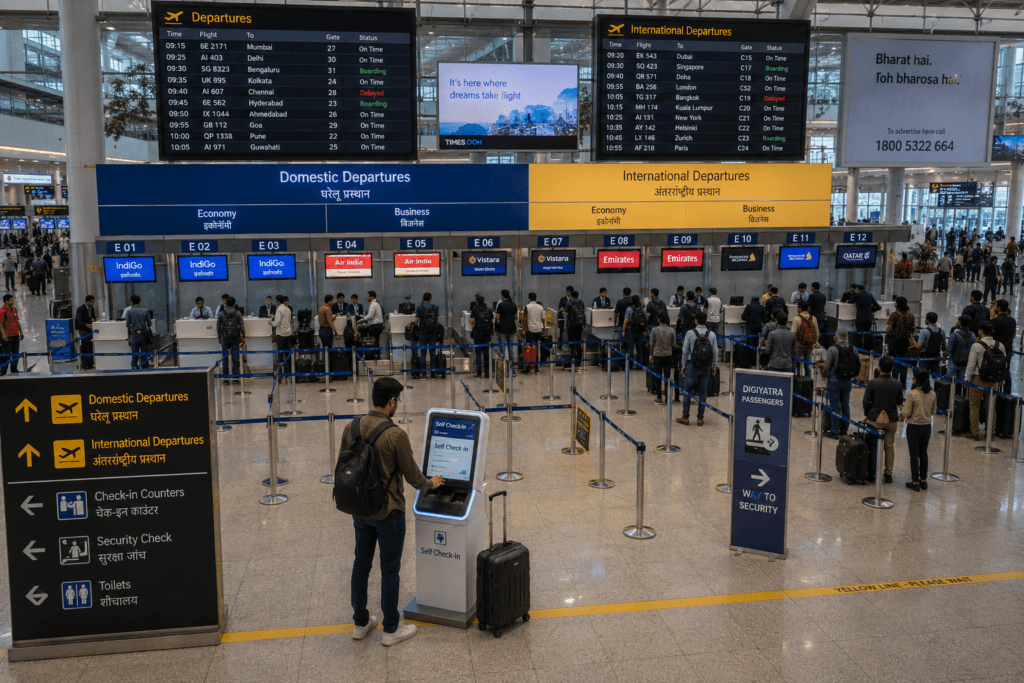
Step 3: Check-In — Detailed Walkthrough
Web Check-In (Do This Always): Most airlines open web check-in 48 hours before departure (some 24 hours). Do it online, select your seat if available, download your boarding pass. You then go directly to the baggage drop counter (5-minute queue) rather than the full check-in queue (15–45 minutes).
At the counter, you’ll be asked:
- Passport (original, not photocopy)
- Destination entry requirements confirmation (some airlines ask if you have a visa for the destination)
- Security questions for checked bags (“did you pack this yourself, has anyone asked you to carry anything”)
Baggage allowance — know before you go:
- Most economy international flights: 23–30kg checked baggage + 7–8kg cabin baggage
- Low-cost carriers (IndiGo, SpiceJet, AirAsia international): Often no free checked bag — buy the baggage add-on at booking time (ALWAYS cheaper at booking than at check-in)
- Carry-on size limit: Typically 55cm × 35cm × 25cm — measure your bag before you go
Overweight baggage charges: ₹500–1,500/kg domestically. Internationally, $25–50 per kg overweight on most carriers. The Chennai airport lesson from the introduction was a ₹3,800 lesson. Don’t repeat it.
Step 4: Security Check — What Happens
The security screening process:
- Show boarding pass and ID at the security entrance
- Remove: laptop (into separate tray), mobile phone, jacket, belt, metal items, shoes if requested
- Place carry-on bag through X-ray belt
- Walk through the body scanner or metal detector
- Collect your items
The liquids rule (international flights): The 100ml rule applies at most international airports: liquids, gels, and aerosols in your carry-on must each be in containers of 100ml or less, and all must fit in a single transparent 1-litre ziplock bag. One bag per person. Oversized liquids will be confiscated at security.
This means: that 200ml sunscreen you bought, the 500ml water bottle, the full-size toothpaste — all stay in your checked bag or get thrown away at security. The 100ml rule is real and enforced.
What you CAN carry through:
- Medicines (carry prescription or doctor’s letter for controlled substances)
- Baby formula and breast milk (no volume limit)
- Special needs items with documentation
At Indian airports specifically: A specific security check stamp is placed on your boarding pass before boarding. Don’t lose the boarding pass after security — you need the stamped version.
Step 5: Departure Immigration — Your First Stamp
At international departure, you pass through immigration before the boarding gates.
What happens at the counter:
- Present: Passport (open to your photo page)
- The officer will: check your passport validity, look at your visa for the destination, ask basic questions (“where are you going, what is the purpose of your visit, how long are you staying”)
- They stamp: your passport with an Indian departure stamp (the exit record)
- You receive: your passport back with the stamp
Common questions and honest answers:
- “Purpose of visit?” → Tourism / Business / Education / Visit family
- “How long are you staying?” → State your intended duration accurately
- “Do you have a return ticket?” → Say yes (you should have one)
- “Where are you staying?” → Hotel name or address
One thing many first-timers miss: The Emigration Check Required (ECR) stamp. Some older Indian passports have an ECR stamp — this requires additional emigration clearance for certain categories of workers going abroad for employment. If your passport says “Emigration Check Required” and you’re travelling for tourism, this doesn’t apply to you, but mention it if the officer asks.
Step 6: At the Boarding Gate and On the Plane
At the gate: Arrive at the gate at least 30 minutes before the departure time shown on your boarding pass (note: the departure time on the ticket is when the plane moves, not when boarding starts — boarding typically begins 45–60 minutes before departure for international flights).
The boarding sequence: Most airlines board in zones — business class first, then families with children, then economy by zone (usually back of plane first). Check your boarding pass for your zone letter.
On the plane:
- Stow your carry-on in the overhead bin above your seat or in the bin nearest your seat
- Personal item (smaller bag) goes under the seat in front
- Buckle your seatbelt before the seatbelt sign comes on — keeps it on throughout
- Arrival/immigration cards: Flight attendants distribute these during the flight. Fill them out before landing. You’ll need: destination address, purpose of visit, duration of stay. Have your hotel booking confirmation accessible for the address.
Step 7: Arrival Immigration — At Your Destination
This is the moment every first-time international traveller imagines as the most stressful. It usually isn’t.
The queue: International arrivals have separate queues for: citizens, visa holders (that’s you), and sometimes visa-on-arrival. Join the correct queue.
At the counter:
- Present: Passport + visa (or e-visa printout) + filled arrival card
- The officer may ask: purpose of visit, where staying, how long, return ticket
- Biometrics: Many countries take fingerprints and photographs at immigration — standard, don’t be alarmed
- Stamp: You receive an entry stamp with the permitted duration of stay
- Critical: Note the date on the stamp. That’s your legal exit deadline.
Using Thailand as a working example (easy first international trip):
Thailand in 2026 is visa-free for Indian passport holders for 60 days. At Suvarnabhumi Airport Bangkok:
- Join the “Visa Exempt” queue (separate from Visa on Arrival)
- Present: Indian passport + return ticket + hotel booking + proof of funds (bank statement or cash)
- The officer checks your documents, takes a photo, may ask where you’re staying and for how long
- Stamp given: 60 days from arrival
- Total time: 10–25 minutes in queue (more during peak hours, less at 3am)
After immigration:
- Baggage claim: Find your flight number on the display boards, locate the correct belt, collect your bags
- Customs: Green channel (nothing to declare) if you’re carrying standard items. Red channel if you have items above customs allowance or prohibited goods. Walk through confidently with standard luggage.
- Arrival hall: SIM card counters, currency exchange, taxi counters. The SIM card and taxi sort yourself out at the airport before leaving — you’ll need connectivity immediately.
Food on the Plane and at Airports
The Airport vs Home Food Debate
The question of whether to carry food from home, buy after security, or rely on airline food is genuinely worth thinking through.
Airline food: Economy airline food on Indian carriers ranges from decent (Air India, Vistara) to functional (IndiGo, SpiceJet — they charge for food). International carriers on long-haul (Emirates, Qatar, Singapore Airlines) typically include meals. Short-haul international economy is often buy-on-board.
The honest truth: airline economy food is fine. It’s not extraordinary. It is hot (usually), it is available, and it prevents you from being the person who gets hypoglycaemic over the Bay of Bengal because they didn’t eat.
Food you can carry from home: You CAN carry home-cooked food in your carry-on — there is no rule against solid food in cabin baggage on most routes. The caveat: liquid-based food (dal, curries, soups) may be flagged at security as a liquid. Pack solid food: rotis, sandwiches, snacks, dry fruit, energy bars, nuts.
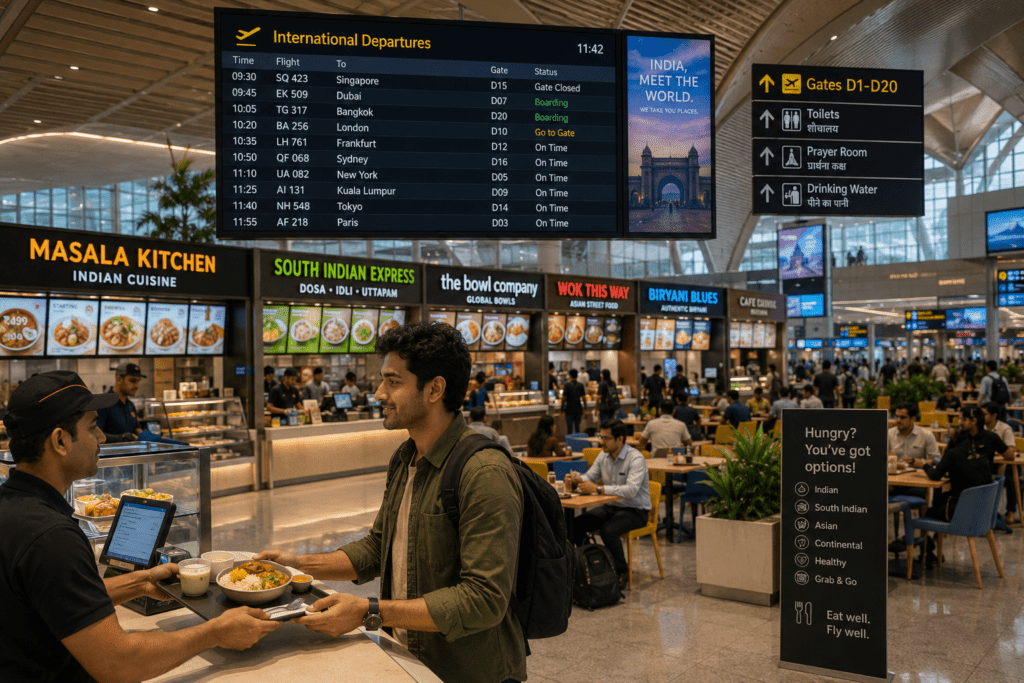
Airport food after security: The best option for quality and choice. Indian airports have improved significantly — Terminal 2 Mumbai has Bombay Salad Company, MTR, and multiple options. Delhi T3 has Café Coffee Day, McDonald’s, Punjab Grill, and others post-security. Prices are 30–50% higher than outside the airport (this is universal globally) but the food is fresh and you can eat comfortably before boarding.
The solid food carry recommendation:
- Homemade sandwiches, rolls, parathas — excellent for domestic and short international flights
- Dry snacks (chivda, nuts, crackers, energy bars) — always carry these, always useful
- Avoid: anything strongly spiced or fragrant (other passengers will remember you), anything liquid (security will remove it), anything perishable without proper packaging
Duty-free food: Most international airports have duty-free zones between immigration and boarding with food products, chocolates, alcohol, and snacks. The primary reason to buy here: it’s tax-free, and some premium items (branded chocolates, specific spirits) are genuinely cheaper than in the destination country. The secondary reason: it’s post-security, so liquids purchased here (including food items with liquid content) are permitted on board in the sealed airport-issued bag.
What you can and cannot bring back to India:
- Alcohol: 2 litres duty-free allowance per adult
- Cigarettes: 200 cigarettes or 50 cigars duty-free
- Food items: Generally permitted for personal consumption; commercially packaged, unopened food is usually fine. Fresh fruits, vegetables, and meat products are restricted.
- Chocolates and confectionery: No problem
- Declare anything above allowance at customs — the penalty for failing to declare is significantly worse than the duty
What to Wear and Carry — Packing for a Flight
The Carry-On Strategy — Do It Right
The best carry-on for a flight is organised, legal in size, and contains everything you’d need if your checked bag went on a different adventure.
Always in your carry-on (not checked bag):
- Passport and all travel documents
- Wallet with card and emergency cash (in local currency of destination AND USD as backup)
- Phone and charger
- Power bank (max 20,000mAh / 100Wh — airline regulation. Higher capacity power banks are not permitted in checked bags either — carry-on only)
- Medication (all medication — always)
- One change of clothes (in case the checked bag is delayed)
- Noise-cancelling earphones
- Neck pillow for long flights
The 100ml liquids bag for international: One clear 1-litre ziplock bag containing: toothpaste (under 100ml), moisturiser (under 100ml), lip balm, hand sanitiser (under 100ml). Everything else goes in the checked bag.
What to Wear on a Flight
The formula: Comfortable layers. Not fashion. Not pyjamas (unless you’re in business class, in which case do whatever you like).
What actually works:
- Comfortable, loose pants — not tight jeans (long flights make jeans uncomfortable after hour 3)
- Breathable t-shirt or shirt — cotton or linen
- Light jacket or hoodie — planes are cold, particularly in economy
- Comfortable shoes you can slip on and off — you’ll remove shoes at security and you may want to remove them during a long flight
- Compression socks for flights over 5 hours — reduces swelling and deep vein thrombosis risk on long-haul
What to avoid:
- Heavy wool sweaters (you can’t temperature-control)
- Perfume or strong cologne (enclosed space, recycled air — your seatmate will silently suffer)
- New or tight shoes (your feet may swell during long flights)
- Anything requiring excessive adjustment during security screening
Checked Baggage Packing Rules
Prohibited in checked bags:
- Power banks and lithium batteries
- Flammable liquids
- Explosives (obviously)
- Loose lithium batteries (only inside devices)
Permitted in checked bags:
- Sharp objects (knives, scissors, razors)
- Liquids above 100ml
- Aerosol cans (within limits)
- Most sporting equipment (properly packed)
The weight distribution trick: Put heavy items closest to the bag’s wheels. Clothes wrapped around fragile items. Shoes at the bottom. Liquids in a sealed ziplock in case of leakage.
Indian Passport — Where You Can Go and How
The 2026 Reality Check
India has risen to 80th place in the Henley Passport Index 2026, tied with Algeria, granting passport holders access to 55 countries with visa-free, visa-on-arrival, or e-visa options. The jump from 85th last year reflects steady progress in diplomatic outreach.
This means Indian passport holders now enjoy greater travel freedom, with access to a wide range of destinations across Asia, Africa, Oceania, the Americas, and the Caribbean.
Visa-Free Countries (No Visa Needed — Just Show Up)
Top visa-free destinations include Thailand (60 days), Indonesia (30 days), Malaysia (30 days), Mauritius (90 days), Seychelles (90 days), Barbados (90 days), Dominica (180 days), and Qatar (30 days).
Complete Visa-Free List for Indians 2026:
Asia & Pacific:
| Country | Stay Duration | Requirements |
|---|---|---|
| Nepal | Unlimited | Indian ID sufficient, no passport required |
| Bhutan | Unlimited | Indian ID sufficient |
| Malaysia | 30 days | Valid passport, return ticket |
| Thailand | 60 days | Valid passport, proof of funds, return ticket |
| Indonesia | 30 days | Valid passport |
| Philippines | 30 days (extended June 2026) | Valid passport |
| Macao | 30 days | Valid passport |
| Fiji | 4 months | Valid passport |
| Maldives | 30 days | Valid passport + hotel booking |
Africa:
| Country | Stay Duration |
|---|---|
| Mauritius | 90 days |
| Seychelles | 30 days (on arrival registration) |
| Rwanda | 30 days |
| Senegal | 90 days |
| Gambia | 90 days |
| Angola | 30 days |
Caribbean & Americas:
| Country | Stay Duration |
|---|---|
| Barbados | 90 days |
| Dominica | 180 days |
| Jamaica | 30 days |
| Grenada | 90 days |
| Trinidad and Tobago | 90 days |
| Haiti | 90 days |
| Saint Vincent and the Grenadines | 30 days |
Visa on Arrival Countries (Get Visa When You Land)
24 countries offer visa on arrival for Indian passport holders in 2026. Process: fill a form at the immigration counter, pay the fee, receive a stamp.
Key visa on arrival destinations:
| Country | Fee | Duration |
|---|---|---|
| Sri Lanka | Free (ETA preferred) | 30 days |
| Kenya | $50 | 90 days |
| Ethiopia | $50 | 30 days |
| Egypt | $25 | 30 days |
| Cambodia | $30 | 30 days |
| Laos | $30-40 | 30 days |
| Comoros | $80 | 45 days |
e-Visa Countries — Apply Online Before You Go
Over 50 countries offer e-visa to Indian passport holders in 2026. The application is online — typically 2–7 days processing, paid by card, received via email.
Best e-Visa destinations for first-time Indian travellers:
Singapore (e-Visa): Apply at ivacasia.com. Process: 2–3 business days. Fee: SGD 30 (~₹1,800). Indian passport holders can visit for tourism up to 30 days. Singapore is consistently recommended as the best first international trip for Indians — English widely spoken, clean, safe, food is extraordinary (see our 50 Dishes guide), and a 4-day trip is perfectly manageable.
Dubai / UAE (Visa on Arrival for most Indians from Oct 2024 onwards): UAE announced visa on arrival for Indian passport holders with valid US/UK/EU visa OR with Indian biometric passport with specific criteria. Verify current rules at the UAE government portal — this changed in late 2024 and continues to evolve in 2026.
Turkey (e-Visa): Apply at evisa.gov.tr. Fee: $25–50 depending on nationality. Processing: 24 hours typically. Duration: 30–90 days depending on application. Istanbul is one of the world’s great cities and surprisingly accessible for Indian passport holders via e-Visa.
Vietnam (e-Visa): Apply at evisa.xuatnhapcanh.gov.vn. Fee: $25. Processing: 3 business days. Duration: 90 days, single or multiple entry. Vietnam has become one of the most popular destinations for Indian travellers in 2026.
Kenya (e-Visa): Apply at evisa.go.ke. Fee: $50. Processing: 3 business days. Duration: 90 days. For wildlife safari travel.
Jordan (e-Visa): Apply at visa.mfa.gov.jo. Fee: JOD 40 (~₹4,600). Processing: 24 hours. Duration: 30 days.
Europe (Schengen) — The Guide for Indians
Europe is not visa-free for Indians. The Schengen visa (covering 26 European countries) requires advance application at the respective embassy/consulate. Here’s the honest guide:
Which embassy to apply at: Apply at the embassy of your primary destination country. If visiting multiple countries, apply at the embassy of the country where you’ll spend the most nights.
Documents required (2026 standard list):
- Passport valid for 3 months beyond return date, with minimum 2 blank pages
- Completed Schengen visa application form
- Recent passport-size photographs (35mm × 45mm, white background, no glasses)
- Travel insurance with minimum €30,000 coverage (mandatory)
- Flight reservation (confirm-but-not-paid-for bookings available — ask travel agents)
- Hotel bookings for entire stay
- Bank statement: last 3 months (minimum ₹2.5–3 lakh balance recommended as a general benchmark, though there’s no official minimum)
- Income proof: Salary slips (last 3 months) + ITR (last 2 years) for salaried; CA-certified financials for business
- Employment certificate or business proof
- No Objection Certificate (NOC) from employer if applicable
- Cover letter explaining purpose and itinerary
Application process: Most European embassies in India now use VFS Global for appointment booking and document submission. Book an appointment at vfsglobal.com. Appointment wait times in Mumbai and Delhi: 2–4 weeks during peak season (May–June, October–November).
Fee: €85 (~₹7,700) for most Schengen countries. Non-refundable regardless of outcome.
Processing time: 15 calendar days for standard applications (up to 30–45 days in peak season).
Tips for a stronger Schengen application:
- Apply for the visa after you have a firm travel plan — scattered or unclear itineraries weaken applications
- The bank balance should be consistent over 3 months, not a sudden large deposit before applying
- Travel insurance must be purchased before applying — it’s a document requirement
- A clean travel history (previous visa stamps from UK, USA, or Schengen countries) significantly improves approval chances
- First-time Schengen applicants sometimes receive a single-entry visa for fewer days than applied for — this is common and not a rejection
Which Schengen country’s embassy is best to apply through for first-timers: Spain and Germany have the most straightforward process for Indian applicants historically. France is popular but has longer queues at VFS. Italy has been streamlining the process. The VFS Global queue wait time is the most significant variable — check current appointment availability.
United States — The Detailed Guide for Indians
The US B1/B2 tourist/business visa is one of the most sought-after and most carefully scrutinised visas for Indian applicants. Here’s the honest picture:
Visa type: B-1 (business) / B-2 (tourism) / B1-B2 (combined — most common)
Step 1: DS-160 Application Form Complete the DS-160 form online at ceac.state.gov. This is your formal application. Take it seriously — every question is recorded, inconsistencies cause problems.
Step 2: Pay the Visa Fee $185 (₹15,400 approx) — MRV (Machine Readable Visa) fee. Pay at the designated bank. Non-refundable.
Step 3: Schedule Your Interview At the US Embassy (New Delhi) or US Consulates (Mumbai, Chennai, Hyderabad, Kolkata). Wait times vary dramatically — during peak periods (June–August), interview slots for first-time applicants can be months away. Check wait times at travel.state.gov.
Step 4: Prepare Your Documents
- DS-160 confirmation
- Valid passport (and all old passports)
- Visa fee payment receipt
- Appointment confirmation
- Photo (2×2 inches / 51mm × 51mm, white background)
- Bank statements (last 6 months), income proof, ITR
- Property/asset documents showing ties to India
- Employment letter confirming employment and approved leave
- If visiting family/friends: Invitation letter, their US immigration status documents
- Travel insurance
Step 5: The Interview The interview is approximately 2–5 minutes. The consular officer is assessing one primary question: “Does this person have strong ties to India that will ensure they return?” They’re looking for evidence of: stable employment, family in India, property ownership, financial stability.
Common questions:
- “What is the purpose of your trip?”
- “Who will you be visiting/where are you going?”
- “What do you do in India?”
- “How long have you been at your current job?”
- “What is your income?”
- “Do you have any relatives in the US?”
The ties-to-India principle: The consular officer is primarily checking that you won’t overstay. Strong ties include: employment you’d be leaving, a home you own, family (especially spouse, children) in India, financial obligations (mortgage, business), previous travel history with clean exits.
Processing time: 3–5 business days if approved at interview. Some cases go to “administrative processing” (221(g)) which can take weeks to months — for certain backgrounds and profiles.
Validity: US B1/B2 visas for Indian applicants are typically issued for 10 years with multiple entry, 6-month stay per visit.
Tips for Enjoying the Plane Travel Experience
For Short Flights (Under 4 Hours)
The short-flight rule: download everything you want to watch/listen to before boarding. Airline Wi-Fi is unreliable and expensive. Offline Netflix, Spotify, or a podcast downloaded to your phone will serve you better than any in-flight entertainment on a budget carrier.
Carry your own earphones — the ones provided on flights are the auditory equivalent of the airline food situation.
Drink water. Not alcohol. Not just coffee. Aeroplanes are extremely dry environments — cabin humidity is typically 10–20%, far below comfortable indoor levels. One glass of water per hour is not an exaggeration.
For Long-Haul Flights (8+ Hours)
Walk every 2 hours. Get up, walk to the back of the plane, do a lap, come back. This is not about fitness — it’s about blood circulation and the prevention of deep vein thrombosis, which is a real risk on long-haul flights.
Set your watch to the destination timezone immediately on boarding. Start adjusting your sleep and eating to the destination’s schedule from this moment. This is the single most effective jet lag strategy available without medication.
The middle seat has armrest rights over both armrests. This is not a written rule. It is an unwritten rule that everyone who has been in a middle seat on an 11-hour flight knows to be correct and just.
Compression socks. Get them. Wear them. Your ankles will thank you.
The Food Decision on the Plane
Order the vegetarian meal for long-haul flights. Not necessarily for ethical reasons — the vegetarian meal is typically fresher (made in smaller batches), served first (which means hot food while window-seat passengers are still being served), and generally better calibrated for the altitude at which you’re eating (your sense of taste changes at 35,000 feet — you taste less sweet and less salty, which is why airline food tastes blander than it does on the ground).
Pre-order special meals when you book — airline websites let you select: vegetarian, Jain, Hindu meal (no beef), Asian vegetarian, and others. These are usually better than the standard economy option and are prepared to specific dietary requirements.
The First International Trip Country Recommendation — Thailand
If you want to take your first international trip from India, Thailand is the most widely recommended first destination by experienced Indian travellers. Here’s why:
No visa required — 60 days, just show up with passport and return ticket Direct flights from multiple Indian cities — Delhi, Mumbai, Chennai, Hyderabad, Bengaluru, Kolkata to Bangkok English widely understood in tourist areas Indian food available everywhere — if you need a dal and roti day, you can have one in Bangkok Safe — consistent safety record for solo travel Budget-friendly — street food from ₹70, budget hotels from ₹800/night Food extraordinary — see our Thailand Food Guide 2026 for everything to eat
The Bangkok immigration experience is smooth and the Suvarnabhumi airport is well-organised. The country is large enough to explore for 10–14 days without ever feeling like you’ve run out of things to see.
Checklist for first India → Thailand trip:
- Book flight on Skyscanner (IndiGo/Air India/Thai Airways all fly direct)
- Ensure passport valid 6+ months beyond return date
- Book hotel first 1–2 nights (Bangkok airport area for first night recommended — recover from journey)
- Buy travel insurance (World Nomads or TATA AIG)
- Download offline Google Maps for Bangkok
- Carry 10,000 THB (~₹24,000) in cash — exchange at airport or bank before departing (not at airport money changers)
- Web check-in 24–48 hours before departure
- Print boarding pass OR save screenshot for offline use
- Arrive 3 hours early
FAQ Section
Q: How do I book the cheapest flights in India in 2026?
A: The cheapest domestic fares appear 5–8 weeks before departure. For international flights, book 8–12 weeks ahead. Use Google Flights for price comparison and date flexibility (the price calendar shows the cheapest day to fly across an entire month). HappyFares charges zero convenience fee for domestic bookings. Fly on Tuesdays and Wednesdays rather than weekends to save ₹1,500–3,000 per ticket. Set price alerts on Google Flights and wait for the route to dip before booking.
Q: Which countries can Indian passport holders visit without a visa in 2026?
A: India has risen to 80th place in the Henley Passport Index 2026 with access to 55 destinations via visa-free, visa-on-arrival, or e-visa. Key visa-free destinations include: Nepal, Bhutan (no passport required), Malaysia (30 days), Thailand (60 days), Indonesia (30 days), Mauritius (90 days), Seychelles (90 days), Jamaica (30 days), Barbados (90 days), and Qatar (30 days). Singapore, Turkey, Vietnam, and Jordan require a quick e-Visa application online before travel.
Q: How early should I arrive at the airport for an international flight?
A: Arrive 3 hours before departure for international flights. This allows time for check-in (15–45 minutes depending on web check-in), security (15–30 minutes), immigration (10–25 minutes), and reaching the boarding gate. During peak travel periods (December–January, summer holidays), add an extra 30–45 minutes buffer.
Q: Can I carry home-cooked food on an international flight?
A: Yes — solid home-cooked food is permitted in your carry-on on most international flights. Roti, sandwiches, dry snacks, and similar items are allowed. Liquid-based food (curry, soup, dal) may be flagged at security under the 100ml liquids rule. Commercially packaged sealed food is allowed. Do not carry fresh fruits, vegetables, or meat products when returning to India from certain countries.
Q: What documents do I need for a Schengen visa as an Indian passport holder? A: Standard Schengen visa requirements include: valid passport (3+ months beyond return date), completed DS-160/Schengen application form, recent photographs, mandatory travel insurance (€30,000+ coverage), flight and hotel reservations, 3-month bank statements, income proof (salary slips + ITR), employer NOC, and a cover letter with itinerary. Fee is €85 (~₹7,700), non-refundable. Apply at VFS Global with minimum 4–6 weeks lead time in peak season.
Q: What is the best first international trip from India?
A: Thailand is the most recommended first international trip for Indian passport holders — no visa required (60 days), direct flights from all major Indian cities, English widely spoken, safe, budget-friendly (street food from ₹70, hotels from ₹800), and the food is extraordinary. Singapore is the alternative for those wanting a more urban, very safe, English-language first experience. Both have smooth, well-organised immigration processes that are genuinely manageable for first-time international travellers.
Conclusion — Your Passport Is Your Permission Slip
I’ve taken 40+ flights since that first panicked sprint through Chennai airport.
The Singh uncle at immigration who asked me to fill the arrival card. The Bangkok street food cart at 11pm. The Skyscanner price alert that told me exactly when to book my Istanbul flight. The HDFC Regalia lounge access that turned a 3-hour Delhi transit from a misery into a meal.
All of it starts with the same first step: booking the flight.
The rest — the airport sequence, the immigration questions, the visa applications, the credit card perks, the packing strategy — is learnable. And once learned, it becomes automatic. The second flight is better than the first. The fifth is better than the second. By the tenth, you’re the person explaining to your seatmate how the immigration card works.
India’s passport is at 80th globally in 2026. It’s not the strongest passport in the world. It is, however, getting there — and the 55+ destinations now accessible without a traditional embassy visa include some of the most extraordinary places on earth.
The trick is to use every tool available: the right booking platform at the right time, the right credit card, the right visa category, the right packing strategy. This guide has given you all of them.
The only thing left is to book the flight.
Go on. Do it.
The departure board is waiting.