

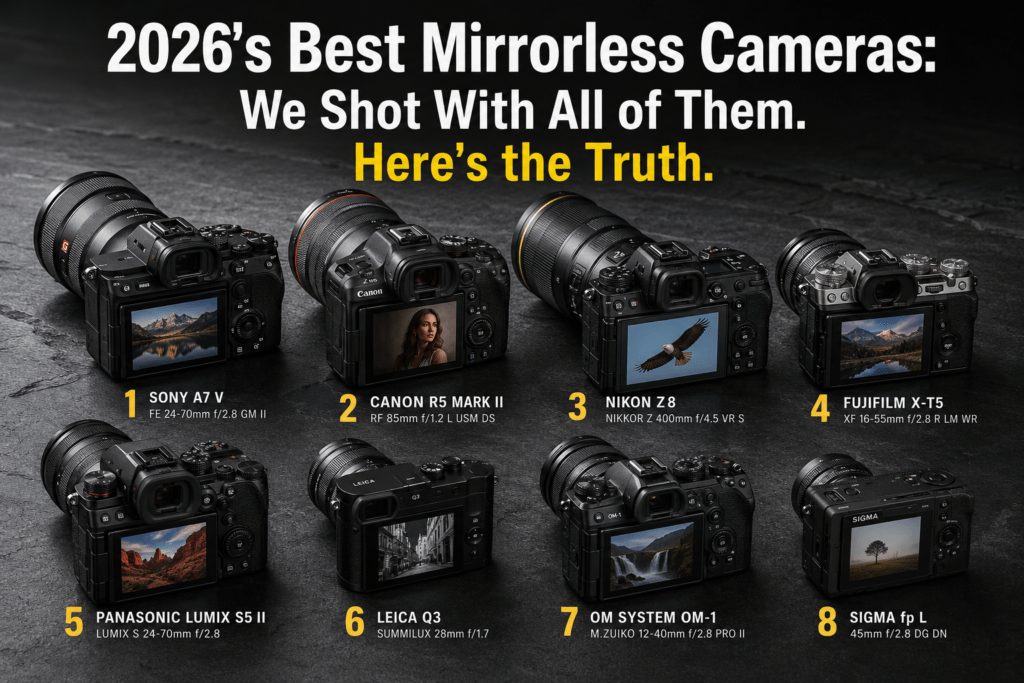
The Camera That Ruined My Workflow (In the Best Way)
I shot my friend’s wedding with a Canon 5D Mark IV for six years. Reliable. Predictable. Heavy enough to double as a weapon in an emergency. I knew exactly what I was getting and exactly what the files would look like.
Then, in 2024, a colleague handed me a Sony A7 IV for a quick portrait session because my camera was at service. Three hours later I handed it back, went home, and spent the rest of the evening doing something I hadn’t done in years — reading camera reviews at midnight.
The autofocus. That’s what did it. The Sony tracked the subject’s eye through a moving fan, around a pillar, and across a crowd of guests without a single missed frame. My Canon — bless it — would have needed me to pick the focus point manually and pray.
This is where mirrorless cameras are in 2026. The gap between the old DSLR world and the new mirrorless reality isn’t small anymore. It’s enormous. And within the mirrorless world itself, the competition between Sony, Canon, Nikon, Fujifilm, and Panasonic has pushed every manufacturer to levels that would have seemed impossible five years ago.
The question isn’t “should I buy a mirrorless camera?” The question is which one, for what you specifically shoot, at a price that makes sense for your business.
This guide answers that properly.
Quick Comparison Table — All Cameras At A Glance
| Camera | Sensor | Resolution | Price (USD) | Price (India ₹) | Best For |
|---|---|---|---|---|---|
| Sony A7 V | Full-frame | 33MP | $3,500 | ₹3,00,000 | Best overall all-rounder |
| Canon EOS R5 Mark II | Full-frame | 45MP stacked | $4,300 | ₹3,70,000 | Best hybrid photo/video |
| Sony A1 II | Full-frame | 50MP stacked | $6,500 | ₹5,60,000 | Best professional flagship |
| Nikon Z8 | Full-frame | 45.7MP stacked | $4,000 | ₹3,45,000 | Best for wildlife/sports |
| Fujifilm X-T5 | APS-C | 40MP | $1,700 | ₹1,47,000 | Best APS-C / compact pro |
| Canon EOS R6 Mark III | Full-frame | 24.2MP | $2,700 | ₹2,33,000 | Best for speed/events |
| Sony A7R V | Full-frame | 61MP | $3,900 | ₹3,36,000 | Best for landscapes/commercial |
| Nikon Z6 III | Full-frame | 24.5MP partial-stacked | $2,500 | ₹2,16,000 | Best value professional |
| Panasonic Lumix S1 II | Full-frame | 24.2MP | $2,500 | ₹2,16,000 | Best for video-first creators |
| Sony a6700 | APS-C | 26MP | $1,400 | ₹1,21,000 | Best APS-C for video |
THE TOP 10 CAMERAS — COMPLETE REVIEWS
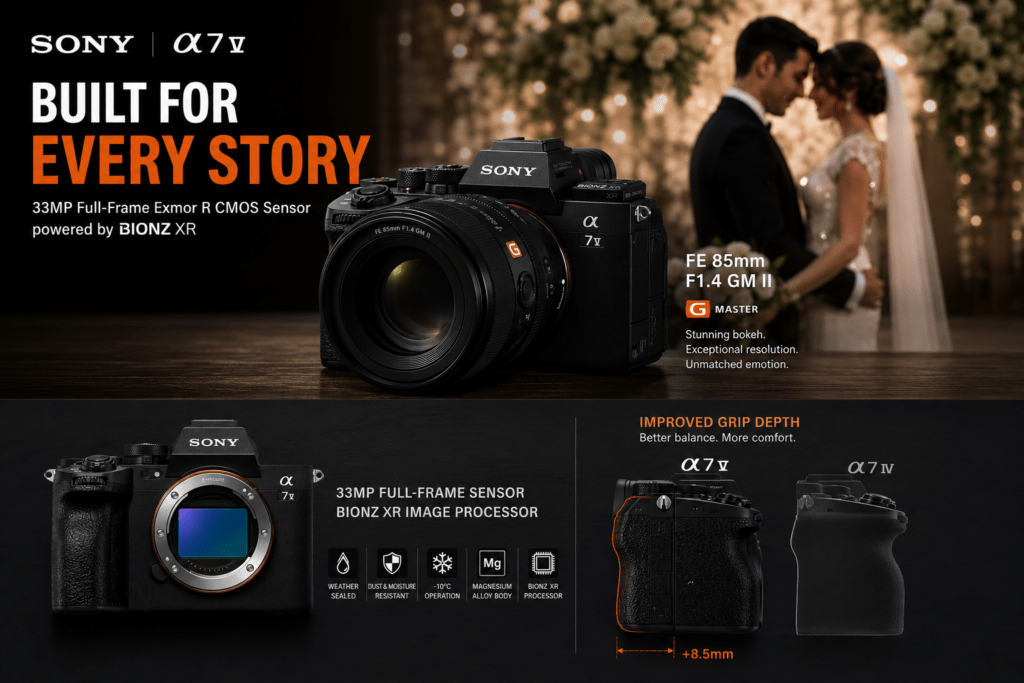
#1 — SONY A7 V
“The Camera That Makes Everyone Else’s Argument Harder”
Price: $3,500 USD | ₹3,00,000 India (approx) Sensor: 33MP full-frame BSI CMOS Released: Late 2025 TechRadar verdict (April 2026): Best overall mirrorless camera Best for: All-round professional use, portraits, weddings, travel, commercial
The Story: The Sony A7 V has arrived and blurs the lines between enthusiast and pro cameras forever. That line, from TechRadar’s own reviewer, tells you everything. Sony took the A7 IV — already the most popular full-frame mirrorless for working photographers — and improved literally everything: sensor, autofocus, video, stabilisation, and the viewfinder.
The A7 V replaced the previous Sony A7 IV as the best Sony all-rounder for enthusiasts, in March 2026. That’s how quickly things move in this category right now.
Sensor & Image Quality: High-resolution 33-megapixel full-frame sensor. The 33MP BSI sensor delivers extraordinary dynamic range — 15+ stops in RAW — which is the number that matters for wedding and landscape photographers who need to recover shadow detail in difficult lighting. ISO performance is excellent: clean usable images to ISO 12,800, acceptable to ISO 25,600.
Autofocus: The upgraded AI autofocus system recognises humans, animals, birds, insects, aircraft, and vehicles. The eye-tracking — both human and animal — is among the best available in 2026. For wedding photographers, the face/eye detection works reliably in challenging backlighting and across a crowd.
Video: 4K/60p 10-bit, 4:2:2, S-Log3, S-Cinetone. The A7 V shoots professional video without the overheating issues that plagued earlier Sony bodies. For hybrid shooters, this is the primary argument for the A7 V over its predecessors.
Stabilisation: 8.5 stops IBIS. The A1 II has Sony’s best ever in-body image stabilisation (IBIS), rated for 8.5 stops of shake reduction. The A7 V shares this generation of stabilisation — remarkably effective for handheld shooting in low light.
What photographers are actually saying: Real-world users consistently mention three things: the autofocus reliability (nobody misses focus at weddings anymore), the low-light performance (late reception hall, no flash — still getting clean shots), and the build quality improvement over the A7 IV.
The honest caveat: The Sony ecosystem has the best range of native lenses, but the best glass — the GM lenses — is expensive. A body + good lens system will set you back significantly. Also: if you’re shooting Canon or Nikon natively, switching systems means reinvesting in glass.
PROS: ✅ Best-in-class autofocus for most shooting scenarios ✅ Outstanding 33MP sensor — excellent dynamic range and ISO performance ✅ 8.5 stops IBIS — one of the best available ✅ Professional 4K/60p 10-bit video without overheating ✅ Best native lens ecosystem (E-mount) — widest selection including third-party ✅ Weather sealing (IPX4-equivalent) ✅ Excellent battery life improvement over A7 IV
CONS: ❌ Sony’s GM lenses are expensive — total system cost is high ❌ Menu system — complex for those new to Sony ❌ No pixel shift/high resolution mode ❌ Joystick position (left thumb area) takes adjustment
Competitor Comparison:
- vs Canon R5 Mark II: A7 V wins on lens ecosystem value; R5 II wins on video capability (8K RAW)
- vs Nikon Z6 III: A7 V wins on resolution (33MP vs 24.5MP) and autofocus maturity
- vs Canon R6 III: A7 V wins on resolution and sensor; R6 III wins on speed (40fps vs 30fps burst)
BEST COMPATIBLE LENSES — Sony A7 V:
For Weddings/Portraits:
- Sony FE 85mm f/1.4 GM II: ₹1,40,000 — The sharpest portrait lens in the E-mount system. The f/1.4 aperture for subject separation in reception halls is extraordinary.
- Sony FE 35mm f/1.4 GM: ₹1,05,000 — The documentary lens. Environmental portraits, getting-ready rooms, wide ceremony shots. Exceptional.
- Sony FE 24-70mm f/2.8 GM II: ₹2,10,000 — The workhorse zoom. If you shoot one lens for a wedding, this is it.
For Wildlife:
- Sony FE 200-600mm f/5.6-6.3 G OSS: ₹1,48,000 — The telephoto solution. Outstanding reach, excellent autofocus tracking, and optical stabilisation for handheld wildlife.
- Sony FE 400mm f/2.8 GM OSS: ₹10,00,000+ — For professionals who need the best reach + aperture combination. Extraordinary but extraordinarily priced.
For Commercial/Architecture:
- Sony FE 16-35mm f/2.8 GM II: ₹1,90,000 — Wide zoom for interior and architectural work. Minimal distortion, excellent at wide apertures.
- Tamron 17-28mm f/2.8 Di III RXD (third-party): ₹55,000 — Exceptional value for the budget-conscious professional.
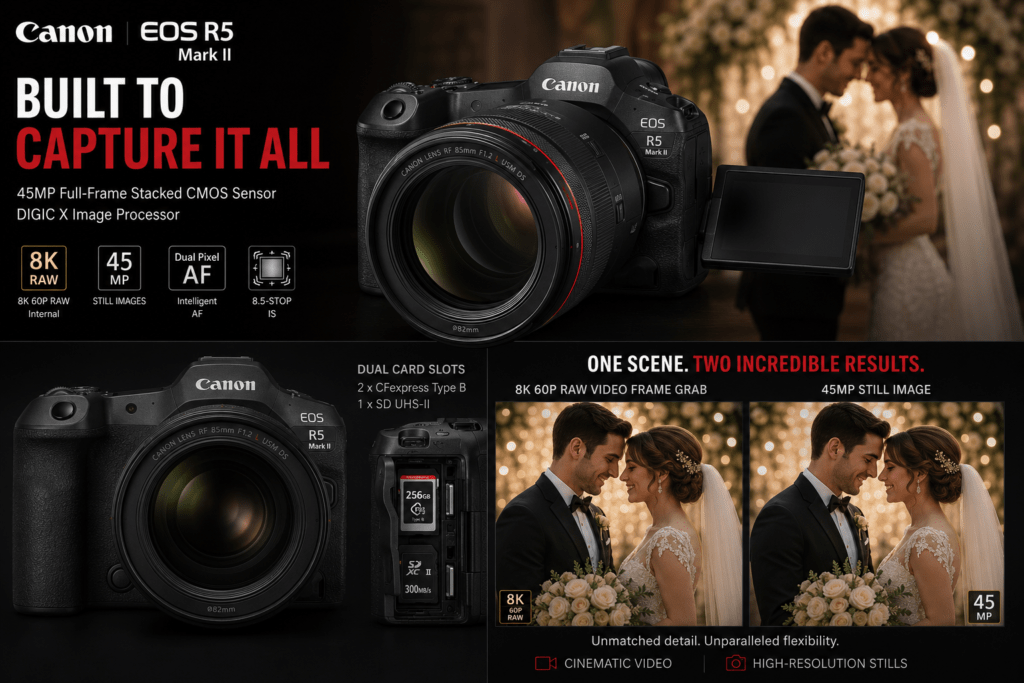
#2 — CANON EOS R5 MARK II
“The Professional Standard for Hybrid Shooters in 2026”
Price: $4,300 USD | ₹3,70,000 India Sensor: 45MP full-frame stacked CMOS TechRadar (April 2026): Best professional mirrorless Best for: Wedding, commercial, hybrid photo/video, sports
The Story: The Canon EOS R5 Mark II sits at the top of nearly every popularity metric right now. It’s not the most technologically advanced camera on this list — the Sony A1 II that title — but it makes the strongest argument for being the best value at the professional level.
The Canon EOS R5 Mark II has a 45MP stacked sensor with no rolling shutter. That last phrase — “no rolling shutter” — is the one that matters for action and video photographers. Rolling shutter (the jello effect where vertical lines bend during fast movement) is the enemy of professional video. The stacked sensor essentially eliminates it.
Sensor & Image Quality: The 45MP stacked sensor is the most sophisticated Canon has ever put in a mirrorless body. Stacked sensors read data off the chip significantly faster than standard BSI sensors — which is how you get fast burst speeds AND video recording without rolling shutter simultaneously.
Video — The Headline Feature: For hybrid shooters, the Canon EOS R5 Mark II offers superior value. The Canon EOS R5 Mark II leads for hybrid photo-video work, with its 8K/60p RAW internal recording and improved thermal management. 8K RAW internal is a phrase that would have been absurd two years ago. It’s real now, and the thermal management improvement means you can actually use it without the camera shutting down.
Autofocus: Canon’s Eye Control AF and person registration modes offer advantages in specific professional contexts like wedding and sports photography. Eye Control AF — where the camera focuses on whatever you’re looking at through the viewfinder — is the most distinctive Canon AF innovation. It’s genuinely useful for documentary and event photographers who need to change focus points quickly.
Burst Speed: 30fps electronic, 12fps mechanical. For sports and wildlife at the professional level, 30fps with full AF is the specification that matters.
The honest caveat: The Canon RF lens ecosystem is powerful but expensive AND restricted. Canon limits what third-party lenses can do on RF mount — preventing some competitors from offering full functionality. Canon still restricts what lenses can exist on RF-mount. This matters for budget-conscious professionals — Sony’s E-mount has far more affordable third-party options.
PROS: ✅ 8K/60p RAW internal — the most capable video in any mirrorless (2026) ✅ No rolling shutter — critical for video and fast-action ✅ 45MP stacked sensor — outstanding resolution AND speed ✅ Eye Control AF — genuinely useful for event photographers ✅ 30fps burst with full AF ✅ Excellent weather sealing ✅ Improved thermal management vs R5 original
CONS: ❌ Most expensive non-flagship camera on this list ❌ Canon RF ecosystem — third-party lens options restricted ❌ RF native lenses are expensive ❌ Body size larger than Sony A7 V ❌ Battery life behind Sony options
Competitor Comparison:
- vs Sony A7 V: R5 II wins on video (8K RAW vs 4K/60p). A7 V wins on lens ecosystem cost.
- vs Nikon Z8: R5 II wins on video capability. Z8 wins marginally for pure still AF in wildlife.
- vs Sony A1 II: R5 II wins on price ($4,300 vs $6,500). A1 II wins on ultimate performance.
BEST COMPATIBLE LENSES — Canon EOS R5 Mark II:
For Weddings/Portraits:
- Canon RF 85mm f/1.2 L USM: ₹1,68,000 — Possibly the finest portrait lens available in any mirrorless system. The bokeh rendering at f/1.2 is extraordinary.
- Canon RF 50mm f/1.2 L USM: ₹1,47,000 — The versatile prime for documentary wedding coverage.
- Canon RF 28-70mm f/2 L USM: ₹2,80,000 — A constant f/2 zoom is optically remarkable. Heavy, expensive, extraordinary.
For Wildlife:
- Canon RF 100-500mm f/4.5-7.1 L IS USM: ₹2,52,000 — The wildlife telephoto of choice for Canon users. Excellent IS, strong autofocus tracking.
- Canon RF 400mm f/2.8 L IS USM: ₹8,50,000+ — Professional wildlife and sports telephoto. The f/2.8 aperture at 400mm is exceptional.
For Commercial/Video:
- Canon RF 24-70mm f/2.8 L IS USM: ₹1,68,000 — The professional zoom standard.
- Canon RF 15-35mm f/2.8 L IS USM: ₹1,68,000 — Wide zoom for architecture, interior, and video B-roll.
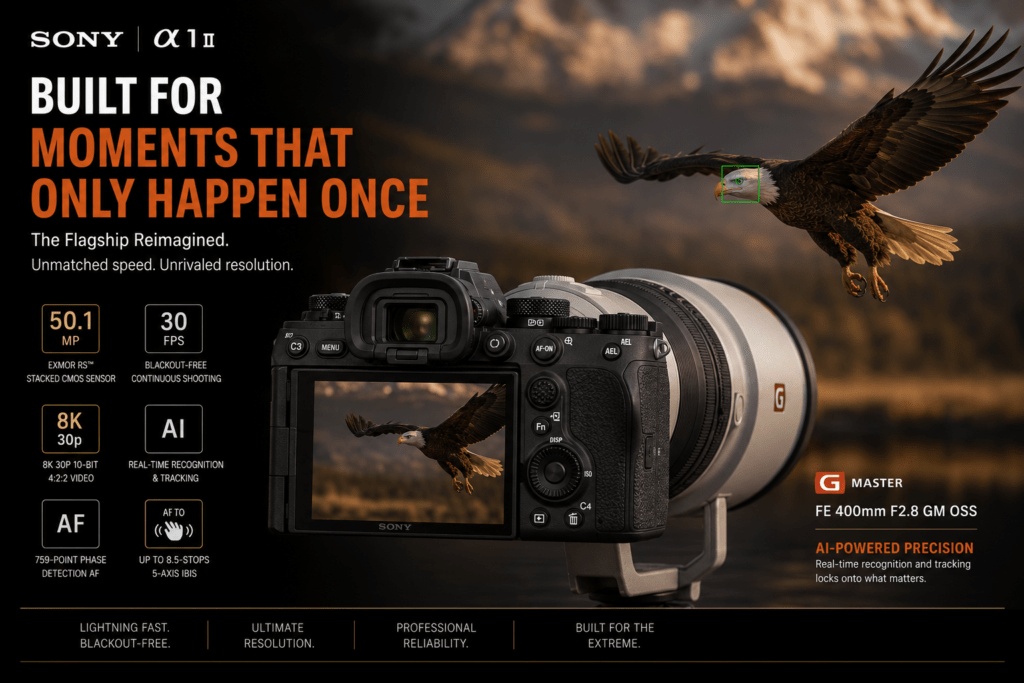
#3 — SONY A1 II
“The Camera That Has No Weakness — And The Price Tag to Match”
Price: $6,500 USD | ₹5,60,000 India Sensor: 50MP full-frame stacked CMOS Best for: Sports, wildlife, photojournalism, commercial — anyone who needs the absolute best
The Story: The Sony A1 II is the most technically capable mirrorless camera available in 2026. That sentence ends the argument. The Sony A1 II does everything — 50MP resolution AND 30fps burst AND 8K video AND the best autofocus available AND weather sealing — simultaneously, without compromise. It is the Swiss Army knife that’s also a surgical scalpel.
The A1 II has Sony’s best ever in-body image stabilisation, rated for 8.5 stops of shake reduction in the centre of the image, compared to 5 stops for the original A1.
Who needs this camera: Sports photographers for international publications. Wildlife photographers who can’t miss the shot. Commercial photographers whose clients pay enough to justify the equipment. Photojournalists covering conflict zones who need the best AF in any conditions.
Who doesn’t need this camera: Most photographers. The Sony A7 V delivers 90% of this camera’s capability at 54% of the price. Unless your shooting requires the specific combination of 50MP + 30fps + zero compromise, the A7 V is the rational choice.
PROS: ✅ Best overall camera available in 2026 — period ✅ 50MP stacked sensor at 30fps — the combination no other camera offers ✅ AI autofocus that tracks subjects in extreme conditions ✅ 8K video without overheating ✅ 8.5 stops IBIS ✅ Dual CFexpress Type A card slots
CONS: ❌ ₹5,60,000 body-only — the most expensive camera on this list ❌ Overkill for 95% of photographers ❌ Large, heavy body ❌ Requires expensive CFexpress cards for full performance
#4 — NIKON Z8
“The Nikon That Finally Competed at the Highest Level”
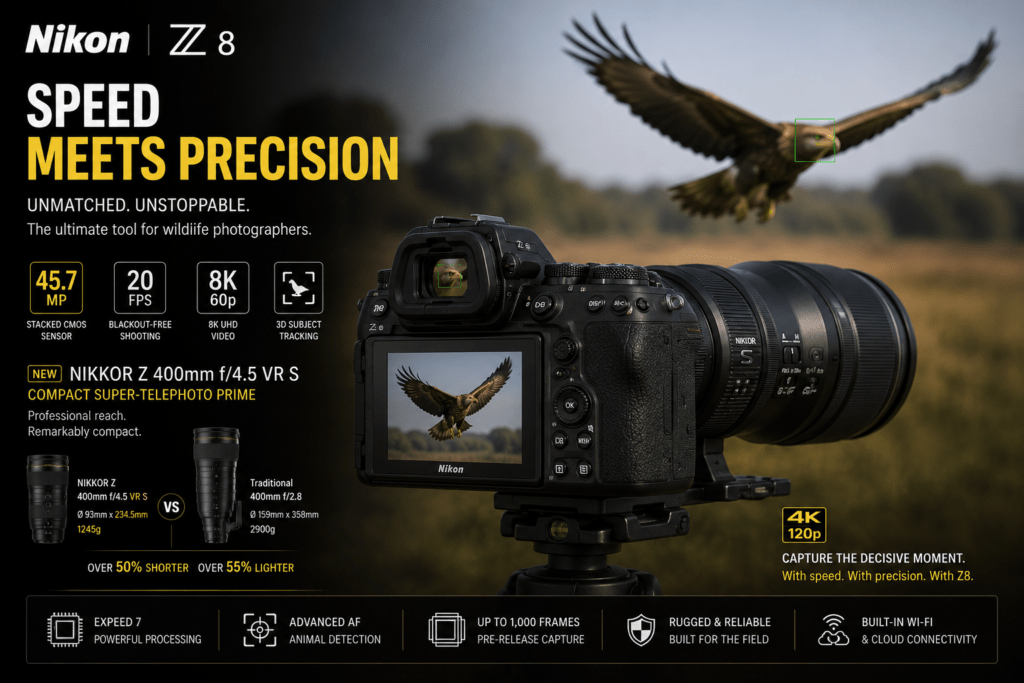
Price: $4,000 USD | ₹3,45,000 India Sensor: 45.7MP full-frame stacked CMOS TechRadar: Best professional mirrorless (joint) Best for: Wildlife, sports, landscape, professional all-round
The Story: The Nikon Z8 is what happens when Nikon takes the Z9 flagship technology and puts it in a smaller, lighter, more affordable body. The Z8 has essentially the same sensor, AF system, and video capabilities as the Z9 — without the integrated vertical grip — at $1,000 less.
For landscape and architecture work, the Nikon Z8 leads in image quality. The 45.7MP sensor with Nikon’s colour science delivers images that many landscape photographers consider the most natural-looking files available in 2026.
Wildlife AF: Nikon’s deep-learning system is excellent for wildlife. The Z8’s subject recognition — birds, animals, vehicles, aircraft — is among the best and handles tracking through complex backgrounds that challenge other systems.
Video: 8K RAW internal. 12-bit N-RAW format. The video specification matches the Canon R5 Mark II and in some ways exceeds it (the internal RAW format is more widely supported in post-production pipelines).
No mechanical shutter: The Z8 has no mechanical shutter at all — entirely electronic. This eliminates shutter shock and shutter wear but requires the stacked sensor to provide clean, distortion-free images. The stacked architecture delivers this reliably.
PROS: ✅ Z9 performance in a lighter, smaller body ✅ 45.7MP stacked sensor — outstanding image quality ✅ Excellent wildlife tracking AF ✅ 8K RAW internal video ✅ No mechanical shutter — silent, no wear ✅ Dual card slots (CFexpress B + SD) ✅ Impressive battery (EN-EL18d)
CONS: ❌ No mechanical shutter (all-electronic — not universally preferred) ❌ Nikkor Z native telephoto lenses still developing vs Sony/Canon selection ❌ Body size — larger than Sony A7 V ❌ Z-mount lenses are mostly expensive; third-party support improving but not Sony-level
Competitor Comparison:
- vs Sony A7 V: Z8 wins on burst speed and buffer. A7 V wins on lens ecosystem value.
- vs Canon R5 Mark II: Very similar capability — Z8 wins on buffer size; R5 II wins on video flexibility.
- vs Sony A1 II: A1 II wins at $6,500 vs Z8 at $4,000. Z8 wins on value.
BEST COMPATIBLE LENSES — Nikon Z8:
For Wildlife:
- NIKKOR Z 400mm f/4.5 VR S: ₹2,52,000 — Lightweight 400mm prime with excellent stabilisation. The go-to wildlife lens for Z8 users.
- NIKKOR Z 100-400mm f/4.5-5.6 VR S: ₹2,24,000 — The flexible wildlife zoom.
- NIKKOR Z 800mm f/6.3 VR S: ₹3,36,000 — For serious wildlife and bird photographers needing extreme reach.
For Landscapes/Commercial:
- NIKKOR Z 14-24mm f/2.8 S: ₹1,96,000 — The wide-angle standard for landscape photographers.
- NIKKOR Z 24-70mm f/2.8 S: ₹1,82,000 — Professional standard zoom.
- NIKKOR Z 58mm f/0.95 S Noct: ₹7,00,000+ — The most optically extraordinary lens in any mirrorless system. f/0.95 aperture. Manual focus only. For photographers who want the impossible.
For Portraits/Weddings:
- NIKKOR Z 85mm f/1.2 S: ₹2,24,000 — The finest portrait prime in the Z system.
#5 — FUJIFILM X-T5
“The APS-C That Thinks It’s a Medium Format Camera”
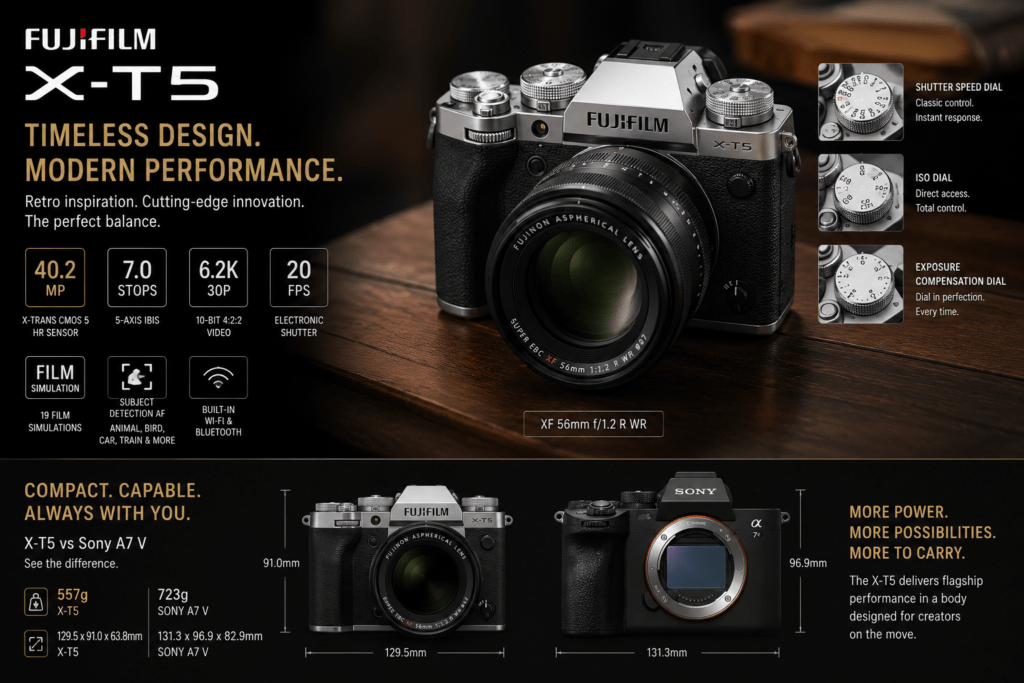
Price: $1,700 USD | ₹1,47,000 India Sensor: 40MP APS-C X-Trans CMOS 5 HR DPReview: Best APS-C mirrorless Best for: Travel, street, documentary, landscape, compact pro setup
The Story: For those who need a compact, high-resolution system, the Fujifilm X-T5 remains unmatched in APS-C. 40 megapixels on an APS-C sensor is extraordinary — it puts the X-T5 ahead of the full-frame Sony A7 IV on resolution, which is a statement that would have seemed impossible a few years ago.
The X-T5 is the camera for photographers who hate cameras that look like cameras. The retro dials — dedicated shutter speed dial, aperture ring on lenses, ISO dial — mean the X-T5 is set up physically the way photographers who think about exposure want to set it up. You feel what the camera is doing rather than navigating menus.
The X-T5’s 40-megapixel sensor, in-body stabilization, physical control layout, and extensive XF lens ecosystem remain unmatched in the APS-C category.
The Film Simulation thing: Fujifilm’s colour science is legendary. The film simulations — Velvia, Provia, Classic Chrome, Acros, Eterna — are not just preset filters. They’re genuine colour science built on Fujifilm’s film heritage. For photographers who want beautiful JPEGs straight from the camera without heavy post-processing, no other system delivers this.
The honest caveat: The autofocus isn’t as advanced as Sony/Canon/Nikon. Fujifilm has improved significantly but for fast-action shooting (sports, wildlife) the X-T5 is not in the same league as the Sony A7 V or Canon R5 Mark II. It’s a high-resolution, beautiful-rendering camera, not a speed machine.
PROS: ✅ 40MP APS-C — the highest-resolution APS-C available (2026) ✅ Physical controls — the best handling of any camera on this list ✅ Film simulations — the best JPEG colour science in the industry ✅ Compact and lightweight — significantly smaller than full-frame cameras ✅ Pixel shift multi-shot (up to 160MP) ✅ Excellent XF lens ecosystem ✅ 7-stop IBIS ✅ Price — genuinely competitive vs full-frame options
CONS: ❌ AF behind Sony/Canon/Nikon for fast subjects ❌ APS-C means lens choices have a crop factor (1.5x) to consider ❌ No headphone jack (audio monitoring requires adapter) ❌ 4K/60p video not available (4K/30p, 10-bit) ❌ Buffer fills quickly in high-burst scenarios
Competitor Comparison:
- vs Sony a6700: X-T5 wins on resolution (40MP vs 26MP), handling, and film simulations. a6700 wins on AF and video capability.
- vs Fujifilm X-H2S: X-T5 wins on resolution and compact size. X-H2S wins on speed (40fps vs 20fps) and video.
BEST COMPATIBLE LENSES — Fujifilm X-T5:
For Portraits/Weddings:
- Fujinon XF 56mm f/1.2 R WR: ₹74,000 — The portrait lens for X system. Equivalent to 85mm on full-frame. Weather sealed, fast autofocus, beautiful rendering.
- Fujinon XF 23mm f/1.4 R LM WR: ₹68,000 — The documentary standard lens (35mm equivalent).
- Fujinon XF 16-55mm f/2.8 R LM WR: ₹85,000 — The professional zoom standard for Fujifilm.
For Wildlife/Sport:
- Fujinon XF 150-600mm f/5.6-8 R LM OIS WR: ₹1,20,000 — The wildlife super-telephoto. Excellent reach on APS-C sensor.
- Fujinon XF 100-400mm f/4.5-5.6 R LM OIS WR: ₹1,00,000 — More compact wildlife zoom option.
For Landscape/Travel:
- Fujinon XF 10-24mm f/4 R OIS WR: ₹60,000 — The wide-angle for travel and landscape.
- Fujinon XF 18-55mm f/2.8-4 R LM OIS: ₹35,000 — The affordable travel zoom.
#6 — CANON EOS R6 MARK III
“The Speed Machine for Event and Sports Photographers”
Price: $2,700 USD | ₹2,33,000 India Sensor: 24.2MP full-frame stacked CMOS Best for: Events, sports, photojournalism, fast-paced documentary
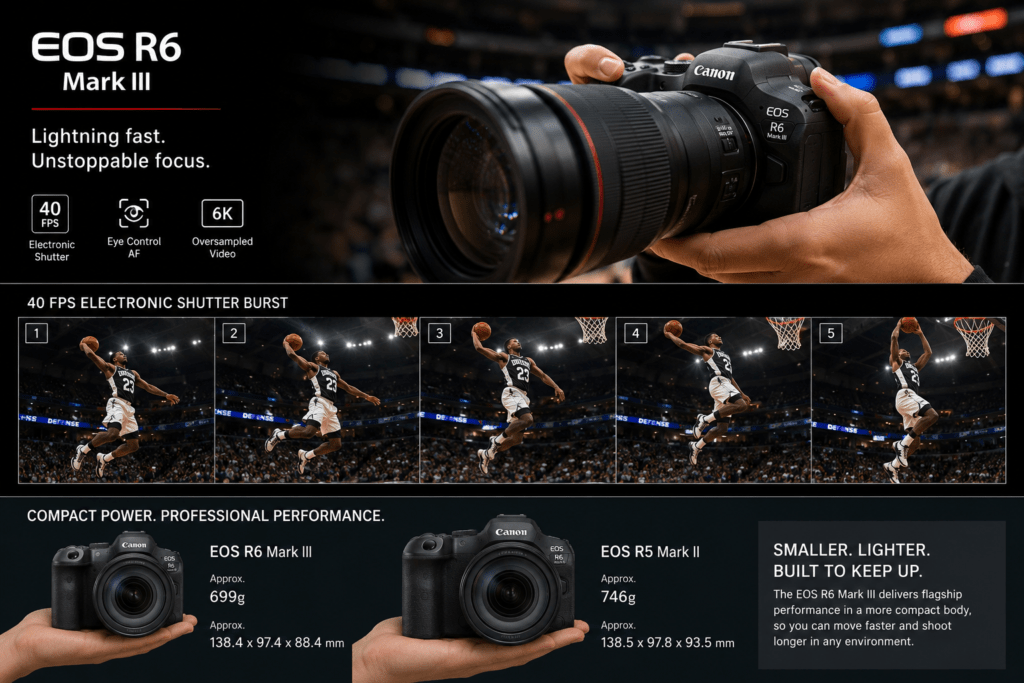
The Story: The Canon R6 II was replaced by the Canon R6 III in the December 2025 update to Amateur Photographer’s rankings. The R6 III takes Canon’s speed focus and pushes it further — 40fps electronic burst, improved AF, and better low-light performance than the R6 II.
The R6 III is the camera for photographers who prioritise keeper rate over resolution. 24.2MP is modest by 2026 flagship standards, but the stacked sensor delivers those 24MP at 40 frames per second with full autofocus. For wedding photographers who want to capture the first kiss with zero missed frames, or sports photographers who need quantity of coverage, the R6 III’s burst speed is extraordinary.
Low-light Performance: The 24MP sensor has larger individual pixels than the 45MP R5 Mark II — which translates directly to better ISO performance. The R6 III shoots comfortably at ISO 25,600 for photojournalism work. The R5 Mark II’s ISO performance is excellent but the R6 III edges ahead in the darkest conditions.
PROS: ✅ 40fps burst — fastest on this list ✅ Best low-light ISO performance of any Canon mirrorless ✅ Smaller and lighter than R5 Mark II ✅ Excellent AF (shared Canon system with R5 Mark II) ✅ Canon dual card slot (CFexpress B + SD) ✅ Better price than R5 Mark II
CONS: ❌ Only 24.2MP — lowest resolution full-frame on this list ❌ Canon RF ecosystem lens restrictions ❌ 4K video (excellent) but not 8K like R5 Mark II ❌ Less versatile than R5 Mark II for commercial/high-res work
BEST COMPATIBLE LENSES — Canon R6 Mark III:
For Events/Documentary:
- Canon RF 24-105mm f/4 L IS USM: ₹84,000 — The versatile event zoom. Covers wide to portrait in one lens.
- Canon RF 50mm f/1.8 STM: ₹18,000 — The most affordable Canon RF prime. Exceptional value.
For Sports/Action:
- Canon RF 70-200mm f/2.8 L IS USM: ₹2,24,000 — The sports and wildlife zoom standard.
- Canon RF 100-500mm f/4.5-7.1 L IS USM: ₹2,52,000 — Extended reach for sports.
#7 — SONY A7R V
“The Resolution King for Commercial and Landscape”
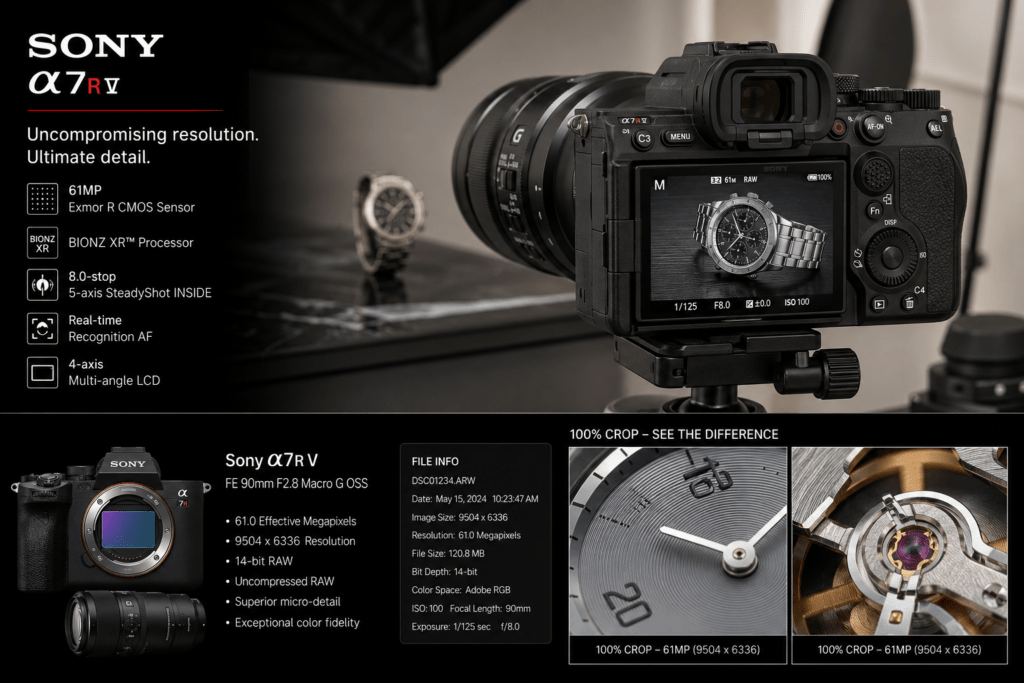
Price: $3,900 USD | ₹3,36,000 India Sensor: 61MP full-frame BSI CMOS Best for: Commercial photography, landscape, fashion, architecture, studio
The Story: Almost reaching the lofty heights of the Sony A1 II, yet more than $2,500 cheaper, is the Sony A7R V. It sells for $4,200 and has an even higher-resolution 61-megapixel sensor. The A7r V still manages to shoot at 10 FPS despite the high-res sensor, and it has a huge buffer of 583 images. And the autofocus system is incredible.
61 megapixels. That number means prints at 60×40 inches with zero visible grain. It means commercial images that can be cropped to 50% and still deliver usable files. It means fashion photographs where individual fabric fibres are individually visible in the full-resolution file.
The A7R V is not for photographers who need speed. It’s for photographers who need detail.
Pixel Shift Multi-Shoot: The A7R V can shoot 16 images in rapid sequence, shift the sensor by 1 pixel between each shot, and combine them in software for a theoretical 240MP image. For product photography and architecture, this is genuinely useful.
PROS: ✅ 61MP — the highest resolution full-frame mirrorless available ✅ Pixel Shift Multi-Shoot (up to 240MP effective) ✅ Excellent autofocus for a high-res body ✅ 8-stop IBIS — critical for high-resolution handheld shooting ✅ Best Sony colour science ✅ Dual card slots
CONS: ❌ 10fps burst — slowest of any professional body on this list ❌ Large files — 61MP RAW files require significant storage and processing power ❌ Not suited to action/sports photography ❌ Expensive
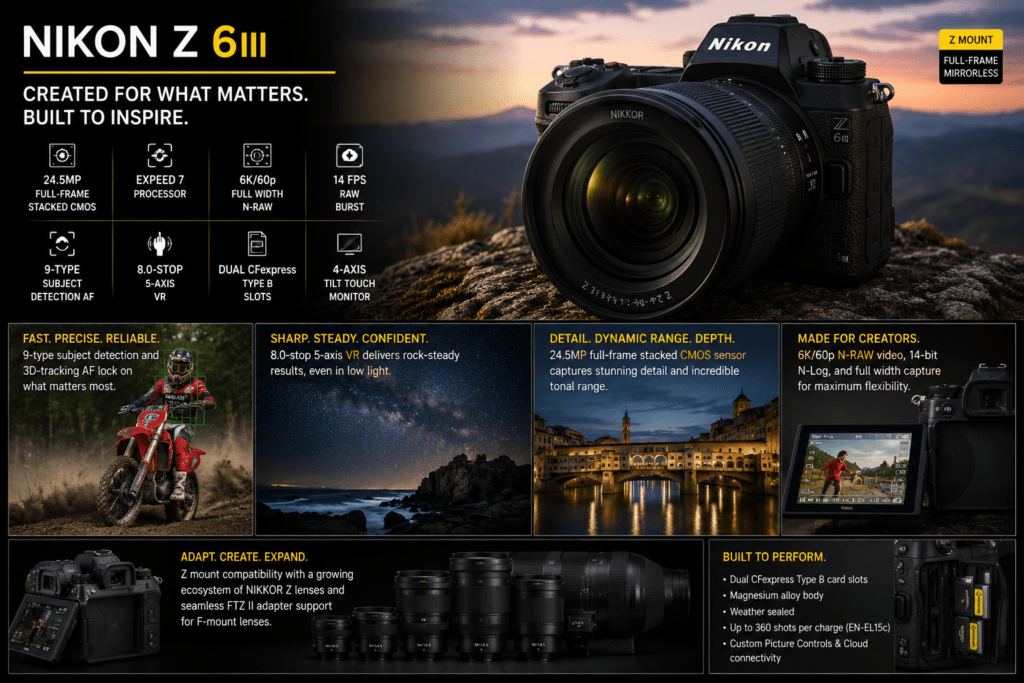
#8 — NIKON Z6 III
“The Best Value Professional Mirrorless Available Right Now”
Price: $2,500 USD | ₹2,16,000 India Sensor: 24.5MP full-frame partial-stacked CMOS Best for: Professional all-round, hybrid shooters, first professional camera
The Story: The most popular mirrorless cameras in 2026 include the Canon EOS R5 Mark II, Nikon Z6 III, Sony a7 IV, Fujifilm X-T5, and Nikon Z5 II. These bodies lead sales across full-frame and APS-C categories due to their strong autofocus performance, competitive pricing, and versatility.
The Nikon Z6 III introduced partial-stacked sensor technology — a middle ground between traditional BSI sensors and the more expensive full-stacked sensors in the Z8/Z9. The result: significantly better burst performance and video capabilities than traditional sensors at a price point below the fully stacked competition.
Video — the surprise: 6K RAW video. At $2,500. The Z6 III’s video credentials are extraordinary for the price — 6K RAW, 4K/120p, Log recording, and 12-bit N-RAW. Wedding videographers and commercial video shooters are discovering this camera.
PROS: ✅ Best value professional full-frame in 2026 ✅ 6K RAW video at $2,500 — extraordinary for the price ✅ 4K/120p for slow-motion ✅ Partial-stacked sensor — better performance than standard BSI ✅ Excellent Nikon colour science ✅ Weather sealing
CONS: ❌ 24.5MP — lower resolution than competitors at similar price ❌ Partial-stacked — not as capable as fully stacked sensors in Z8 ❌ Nikkor Z telephoto ecosystem still developing
BEST LENSES — Nikon Z6 III:
- NIKKOR Z 24-70mm f/2.8 S: ₹1,82,000 — Professional zoom standard
- NIKKOR Z 50mm f/1.2 S: ₹1,68,000 — Portrait prime of exceptional quality
- NIKKOR Z 17-28mm f/2.8: ₹65,000 — Affordable wide zoom with f/2.8 aperture
#9 — PANASONIC LUMIX S1 II
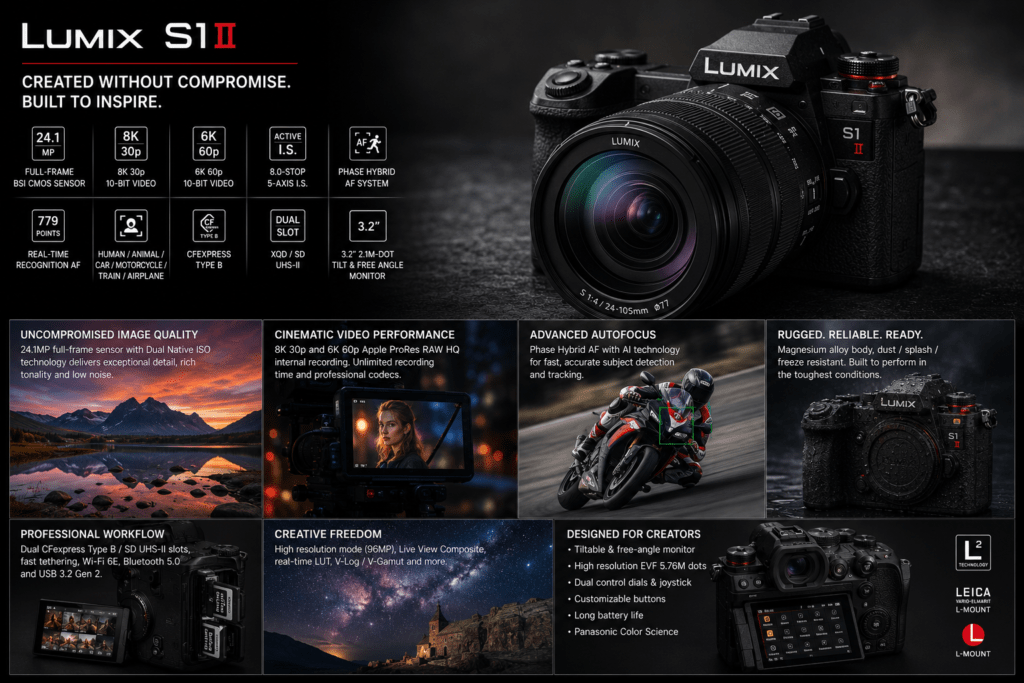
“The Video-First Choice for Creators and Cinematographers”
Price: $2,500 USD | ₹2,16,000 India Sensor: 24.2MP full-frame BSI CMOS TechRadar (April 2026): Best for video Best for: Video creators, documentary filmmakers, YouTube/OTT content
The Story: The Panasonic Lumix S1II was added as the best Panasonic all-rounder for enthusiasts. The Panasonic Lumix S1 II is the fastest Panasonic Lumix yet.
Panasonic approaches cameras from a video-first philosophy — the company that created the GH series for video shooters has brought that heritage to full-frame mirrorless. The S1 II’s video specifications are extraordinary: 6K, 4K/120p, 12-bit RAW output, V-Log, and an anamorphic mode that cinematographers find genuinely useful.
The honest positioning: Panasonic’s stills autofocus has historically been behind Sony/Canon/Nikon. The S1 II has improved significantly — but for photographers who shoot primarily stills, the Sony A7 V at a similar price is the stronger choice. For video creators who also need to shoot stills, the S1 II’s video credentials are compelling.
Phase-detect AF: The S1 II introduced phase-detect AF to Panasonic’s full-frame lineup — a significant upgrade from the contrast-detect-only systems in earlier Lumix cameras. The subject recognition and tracking is now competitive for most shooting scenarios.
PROS: ✅ Best video specifications at this price point ✅ Anamorphic shooting mode ✅ 4K/120p for ultra-slow motion ✅ L-mount alliance lens compatibility (Leica + Sigma glass available) ✅ Excellent built-in stabilisation for video ✅ Dual card slots
CONS: ❌ Stills AF still behind Sony/Canon/Nikon ❌ Heavier than Sony A7 V ❌ JPEG colour science behind Fujifilm ❌ Less native L-mount lens selection than E-mount or RF
BEST LENSES — Panasonic S1 II (L-Mount):
- Sigma 24-70mm f/2.8 DG DN Art (L-mount): ₹98,000 — The most affordable professional zoom for L-mount
- Leica 50mm f/1.4 SUMMILUX-SL: ₹4,90,000 — For those who want Leica optical quality
- Panasonic S Pro 70-200mm f/4 OIS: ₹1,12,000 — The telephoto standard for S-system
#10 — SONY A6700
“The Best APS-C Camera for Video Creators”
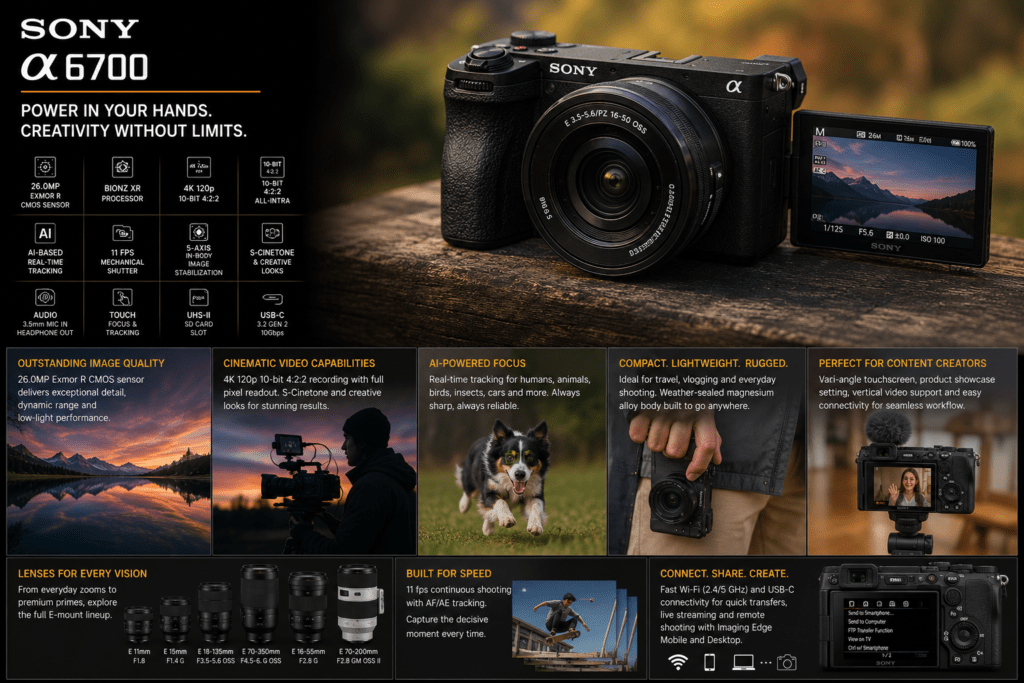
Price: $1,400 USD | ₹1,21,000 India Sensor: 26MP APS-C BSI CMOS DPReview: Most capable APS-C camera on the market Best for: Content creators, video creators, travel, compact professional kit
The Story: The Sony a6700 is the most capable APS-C camera on the market, with extremely strong autofocus performance, image quality and video capabilities. Sony’s E-mount also has the most complete array of APS-C lenses after Fujifilm’s, largely thanks to support from third parties.
The a6700 is the camera for the creator who needs professional capability in the most compact package. It shoots 4K/120p, has Sony’s flagship AI autofocus system in a body the size of a compact camera, and accesses the entire E-mount lens ecosystem — including full-frame Sony GM lenses (with crop factor).
For YouTube creators, travel photographers, and professionals who need a lightweight backup body, the a6700 is the most versatile option at this price.
PROS: ✅ Sony flagship AI AF in a compact APS-C body ✅ 4K/120p video — extraordinary at this price ✅ Access to full E-mount lens ecosystem ✅ Best APS-C autofocus available ✅ ₹1,21,000 — significant savings vs full-frame ✅ Lightweight and compact
CONS: ❌ No viewfinder on base model (add-on) ❌ APS-C crop factor on full-frame lenses ❌ 26MP — lower resolution than Fujifilm X-T5 (40MP) ❌ JPEG colour science behind Fujifilm
BEST LENSES — Sony a6700:
- Sony E 16-55mm f/2.8 G: ₹98,000 — The professional zoom for APS-C Sony
- Sony E 70-350mm f/4.5-6.3 G OSS: ₹65,000 — Reach for wildlife and sports
- Sigma 18-50mm f/2.8 DC DN (E-mount): ₹35,000 — Affordable professional zoom
The Specialist Guide — Which Camera for Which Work?
For Wedding Photographers
| Priority | Camera | Why |
|---|---|---|
| Best overall | Sony A7 V | AF reliability in all conditions, 33MP, IBIS |
| Best for video too | Canon R5 Mark II | 8K video alongside stills |
| Best budget option | Nikon Z6 III | Full professional at $2,500 |
| Best compact kit | Fujifilm X-T5 | Smaller rig, beautiful colour, physical controls |
Best wedding lenses to own:
- 35mm f/1.4 (getting ready, reception coverage)
- 85mm f/1.4 (portraits, ceremony, first dance)
- 24-70mm f/2.8 (the workhorse for everything else)
- 70-200mm f/2.8 (ceremony from distance, detail shots)
For Wildlife Photographers
| Priority | Camera | Why |
|---|---|---|
| Best overall | Nikon Z8 | Best wildlife AF, 45MP, excellent buffer |
| Best for budget | Nikon Z6 III | Same AF system, lower price |
| Best Sony option | Sony A7 V or A1 II | Outstanding tracking AF |
| Best APS-C reach | Sony a6700 or Fujifilm X-T5 | 1.5x crop = more reach from telephoto |
Best wildlife lenses:
- 200-600mm f/5.6-6.3 (Sony) or 100-500mm (Canon) — the versatile choice
- 400mm f/4.5 prime (Nikon) — lightweight reach
- 600mm f/4 prime — for serious professionals
For Commercial Photographers
| Priority | Camera | Why |
|---|---|---|
| Best resolution | Sony A7R V | 61MP for print and large-scale commercial |
| Best versatility | Canon R5 Mark II | Photo + video in one body |
| Best value | Sony A7 V | 33MP covers most commercial needs |
Best commercial lenses:
- 85mm f/1.2 (portraits, beauty, product)
- 24-70mm f/2.8 (location commercial)
- 90mm macro (product detail)
- 16-35mm f/2.8 (architecture, interior)
For Video Creators and Videographers
| Priority | Camera | Why |
|---|---|---|
| Best overall video | Panasonic Lumix S1 II | Video-first design, 6K, anamorphic |
| Best hybrid | Canon R5 Mark II | 8K RAW internal |
| Best value video | Nikon Z6 III | 6K RAW at $2,500 |
| Best compact video | Sony a6700 | 4K/120p in a tiny body |
Full Camera Comparison Table — All Specs
| Camera | MP | Sensor | Burst | Video Max | IBIS | Weather | Price USD |
|---|---|---|---|---|---|---|---|
| Sony A7 V | 33 | FF BSI | 30fps | 4K/60p 10-bit | 8.5 stops | Yes | $3,500 |
| Canon R5 Mark II | 45 | FF Stacked | 30fps | 8K/60p RAW | 8 stops | Yes | $4,300 |
| Sony A1 II | 50 | FF Stacked | 30fps | 8K/30p | 8.5 stops | Yes | $6,500 |
| Nikon Z8 | 45.7 | FF Stacked | 30fps | 8K RAW | 8 stops | Yes | $4,000 |
| Fujifilm X-T5 | 40 | APS-C | 15fps | 4K/30p 10-bit | 7 stops | Yes | $1,700 |
| Canon R6 III | 24.2 | FF Stacked | 40fps | 4K/60p | 8 stops | Yes | $2,700 |
| Sony A7R V | 61 | FF BSI | 10fps | 8K (limited) | 8 stops | Yes | $3,900 |
| Nikon Z6 III | 24.5 | FF Part-Stack | 20fps | 6K RAW | 8 stops | Yes | $2,500 |
| Panasonic S1 II | 24.2 | FF BSI | 30fps | 6K | 7 stops | Yes | $2,500 |
| Sony a6700 | 26 | APS-C | 11fps | 4K/120p | 5 stops | Yes | $1,400 |
FAQ Section
Q: What is the best mirrorless camera in 2026?
A: The Sony A1 II is the most technically capable mirrorless camera available in 2026. However, “best” depends on the use case. For hybrid shooters, the Canon EOS R5 Mark II offers superior value. For landscape and architecture work, the Nikon Z8 leads in image quality. For most photographers who want one excellent camera for all scenarios, the Sony A7 V is the best overall recommendation.
Q: Is mirrorless better than DSLR in 2026?
A: If you want the best cameras in 2026, you’re realistically looking at mirrorless cameras. Whether you’re a beginner, enthusiast or pro, the mirrorless systems of almost all the major manufacturers are where they’re pouring the most time and energy — and it shows. DSLRs are no longer receiving new development. Mirrorless is definitively the superior choice in 2026.
Q: Which mirrorless camera is best for wildlife photography?
A: Nikon’s deep-learning system is excellent for wildlife — making the Nikon Z8 ($4,000) the top recommendation for wildlife photographers. The Sony A7 V is close behind with excellent AI subject tracking. For budget wildlife photographers, the Nikon Z6 III offers the same AF system at $2,500.
Q: Which mirrorless camera is best for wedding photography in India?
A: The Sony A7 V at ₹3,00,000 is the best recommendation for wedding photographers — the AI eye-tracking autofocus, 33MP resolution, 8.5 stops of IBIS for low-light reception halls, and excellent dynamic range cover all wedding photography needs. For those on a tighter budget, the Nikon Z6 III at ₹2,16,000 is an outstanding professional camera at a lower price point.
Q: Is full-frame better than APS-C for professional photography?
A: Full-frame sensors offer better low-light performance, wider dynamic range, and more background separation at equivalent apertures. But APS-C cameras like the Fujifilm X-T5 produce exceptional image quality at a lower cost and weight. For many photographers — especially those in travel, street, and documentary — APS-C is the more practical and equally satisfying choice.
Q: What is the best mirrorless camera under ₹2,00,000 in India?
A: The Fujifilm X-T5 at ₹1,47,000 is the best professional camera under ₹2 lakh — 40MP APS-C sensor, outstanding colour science, physical controls, and a complete lens ecosystem. For video-focused creators, the Sony a6700 at ₹1,21,000 has Sony’s flagship AI autofocus and 4K/120p video in a compact body.
Conclusion — The Camera Doesn’t Make the Photograph. But the Right Camera Makes Your Job Easier.
I said earlier that a borrowed Sony changed my midnight reading habits. What it didn’t change was my fundamental approach to photography — the framing, the light, the relationship with the subject.
But here’s what it did change: the number of shots I had to take to get one keeper. The confidence I felt in difficult lighting. The time spent in post-production trying to fix missed focus. The stress of shooting a critical moment knowing my AF system was operating at its limit.
The camera is a tool. The best tool for your specific work, in your budget, for your system, is the right camera for you. This guide has tried to identify that clearly.
Sony A7 V for most people. Canon R5 Mark II for video-photo hybrid professionals. Nikon Z8 for wildlife. Fujifilm X-T5 for those who want compact and beautiful. Sony A1 II for those who want zero compromise regardless of price.
Pick your system. Invest in lenses — the glass holds value and transfers across generations. And then go out and use it until it feels like an extension of yourself.
That’s when the real photography starts.
[…] Best Mirrorless Cameras 2026 […]